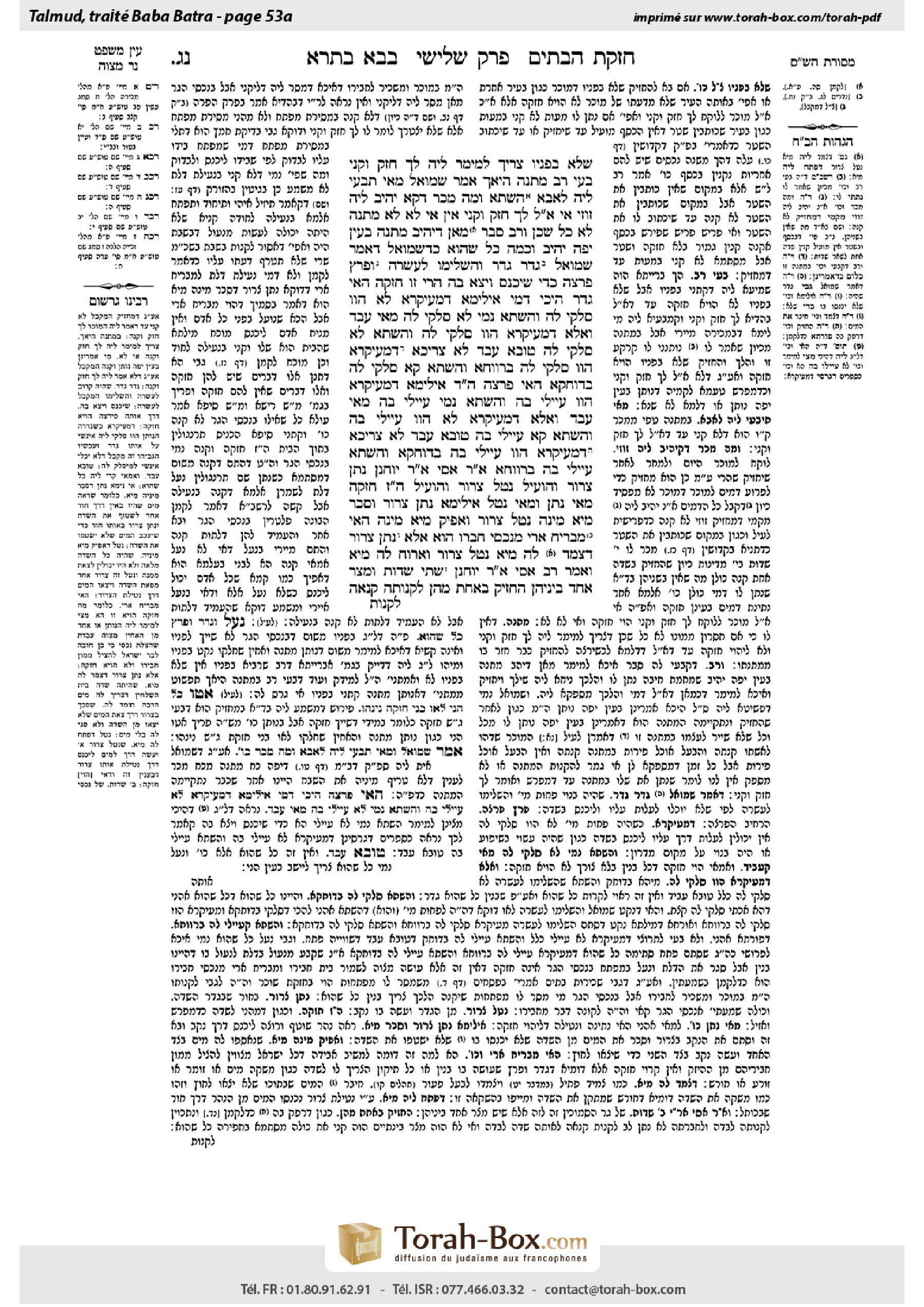
Bava Batra 53a: Talmud study for Daf Yomi
Study the Talmud for Daf Yomi with scanned pages, Hebrew text, English translations from Sefaria and AI-generated French translations.
Passage selection and English or AI-generated French translation are available where the scan has annotations. Daf Study is independent of Torah-Box and Sefaria.
Browse Bava Batra · בבא בתרא · All tractatesBava Batra 53a text and translations
This page of Bava Batra includes the Aramaic text, an English translation and an AI-generated French translation, alongside the scan above.
בבא בתרא נ״ג א · Aramaic and Hebrew text
שֶׁלֹּא בְּפָנָיו – צָרִיךְ לְמֵימַר לֵיהּ: ״לֵךְ חֲזֵק וּקְנִי״.
בָּעֵי רַב: מַתָּנָה – הֵיאַךְ? אָמַר שְׁמוּאֵל: מַאי תִּבְעֵי לֵיהּ לְאַבָּא? הַשְׁתָּא וּמָה מֶכֶר, דְּקָא יָהֵיב לֵיהּ זוּזֵי, אִי אֲמַר לֵיהּ: ״לֵךְ חֲזֵק וּקְנִי״ – אִין, אִי לָא – לָא; מַתָּנָה, לֹא כׇּל שֶׁכֵּן?! וְרַב סָבַר: מַאן דְּיָהֵיב מַתָּנָה, בְּעַיִן יָפָה יָהֵיב.
וְכַמָּה כׇּל שֶׁהוּא? כְּדִשְׁמוּאֵל – דְּאָמַר שְׁמוּאֵל: גָּדַר גָּדֵר וְהִשְׁלִימוֹ לַעֲשָׂרָה, וּפָרַץ פִּרְצָה כְּדֵי שֶׁיִּכָּנֵס וְיֵצֵא בָּהּ – הֲרֵי זוֹ חֲזָקָה.
הַאי גָּדֵר הֵיכִי דָמֵי? אִילֵּימָא דְּמֵעִיקָּרָא לָא הֲווֹ סָלְקִי לַהּ, וְהַשְׁתָּא נָמֵי לָא סָלְקִי לַהּ – מַאי עֲבַד? וְאֶלָּא דְּמֵעִיקָּרָא הֲווֹ סָלְקִי לַהּ, וְהַשְׁתָּא לָא סָלְקִי לַהּ – טוּבָא עֲבַד! לָא צְרִיכָא, דְּמֵעִיקָּרָא הֲווֹ סָלְקִי לַהּ בְּרַוְוחָא, וְהַשְׁתָּא קָא סָלְקִי לַהּ בְּדוּחְקָא.
הַאי פִּרְצָה – הֵיכִי דָמֵי? אִילֵּימָא דְּמֵעִיקָּרָא הֲווֹ עָיְילִי בַּהּ, וְהַשְׁתָּא נָמֵי עָיְילִי בַּהּ – מַאי עֲבַד? וְאֶלָּא דְּמֵעִיקָּרָא לָא הֲווֹ עָיְילִי בַּהּ, וְהַשְׁתָּא קָא עָיְילִי בַּהּ – טוּבָא עֲבַד! לָא צְרִיכָא, דְּמֵעִיקָּרָא הֲווֹ עָיְילִי בַּהּ בְּדוּחְקָא, וְהַשְׁתָּא עָיְילִי בַּהּ בְּרַוְוחָא.
אָמַר רַב אַסִּי אָמַר רַבִּי יוֹחָנָן: נָתָן צְרוֹר וְהוֹעִיל, נָטַל צְרוֹר וְהוֹעִיל – הֲרֵי זוֹ חֲזָקָה. מַאי ״נָתַן״ וּמַאי ״נָטַל״?
אִילֵּימָא נָתַן צְרוֹר – וּסְכַר מַיָּא מִינַּהּ, נָטַל צְרוֹר – וְאַפֵּיק מַיָּא מִינַּהּ; הַאי מַבְרִיחַ אֲרִי מִנִּכְסֵי חֲבֵרוֹ הוּא! אֶלָּא נָתַן צְרוֹר – דְּצַמֵּד לַהּ מַיָּא, נָטַל צְרוֹר – וְאַרְוַח לַהּ מַיָּא.
וְאָמַר רַב אַסִּי אָמַר רַבִּי יוֹחָנָן: שְׁתֵּי שָׂדוֹת וּמֶצֶר אֶחָד בֵּינֵיהֶן, הֶחְזִיק בְּאַחַת מֵהֶן לִקְנוֹתָהּ – קְנָאָהּ.
Bava Batra 53a · English translation
But if the act was performed not in the seller’s presence, the seller must say to him: Go, take possession and thereby acquire the property for him to acquire it.
Rav raises a dilemma: How does one acquire a gift, i.e., is it necessary for the giver to say: Go, take possession and thereby acquire? Shmuel said: What dilemma is raised to Abba, i.e., Rav? Now one could say the following: And what is the halakha with regard to a sale, where the buyer is giving money to the seller? If the seller says to the buyer: Go, take possession and thereby acquire the property, the acquisition does take effect, but if he did not say this, it does not. Therefore, with regard to a gift, where no money is given to the seller, is it not all the more so reasonable that the acquisition not take effect without a clear directive from the seller? The Gemara answers: And Rav holds that it is possible to say that one who gives a gift gives it generously, and would allow the acquisition even absent a clear directive.
§ The mishna teaches that taking possession can be performed by building a fence or breaching a fence even a bit. The Gemara clarifies: And how much is the measure of a bit? It is in accordance with the statement of Shmuel, as Shmuel says: If one had previously built a fence, and now completed it to a height of ten handbreadths, which is the height of a halakhically significant barrier; or similarly, if one had previously breached a breach, and now expanded it in order that it be large enough that a person can enter and exit through it, this is considered taking possession.
The Gemara asks: What are the circumstances of this fence? If we say that initially one could not climb over it to enter the field, and now too one still could not climb over it, what did he accomplish? Nothing has changed through his completing the height of the fence. And alternatively, if it was such that initially one could climb over it to enter the field, and now one could not climb over it, he has accomplished a great deal, and the mishna should not have referred to this addition as: A bit. The Gemara answers: No, it is necessary to state this ruling if the height of the fence was such that initially one could climb over it with ease, and now one could climb over it only with effort.
The Gemara similarly asks: What are the circumstances of this breach? If we say that initially, one could enter the field through it, and now too one could enter the field through it, what did he accomplish? Nothing has changed through his expanding the breach? And alternatively, if it was such that initially one could not enter the field through it, and now one could enter the field through it, he has accomplished a great deal, and the mishna should not have referred to this as: A bit. The Gemara answers: No, it is necessary to state this ruling if the size of the breach was such that initially one could enter the field through it with effort, and now one could enter the field through it with ease.
Rav Asi says that Rabbi Yoḥanan says: If one placed a stone and it helps to serve some objective, or if one removed a stone and it helps to serve some objective, this act is considered taking possession. The Gemara asks: What is the meaning of placed, and what is the meaning of removed?
If we say that he placed a stone in the fence and stopped the water from flooding the field, or he removed a stone from the fence and thereby fashioned an opening that released water that had been flooding the field, this is analogous to one who chases away a lion from another’s property. In other words, these acts prevent damage to the field, which one is obligated to prevent even in the case of the property of another, and accordingly, they do not constitute a demonstration of ownership. Rather, it means that he placed a stone that connected water to the field and irrigated it, or he removed a stone and enhanced the flow of water to it.
§ The Gemara cites another statement of the same amora with regard to taking possession. And Rav Asi says that Rabbi Yoḥanan says: If there were two fields with one boundary between them, and one took possession of one of the fields in order to acquire it, he has acquired it.
Bava Batra 53a · Traduction française (IA)
Mais si l'acte a été accompli en l'absence du vendeur, le vendeur doit dire à l'acheteur : Va, prends possession et ainsi acquiers la propriété, afin qu'il l'acquière.
Rav pose un dilemme : Comment acquiert-on un don, c'est-à-dire est-il nécessaire que le donneur dise : Va, prends possession et ainsi acquiers ? Shmuel dit : Quel dilemme est posé à Abba, c'est-à-dire à Rav ? On pourrait dire ceci : Et quelle est la halakha concernant une vente, où l'acheteur donne de l'argent au vendeur ? Si le vendeur dit à l'acheteur : Va, prends possession et ainsi acquiers la propriété, l'acquisition prend effet, mais si ce n'est pas dit, elle ne prend pas effet. Ainsi, concernant un don, où aucun argent n'est donné au vendeur, n'est-il pas encore plus raisonnable que l'acquisition ne prenne effet sans directive claire du vendeur ? La Guemara répond : Et Rav considère que l'on peut dire qu'une personne qui fait un don le fait généreusement, et permet l'acquisition même en l'absence d'une directive claire.
§ La mitsna enseigne que prendre possession peut être accompli en construisant un mur ou en creusant un passage même un peu. La Guemara précise : Et quelle est la mesure d'un peu ? C'est selon l'affirmation de Shmuel, car Shmuel dit : Si l'on avait déjà construit un mur, et maintenant on l'a achevé à une hauteur de dix paumes, qui est la hauteur d'un obstacle halakhique ; ou de même, si l'on avait déjà fait un passage, et maintenant on l'a agrandi afin qu'il soit suffisamment grand pour que l'on puisse entrer et sortir par là, cela est considéré comme prendre possession.
La Guemara pose la question : Quelles sont les circonstances de ce mur ? Si l'on dit que d'abord on ne pouvait pas monter dessus pour entrer dans le champ, et maintenant on ne peut pas non plus monter dessus, que l'on a accompli ? Rien n'a changé en achevant la hauteur du mur. Et de manière alternative, si c'était tel que d'abord on pouvait monter dessus pour entrer dans le champ, et maintenant on ne peut plus monter dessus, l'on a accompli beaucoup, et la mitsva ne devrait pas avoir mentionné cette addition comme : un peu. La Guemara répond : Non, il est nécessaire d'énoncer cette décision si la hauteur du mur était telle que d'abord on pouvait monter dessus facilement, et maintenant on pouvait monter dessus avec effort.
La Guemara pose également la question : Quelles sont les circonstances de ce passage ? Si l'on dit que d'abord l'on pouvait entrer dans le champ par là, et maintenant l'on peut encore entrer dans le champ par là, que l'on a accompli ? Rien n'a changé en agrandissant le passage. Et de manière alternative, si c'était tel que d'abord l'on ne pouvait pas entrer dans le champ par là, et maintenant l'on peut entrer dans le champ par là, l'on a accompli beaucoup, et la mitsva ne devrait pas avoir mentionné cela comme : un peu. La Guemara répond : Non, il est nécessaire d'énoncer cette décision si la taille du passage était telle que d'abord l'on pouvait entrer dans le champ par là avec effort, et maintenant l'on pouvait entrer dans le champ par là facilement.
Rav Asi dit que Rabbi Yoḥanan dit : Si l'on a posé une pierre et cela aide à servir un but, ou si l'on a enlevé une pierre et cela aide à servir un but, cet acte est considéré comme prendre possession. La Guemara pose la question : Quelle est la signification de posé, et quelle est la signification d'enlevé ?
Si l'on dit qu'il a posé une pierre dans le mur et a empêché l'eau de s'inonder le champ, ou qu'il a enlevé une pierre du mur et a ainsi fait un passage qui a libéré l'eau qui s'inondait le champ, cela est analogue à celui qui chasse un lion d'une propriété d'autrui. En d'autres termes, ces actes empêchent les dommages au champ, ce que l'on est tenu de prévenir même dans le cas d'une propriété d'autrui, et par conséquent, ils ne constituent pas une démonstration d'appartenance. Plutôt, cela signifie qu'il a posé une pierre qui a connecté l'eau au champ et l'a arrosé, ou qu'il a enlevé une pierre et a amélioré le débit de l'eau vers le champ.
§ La Guemara cite une autre déclaration de l'ameora concernant l'acquisition. Et Rav Asi dit que Rabbi Yoḥanan dit : S'il y avait deux champs avec une frontière entre eux, et l'un a pris possession d'un des champs afin d'en acquérir la propriété, il a acquis la propriété.
Traduction française générée par IA à partir de l’édition anglaise de Sefaria. Vérifie toujours un passage avec le texte source.
Text from Sefaria: William Davidson Edition - Vocalized Aramaic (CC BY NC); William Davidson Edition - English (CC BY NC).