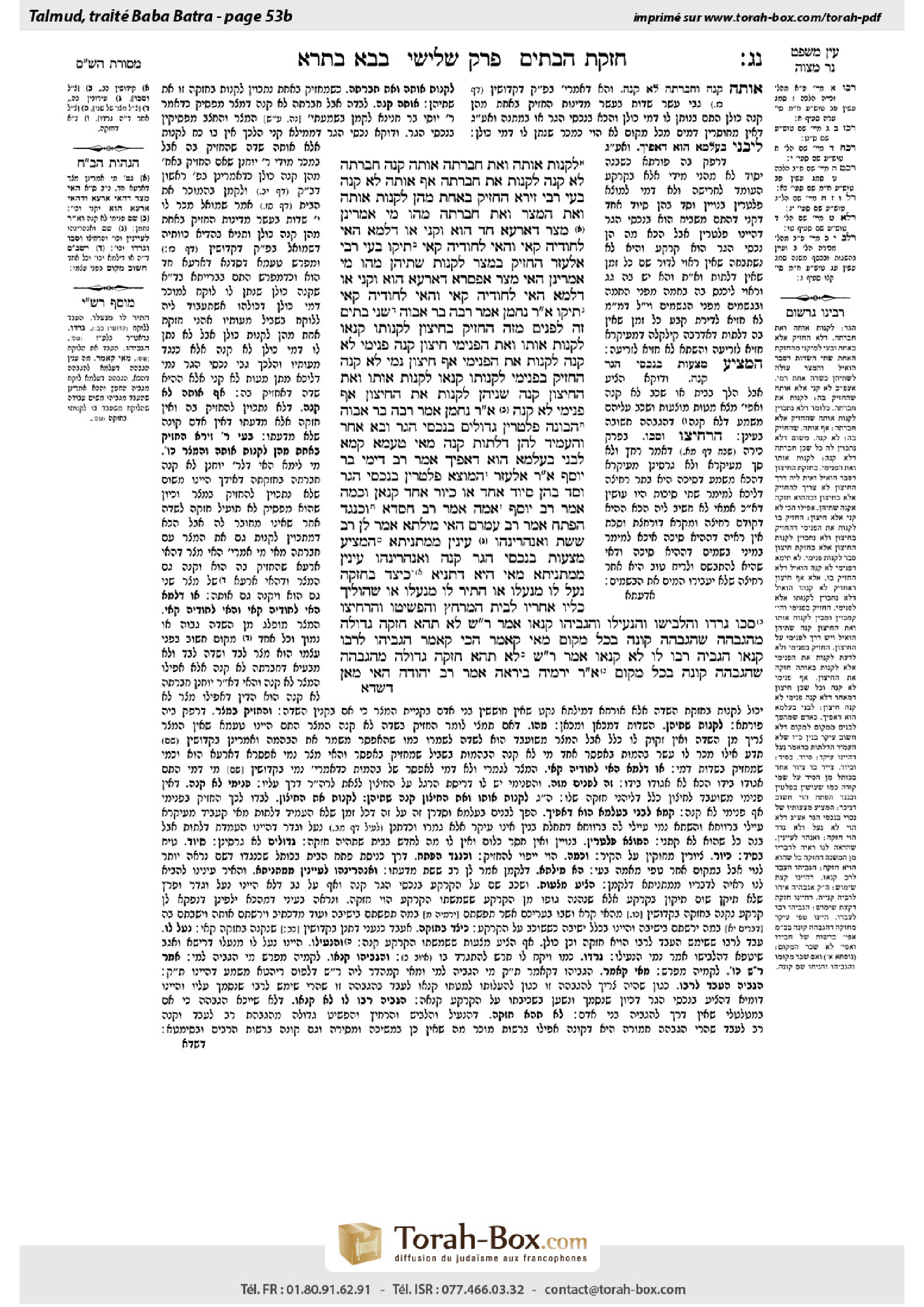
Bava Batra 53b: Talmud study for Daf Yomi
Study the Talmud for Daf Yomi with scanned pages, Hebrew text, English translations from Sefaria and AI-generated French translations.
Passage selection and English or AI-generated French translation are available where the scan has annotations. Daf Study is independent of Torah-Box and Sefaria.
Browse Bava Batra · בבא בתרא · All tractatesBava Batra 53b text and translations
This page of Bava Batra includes the Aramaic text, an English translation and an AI-generated French translation, alongside the scan above.
בבא בתרא נ״ג ב · Aramaic and Hebrew text
לִקְנוֹת אוֹתָהּ וְאֶת חֲבֶרְתָּהּ – אוֹתָהּ קָנָה, חֲבֶרְתָּהּ לֹא קָנָה. לִקְנוֹת אֶת חֲבֶרְתָּהּ – אַף אוֹתָהּ לֹא קָנָה.
בָּעֵי רַבִּי זֵירָא: הֶחְזִיק בְּאַחַת מֵהֶן לִקְנוֹת אוֹתָהּ, וְאֶת הַמֶּצֶר, וְאֶת חֲבֶרְתָּהּ – מַהוּ? מִי אָמְרִינַן: מֶצֶר דְּאַרְעָא חַד הוּא, וְקָנֵי; אוֹ דִּלְמָא הַאי לְחוֹדֵיהּ קָאֵי וְהַאי לְחוֹדֵיהּ קָאֵי? תֵּיקוּ.
בָּעֵי רַבִּי אֶלְעָזָר: הֶחְזִיק בַּמֶּצֶר לִקְנוֹת שְׁתֵּיהֶן, מַהוּ? מִי אָמְרִינַן הַאי מֶצֶר – אַפְסֵרָא דְאַרְעָא הוּא, וְקָנֵי; אוֹ דִּלְמָא הַאי לְחוֹדֵיהּ קָאֵי וְהַאי לְחוֹדֵיהּ קָאֵי? תֵּיקוּ.
אָמַר רַב נַחְמָן אָמַר רַבָּה בַּר אֲבוּהּ: שְׁנֵי בָתִּים זֶה לִפְנִים מִזֶּה, הֶחְזִיק בַּחִיצוֹן לִקְנוֹתוֹ – קְנָאוֹ. לִקְנוֹת אוֹתוֹ וְאֶת הַפְּנִימִי – חִיצוֹן קָנָה, פְּנִימִי לֹא קָנָה. לִקְנוֹת אֶת הַפְּנִימִי – אַף חִיצוֹן נָמֵי לֹא קָנָה.
הֶחְזִיק בַּפְּנִימִי לִקְנוֹתוֹ – קְנָאוֹ. לִקְנוֹת אוֹתוֹ וְאֶת הַחִיצוֹן – קָנָה שְׁנֵיהֶן. לִקְנוֹת אֶת הַחִיצוֹן – אַף פְּנִימִי לֹא קָנָה.
אָמַר רַב נַחְמָן אָמַר רַבָּה בַּר אֲבוּהּ: הַבּוֹנֶה פַּלְטֵרִין גְּדוֹלִים בְּנִכְסֵי הַגֵּר, וּבָא אַחֵר וְהֶעֱמִיד לָהֶן דְּלָתוֹת – קָנָה. מַאי טַעְמָא? קַמָּא – לִבְנֵי בְּעָלְמָא הוּא דַּאֲפֵיךְ.
אָמַר רַב דִּימִי בַּר יוֹסֵף אָמַר רַבִּי אֶלְעָזָר: הַמּוֹצֵא פַּלְטֵרִין בְּנִכְסֵי הַגֵּר, וְסָד בָּהֶן סִיּוּד אֶחָד אוֹ כִּיּוּר אֶחָד – קְנָאָן. וְכַמָּה? אָמַר רַב יוֹסֵף: אַמָּה. אָמַר רַב חִסְדָּא: וּכְנֶגֶד הַפֶּתַח.
אָמַר רַב עַמְרָם: הַאי מִילְּתָא אֲמַר לַן רַב שֵׁשֶׁת, וְאַנְהֲרִינְהוּ עַיְנִין מִמַּתְנִיתָא: הַמַּצִּיעַ מַצָּעוֹת בְּנִכְסֵי הַגֵּר – קָנָה. ״וְאַנְהֲרִינְהוּ עַיְנִין מִמַּתְנִיתָא״ – מַאי הִיא? דְּתַנְיָא: כֵּיצַד בַּחֲזָקָה? נָעַל לוֹ מִנְעָלוֹ, אוֹ הִתִּיר לוֹ מִנְעָלוֹ, אוֹ שֶׁהוֹלִיךְ כֵּלָיו אַחֲרָיו לְבֵית הַמֶּרְחָץ, וְהִפְשִׁיטוֹ, וְהִרְחִיצוֹ, סָכוֹ, גֵּרְדוֹ, וְהִלְבִּישׁוֹ, וְהִנְעִילוֹ, וְהִגְבִּיהוֹ – קְנָאוֹ. אָמַר רַבִּי שִׁמְעוֹן: לֹא תְּהֵא חֲזָקָה גְּדוֹלָה מֵהַגְבָּהָה – שֶׁהַגְבָּהָה קוֹנָה בְּכׇל מָקוֹם.
מַאי קָאָמַר? הָכִי קָאָמַר: הִגְבִּיהוֹ לְרַבּוֹ – קְנָאוֹ, הִגְבִּיהַּ רַבּוֹ לוֹ – לֹא קְנָאוֹ. אָמַר רַבִּי שִׁמְעוֹן: לֹא תְּהֵא חֲזָקָה גְּדוֹלָה מֵהַגְבָּהָה – שֶׁהַגְבָּהָה קוֹנָה בְּכׇל מָקוֹם.
אָמַר רַב יִרְמְיָה בִּירָאָה אָמַר רַב יְהוּדָה: הַאי מַאן
Bava Batra 53b · English translation
If his intention was to acquire it and also acquire the other field, he has acquired the first field, but has not acquired the other field, since the fields are separated by a boundary. If he took possession of one field in order to acquire only the other field, he has not acquired even that field of which he took possession, since his intention when taking possession was to acquire the other field, and one does not acquire an item without the intention to do so.
Rabbi Zeira raises a dilemma: What is the halakha if one took possession of one of the fields in order to acquire it, and the boundary, and the other field, all together? Do we say that the boundary of the land is one, i.e., these two fields are joined by means of their common boundary, and therefore he has acquired all of them? Or perhaps this field stands alone and that field stands alone. The Gemara notes that the dilemma shall stand unresolved.
Rabbi Elazar raises a dilemma: What is the halakha if one took possession of the boundary between the two fields in order to acquire both of the fields? Do we say that the legal status of this boundary is that of the halter of the land and he acquires the fields, just as one acquires an animal through the acquisition of its halter? Or perhaps this field stands alone and that field stands alone, as the boundary is not connected to the field in the same manner that a halter is connected to an animal. The Gemara notes that the dilemma shall stand unresolved.
Similarly, Rav Naḥman says that Rabba bar Avuh says: If there were two houses in a courtyard, this one situated within the courtyard relative to that one, and one took possession of the outer house in order to acquire it, he has acquired it. If his intention was to acquire it and also acquire the inner house, he has acquired the outer house, but has not acquired the inner house. If he took possession of the outer house in order to acquire the inner house alone, he has not acquired even the outer house.
If he took possession of the inner house in order to acquire it, he has acquired it. If his intention was to acquire it and also acquire the outer house, he has acquired both of them. Since the residents of the inner house possess the right to pass through the outer house in order to enter and exit the courtyard, the outer house is viewed as an extension of the inner house. If he took possession of the inner house in order to acquire only the outer house, he has not acquired even the inner house, since he did not take possession of the property that he intended to acquire.
§ The Gemara continues its discussion of taking possession of ownerless property. Rav Naḥman says that Rabba bar Avuh says: With regard to one who builds large palaces [palterin] on the property of a convert who died without heirs, and another came and placed doors upon them, the latter has acquired the property. The Gemara explains: What is the reason for this? The first, i.e., the one who built the palaces, merely turned over bricks, i.e., building an incomplete house is not sufficient to take possession of the property.
Rav Dimi bar Yosef says that Rabbi Elazar says: One who finds palaces built on the property of a convert who died without heirs and plastered them with one application of plaster or tiled them with one tile, has acquired them. The Gemara asks: And how much, i.e., what is the minimum area that must be plastered or tiled? Rav Yosef said: A square cubit. Rav Ḥisda said: And he acquires it in this manner only if it was plastered or tiled opposite the entrance, where it can be easily seen.
Rav Amram said: Rav Sheshet said this statement to us, and he enlightened our eyes from a baraita that alludes to the same matter. He said: One who spreads out mattresses on the property of a convert who died without heirs has acquired it. And that which I said, that he enlightened our eyes from a baraita, what is it? As it is taught in a baraita (Tosefta, Kiddushin 1:5): How does one acquire a Canaanite slave through taking possession? If the slave placed one’s shoe for him, or untied his shoe for him, or if it occurred that he carried his garments after him to the bathhouse, or undresses him, or bathes him, or anoints him, or scrubs the oil off him, or dresses him, or puts on his shoes, or lifts him, one acquires the slave. Rabbi Shimon said: The acquisition generated by taking possession should not be considered greater than the acquisition generated by lifting, as lifting acquires property in any situation.
With regard to this last statement, the Gemara asks: What is Rabbi Shimon saying here, as the first tanna also said that a slave can be acquired by lifting? The Gemara explains: This is what he is saying: The first tanna holds that if he lifted his master, the master acquires him, as he is performing labor for the master, but if his master lifted him, the master does not acquire him, as the slave has not performed labor on his behalf. With regard to this halakha, Rabbi Shimon said: Acquisition generated through taking possession should not be greater than acquisition generated through lifting, as lifting acquires property in any situation. Consequently, one can acquire a slave even by lifting him.
Rav Yirmeya Bira’a says that Rav Yehuda says: With regard to this one
Bava Batra 53b · Traduction française (IA)
Si son intention était d'acquérir ce champ et aussi l'autre champ, il a acquis le premier champ, mais n'a pas acquis l'autre champ, car les champs sont séparés par une limite. Si l'on a pris possession d'un champ afin d'acquérir uniquement l'autre champ, il n'a pas acquis même ce champ dont il a pris possession, car son intention lors de la prise de possession était d'acquérir l'autre champ, et l'on ne peut acquérir un objet sans l'intention de le faire.
Rabbi Zeira énonce un dilemme : Quelle est la halakha si l'on a pris possession d'un des champs afin d'acquérir ce champ, la limite et l'autre champ ensemble ? Disons-nous que la limite du terrain est une, c'est-à-dire que ces deux champs sont joints par leur limite commune, et donc il a acquis tous les deux ? Ou bien peut-être que ce champ est isolé et que l'autre champ est isolé. La Guemara note que ce dilemme restera sans solution.
Rabbi Elazar énonce un dilemme : Quelle est la halakha si l'on a pris possession de la limite entre les deux champs afin d'acquérir les deux champs ? Disons-nous que le statut juridique de cette limite est celui du halter du terrain et qu'il acquiert les champs, tout comme l'on acquiert un animal par l'acquisition de son halter ? Ou bien peut-être que ce champ est isolé et que l'autre champ est isolé, car la limite n'est pas connectée au champ de la même manière que le halter est connecté à l'animal. La Guemara note que ce dilemme restera sans solution.
De même, Rav Naḥman dit que Rabba bar Avuh dit : Si deux maisons étaient dans une cour, l'une située dans la cour par rapport à l'autre, et l'on a pris possession de la maison extérieure afin d'acquérir celle-ci, il l'a acquise. Si son intention était d'acquérir celle-ci et aussi la maison intérieure, il a acquis la maison extérieure, mais n'a pas acquis la maison intérieure. Si l'on a pris possession de la maison extérieure afin d'acquérir uniquement la maison intérieure, il n'a pas acquis même la maison extérieure.
Si l'on a pris possession de la maison intérieure afin d'acquérir celle-ci, il l'a acquise. Si son intention était d'acquérir celle-ci et aussi la maison extérieure, il a acquis les deux. Puisque les habitants de la maison intérieure ont le droit de traverser la maison extérieure pour entrer et sortir de la cour, la maison extérieure est considérée comme une extension de la maison intérieure. Si l'on a pris possession de la maison intérieure afin d'acquérir uniquement la maison extérieure, il n'a pas acquis même la maison intérieure, car il n'a pas pris possession de la propriété qu'il voulait acquérir.
§ La Guemara continue sa discussion sur l'acquisition de propriété sans propriétaire. Rav Naḥman dit que Rabba bar Avuh dit : En ce qui concerne celui qui construit de grands palais [palterin] sur la propriété d'un converti décédé sans héritiers, et un autre vient et place des portes sur eux, le second a acquis la propriété. La Guemara explique : Quelle est la raison de cela ? Le premier, c'est-à-dire celui qui a construit les palais, a simplement déplacé des briques, c'est-à-dire que construire une maison incomplète n'est pas suffisant pour acquérir la propriété.
Rav Dimi bar Yosef dit que Rabbi Elazar dit : Celui qui trouve des palais construits sur la propriété d'un converti décédé sans héritiers et les plâtre avec une couche de plâtre ou les carrelage avec un carrelage, a acquis ces palais. La Guemara pose une question : Et combien, c'est-à-dire quelle est la surface minimale à plâtrer ou carreler ? Rav Yosef dit : Un cubit carré. Rav Ḥisda dit : Et il l'acquiert ainsi uniquement si c'est plâtré ou carrelé en face de l'entrée, où il peut être facilement vu.
Rav Amram dit : Rav Sheshet a dit cela à nous, et il a éclairé nos yeux à partir d'une baraïta qui évoque la même chose. Il dit : Celui qui étend des matelas sur la propriété d'un converti décédé sans héritiers a acquis cette propriété. Et ce que j'ai dit, que c'est à partir d'une baraïta, qu'est-ce que c'est ? Comme il est enseigné dans une baraïta (Tosefta, Kiddushin 1:5) : Comment acquiert-on un esclave cananéen par l'acquisition ? Si l'esclave place son chaussure pour lui, ou dénoue sa chaussure pour lui, ou si c'est arrivé qu'il ait porté ses vêtements après lui à la maison de bain, ou qu'il l'ait déshabillé, ou qu'il l'ait baigné, ou qu'il l'ait parfumé, ou qu'il l'ait nettoyé, ou qu'il l'ait habillé, ou qu'il l'ait chaussé, ou qu'il l'ait soulevé, on acquiert l'esclave. Rabbi Shimon dit : L'acquisition générée par l'acquisition ne doit pas être considérée comme supérieure à l'acquisition générée par le soulevement, car le soulevement acquiert la propriété dans tous les cas.
En ce qui concerne cette dernière déclaration, la Guemara pose une question : Qu'est-ce que Rabbi Shimon dit ici, puisque le premier tanna a aussi dit qu'un esclave peut être acquis par le soulevement ? La Guemara explique : C'est ce qu'il dit : Le premier tanna considère que si l'on soulève son maître, le maître l'acquiert, car il effectue un travail pour le maître, mais si son maître l'a soulevé, le maître ne l'acquiert pas, car l'esclave n'a pas effectué de travail à son égard. En ce qui concerne cette halakha, Rabbi Shimon dit : L'acquisition générée par l'acquisition ne doit pas être considérée comme supérieure à l'acquisition générée par le soulevement, car le soulevement acquiert la propriété dans tous les cas. Par conséquent, l'on peut acquérir un esclave même en le soulevant.
Rav Yirmeya Bira’a dit que Rav Yehuda dit : En ce qui concerne celui-ci
Traduction française générée par IA à partir de l’édition anglaise de Sefaria. Vérifie toujours un passage avec le texte source.
Text from Sefaria: William Davidson Edition - Vocalized Aramaic (CC BY NC); William Davidson Edition - English (CC BY NC).