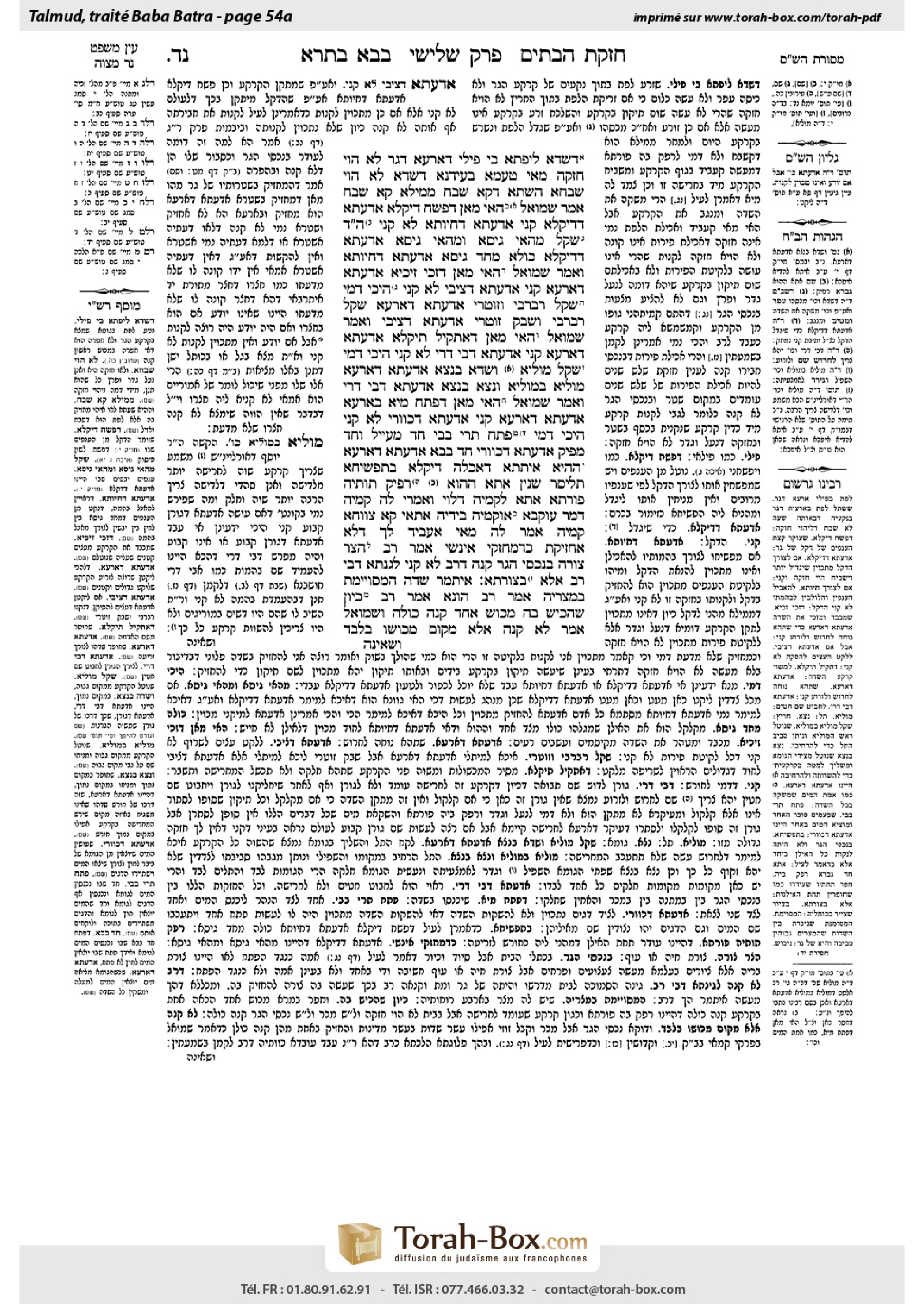
Bava Batra 54a: Talmud study for Daf Yomi
Study the Talmud for Daf Yomi with scanned pages, Hebrew text, English translations from Sefaria and AI-generated French translations.
Passage selection and English or AI-generated French translation are available where the scan has annotations. Daf Study is independent of Torah-Box and Sefaria.
Browse Bava Batra · בבא בתרא · All tractatesBava Batra 54a text and translations
This page of Bava Batra includes the Aramaic text, an English translation and an AI-generated French translation, alongside the scan above.
בבא בתרא נ״ד א · Aramaic and Hebrew text
דִּשְׁדָא לִיפְתָּא בֵּי פִילֵי דְּאַרְעָא דְגֵר – לָא הָוֵי חֲזָקָה. מַאי טַעְמָא? בְּעִידָּנָא דִּשְׁדָא – לָא הָוֵי שְׁבָחָא, הַשְׁתָּא דְּקָא שָׁבַח – מִמֵּילָא קָא שָׁבַח.
אָמַר שְׁמוּאֵל: הַאי מַאן דְּפָשַׁח דִּיקְלָא; אַדַּעְתָּא דְּדִיקְלָא – קָנֵי, אַדַּעְתָּא דְחֵיוָתָא – לָא קָנֵי. הֵיכִי דָּמֵי? שְׁקַל מֵהַאי גִּיסָא וּמֵהַאי גִּיסָא – אַדַּעְתָּא דְּדִיקְלָא. כּוֹלָּא מֵחַד גִּיסָא – אַדַּעְתָּא דְחֵיוָתָא.
וְאָמַר שְׁמוּאֵל: הַאי מַאן דְּזָכֵי זִיכְיָא; אַדַּעְתָּא דְאַרְעָא – קָנֵי, אַדַּעְתָּא דְצִיבֵי – לָא קָנֵי. הֵיכִי דָּמֵי? שְׁקַל רַבְרְבֵי וְזוּטְרֵי – אַדַּעְתָּא דְאַרְעָא, שְׁקַל רַבְרְבֵי וּשְׁבַק זוּטְרֵי – אַדַּעְתָּא דְצִיבֵי.
וְאָמַר שְׁמוּאֵל: הַאי מַאן דְּאתָקֵיל תִּיקְלָא; אַדַּעְתָּא דְאַרְעָא – קָנֵי, אַדַּעְתָּא דְבֵי דָרֵי – לָא קָנֵי. הֵיכִי דָּמֵי? שְׁקַל מוּלְיָא וּשְׁדָא בְּנַצָּא – אַדַּעְתָּא דְאַרְעָא. מוּלְיָא בְּמוּלְיָא וְנַצָּא בְּנַצָּא – אַדַּעְתָּא דְבֵי דָרֵי.
וְאָמַר שְׁמוּאֵל: הַאי מַאן דְּפָתַח מַיָּא בְּאַרְעָא; אַדַּעְתָּא דְאַרְעָא – קָנֵי, אַדַּעְתָּא דְכַוְורֵי – לָא קָנֵי. הֵיכִי דָּמֵי? פָּתַח תְּרֵי בָבֵי, חַד מְעַיֵּיל וְחַד מַפֵּיק – אַדַּעְתָּא דְכַוְורֵי. חַד בָּבָא – אַדַּעְתָּא דְאַרְעָא.
הָהִיא אִיתְּתָא דַּאֲכַלָה דִּיקְלָא בְּתַפְשִׁיחָא, תְּלֵיסַר שְׁנִין. אֲתָא הָהוּא [גַּבְרָא], רָפֵיק תּוּתֵיהּ פּוּרְתָּא. אֲתָא לְקַמֵּיהּ דְּלֵוִי, וְאָמְרִי לַהּ קַמֵּיהּ דְּמָר עוּקְבָא, אוֹקְמֵיהּ בִּידֵיהּ. אֲתַאי קָא צָוְוחָא קַמֵּיהּ, אֲמַר לַהּ: מַאי אֶעֱבֵיד לָךְ, דְּלָא אַחְזֵיקְתְּ כִּדְמַחְזְקִי אִינָשֵׁי.
אָמַר רַב: הַצָּר צוּרָה בְּנִכְסֵי הַגֵּר – קָנָה; דְּרַב לָא קָנֵי לְגִנְּתָא דְּבֵי רַב, אֶלָּא בְּצוּרְתָּא.
אִיתְּמַר: שָׂדֶה הַמְסוּיֶּימֶת בִּמְצָרֶיהָ – אָמַר רַב הוּנָא אָמַר רַב: כֵּיוָן שֶׁהִכִּישׁ בָּהּ מַכּוֹשׁ אֶחָד – קָנָה כּוּלָּהּ. וּשְׁמוּאֵל אָמַר: לֹא קָנָה אֶלָּא מְקוֹם מַכּוֹשׁוֹ בִּלְבַד.
Bava Batra 54a · English translation
who threw turnip seeds in the crevices [filei] of the land of a convert who died without heirs, it is not sufficient to take possession. What is the reason for this? As at the time that he threw the seeds there was no enhancement to the value of the field. Now that the turnips have grown and the value of the field is enhanced, it is enhanced by itself.
The Gemara records a series of rulings with regard to taking possession of land. Shmuel says: With regard to this one who cuts the branches of a palm tree, if he had in mind the acquisition of the palm tree, he has acquired it; but if he had in mind the benefit of the animals, to feed his animals the branches, he has not acquired it. The Gemara asks: What are the circumstances in which it can be known what he had in mind? The Gemara answers: If he took branches from this side and from that side, he had in mind the acquisition of the palm tree, as this assists the growth of the tree; but if the branches that he took were all from one side, he had in mind the benefit of the animals.
And Shmuel says with regard to this one who clears [dezakkei zikheya] a field of trees, if he had in mind the improvement of the field, to prepare it for plowing, he has acquired it; but if he had in mind the collection of the wood, he has not acquired it. The Gemara asks: What are the circumstances in which it can be known what he had in mind? The Gemara answers: If he took large and small pieces of wood, he had in mind the improvement of the field; however, if he took the large pieces of wood but left the small ones, he had in mind the collection of the wood.
And Shmuel says with regard to this one who removes protuberances and levels the ground, if he had in mind the improvement of the field, to prepare it for plowing, he has acquired it; but if he had in mind the conversion of the field into a threshing floor, he has not acquired it. The Gemara asks: What are the circumstances in which it can be known what he had in mind? The Gemara answers: If he took a mound and threw it in a ditch, thereby leveling both areas, he had in mind the improvement of the field; but if he leveled the ground with a mound in the place of a mound and a ditch in the place of a ditch, expanding each area but leaving the field as a whole uneven, he had in mind the conversion of the field into a threshing floor.
And Shmuel says with regard to this one who opened a blockage and enabled water to enter into a section of land, if he had in mind the improvement of the field, to irrigate it, he has acquired it; but if he had in mind the catching of the fish, i.e., to enable the water to flow in so that he could catch the fish therein, he has not acquired it. The Gemara asks: What are the circumstances in which it can be known what he had in mind? The Gemara answers: If he opened two gates, one bringing in the water and one taking out the water, this indicates that he had in mind the catching of the fish, as the water will flow out of the field, giving him the means to catch the fish; but if he opened only one gate, this indicates that he had in mind the improvement of the field.
The Gemara relates: There was a certain woman who profited from an ownerless palm tree by cutting its branches for thirteen years. Another then came and plowed beneath it a bit. The case came before Levi, and some say that it came before Mar Ukva, who established the property in the possession of the one who plowed. The woman came and shouted before him, protesting the perceived injustice of his ruling. Mar Ukva said to her: What can I do for you, as you did not take possession of the property in the manner that people take possession?
Rav says: One who draws an image, e.g., he paints an image on the wall, on the property of a convert who died without heirs has acquired it, as Rav himself acquired the garden of the house of Rav, which had been ownerless property, only by drawing an image.
§ It was stated: With regard to a field that is defined by its boundaries, i.e., it has clearly demarcated boundaries on all sides, Rav Huna says that Rav says: Once he struck the land with a hoe one time, he acquired the entire property. And Shmuel says that he has acquired only the place that he struck with the hoe.
Bava Batra 54a · Traduction française (IA)
Celui qui a jeté des graines de chou dans les interstices [filei] du terrain d'un converti décédé sans héritiers, il n'est pas suffisant pour acquérir la propriété. Quelle est la raison de cela ? À l'époque où il a jeté les graines, il n'y avait pas d'amélioration de la valeur du champ. Maintenant que les choux ont poussé et que la valeur du champ est améliorée, c'est l'amélioration elle-même qui l'a fait.
La Guemara rapporte une série de décisions concernant l'acquisition de la propriété terrienne. Shmuel dit : En ce qui concerne celui qui coupe les branches d'un arbre à palme, s'il avait l'intention d'acquérir l'arbre à palme, il l'a acquis ; mais s'il avait l'intention du bénéfice des animaux, pour nourrir ses animaux avec les branches, il ne l'a pas acquis. La Guemara demande : Quelles sont les circonstances dans lesquelles on peut savoir ce qu'il avait en tête ? La Guemara répond : Si il a pris des branches de ce côté et de l'autre, il avait l'intention d'acquérir l'arbre à palme, car cela favorise la croissance de l'arbre ; mais si les branches qu'il a prises étaient toutes d'un seul côté, il avait l'intention du bénéfice des animaux.
Et Shmuel dit en ce qui concerne celui qui débarrasse [dezakkei zikheya] un champ des arbres, s'il avait l'intention d'améliorer le champ, pour le préparer à la culture, il l'a acquis ; mais s'il avait l'intention de ramasser du bois, il ne l'a pas acquis. La Guemara demande : Quelles sont les circonstances dans lesquelles on peut savoir ce qu'il avait en tête ? La Guemara répond : Si il a pris des morceaux de bois de grande et de petite taille, il avait l'intention d'améliorer le champ ; toutefois, si il a pris les morceaux de bois de grande taille mais a laissé les petits, il avait l'intention de ramasser du bois.
Et Shmuel dit concernant celui qui enlève les bosses et nivelle le sol, s'il avait l'intention d'améliorer le champ, pour le préparer à la culture, il l'a acquis ; mais s'il avait l'intention de le transformer en un lieu de battage, il ne l'a pas acquis. La Guemara demande : Quelles sont les circonstances dans lesquelles on peut savoir ce qu'il avait en tête ? La Guemara répond : Si il a pris une butte et l'a jetée dans un fossé, nivelant ainsi les deux zones, il avait l'intention d'améliorer le champ ; mais si il a nivelle le sol en laissant une butte à la place d'une butte et un fossé à la place d'un fossé, en étendant chaque zone mais en laissant le champ global inégal, il avait l'intention de le transformer en un lieu de battage.
Et Shmuel dit concernant celui qui a ouvert un blocage et a permis à l'eau d'entrer dans une section de terrain, s'il avait l'intention d'améliorer le champ, pour l'irriguer, il l'a acquis ; mais s'il avait l'intention de pêcher les poissons, c'est-à-dire de permettre à l'eau de couler afin de pêcher les poissons, il ne l'a pas acquis. La Guemara demande : Quelles sont les circonstances dans lesquelles on peut savoir ce qu'il avait en tête ? La Guemara répond : Si il a ouvert deux portes, une pour faire entrer l'eau et une pour la faire sortir, cela indique qu'il avait l'intention de pêcher les poissons, car l'eau sortira du champ, lui donnant le moyen de pêcher les poissons ; mais si il a ouvert seulement une porte, cela indique qu'il avait l'intention d'améliorer le champ.
La Guemara rapporte : Il y avait une certaine femme qui a bénéficié d'un arbre à palme sans propriétaire en coupant ses branches pendant treize ans. Un autre est ensuite venu et a labouré sous lui un peu. Le cas est venu devant Levi, et certains disent qu'il est venu devant Mar Ukva, qui a établi la propriété en possession de celui qui a labouré. La femme est venue et a crié devant lui, protestant contre l'injustice perçue de son jugement. Mar Ukva a dit à elle : Que puis-je faire pour vous, comme vous n'avez pas acquis la propriété dans la manière dont les gens acquièrent la propriété ?
Rav dit : Celui qui dessine une image, par exemple, il peint une image sur le mur, sur la propriété d'un converti décédé sans héritiers, a acquis cela, car Rav lui-même a acquis le jardin de la maison de Rav, qui était une propriété sans propriétaire, seulement en dessinant une image.
§ Il a été dit : En ce qui concerne un champ défini par ses limites, c'est-à-dire qui a des limites clairement marquées de tous les côtés, Rav Huna dit que Rav dit : Une fois qu'il a frappé le sol avec une houe une fois, il a acquis toute la propriété. Et Shmuel dit qu'il a acquis seulement la place qu'il a frappée avec la houe.
Traduction française générée par IA à partir de l’édition anglaise de Sefaria. Vérifie toujours un passage avec le texte source.
Text from Sefaria: William Davidson Edition - Vocalized Aramaic (CC BY NC); William Davidson Edition - English (CC BY NC).