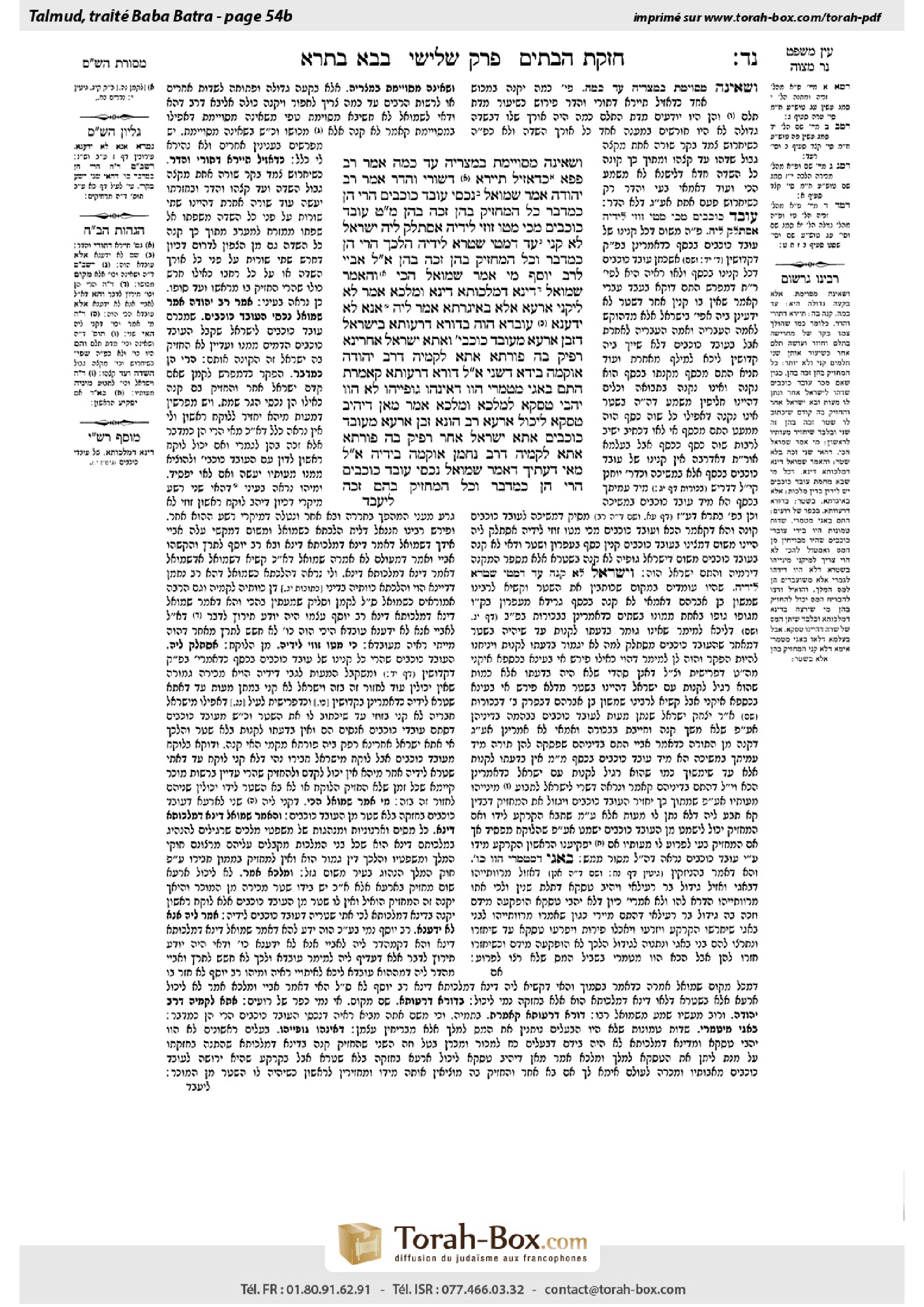
Bava Batra 54b: Talmud study for Daf Yomi
Study the Talmud for Daf Yomi with scanned pages, Hebrew text, English translations from Sefaria and AI-generated French translations.
Passage selection and English or AI-generated French translation are available where the scan has annotations. Daf Study is independent of Torah-Box and Sefaria.
Browse Bava Batra · בבא בתרא · All tractatesBava Batra 54b text and translations
This page of Bava Batra includes the Aramaic text, an English translation and an AI-generated French translation, alongside the scan above.
בבא בתרא נ״ד ב · Aramaic and Hebrew text
וְשֶׁאֵינָהּ מְסוּיֶּימֶת בִּמְצָרֶיהָ, עַד כַּמָּה? אָמַר רַב פָּפָּא: כִּדְאָזֵיל תַּיָּירָא דְשׁוֹרֵי וְהָדַר.
אָמַר רַב יְהוּדָה אָמַר שְׁמוּאֵל: נִכְסֵי גּוֹי הֲרֵי הֵן כְּמִדְבָּר, כׇּל הַמַּחְזִיק בָּהֶן זָכָה בָּהֶן. מַאי טַעְמָא? גּוֹי – מִכִּי מָטוּ זוּזֵי לִידֵיהּ אִסְתַּלַּק לֵיהּ, יִשְׂרָאֵל לָא קָנֵי עַד דְּמָטֵי שְׁטָרָא לִידֵיהּ. הִלְכָּךְ הֲרֵי הֵן כְּמִדְבָּר, וְכׇל הַמַּחְזִיק בָּהֶן זָכָה בָּהֶן.
אֲמַר לֵיהּ אַבָּיֵי לְרַב יוֹסֵף: מִי אָמַר שְׁמוּאֵל הָכִי?! וְהָאָמַר שְׁמוּאֵל: דִּינָא דְמַלְכוּתָא דִּינָא; וּמַלְכָּא אָמַר: לָא לִיקְנֵי אַרְעָא אֶלָּא בְּאִיגַּרְתָּא! אֲמַר לֵיהּ: אֲנָא לָא יָדַעְנָא; עוֹבָדָא הֲוָה בְּדוּרָא דְרָעֲוָתָא, בְּיִשְׂרָאֵל דִּזְבַן אַרְעָא מִגּוֹי, וַאֲתָא יִשְׂרָאֵל אַחֲרִינָא רָפֵיק בָּהּ פּוּרְתָּא; אֲתָא לְקַמֵּיהּ דְּרַב יְהוּדָה, אוֹקְמַהּ בִּידָא דְּשֵׁנִי.
אֲמַר לֵיהּ: דּוּרָא דְרָעֲוָתָא קָאָמְרַתְּ?! הָתָם בָּאגֵי מִטַּמְּרִי הֲווֹ – דְּאִינְהוּ גּוּפַיְיהוּ לָא הֲווֹ יָהֲבִי טַסְקָא לְמַלְכָּא, וּמַלְכָּא אֲמַר: מַאן דְּיָהֵיב טַסְקָא, לֵיכוֹל אַרְעָא.
רַב הוּנָא זְבֵן אַרְעָא מִגּוֹי, אֲתָא יִשְׂרָאֵל אַחֵר רָפֵיק בַּהּ פּוּרְתָּא. אֲתָא לְקַמֵּיהּ דְּרַב נַחְמָן, אוֹקְמַהּ בִּידֵיהּ. אֲמַר לֵיהּ: מַאי דַּעְתָּיךְ? דְּאָמַר שְׁמוּאֵל: נִכְסֵי גּוֹי הֲרֵי הֵן כְּמִדְבָּר, וְכׇל הַמַּחְזִיק בָּהֶם זָכָה?
Bava Batra 54b · English translation
And if it is not defined by its boundaries, up to how much of the field is acquired by one strike of the hoe? Rav Pappa said: He acquires as far as an ox driver goes and returns, i.e., the size of a standard furrow, beginning where the hoe entered the ground.
§ Rav Yehuda says that Shmuel says: With regard to the property of a gentile that was sold to a Jew for money, it is ownerless like a desert until the purchaser performs an act of acquisition; anyone who takes possession of it in the interim has acquired it. What is the reason for this? The gentile relinquishes ownership of it from the moment when the money reaches his hand, while the Jew who purchased it does not acquire it until the deed reaches his hand. Therefore, in the period of time between the giving of the money and the receiving of the deed, the property is like a desert, and anyone who takes possession of it has acquired it.
Abaye said to Rav Yosef: Did Shmuel actually say this? But doesn’t Shmuel say that the law of the kingdom is the law, i.e., the halakha obligates Jews to observe the laws of the locale in which they reside, and the king said that land may not be acquired without a document? Therefore, taking possession should not be effective for acquisition. Rav Yosef said to him: I do not know how to reconcile this contradiction, but there was an incident in the village of Dura that was founded by shepherds, where there was a Jew who purchased land from a gentile by giving money, and in the interim another Jew came and plowed it a bit. The two Jews came before Rav Yehuda for a ruling, and he established the property in the possession of the second individual. This accords with the ruling of Shmuel that the property is ownerless until a Jew performs an act of acquisition.
Abaye said to him: Are you saying that the incident occurred in Dura that was founded by shepherds? Proof cannot be brought from that case, as there the fields were concealed, since the owners of fields would not pay the land tax [taska] to the king, and the king says that one who pays land tax may profit from the field. Therefore, in that case, the gentile who sold the property did not actually own it, and consequently by the laws of the kingdom could not sell it. The one who took possession of the property acquired it in accordance with the law of the kingdom, as he committed to pay the land tax. Elsewhere, one would not acquire the field until he received a deed of sale from the gentile.
The Gemara relates: Rav Huna purchased land from a gentile. Another Jew came and plowed it slightly. Rav Huna and that Jew came before Rav Naḥman, who established the property in the possession of the latter. Rav Huna said to Rav Naḥman: What are you thinking in issuing this ruling? Is it because Shmuel says that the property of a gentile is like a desert, and anyone who takes possession of it has acquired it?
Bava Batra 54b · Traduction française (IA)
Et si ce n'est pas défini par ses limites, jusqu'à quelle mesure du champ est acquis par un seul coup de faux ? Rav Pappa dit : Il acquiert jusqu'à ce que l'homme qui conduit les bœufs aille et revienne, c'est-à-dire la taille d'un sillon normal, commençant là où le faux a pénétré dans le sol.
§ Rav Yehuda dit que Shmuel dit : En ce qui concerne la propriété d'un non-Juif vendue à un Juif pour de l'argent, elle est comme une désert jusqu'à ce que l'acheteur accomplisse un acte d'acquisition ; quiconque s'en empare pendant ce temps l'acquiert. Pourquoi cela ? Le non-Juif renonce à sa propriété dès le moment où l'argent arrive entre ses mains, tandis que le Juif qui l'a acheté ne l'acquiert pas jusqu'à ce que le contrat arrive entre ses mains. Ainsi, pendant la période entre le paiement de l'argent et la réception du contrat, la propriété est comme une désert, et quiconque s'en empare l'acquiert.
Abaye dit à Rav Yosef : Est-ce que Shmuel a vraiment dit cela ? Mais ne dit-il pas Shmuel que la loi du royaume est la loi, c'est-à-dire que la halakha oblige les Juifs à observer les lois du lieu où ils résident, et que le roi a dit que la terre ne peut être acquise sans un document ? Ainsi, l'acquisition par possession ne devrait pas être efficace. Rav Yosef dit à lui : Je ne sais pas comment concilier ce conflit, mais il y avait un incident dans le village de Dura, fondé par des bergers, où il y avait un Juif qui avait acheté une terre à un non-Juif en donnant de l'argent, et pendant ce temps un autre Juif est venu et a labouré un peu. Les deux Juifs sont allés devant Rav Yehuda pour obtenir un avis, et il a établi la propriété en possession de la deuxième personne. Cela correspond à la décision de Shmuel que la propriété est sans propriétaire jusqu'à ce qu'un Juif accomplisse un acte d'acquisition.
Abaye dit à lui : Est-ce que vous dites que l'incident s'est produit à Dura, fondé par des bergers ? La preuve ne peut être tirée de ce cas, car là les champs étaient cachés, car les propriétaires des champs ne paient pas l'impôt sur les terres [taska] au roi, et le roi dit que celui qui paie l'impôt sur les terres peut profiter du champ. Ainsi, dans ce cas, le non-Juif qui a vendu la propriété ne possédait pas réellement celle-ci, et par conséquent, selon les lois du royaume, il ne pouvait pas la vendre. Celui qui s'est emparé de la propriété l'a acquis selon la loi du royaume, car il s'est engagé à payer l'impôt sur les terres. Ailleurs, on ne peut pas acquérir la terre jusqu'à ce qu'on reçoive un contrat de vente du non-Juif.
La Guemara rapporte : Rav Huna a acheté une terre d'un non-Juif. Un autre Juif est venu et a labouré un peu. Rav Huna et ce Juif sont allés devant Rav Naḥman, qui a établi la propriété en possession de la dernière personne. Rav Huna a dit à Rav Naḥman : Qu'est-ce que vous pensez en émettant cette décision ? Est-ce parce que Shmuel dit que la propriété d'un non-Juif est comme une désert, et quiconque s'en empare l'acquiert ?
Traduction française générée par IA à partir de l’édition anglaise de Sefaria. Vérifie toujours un passage avec le texte source.
Text from Sefaria: William Davidson Edition - Vocalized Aramaic (CC BY NC); William Davidson Edition - English (CC BY NC).