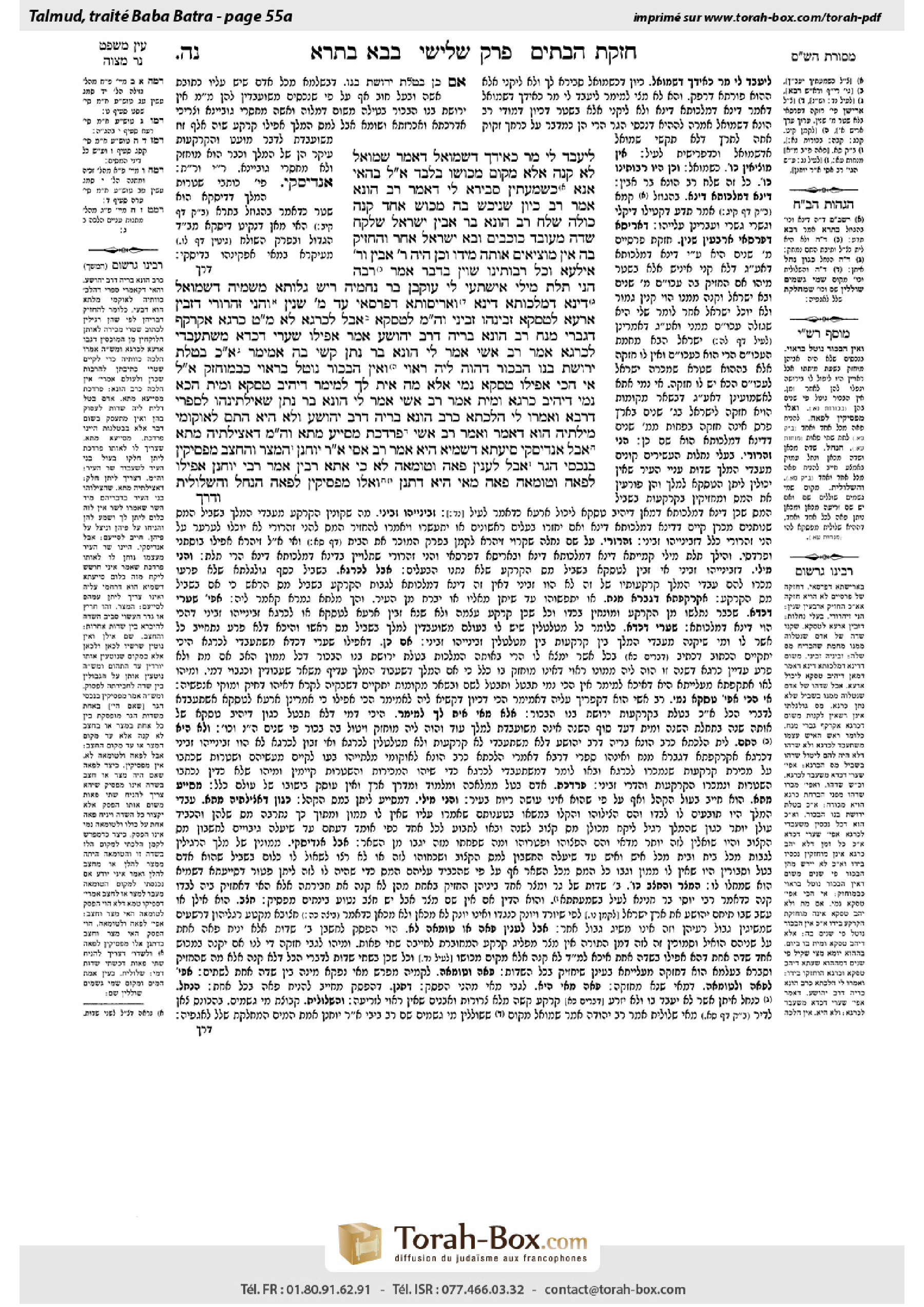
Bava Batra 55a: Talmud study for Daf Yomi
Study the Talmud for Daf Yomi with scanned pages, Hebrew text, English translations from Sefaria and AI-generated French translations.
Passage selection and English or AI-generated French translation are available where the scan has annotations. Daf Study is independent of Torah-Box and Sefaria.
Browse Bava Batra · בבא בתרא · All tractatesBava Batra 55a text and translations
This page of Bava Batra includes the Aramaic text, an English translation and an AI-generated French translation, alongside the scan above.
בבא בתרא נ״ה א · Aramaic and Hebrew text
לֶיעְבַּד לִי מָר כְּאִידַּךְ דִּשְׁמוּאֵל, דְּאָמַר שְׁמוּאֵל: לֹא קָנָה אֶלָּא מְקוֹם מַכּוֹשׁוֹ בִּלְבַד! אֲמַר לֵיהּ: בְּהַאי, אֲנָא כִּשְׁמַעְתִּין סְבִירָא לִי – דְּאָמַר רַב הוּנָא אָמַר רַב: כֵּיוָן שֶׁנִּיכֵּשׁ בָּהּ מַכּוֹשׁ אֶחָד – קָנָה כּוּלָּהּ.
שְׁלַח רַב הוּנָא בַּר אָבִין: יִשְׂרָאֵל שֶׁלָּקַח שָׂדֶה מִגּוֹי, וּבָא יִשְׂרָאֵל אַחֵר וְהֶחֱזִיק בָּהּ – אֵין מוֹצִיאִים אוֹתָהּ מִיָּדוֹ. וְכֵן הָיָה רַבִּי אָבִין וְרַבִּי אִילְעָא וְכׇל רַבּוֹתֵינוּ שָׁוִין בַּדָּבָר.
אָמַר רַבָּה: הָנֵי תְּלָת מִילֵּי, אִישְׁתַּעִי לִי עוּקְבָן בַּר נְחֶמְיָה רֵישׁ גָּלוּתָא, מִשְּׁמֵיהּ דִּשְׁמוּאֵל: דִּינָא דְמַלְכוּתָא דִּינָא, וַאֲרִיסוּתָא דְפָרְסָאֵי – עַד אַרְבְּעִין שְׁנִין, וְהָנֵי זַהֲרוּרֵי דְּזָבֵין אַרְעָא לְטַסְקָא – זְבִינַיְהוּ זְבִינֵי.
וְהָנֵי מִילֵּי לְטַסְקָא, אֲבָל לִכְרָגָא – לָא. מַאי טַעְמָא? כְּרָגָא – אַקַּרְקַף דְּגַבְרֵי מַנַּח. רַב הוּנָא בְּרֵיהּ דְּרַב יְהוֹשֻׁעַ אָמַר: אֲפִילּוּ שְׂעָרֵי דְכַדָּא מִשְׁתַּעְבְּדִי לִכְרָגָא.
אָמַר רַב אָשֵׁי: אֲמַר לִי הוּנָא בַּר נָתָן, קָשֵׁי בַּהּ אַמֵּימָר: אִם כֵּן, בִּטַּלְתָּ יְרוּשַּׁת בְּנוֹ הַבְּכוֹר – דְּהָוֵה לֵיהּ רָאוּי, וְאֵין הַבְּכוֹר נוֹטֵל בָּרָאוּי כְּבַמּוּחְזָק.
אָמְרִי לֵיהּ: אִי הָכִי, אֲפִילּוּ טַסְקָא נָמֵי! אֶלָּא מָה אִית לָךְ לְמֵימַר – דִּיהַיב טַסְקָא וּמִית; הָכָא נָמֵי – דִּיהַיב כְּרָגָא וּמִית.
אָמַר רַב אָשֵׁי, אָמַר לִי הוּנָא בַּר נָתָן: שְׁאֵילְתִּינְהוּ לְסָפְרֵי דְרָבָא, וַאֲמַרוּ לִי: הִלְכְתָא כְּרַב הוּנָא בְּרֵיהּ דְּרַב יְהוֹשֻׁעַ. וְלָא הִיא, הָתָם – לְאוֹקוֹמֵי מִילְּתֵיהּ הוּא דְּאָמַר.
וְאָמַר רַב אָשֵׁי: פַּרְדָּכְתְּ – מְסַיַּיע מָתָא. וְהָנֵי מִילֵּי דְּאַצֵּילְתֵּיהּ מָתָא, אֲבָל אַנְדִּיסְקֵי – סִיַּעְתָּא דִשְׁמַיָּא הִיא.
אָמַר רַב אַסִּי אָמַר רַבִּי יוֹחָנָן: הַמֶּצֶר וְהֶחָצָב מַפְסִיקִין בְּנִכְסֵי הַגֵּר, אֲבָל לְעִנְיַן פֵּאָה וְטוּמְאָה – לָא. כִּי אֲתָא רָבִין אָמַר רַבִּי יוֹחָנָן: אֲפִילּוּ לְפֵאָה וְטוּמְאָה.
פֵּאָה – מַאי הִיא? דִּתְנַן: וְאֵלּוּ מַפְסִיקִין לַפֵּאָה – הַנַּחַל, וְהַשְּׁלוּלִית,
Bava Batra 55a · English translation
If so, the Master should do for me in accordance with another statement of Shmuel, as Shmuel says that one who hoes ownerless property has acquired only the place that he struck with the hoe. Rav Naḥman said to him: In this matter I hold in accordance with our halakha, as Rav Huna says that Rav says: Once he struck the land with a hoe one time, he acquired the entire property.
The Gemara relates that Rav Huna bar Avin sent a ruling: In the case of a Jew who purchased a field from a gentile, and then another Jew came and took possession of it, it is not removed from the possession of the second Jew. And so too, Rabbi Avin, and Rabbi Ile’a, and all of our Rabbis agree with regard to this matter.
§ Rabba said: These three statements were told to me by Ukvan bar Neḥemya the Exilarch in the name of Shmuel: The law of the kingdom is the law; and the term of Persian sharecropping [arisuta] is for up to forty years, since according to Persian laws the presumption of ownership is established after forty years of use; and in the case of these tax officials [zaharurei] who sold land in order to pay the land tax, the sale is valid, as the tax officials were justified in seizing it, and one may purchase the land from them.
The Gemara notes: And this statement applies to land seized to pay the land tax, but not to land seized to pay the head tax. What is the reason for this? The head tax is placed on a man’s head, i.e., the obligation of this tax is on the individual and is unrelated to his property. It is therefore theft for the tax officials to sell land for this purpose. Rav Huna, son of Rav Yehoshua, said: Everything, even the barley in the pitcher, is mortgaged for the payment of the head tax.
Rav Ashi said: Huna bar Natan said to me that Ameimar raised a difficulty with regard to this statement of Rav Huna, son of Rav Yehoshua: If so, you have abolished the inheritance of the firstborn son of one who owes taxes to the kingdom. If everything can be seized by the tax collectors to pay the father’s debt, any property that he left behind is only a potential inheritance, not actually property of the heirs, and the halakha is that the firstborn does not take a double share in a potential inheritance as he does in property that the deceased possessed.
The Gemara continues the statement of Huna bar Natan: And I said to Ameimar: If it is so that this presents a difficulty, then even if the property can be seized as payment for the land tax this difficulty would present itself as well, as the sons would not inherit their father’s estate in the event that it is seized to pay the land tax. Rather, what have you to say to deflect this question? That the firstborn son’s right is not negated in a case where the father gave the land tax and then died, so that he is no longer indebted to the government and the field is completely his. Here too, the firstborn son maintains his rights in a case where the father gave the head tax and then died.
Rav Ashi said: Huna bar Natan said to me: I asked the scribes who wrote documents and recorded halakhic rulings in the court of Rava, and they said to me that the halakha is in accordance with the opinion of Rav Huna, son of Rav Yehoshua, who states that one’s possessions are all mortgaged for the payment of the head tax. The Gemara notes: But that is not so, as there, Huna bar Natan said that in order to buttress his previous statement.
And Rav Ashi said: An idler [pardakht] must assist the town by paying taxes even though he has no income in that town. And this matter applies in a case where the town saved him from his obligation by asking for a reduction on his behalf. But if the tax collectors [andisekei] do not seek to collect his debt this is regarded as heavenly assistance, and he is not obligated to volunteer to pay his share.
§ Rav Asi says that Rabbi Yoḥanan says: The boundary between fields and the sea squill that was planted to demarcate the border between fields serve as a barrier between fields with regard to the property of a convert who died without heirs, so that one who takes possession of the property acquires land only until the boundary or the sea squill, but not other land the convert had possessed beyond that point. But they do not serve as a barrier between fields with regard to the matter of produce in the corner of the field, which is given to the poor [pe’a], and ritual impurity, and even the area beyond it is considered to be part of the same field. When Ravin came to Babylonia from Eretz Yisrael, he said in the name of Rabbi Yoḥanan: They serve as a barrier between the fields even with regard to the halakhot of pe’a and ritual impurity.
The Gemara explains: What is the halakha of pe’a that is affected by determining whether it is one or two fields? As we learned in a mishna (Pe’a 2:1): And these serve as a barrier for the purpose of pe’a, i.e., the presence of any of these divides a field so that each section constitutes a distinct field from which pe’a must be given independently: A stream that passes through the field; and a canal;
Bava Batra 55a · Traduction française (IA)
Si c'est ainsi, le Maître devrait agir pour moi selon une autre déclaration de Shmuel, car Shmuel dit qu'une personne qui batait une propriété sans propriétaire a acquis seulement la place qu'elle avait frappée avec la houe. Rav Naḥman dit à lui : Dans cette affaire, je suis d'avec notre halakha, car Rav Huna dit que Rav dit : Une fois qu'on a frappé le sol avec une houe une fois, on a acquis toute la propriété.
La Guemara rapporte que Rav Huna bar Avin a envoyé un avis : Dans le cas d'un Juif qui a acheté un champ d'un non-Juif, et ensuite un autre Juif est venu et a pris possession de celui-ci, il n'est pas retiré de la possession du second Juif. Et de même, Rabbi Avin, et Rabbi Ile’a, et tous nos Rabbins sont d'accord sur ce point.
§ Rabba dit : Ces trois déclarations m'ont été racontées par Ukvan bar Neḥemya, le prince exilé, au nom de Shmuel : La loi du royaume est la loi ; et la durée de la culture de partage perse [arisuta] est jusqu'à quarante ans, car selon les lois perses, la présomption de propriété est établie après quarante ans d'utilisation ; et dans le cas de ces officiers fiscaux [zaharurei] qui ont vendu des terres afin de payer l'impôt foncier, la vente est valide, car les officiers fiscaux avaient le droit de s'emparer de celles-ci, et l'on peut acheter la terre auprès d'eux.
La Guemara note : Et cette déclaration s'applique à une terre saisie pour payer l'impôt foncier, mais pas à une terre saisie pour payer l'impôt capiteux. Quelle est la raison de cela ? L'impôt capiteux est imposé sur la tête d'un homme, c'est-à-dire que l'obligation de cet impôt incombe à l'individu et n'est pas liée à sa propriété. Il est donc un vol que les officiers fiscaux vendent une terre à cet effet. Rav Huna, fils de Rav Yehoshua, dit : Tout, même le blé dans le bidon, est hypothéqué pour le paiement de l'impôt capiteux.
Rav Ashi dit : Huna bar Natan dit à moi que Ameimar a soulevé une difficulté concernant cette déclaration de Rav Huna, fils de Rav Yehoshua : Si c'est ainsi, vous avez aboli l'héritage du fils aîné d'un homme qui doit des impôts au royaume. Si tout peut être saisi par les collecteurs d'impôts pour payer la dette du père, toute la propriété qu'il a laissée derrière lui n'est qu'un héritage potentiel, pas une propriété réelle des héritiers, et la halakha est que le fils aîné ne prend pas une part double dans un héritage potentiel comme il le fait dans la propriété que le défunt possédait.
La Guemara continue la déclaration de Huna bar Natan : Et je dis à Ameimar : Si c'est ainsi que cela présente une difficulté, alors même si la propriété peut être saisie pour payer l'impôt foncier, cette difficulté se présenterait également, car les fils ne hériteraient pas de l'immobilier du père si celui-ci était saisi pour payer l'impôt foncier. Et puis, que dis-tu pour détourner cette question ? Que le droit du fils aîné n'est pas annulé dans le cas où le père a payé l'impôt foncier et est ensuite décédé, de sorte qu'il n'est plus débiteur de l'État et que le champ est entièrement sien. Ici aussi, le fils aîné maintient ses droits dans le cas où le père a payé l'impôt capiteux et est ensuite décédé.
Rav Ashi dit : Huna bar Natan dit à Rav Ashi : J'ai interrogé les scribes qui écrivaient des documents et qui notaient les décisions halakhiques dans la cour de Rava, et ils m'ont dit que la halakha suit l'opinion de Rav Huna, fils de Rav Yehoshua, qui affirme que les possessions d'une personne sont toutes hypothéquées pour le paiement de l'impôt capiteux. La Guemara note : Mais cela n'est pas vrai, car là, Huna bar Natan a dit que pour soutenir sa déclaration précédente.
Et Rav Ashi dit : Un oisif [pardakht] doit aider la ville en payant des impôts même s'il n'a pas de revenu dans cette ville. Et cette affaire s'applique dans le cas où la ville l'a sauvé de son obligation en demandant une réduction à son sujet. Mais si les collecteurs d'impôts [andisekei] ne cherchent pas à recouvrer sa dette, cela est considéré comme une aide céleste, et il n'est pas tenu de volontairement payer sa part.
§ Rav Asi dit que Rabbi Yoḥanan dit : La limite entre les champs et la squill de mer plantée pour marquer la frontière entre les champs sert de barrière entre les champs concernant la propriété d'un converti décédé sans héritiers, de sorte qu'une personne qui prend possession de la propriété acquiert la terre seulement jusqu'à la limite ou la squill de mer, mais pas d'autres terres que le converti avait possédées au-delà de ce point. Mais elles ne servent pas de barrière entre les champs concernant la matière des produits du coin du champ, qui est donné aux pauvres [pe’a], et la souillure rituelle, et même l'aire au-delà est considérée comme faisant partie du même champ. Quand Rabin est venu en Babylone depuis Eretz Yisrael, il a dit au nom de Rabbi Yoḥanan : Elles servent de barrière entre les champs même concernant les halakhot de pe’a et de souillure rituelle.
La Guemara explique : Quelle est la halakha du pe’a qui dépend de déterminer si c'est un ou deux champs ? Comme nous avons appris dans une mitsva (Pe’a 2:1) : Et ces choses servent de barrière pour l'effet du pe’a, c'est-à-dire la présence de l'une d'entre elles divise un champ de sorte que chaque section constitue un champ distinct d'où le pe’a doit être donné indépendamment : un cours d'eau qui traverse le champ ; et un canal ;
Traduction française générée par IA à partir de l’édition anglaise de Sefaria. Vérifie toujours un passage avec le texte source.
Text from Sefaria: William Davidson Edition - Vocalized Aramaic (CC BY NC); William Davidson Edition - English (CC BY NC).