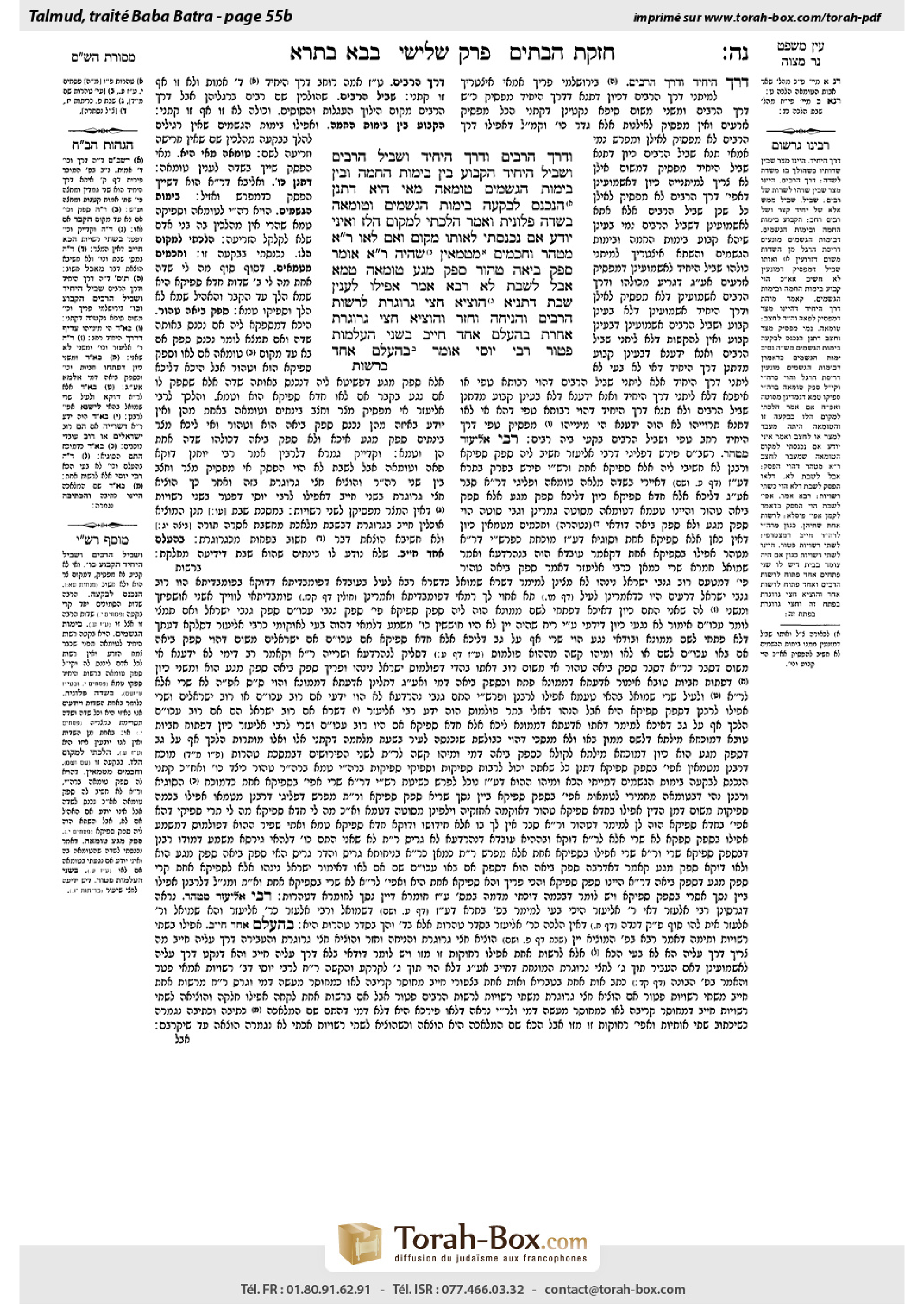
Bava Batra 55b: Talmud study for Daf Yomi
Study the Talmud for Daf Yomi with scanned pages, Hebrew text, English translations from Sefaria and AI-generated French translations.
Passage selection and English or AI-generated French translation are available where the scan has annotations. Daf Study is independent of Torah-Box and Sefaria.
Browse Bava Batra · בבא בתרא · All tractatesBava Batra 55b text and translations
This page of Bava Batra includes the Aramaic text, an English translation and an AI-generated French translation, alongside the scan above.
בבא בתרא נ״ה ב · Aramaic and Hebrew text
וְדֶרֶךְ הָרַבִּים, וְדֶרֶךְ הַיָּחִיד, וּשְׁבִיל הָרַבִּים, וּשְׁבִיל הַיָּחִיד הַקָּבוּעַ בֵּין בִּימוֹת הַחַמָּה וּבֵין בִּימוֹת הַגְּשָׁמִים.
טוּמְאָה – מַאי הִיא? דִּתְנַן: הַנִּכְנָס לְבִקְעָה בִּימוֹת הַגְּשָׁמִים, וְטוּמְאָה בְּשָׂדֶה פְּלוֹנִית, וְאָמַר: הָלַכְתִּי לַמָּקוֹם הַלָּז, וְאֵינִי יוֹדֵעַ אִם נִכְנַסְתִּי לְאוֹתוֹ מָקוֹם וְאִם לָאו – רַבִּי אֱלִיעֶזֶר מְטַהֵר, וַחֲכָמִים מְטַמְּאִין.
שֶׁהָיָה רַבִּי אֱלִיעֶזֶר אוֹמֵר: סְפֵק בִּיאָה – טָהוֹר, סְפֵק מַגַּע טוּמְאָה – טָמֵא.
אֲבָל לְשַׁבָּת לֹא.
רָבָא אָמַר: אֲפִילּוּ לְעִנְיַן שַׁבָּת, דְּתַנְיָא: הוֹצִיא חֲצִי גְרוֹגֶרֶת לִרְשׁוּת הָרַבִּים וְהִנִּיחָה, וְחָזַר וְהוֹצִיא חֲצִי גְרוֹגֶרֶת אַחֶרֶת; בְּהֶעְלֵם אֶחָד – חַיָּיב. בִּשְׁנֵי הֶעְלֵמוֹת – פָּטוּר.
רַבִּי יוֹסֵי אוֹמֵר: בְּהֶעְלֵם אֶחָד;
Bava Batra 55b · English translation
and a public road that is at least sixteen cubits wide; and a private road that is four cubits wide; and a public trail; and a permanent private trail that is used whether in the summer or in the rainy season, i.e., winter. Rav Asi and Ravin disagree with regard to whether Rabbi Yoḥanan held that a boundary or sea squill also serves to subdivide a field for the purpose of pe’a.
The Gemara further clarifies: What is the halakha of ritual impurity that is affected by determining whether an area is one or two fields? As we learned in a mishna (Teharot 6:5): With regard to one who enters into a valley during the rainy season, i.e., winter, when people generally do not enter this area, and therefore for the purpose of this halakha it is considered a private domain, and there is a principle that in a case of uncertainty concerning whether one contracted ritual impurity in a private domain he is ritually impure; and there was ritual impurity in such and such a field, and he said: I know I walked to that place, i.e., I walked in the valley, but I do not know whether I entered that place where the ritual impurity was or whether I did not enter, Rabbi Eliezer deems him pure and the Rabbis deem him impure.
Rabbi Eliezer deems him pure, as Rabbi Eliezer would say: Concerning uncertainty with regard to entry, i.e., it is uncertain whether he entered the area where the ritual impurity is located, he is ritually pure. But if he certainly entered the area where the ritual impurity is located and the uncertainty is with regard to contact with ritual impurity, he is ritually impure. It is with regard to this halakha that Ravin said in the name of Rabbi Yoḥanan that a boundary or sea squill defines these fields as distinct areas.
The Gemara infers, though, that even Ravin holds that a boundary or sea squill serves as a barrier only with regard to pe’a and ritual impurity, but with regard to the halakhot of Shabbat, they do not serve as a barrier between fields.
Rava says: They serve as a barrier between fields even with regard to the matter of Shabbat, as it is taught in a baraita: With regard to one who carried out half of a dried fig from a private domain into the public domain and placed it there, and then returned and carried out another half of a dried fig, if it was done within one lapse of awareness, i.e., he did not remember in the interim that this act is prohibited or that it was Shabbat, the two acts are considered as one, and since the two items together equal the size of a dried fig, he is liable to bring a sin-offering. But if it was done within two lapses of awareness, i.e., after he carried out the first half of a dried fig he remembered that this act is prohibited or that it was Shabbat, but subsequently forgot again and carried out the second half of a dried fig, he is exempt.
The baraita continues. Rabbi Yosei says: If it was done within one lapse of awareness,
Bava Batra 55b · Traduction française (IA)
et une route publique d'au moins seize coudées de largeur ; et une route privée de quatre coudées de largeur ; et un sentier public ; et un sentier privé permanent utilisé tant en été qu'en saison de pluie, c'est-à-dire l'hiver. Rav Asi et Ravin s'opposent quant à la question de savoir si Rabbi Yoḥanan considérait que la limite ou le squille de mer pouvait également servir à subdiviser un champ à l'effet du pe'a.
La Guemara précise davantage : Quelle est la halakha concernant l'impureté rituelle qui dépend de la détermination d'une zone comme un champ ou deux champs ? Comme nous l'avons appris dans une mitsva (Teharot 6:5) : Concernant celui qui entre dans une vallée pendant la saison de pluie, c'est-à-dire l'hiver, lorsque les gens n'entrent généralement pas dans cette zone, et donc, à l'effet de cette halakha, elle est considérée comme un domaine privé, et il y a un principe selon lequel, en cas d'incertitude quant à la contraction d'impureté rituelle dans un domaine privé, on le considère comme impur ; et il y avait de l'impureté rituelle dans un tel et tel champ, et il dit : Je sais que j'ai marché jusqu'à ce lieu, c'est-à-dire j'ai marché dans la vallée, mais je ne sais pas si j'ai entré dans le lieu où l'impureté rituelle était ou non, Rabbi Eliezer le déclare pur et les Rabbins le déclarent impur.
Rabbi Eliezer le déclare pur, car Rabbi Eliezer dirait : Concernant l'incertitude concernant l'entrée, c'est-à-dire qu'il est incertain s'il a entré dans la zone où l'impureté rituelle est située, il est rituellement pur. Mais si certainement il a entré dans la zone où l'impureté rituelle est située et l'incertitude concerne le contact avec l'impureté rituelle, il est rituellement impur. C'est concernant cette halakha que Ravin a dit en nom de Rabbi Yoḥanan que la limite ou le squille de mer définit ces champs comme des zones distinctes.
La Guemara en déduit cependant que même Ravin considère que la limite ou le squille de mer sert uniquement de barrière concernant le pe'a et l'impureté rituelle, mais concernant les halakhot de Shabbat, ils ne servent pas de barrière entre les champs.
Rava dit : Ils servent de barrière entre les champs même concernant la question de Shabbat, comme il est enseigné dans une baraïta : Concernant celui qui a transporté la moitié d'une figue sèche d'un domaine privé vers le domaine public et l'a placée là, puis est revenu et a transporté l'autre moitié d'une figue sèche, si cela a été fait dans un seul laps de conscience, c'est-à-dire qu'il n'a pas souvenir pendant l'intervalle que cet acte est interdit ou qu'il était Shabbat, les deux actes sont considérés comme un seul, et puisque les deux objets ensemble égalent la taille d'une figue sèce, il est tenu responsable de présenter un sacrifice expiatoire. Mais si cela a été fait dans deux laps de conscience, c'est-à-dire après avoir transporté la première moitié d'une figue sèce, il a souvenir que cet acte est interdit ou qu'il était Shabbat, mais ensuite il a oublié à nouveau et a transporté la seconde moitié d'une figue sèce, il est exempt.
La baraïta continue. Rabbi Yosei dit : Si cela a été fait dans un seul laps de conscience,
Traduction française générée par IA à partir de l’édition anglaise de Sefaria. Vérifie toujours un passage avec le texte source.
Text from Sefaria: William Davidson Edition - Vocalized Aramaic (CC BY NC); William Davidson Edition - English (CC BY NC).