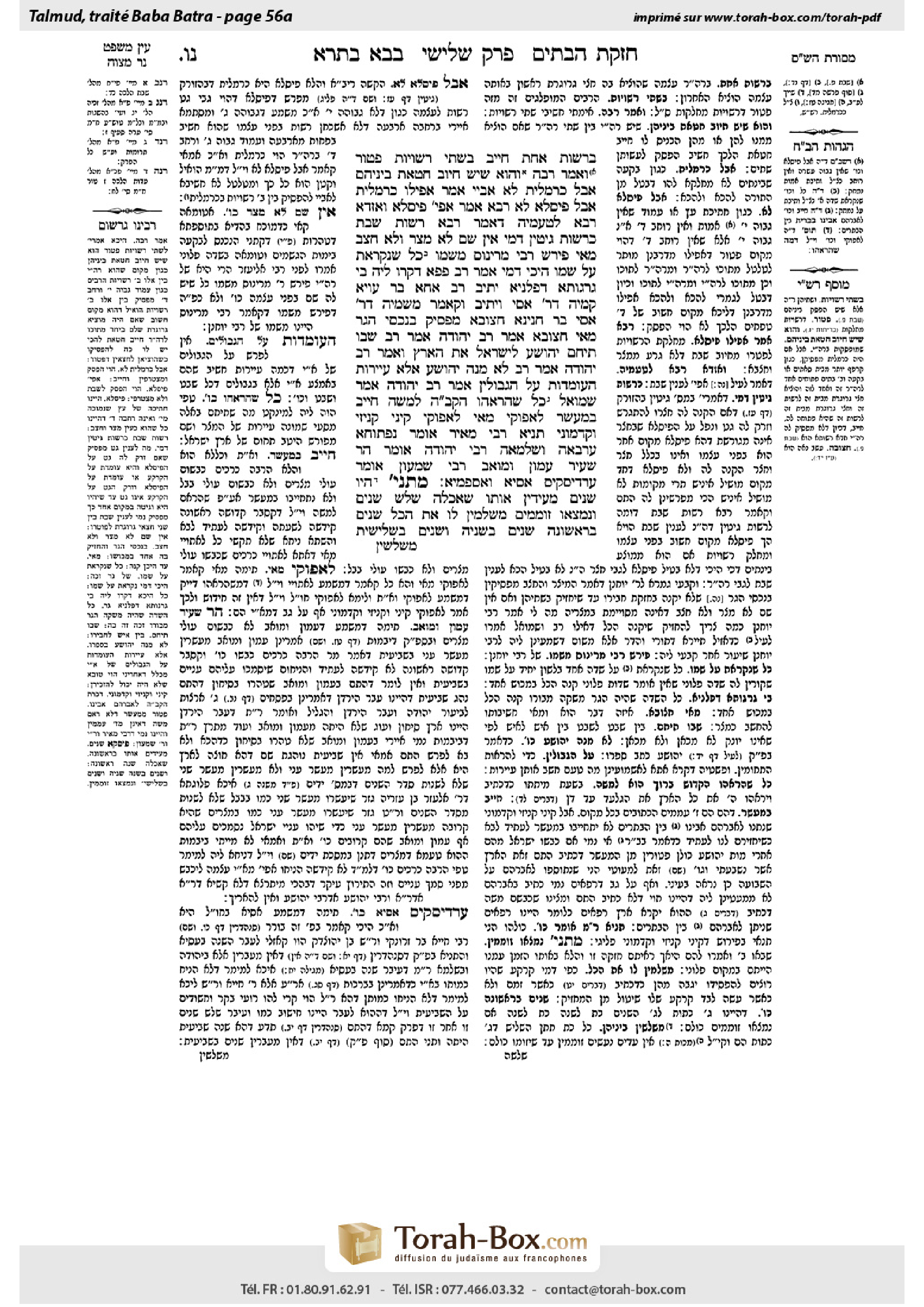
Bava Batra 56a: Talmud study for Daf Yomi
Study the Talmud for Daf Yomi with scanned pages, Hebrew text, English translations from Sefaria and AI-generated French translations.
Passage selection and English or AI-generated French translation are available where the scan has annotations. Daf Study is independent of Torah-Box and Sefaria.
Browse Bava Batra · בבא בתרא · All tractatesBava Batra 56a text and translations
This page of Bava Batra includes the Aramaic text, an English translation and an AI-generated French translation, alongside the scan above.
בבא בתרא נ״ו א · Aramaic and Hebrew text
בִּרְשׁוּת אַחַת – חַיָּיב, בִּשְׁתֵּי רְשׁוּיוֹת – פָּטוּר.
וְאָמַר רַבָּה: וְהוּא שֶׁיֵּשׁ חִיּוּב חַטָּאת בֵּינֵיהֶם, אֲבָל כַּרְמְלִית – לֹא. אַבָּיֵי אָמַר: אֲפִילּוּ כַּרְמְלִית, אֲבָל פִּיסְלָא – לֹא. רָבָא אָמַר: אֲפִילּוּ פִּיסְלָא.
וְאַזְדָּא רָבָא לְטַעְמֵיהּ, דְּאָמַר רָבָא: רְשׁוּת שַׁבָּת כִּרְשׁוּת גִּיטִּין דָּמֵי.
אֵין שָׁם לֹא מֶצֶר וְלֹא חָצָב, מַאי? פֵּירֵשׁ רַבִּי מָרִינוּס מִשְּׁמוֹ: כׇּל שֶׁנִּקְרֵאת עַל שְׁמוֹ. הֵיכִי דָּמֵי? אָמַר רַב פָּפָּא: דְּקָרוּ לֵיהּ ״בֵּי גַרְגּוּתָא דִּפְלָנְיָא״.
יָתֵיב רַב אַחָא בַּר עַוְיָא קַמֵּיהּ דְּרַבִּי אַסִּי, וְיָתֵיב וְקָאָמַר מִשְּׁמֵיהּ דְּרַבִּי אַסִּי בַּר חֲנִינָא: חֲצוּבָא מַפְסֵיק בְּנִכְסֵי הַגֵּר.
מַאי חֲצוּבָא? אָמַר רַב יְהוּדָה אָמַר רַב: שֶׁבּוֹ תִּיחֵם יְהוֹשֻׁעַ לְיִשְׂרָאֵל אֶת הָאָרֶץ.
וְאָמַר רַב יְהוּדָה אָמַר רַב: לֹא מָנָה יְהוֹשֻׁעַ אֶלָּא עֲיָירוֹת הָעוֹמְדוֹת עַל הַגְּבוּלִין.
אָמַר רַב יְהוּדָה אָמַר שְׁמוּאֵל: כֹּל שֶׁהֶרְאָהוּ הַקָּדוֹשׁ בָּרוּךְ הוּא לְמֹשֶׁה – חַיָּיב בְּמַעֲשֵׂר.
לְאַפּוֹקֵי מַאי? לְאַפּוֹקֵי קֵינִי, קְנִיזִּי וְקַדְמוֹנִי. תַּנְיָא, רַבִּי מֵאִיר אוֹמֵר: נַפְתּוֹחָא, עַרְבָאָה וְשַׁלְמָאָה. רַבִּי יְהוּדָה אוֹמֵר: הַר שֵׂעִיר, עַמּוֹן וּמוֹאָב. רַבִּי שִׁמְעוֹן אוֹמֵר: עַרְדִּיסָקִיס, אַסְיָא וְאַסְפַּמְיָא.
מַתְנִי׳ הָיוּ שְׁנַיִם מְעִידִין אוֹתוֹ שֶׁאֲכָלָהּ שָׁלֹשׁ שָׁנִים, וְנִמְצְאוּ זוֹמְמִים – מְשַׁלְּמִין לוֹ אֶת הַכֹּל. שְׁנַיִם בָּרִאשׁוֹנָה, שְׁנַיִם בַּשְּׁנִיָּה, וּשְׁנַיִם בַּשְּׁלִישִׁית –
Bava Batra 56a · English translation
and in one domain, i.e., he carried half the dried fig into the same public domain each time, he is liable, but if it was in two domains, i.e., he carried the item into two separate public domains, he is exempt.
And Rabba says in explanation of Rabbi Yosei’s opinion: And this division of the public domain applies only where there is a property where one would incur liability to bring a sin-offering if one unintentionally carried out of it or into it, i.e., a private domain, between the two sections. But if there was only a karmelit, i.e., an area that is not defined as either a private domain or public domain and to and from which the prohibition against carrying is only of rabbinic origin, it does not divide the public domain. Abaye says: Even a karmelit divides the public domain into separate sections, but a beam [pisela] does not. Rava says: Even a beam divides the public domain, since it is no less than a boundary or sea squill, which do serve as a barrier between fields.
The Gemara notes: And Rava follows his own line of reasoning, as Rava says: The definition of a domain for the purpose of Shabbat is like the definition of a domain for the purpose of bills of divorce: Just as a beam is defined as a distinct domain for the purpose of bills of divorce, so too it is considered a distinct domain for the purpose of Shabbat.
The Gemara returns to discuss the acquisition of a field that belonged to a convert who died without heirs. The Gemara asks: If there was no boundary and there was no sea squill, what are the limits to the acquisition? Rabbi Marinus explains in the name of Rabbi Yoḥanan: Any area that is called by his name. The Gemara asks: What are the circumstances where it is called by his name? Rav Pappa said: Where it is called: The place that is irrigated by so-and-so’s well. The entire area referred to as such would be considered one section with regard to acquisition.
Rav Aḥa bar Avya sat before Rabbi Asi, and he sat and was saying the following in the name of Rabbi Asi bar Ḥanina: A row of sea squill serves as a barrier with regard to the property of a convert who died without heirs, so that each section is considered a distinct field.
The Gemara asks: What is sea squill? Rav Yehuda says that Rav says: It is the growth by which Joshua established the boundaries of Eretz Yisrael for the Jews.
The Gemara teaches a related statement. And Rav Yehuda says that Rav says: In his book, Joshua enumerated only the towns that stand upon the borders, but not the towns that were within the portions of each tribe.
On the subject of the boundaries of Eretz Yisrael, Rav Yehuda says that Shmuel says: Any area that the Holy One, Blessed be He, showed to Moses before his death, as it is written: “And the Lord showed him all the land, Gilead…as far as Zoar” (Deuteronomy 34:1–3), is within the boundaries of Eretz Yisrael, and therefore produce that grows there is obligated in tithe.
The Gemara asks: To exclude what area? The Gemara answers: To exclude the lands of the Kenite, Kenizzite, and Kadmonite, as God had promised to Abraham at the Covenant between the Pieces: “To your offspring have I given this land…to…the Kenite, and the Kenizzite, and the Kadmonite” (Genesis 15:18–19). These areas are not obligated in tithe. What are these three areas? It is taught in a baraita that Rabbi Meir says: They are Naftuḥa, Arva’a, and Shalma’a. Rabbi Yehuda says: They are Mount Seir, Ammon, and Moab. Rabbi Shimon says: They are Ardisekis, Asya, and Aspamya.
MISHNA: If there were two witnesses testifying on his behalf that he, the possessor of the land, worked and profited from a field for three years, and therefore has presumptive ownership, and they were found to be conspiring witnesses, as it was proven that they were not present to witness the matter about which they had testified, they must pay the true owner of the field the full value of the field that they attempted, through their testimony, to remove from his possession, as it is written in the Torah: “Then shall you do to him, as he had planned to do to his brother” (Deuteronomy 19:19). If two witnesses testify that he worked and profited from the field during the first year, another two testify that he worked and profited from it during the second year, and another two testify that he worked and profited from it during the third, and all were found to be conspiring witnesses,
Bava Batra 56a · Traduction française (IA)
et dans un seul domaine, c'est-à-dire qu'il transportait la moitié des figues sèches dans le même domaine public à chaque fois, il est responsable, mais si c'était dans deux domaines, c'est-à-dire qu'il transportait l'objet dans deux domaines publics séparés, il est exempt.
Et Rabba dit, en expliquant l'opinion de Rabbi Yosei : Cette division du domaine public s'applique uniquement là où il y a une propriété dans laquelle on incarne une obligation de présenter un sacrifice expiatoire si l'on transporte accidentellement hors ou dedans, c'est-à-dire un domaine privé, entre les deux sections. Mais si la propriété était uniquement un karmelit, c'est-à-dire une zone qui n'est pas définie comme un domaine privé ou public et dont l'interdiction de transport est uniquement d'origine rabbinique, elle ne divise pas le domaine public. Abaye dit : Même un karmelit divise le domaine public en sections distinctes, mais un pisele ne le fait pas. Rava dit : Même un pisele divise le domaine public, car il n'est pas moins qu'une limite ou un pisele, qui servent de barrière entre les champs.
Le Guemara note : Et Rava suit sa propre ligne de raisonnement, car Rava dit : La définition d'un domaine pour l'objet du Shabbat est comme la définition d'un domaine pour l'objet des époux : Tout comme un pisele est défini comme un domaine distinct pour l'objet des époux, ainsi aussi il est considéré comme un domaine distinct pour l'objet du Shabbat.
Le Guemara reprend la discussion sur l'acquisition d'un champ appartenant à un converti décédé sans héritiers. Le Guemara pose la question : Si il n'y avait pas de limite et pas de pisele, quels sont les limites de l'acquisition ? Rabbi Marinus explique en nom de Rabbi Yoḥanan : Toute zone qui porte le nom de celui-ci. Le Guemara pose la question : Quelles sont les circonstances où elle porte le nom de celui-ci ? Rav Pappa dit : Où elle est appelée : La place qui est arrosée par le puits de tel ou tel. La totalité de la zone ainsi désignée serait considérée comme une seule section en ce qui concerne l'acquisition.
Rav Aḥa bar Avya s'est assis devant Rabbi Asi, et il disait ce qui suit en nom de Rabbi Asi bar Ḥanina : Une rangée de piseles sert de barrière concernant la propriété d'un converti décédé sans héritiers, de sorte que chaque section est considérée comme un champ distinct.
Le Guemara pose la question : Qu'est-ce que le pisele ? Rav Yehuda dit que Rav dit : C'est la croissance par laquelle Josué a établi les limites de la Terre d'Israël pour les Juifs.
Le Guemara enseigne une déclaration liée. Et Rav Yehuda dit que Rav dit : Dans son livre, Josué a énuméré uniquement les villes qui se trouvent sur les frontières, mais pas les villes qui étaient à l'intérieur des portions de chaque tribu.
Sur le sujet des limites de la Terre d'Israël, Rav Yehuda dit que Shmuel dit : Toute zone que l'Éternel, béni soit Son Nom, a montrée à Moïse avant sa mort, comme il est écrit : « Et l'Éternel montra à lui toute la terre, Gilead… jusqu'à Zoar » (Deutéronome 34:1–3), est dans les limites de la Terre d'Israël, et donc les produits qui y poussent sont soumis à la dîme.
Le Guemara pose la question : Pour exclure quelle zone ? Le Guemara répond : Pour exclure les terres des Kénites, des Kénizites et des Kadmonites, car Dieu avait promis à Abraham à la Sainte Alliance entre les Parties : « À ta descendance ai-je donné cette terre… à… les Kénites, et les Kénizites, et les Kadmonites » (Genèse 15:18–19). Ces zones ne sont pas soumises à la dîme. Quelles sont ces trois zones ? Il est enseigné dans une baraïta que Rabbi Meir dit : Elles sont Naftuḥa, Arva’a et Shalma’a. Rabbi Yehuda dit : Elles sont le Mont Séir, l'Ammon et le Moab. Rabbi Shimon dit : Elles sont Ardisekis, Asya et Aspamya.
MICHNA : Si deux témoins témoignaient en son nom que le propriétaire du terrain avait travaillé et tiré profit d'un champ pendant trois ans, et donc avait une propriété présumée, et qu'ils étaient trouvés être des témoins complotant, comme il a été prouvé qu'ils n'étaient pas présents pour témoigner sur l'affaire dont ils avaient témoigné, ils doivent payer à l'owner véritable du champ la valeur totale du champ qu'ils ont tenté, par leur témoignage, de lui retirer de sa possession, comme il est écrit dans la Torah : « Et tu feras ainsi à lui, comme il avait projeté de faire à son frère » (Deutéronome 19:19). Si deux témoins témoignent qu'il a travaillé et tiré profit du champ pendant la première année, deux autres témoins témoignent qu'il a travaillé et tiré profit du champ pendant la deuxième année, et deux autres témoins témoignent qu'il a travaillé et tiré profit du champ pendant la troisième année, et tous ont été trouvés être des témoins complotant,
Traduction française générée par IA à partir de l’édition anglaise de Sefaria. Vérifie toujours un passage avec le texte source.
Text from Sefaria: William Davidson Edition - Vocalized Aramaic (CC BY NC); William Davidson Edition - English (CC BY NC).