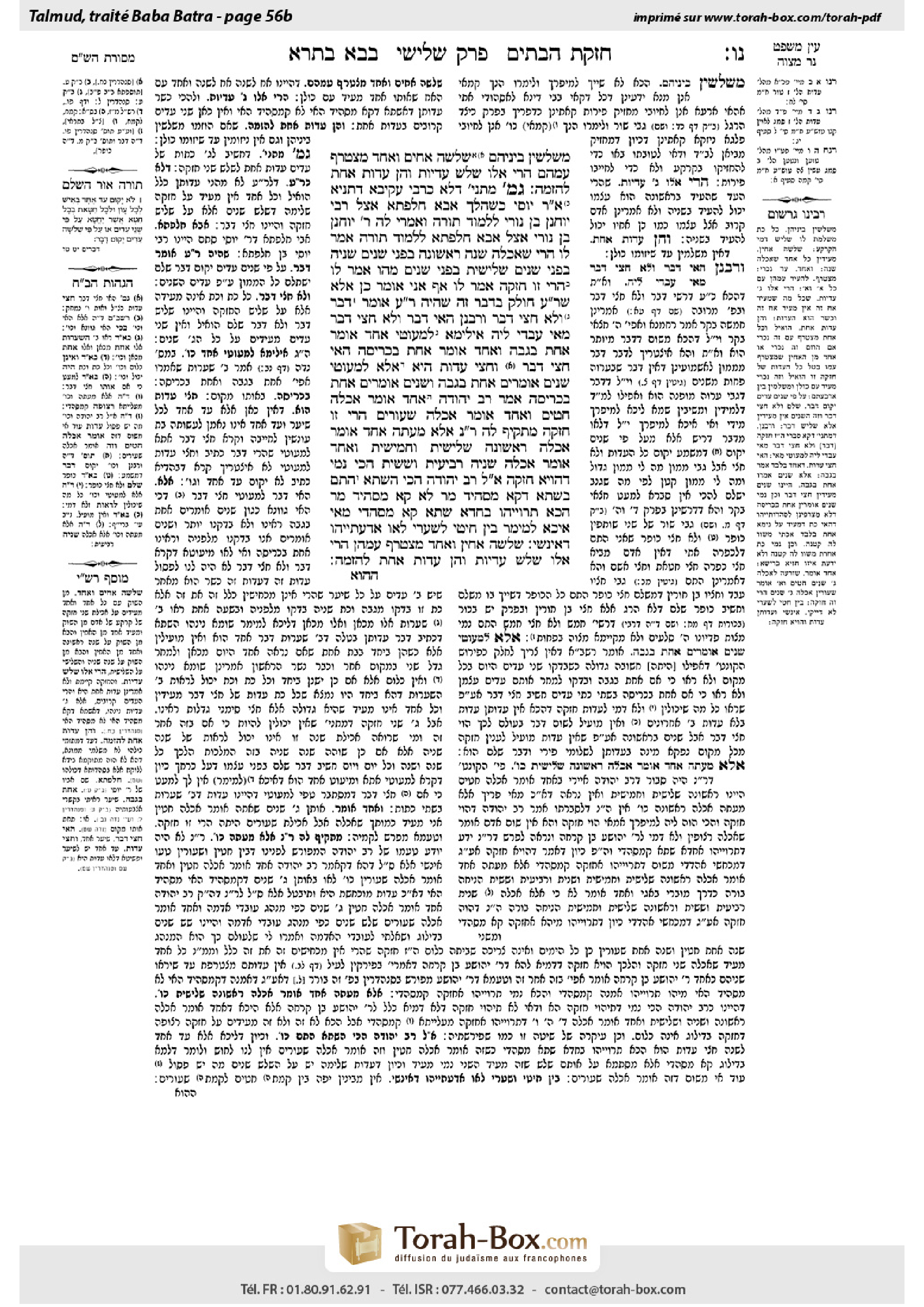
Bava Batra 56b: Talmud study for Daf Yomi
Study the Talmud for Daf Yomi with scanned pages, Hebrew text, English translations from Sefaria and AI-generated French translations.
Passage selection and English or AI-generated French translation are available where the scan has annotations. Daf Study is independent of Torah-Box and Sefaria.
Browse Bava Batra · בבא בתרא · All tractatesBava Batra 56b text and translations
This page of Bava Batra includes the Aramaic text, an English translation and an AI-generated French translation, alongside the scan above.
בבא בתרא נ״ו ב · Aramaic and Hebrew text
מְשַׁלְּשִׁין בֵּינֵיהֶם.
שְׁלֹשָׁה אַחִים, וְאֶחָד מִצְטָרֵף עִמָּהֶם – הֲרֵי אֵלּוּ שָׁלֹשׁ עֵדֻיוֹת, וְהֵן עֵדוּת אַחַת לַהֲזָמָה.
גְּמָ׳ מַתְנִיתִין דְּלָא כְּרַבִּי עֲקִיבָא – דְּתַנְיָא, אָמַר רַבִּי יוֹסֵי: כְּשֶׁהָלַךְ אַבָּא חֲלַפְתָּא אֵצֶל רַבִּי יוֹחָנָן בֶּן נוּרִי לִלְמוֹד תּוֹרָה, וְאָמְרִי לַהּ: רַבִּי יוֹחָנָן בֶּן נוּרִי אֵצֶל אַבָּא חֲלַפְתָּא לִלְמוֹד תּוֹרָה, אָמַר לוֹ: הֲרֵי שֶׁאֲכָלָהּ שָׁנָה רִאשׁוֹנָה בִּפְנֵי שְׁנַיִם, שְׁנִיָּה בִּפְנֵי שְׁנַיִם, שְׁלִישִׁית בִּפְנֵי שְׁנַיִם – מַהוּ? אָמַר לוֹ: הֲרֵי זוֹ חֲזָקָה.
אָמַר לוֹ: אַף אֲנִי אוֹמֵר כֵּן, אֶלָּא שֶׁרַבִּי עֲקִיבָא חוֹלֵק בְּדָבָר זֶה; שֶׁהָיָה רַבִּי עֲקִיבָא אוֹמֵר: ״דָּבָר״ – וְלֹא חֲצִי דָבָר.
וְרַבָּנַן – הַאי ״דָּבָר״ וְלֹא חֲצִי דָבָר, מַאי עָבְדִי לֵיהּ? אִילֵּימָא לְמַעוֹטֵי אֶחָד אוֹמֵר אַחַת בְּגַבָּהּ וְאֶחָד אוֹמֵר אַחַת בִּכְרֵיסָהּ; הַאי חֲצִי דָבָר וַחֲצִי עֵדוּת הִיא!
אֶלָּא לְמַעוֹטֵי שְׁנַיִם אוֹמְרִים אַחַת בְּגַבָּהּ, וּשְׁנַיִם אוֹמְרִים אַחַת בִּכְרֵסָהּ.
אָמַר רַב יְהוּדָה: אֶחָד אוֹמֵר אֲכָלָהּ חִטִּים, וְאֶחָד אוֹמֵר אֲכָלָהּ שְׂעוֹרִים – הֲרֵי זוֹ חֲזָקָה. מַתְקֵיף לַהּ רַב נַחְמָן: אֶלָּא מֵעַתָּה, אֶחָד אוֹמֵר: אֲכָלָהּ רִאשׁוֹנָה שְׁלִישִׁית וַחֲמִישִׁית, וְאֶחָד אוֹמֵר: אֲכָלָהּ שְׁנִיָּה רְבִיעִית וְשִׁשִּׁית, הָכִי נָמֵי דְּהָוְיָא חֲזָקָה?!
אֲמַר לֵיהּ רַב יְהוּדָה: הָכִי הַשְׁתָּא?! הָתָם, בְּשַׁתָּא דְּקָא מַסְהֵיד מָר – לָא קָא מַסְהֵיד מָר; הָכָא, תַּרְוַיְיהוּ בַּחֲדָא שַׁתָּא קָא מַסְהֲדִי. מַאי אִיכָּא לְמֵימַר – בֵּין חִיטֵּי לִשְׂעָרֵי? לָאו אַדַּעְתַּיְיהוּ דְּאִינָשֵׁי.
שְׁלֹשָׁה אַחִין, וְאֶחָד מִצְטָרֵף עִמָּהֶן – הֲרֵי אֵלּוּ שָׁלֹשׁ עֵדֻיוֹת, וְהֵן עֵדוּת אַחַת לַהֲזָמָה.
Bava Batra 56b · English translation
payment of the value of the field to the owner is divided among them.
If the testimony was given by three brothers, each of whom testify about one year, and another unrelated individual joined with each of the brothers as the second witness, these are three distinct testimonies and they are accepted by the court. If they were to be considered one testimony, it would not be accepted, as brothers may not testify together. But they are one testimony for the purpose of rendering them as conspiring witnesses, and the payment is divided among them.
GEMARA: The Gemara notes: The mishna is not in accordance with the opinion of Rabbi Akiva, as it is taught in a baraita (Tosefta, 2:10) that Rabbi Yosei said: When Abba Ḥalafta, Rabbi Yosei’s father, went to Rabbi Yoḥanan ben Nuri to study Torah, and some say: When Rabbi Yoḥanan ben Nuri went to Abba Ḥalafta to study Torah, he said to him: What is the halakha if there is one who worked and profited from a field in the presence of two witnesses during the first year, then in the presence of two other witnesses during the second year, and finally in the presence of two other witnesses during the third year? He said to him: This is sufficient for establishing the presumption of ownership.
The latter said to him: I say this as well, but Rabbi Akiva disagrees with regard to this matter, as Rabbi Akiva would say that since the verse states: “At the mouth of two witnesses, or at the mouth of three witnesses, shall a matter be established” (Deuteronomy 19:15), one can derive that testimony is accepted only with regard to a complete matter, and not with regard to half of a matter. In this mishna, although presumptive ownership requires testimony that the property had been worked and profited from for three years, testimony is accepted from each pair of witnesses with regard to one year. Consequently, the ruling of the mishna does not accord with the opinion of Rabbi Akiva.
The Gemara asks: And with regard to the Rabbis, who accept the testimony of each of the three pairs of witnesses, what do they do with this derivation of: A complete matter, and not half of a matter, i.e., what type of testimony is disqualified based on this derivation? If we say that it serves to exclude a case where two witnesses testify that a young woman has two pubic hairs and has therefore reached maturity, where one says she has one hair on her back and one says she has one hair on her lower abdomen, i.e., they are testifying to two different pubic hairs, and in this case the Rabbis say this testimony is not accepted, since they each testify with regard to only half of the matter, that is difficult. But this is both half of a matter and half of a testimony, as there is only one witness with regard to each pubic hair. This testimony would not be valid even without the derivation.
Rather, in the opinion of the Rabbis the derivation serves to exclude a case where two witnesses say she has one hair on her back and two witnesses say she has one hair on her lower abdomen. In this case, each group of witnesses gives full testimony with regard to half of a matter, i.e., one pubic hair, as both hairs must be present concurrently in order for her to assume the status of an adult. By contrast, in the case of the mishna, the years are by definition not concurrent. Therefore, the Rabbis rule that testimony with regard to one year is accepted.
§ In a related matter, Rav Yehuda says: If two witnesses testify that one had worked and profited from a field for three years, where one witness says he consumed wheat from the field, and one says he consumed barley from it, this is sufficient for establishing the presumption of ownership. Rav Naḥman objects to this ruling: If that is so, then if one witness says he worked and profited from the field during the first, third, and fifth years; and one witness says he worked and profited from it during the second, fourth, and sixth years, would you also say that this is sufficient for establishing the presumption of ownership? What is the difference between testifying about different crops and testifying about different years?
Rav Yehuda said to him: How can these cases be compared? There, i.e., in your example, with regard to the year about which one Master, i.e., witness, is testifying, the other Master is not testifying about it, while here, both are testifying with regard to one year. What is there to say, that there is a contradiction in their testimonies between wheat and barley? It does not enter people’s minds to note this distinction. Two witnesses did, however, testify that he worked and profited from the field for three years.
§ The mishna teaches that if the testimony was given by three brothers, each of whom testified about one year, and another, unrelated individual joined with each of the brothers as the second witness, these are three distinct testimonies and they are accepted by the court. But they are one testimony for the purpose of rendering them as conspiring witnesses.
Bava Batra 56b · Traduction française (IA)
Le paiement de la valeur du champ à l'propriétaire est réparti entre eux.
Si le témoignage a été donné par trois frères, chacun ayant témoigné sur un an, et un individu non parent s'est joint à chaque frère en tant que second témoin, ces sont trois témoignages distincts et ils sont acceptés par la cour. Si on les considérait comme un seul témoignage, il ne serait pas accepté, car les frères ne peuvent témoigner ensemble. Cependant, ils constituent un seul témoignage au sujet de leur possible complicité, et le paiement est réparti entre eux.
GUEMARA : La Guemara note : La mitsna n’est pas en accord avec l’opinion de Rabbi Akiva, car il est enseigné dans une baraïta (Tosefta, 2:10) que Rabbi Yosei a dit : Lorsque Abba Ḥalafta, le père de Rabbi Yosei, est allé chez Rabbi Yoḥanan ben Nuri pour étudier la Torah, et certains disent : Lorsque Rabbi Yoḥanan ben Nuri est allé chez Abba Ḥalafta pour étudier la Torah, il lui a dit : Quel est le halakha si quelqu’un a travaillé et tiré profit d’un champ devant deux témoins pendant la première année, puis devant deux autres témoins pendant la deuxième année, et enfin devant deux autres témoins pendant la troisième année ? Il lui a répondu : Cela suffit pour établir la présomption d’ownership.
Celui-ci lui a répondu : Je dis cela également, mais Rabbi Akiva s’y oppose, car Rabbi Akiva dirait que puisque la Bible dit : « À la bouche de deux témoins, ou à la bouche de trois témoins, une affaire est établie » (Deutéronome 19:15), on peut déduire que le témoignage est accepté uniquement concernant une affaire complète, et non concernant la moitié d’une affaire. Dans cette mitsna, bien que la présomption de propriété nécessite un témoignage selon lequel la propriété a été travaillée et tirée profit pendant trois ans, le témoignage est accepté pour chaque couple de témoins concernant un an. Ainsi, le jugement de la mitsna ne correspond pas à l’opinion de Rabbi Akiva.
La Guemara pose la question : Et concernant les Rabbins, qui acceptent le témoignage de chaque couple de témoins, que font-ils avec cette déduction : une affaire complète, et non la moitié d’une affaire, c’est-à-dire quel type de témoignage est invalidé par cette déduction ? Si nous disons qu’il sert à exclure un cas où deux témoins témoignent qu’une jeune femme a deux poils pubiens et a donc atteint l’âge adulte, où l’un dit qu’elle a un poil sur le dos et l’autre un poil sur l’abdomen inférieur, c’est-à-dire qu’ils témoignent sur deux poils pubiens différents, et dans ce cas les Rabbins disent que ce témoignage n’est pas accepté, car ils témoignent chacun sur la moitié de l’affaire, cela est difficile. Mais cela est à la fois la moitié d’une affaire et la moitié d’un témoignage, car il n’y a qu’un seul témoin concernant chaque poil pubien. Ce témoignage serait invalide même sans cette déduction.
Au contraire, selon l’opinion des Rabbins, cette déduction sert à exclure un cas où deux témoins disent qu’elle a un poil sur le dos et deux témoins disent qu’elle a un poil sur l’abdomen inférieur. Dans ce cas, chaque groupe de témoins donne un témoignage complet concernant la moitié d’une affaire, c’est-à-dire un poil pubien, car les deux poils doivent être présents simultanément pour qu’elle assume le statut d’adulte. À l’inverse, dans le cas de la mitsva, les années ne sont pas par définition simultanées. Ainsi, les Rabbins jugent que le témoignage concernant une année est accepté.
§ Dans un cas lié, Rav Yehuda dit : Si deux témoins témoignent qu’un homme a travaillé et tiré profit d’un champ pendant trois ans, où l’un dit qu’il a consommé du blé de ce champ et l’autre du seigle, cela suffit pour établir la présomption d’ownership. Rav Naḥman s’oppose à ce jugement : Si c’est ainsi, alors si un témoin dit qu’il a travaillé et tiré profit du champ pendant la première, troisième et cinquième année, et un autre témoin dit qu’il l’a fait pendant la deuxième, quatrième et sixième année, diriez-vous aussi que cela suffit pour établir la présomption d’ownership ? Quelle est la différence entre témoigner sur des cultures différentes et témoigner sur des années différentes ?
Rav Yehuda a répondu à lui : Comment peuvent ces cas être comparés ? Là, c’est-à-dire dans votre exemple, concernant l’année à laquelle un seul maître, c’est-à-dire témoin, témoigne, l’autre maître n’en témoigne pas, tandis que ici, les deux témoignent concernant une même année. Qu’est-ce que cela signifie, que leurs témoignages sont en contradiction entre le blé et le seigle ? Ce n’est pas dans l’esprit des gens de noter cette distinction. Deux témoins ont cependant témoigné qu’il a travaillé et tiré profit du champ pendant trois ans.
§ La mitsva enseigne que si le témoignage a été donné par trois frères, chacun ayant témoigné sur un an, et un individu non parent s’est joint à chaque frère en tant que second témoin, ces trois témoignages sont distincts et ils sont acceptés par la cour. Cependant, ils constituent un seul témoignage au sujet de leur possible complicité.
Traduction française générée par IA à partir de l’édition anglaise de Sefaria. Vérifie toujours un passage avec le texte source.
Text from Sefaria: William Davidson Edition - Vocalized Aramaic (CC BY NC); William Davidson Edition - English (CC BY NC).