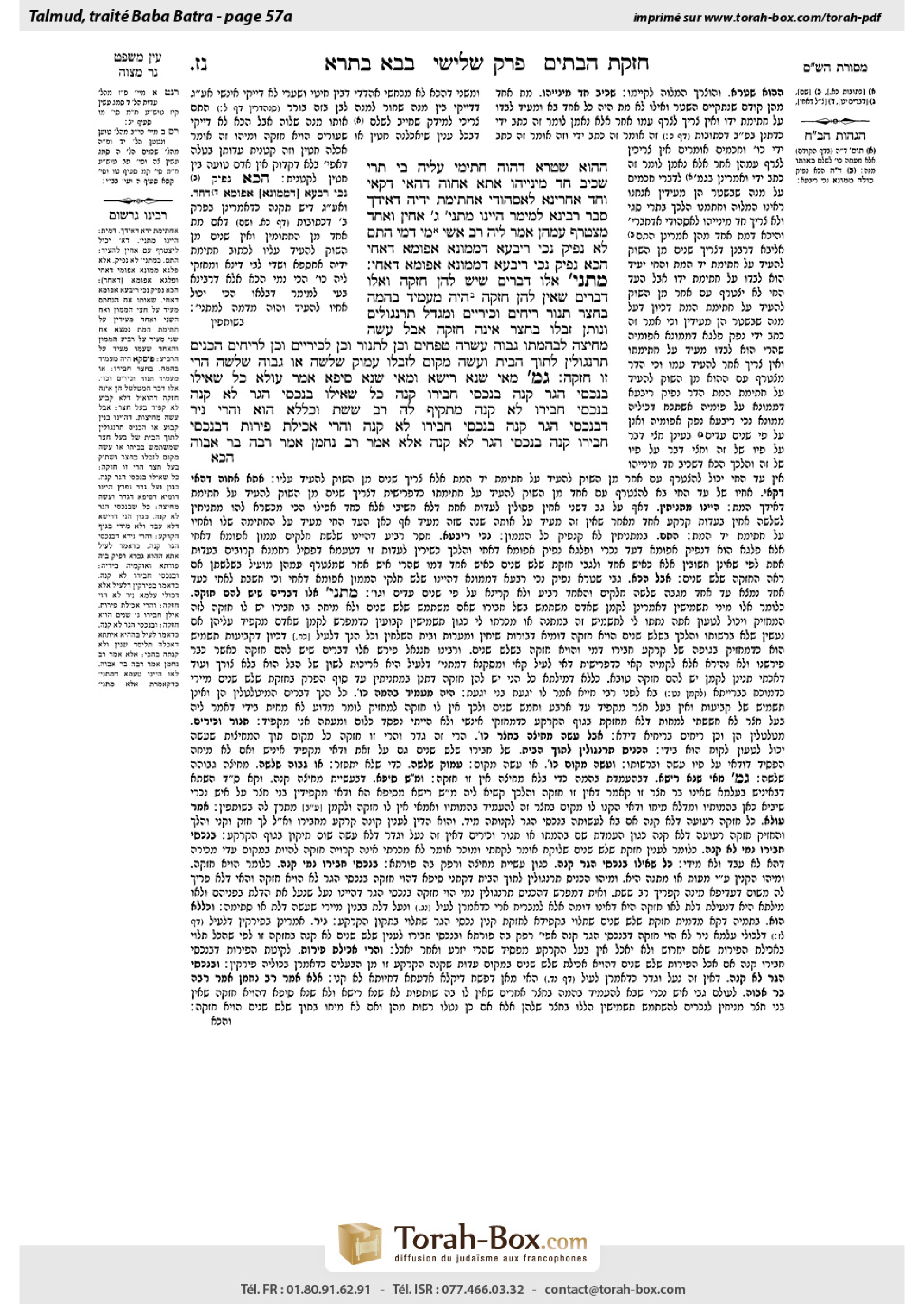
Bava Batra 57a: Talmud study for Daf Yomi
Study the Talmud for Daf Yomi with scanned pages, Hebrew text, English translations from Sefaria and AI-generated French translations.
Passage selection and English or AI-generated French translation are available where the scan has annotations. Daf Study is independent of Torah-Box and Sefaria.
Browse Bava Batra · בבא בתרא · All tractatesBava Batra 57a text and translations
This page of Bava Batra includes the Aramaic text, an English translation and an AI-generated French translation, alongside the scan above.
בבא בתרא נ״ז א · Aramaic and Hebrew text
הָהוּא שְׁטָרָא דַּהֲוָה חֲתִימִי עֲלֵיהּ בֵּי תְרֵי, שָׁכֵיב חַד מִינַּיְיהוּ. אֲתָא אֲחוּהּ דְּהַאי דְּקָאֵי, וְחַד אַחֲרִינָא, לְאַסְהוֹדֵי אַחֲתִימַת יְדֵיהּ דְּאִידַּךְ.
סְבַר רָבִינָא לְמֵימַר: הַיְינוּ מַתְנִיתִין – שְׁלֹשָׁה אַחִין, וְאֶחָד מִצְטָרֵף עִמָּהֶן.
אֲמַר לֵיהּ רַב אָשֵׁי: מִי דָּמֵי?! הָתָם לָא נָפֵיק נְכֵי רִיבְעָא דְמָמוֹנָא אַפּוּמָּא דְאַחֵי, הָכָא נָפֵיק נְכֵי רִיבְעָא דְמָמוֹנָא אַפּוּמָּא דְאַחֵי.
מַתְנִי׳ אֵלּוּ דְּבָרִים שֶׁיֵּשׁ לָהֶן חֲזָקָה, וְאֵלּוּ דְּבָרִים שֶׁאֵין לָהֶן חֲזָקָה? הָיָה מַעֲמִיד בְּהֵמָה בֶּחָצֵר; תַּנּוּר, רֵיחַיִם וְכִירַיִים; וּמְגַדֵּל תַּרְנְגוֹלִים; וְנוֹתֵן זִבְלוֹ בֶּחָצֵר – אֵינָהּ חֲזָקָה. אֲבָל עָשָׂה מְחִיצָה לִבְהֶמְתּוֹ – גָּבוֹהַּ עֲשָׂרָה טְפָחִים, וְכֵן לַתַּנּוּר וְכֵן לַכִּירַיִים וְכֵן לָרֵיחַיִם; הִכְנִיס תַּרְנְגוֹלִין לְתוֹךְ הַבַּיִת; וְעָשָׂה מָקוֹם לְזִבְלוֹ – עָמוֹק שְׁלֹשָׁה אוֹ גָבוֹהַּ שְׁלֹשָׁה; הֲרֵי זוֹ חֲזָקָה.
גְּמָ׳ מַאי שְׁנָא רֵישָׁא, וּמַאי שְׁנָא סֵיפָא?
אָמַר עוּלָּא: כֹּל שֶׁאִילּוּ בְּנִכְסֵי הַגֵּר קָנָה – בְּנִכְסֵי חֲבֵירוֹ קָנָה, כֹּל שֶׁאִילּוּ בְּנִכְסֵי הַגֵּר לֹא קָנָה – בְּנִכְסֵי חֲבֵירוֹ לֹא קָנָה.
מַתְקֵיף לַהּ רַב שֵׁשֶׁת: וּכְלָלָא הוּא?! וַהֲרֵי נִיר – דִּבְנִכְסֵי הַגֵּר קָנָה, בְּנִכְסֵי חֲבֵירוֹ לֹא קָנָה! וַהֲרֵי אֲכִילַת פֵּירוֹת – דִּבְנִכְסֵי חֲבֵירוֹ קָנָה, בְּנִכְסֵי הַגֵּר לֹא קָנָה!
אֶלָּא אָמַר רַב נַחְמָן אָמַר רַבָּה בַּר אֲבוּהּ:
Bava Batra 57a · English translation
The Gemara relates: There was a certain document that had the signatures of two individuals on it. One of the signatory witnesses died, and when the court sought to ratify the document, which requires either that the witnesses personally attest to the validity of their signatures or that two other witnesses attest to the validity of the signatures, the brother of the witness who remained alive and one other individual came to testify with regard to the signature of the other, deceased, witness, while the living witness attested to his own signature.
Ravina thought to say that this case is the same as the halakha in the mishna, which states that if testimony was given by three brothers, each of whom testify about one year, and another, unrelated individual joined with each of the brothers as the second witness, these are considered to be three distinct testimonies. Similarly, in this case, one brother attests to his own signature, while the other brother attests to the signature of the deceased witness.
Rav Ashi said to him: Are these cases comparable? There, the property less one-quarter, i.e., three-quarters of the property in question, is not removed from the possession of the prior owner based upon the mouth, i.e., the testimony, of brothers. Each brother provides only half of the testimony for each year about which he testifies. Here, the property less one-quarter is removed from the possession of the debtor detailed in the document based upon the mouth of brothers. One brother attests to his own signature, which constitutes half of the testimony, while the other signature is authenticated by the testimony of the other brother and another individual. It follows that three-quarters of the testimony is given by brothers, and it is therefore invalid.
MISHNA: These are uses of property that have the means to establish the presumption of ownership, and these are uses of property that do not have the means to establish the presumption of ownership: If one would stand an animal in a courtyard; or if one would place an oven, a millstone, or a stove there; or if one raises chickens in a courtyard, or places his fertilizer in a courtyard, these actions are not sufficient to establish the presumption of ownership. But if one constructed a partition ten handbreadths high to contain his animal, and similarly if he constructed a partition for his oven, and similarly if he constructed a partition for his stove, and similarly if he constructed a partition for his millstone; or if one brought chickens into the house, or if he fashioned a place in the ground for his fertilizer that is three handbreadths deep or three handbreadths high, these actions are sufficient to establish the presumption of ownership.
GEMARA: The Gemara asks: What is different in the first clause, where having an animal stand in a courtyard is insufficient to establish the presumption of ownership, and what is different in the latter clause, where constructing a partition is sufficient to establish the presumption of ownership?
Ulla says: With regard to any act which, if one were to perform it on ownerless property such as the property of a convert who dies without heirs he would acquire that property, that same act is sufficient for him to acquire the property of another if he performed it over the course of three years, provided it is accompanied by the claim that the property had been purchased. Conversely, any act that if one were to perform it on the property of a convert who died without heirs he would not acquire that property, that same act is not sufficient for him to acquire the property of another. Taking possession of ownerless property requires an act to be done with regard to the property itself, such as constructing a partition, but merely having an animal stand there is not sufficient. Therefore, it does not establish the presumption of ownership.
Rav Sheshet objects to this explanation: And is this an established principle? But there is plowing, which, if performed on the property of a convert who died without heirs one acquires it, but if performed on the property of another one does not acquire it. And additionally, there is consumption of produce for the duration of three years, which, if performed on the property of another one acquires it by establishing the presumption of ownership, but if performed on the property of a convert who died without heirs one does not acquire it. These cases contradict Ulla’s claim that the modes of acquisition are analogous.
Rather, Rav Naḥman said that Rabba bar Avuh said:
Bava Batra 57a · Traduction française (IA)
La Guemara rapporte : Il y avait un certain document signé par deux personnes. L'un des témoins est décédé, et lorsqu'on a voulu valider le document, ce qui exige que les témoins attestent personnellement de la validité de leurs signatures ou que deux autres témoins attestent de la validité des signatures, le frère du témoin survivant et une autre personne ont témoigné concernant la signature du témoin décédé, tandis que le témoin vivant attestait de sa propre signature.
Ravina pensait dire que ce cas est identique à la halakha de la michna, qui stipule que si des témoins ont été donnés par trois frères, chacun attestant d'une année, et qu'un individu étranger s'est joint à chaque frère comme deuxième témoin, ces témoignages sont considérés comme trois témoignages distincts. De même, dans ce cas, un frère atteste de sa propre signature, tandis que l'autre frère atteste de la signature du témoin décédé.
Rav Ashi lui dit : Ces cas sont-ils comparables ? Là, la propriété moins un quart, c'est-à-dire trois quarts de la propriété en question, n'est pas retirée de la possession du propriétaire précédent en vertu de la parole, c'est-à-dire du témoignage, des frères. Chaque frère fournit seulement la moitié du témoignage pour chaque année dont il témoigne. Ici, la propriété moins un quart est retirée de la possession du débiteur mentionné dans le document en vertu de la parole des frères. Un frère atteste de sa propre signature, ce qui constitue la moitié du témoignage, tandis que l'autre signature est authentifiée par le témoignage du frère et d'un autre individu. Il en résulte que trois quarts du témoignage sont donnés par des frères, et il est donc invalide.
MICHNA : Ces sont les usages de propriété qui permettent d'établir la présomption d'appartenance, et ces sont les usages de propriété qui ne permettent pas d'établir la présomption d'appartenance : Si l'on place un animal dans une cour ; ou si l'on place une fournaise, une meule, ou une cuisinière là ; ou si l'on élève des poulets dans une cour, ou si l'on place son fumier dans une cour, ces actions ne sont pas suffisantes pour établir la présomption d'appartenance. Mais si l'on construit une clôture de dix tefachim de haut pour contenir son animal, et de même si l'on construit une clôture pour sa fournaise, et de même si l'on construit une clôture pour sa cuisinière, et de même si l'on construit une clôture pour sa meule ; ou si l'on amène des poulets dans la maison, ou si l'on fait un endroit dans le sol pour son fumier qui est trois tefachim de profondeur ou trois tefachim de hauteur, ces actions sont suffisantes pour établir la présomption d'appartenance.
GUEMARA : La Guemara demande : Qu'est-ce qui diffère dans la première clause, où avoir un animal dans une cour n'est pas suffisant pour établir la présomption d'appartenance, et qu'est-ce qui diffère dans la seconde clause, où la construction d'une clôture est suffisante pour établir la présomption d'appartenance ?
Ulla dit : Concernant toute action qui, si l'on la faisait sur une propriété sans propriétaire telle que la propriété d'un converti décédé sans héritiers, l'on acquiert cette propriété, cette même action est suffisante pour acquérir la propriété d'un autre si l'on la fait pendant trois ans, à condition qu'elle soit accompagnée de la déclaration que la propriété a été achetée. À l'inverse, toute action qui, si l'on la faisait sur la propriété d'un converti décédé sans héritiers, l'on ne l'acquiert pas, cette même action n'est pas suffisante pour acquérir la propriété d'un autre. L'acquisition d'une propriété sans propriétaire exige une action faite envers la propriété elle-même, telle que la construction d'une clôture, mais avoir simplement un animal là n'est pas suffisant. Par conséquent, cela ne permet pas d'établir la présomption d'appartenance.
Rav Sheshet s'oppose à cette explication : Et est-ce un principe établi ? Mais il y a la culture, qui, si elle est faite sur la propriété d'un converti décédé sans héritiers, l'on l'acquiert, mais si elle est faite sur la propriété d'un autre, l'on ne l'acquiert pas. Et de plus, il y a la consommation des produits pendant trois ans, qui, si elle est faite sur la propriété d'un autre, l'on l'acquiert par l'établissement de la présomption d'appartenance, mais si elle est faite sur la propriété d'un converti décédé sans héritiers, l'on ne l'acquiert pas. Ces cas contredisent l'affirmation d'Ulla selon laquelle les modes d'acquisition sont analogues.
Plutôt, Rav Naḥman dit que Rabba bar Avuh a dit :
Traduction française générée par IA à partir de l’édition anglaise de Sefaria. Vérifie toujours un passage avec le texte source.
Text from Sefaria: William Davidson Edition - Vocalized Aramaic (CC BY NC); William Davidson Edition - English (CC BY NC).