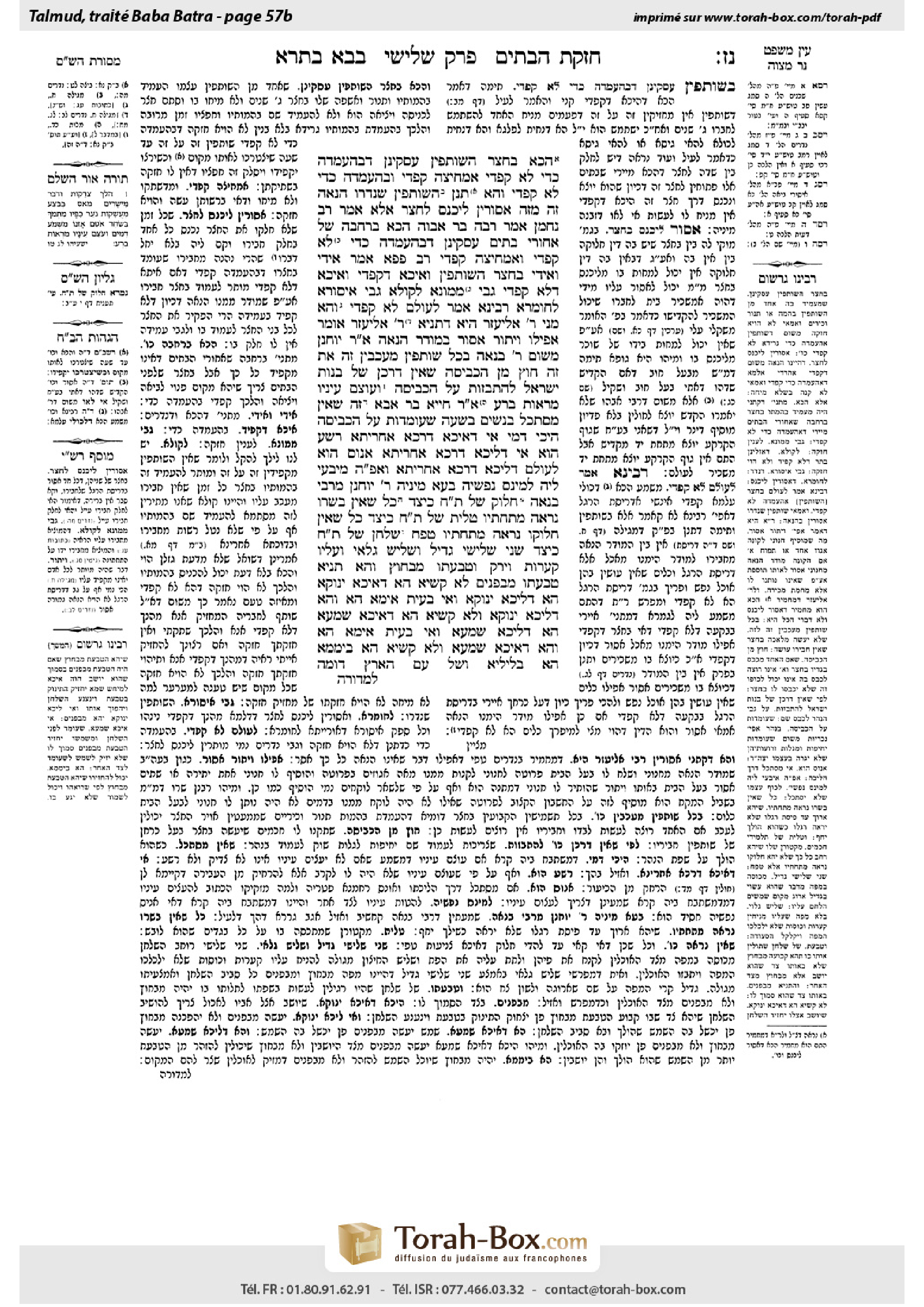
Bava Batra 57b: Talmud study for Daf Yomi
Study the Talmud for Daf Yomi with scanned pages, Hebrew text, English translations from Sefaria and AI-generated French translations.
Passage selection and English or AI-generated French translation are available where the scan has annotations. Daf Study is independent of Torah-Box and Sefaria.
Browse Bava Batra · בבא בתרא · All tractatesBava Batra 57b text and translations
This page of Bava Batra includes the Aramaic text, an English translation and an AI-generated French translation, alongside the scan above.
בבא בתרא נ״ז ב · Aramaic and Hebrew text
הָכָא בַּחֲצַר הַשּׁוּתָּפִין עָסְקִינַן – דִּבְהַעֲמָדָה כְּדִי לָא קָפְדִי, אַמְּחִיצָה קָפְדִי.
וּבְהַעֲמָדָה כְּדִי לָא קָפְדִי?! וְהָא תְּנַן: הַשּׁוּתָּפִין שֶׁנָּדְרוּ הֲנָאָה זֶה מִזֶּה – אֲסוּרִין לִיכָּנֵס לֶחָצֵר!
אֶלָּא אָמַר רַב נַחְמָן אָמַר רַבָּה בַּר אֲבוּהּ: הָכָא בִּרְחָבָה שֶׁל אֲחוֹרֵי בָתִּים עָסְקִינַן; דִּבְהַעֲמָדָה כְּדִי לָא קָפְדִי, וְאַמְּחִיצָה קָפְדִי.
רַב פָּפָּא אָמַר: אִידֵּי וְאִידֵּי בַּחֲצַר הַשּׁוּתָּפִין; וְאִיכָּא דְּקָפְדִי וְאִיכָּא דְּלָא קָפְדִי; גַּבֵּי מָמוֹנָא – לְקוּלָּא, גַּבֵּי אִיסּוּרָא – לְחוּמְרָא.
רָבִינָא אָמַר: לְעוֹלָם לָא קָפְדִי, וְהָא מַנִּי – רַבִּי אֱלִיעֶזֶר הִיא; דְּתַנְיָא, רַבִּי אֱלִיעֶזֶר אוֹמֵר: אֲפִילּוּ וִיתּוּר אָסוּר בְּמוּדַּר הֲנָאָה.
אָמַר רַבִּי יוֹחָנָן מִשּׁוּם רַבִּי בְּנָאָה: בַּכֹּל שׁוּתָּפִין מְעַכְּבִין זֶה אֶת זֶה, חוּץ מִן הַכְּבִיסָה – שֶׁאֵין דַּרְכָּן שֶׁל בְּנוֹת יִשְׂרָאֵל לְהִתְבַּזּוֹת עַל הַכְּבִיסָה.
״וְעֹצֵם עֵינָיו מֵרְאוֹת בְּרָע״ – אָמַר רַבִּי חִיָּיא בַּר אַבָּא: זֶה שֶׁאֵין מִסְתַּכֵּל בְּנָשִׁים בְּשָׁעָה שֶׁעוֹמְדוֹת עַל הַכְּבִיסָה.
הֵיכִי דָמֵי? אִי דְּאִיכָּא דַּרְכָּא אַחְרִיתָא – רָשָׁע הוּא! אִי דְּלֵיכָּא דַּרְכָּא אַחְרִיתָא – אָנוּס הוּא! לְעוֹלָם דְּלֵיכָּא דַּרְכָּא אַחְרִיתָא, וַאֲפִילּוּ הָכִי – מִיבְּעֵי לֵיהּ לְמֵינַס נַפְשֵׁיהּ.
בְּעָא מִינֵּיהּ רַבִּי יוֹחָנָן מֵרַבִּי בְּנָאָה: חָלוּק שֶׁל תַּלְמִיד חָכָם – כֵּיצַד? כֹּל שֶׁאֵין בְּשָׂרוֹ נִרְאֶה מִתַּחְתָּיו. טַלִּית שֶׁל תַּלְמִיד חָכָם – כֵּיצַד? כֹּל שֶׁאֵין חֲלוּקוֹ נִרְאֶה מִתַּחְתָּיו טֶפַח. שֻׁלְחָן שֶׁל תַּלְמִיד חָכָם – כֵּיצַד? שְׁנֵי שְׁלִישֵׁי גְּדִיל, וּשְׁלִישׁ גְּלַאי – וְעָלָיו קְעָרוֹת וְיָרָק. וְטַבַּעְתּוֹ מִבַּחוּץ.
וְהָא תַּנְיָא: טַבַּעְתּוֹ מִבִּפְנִים! לָא קַשְׁיָא – הָא דְּאִיכָּא יָנוֹקָא, הָא דְּלֵיכָּא יָנוֹקָא.
וְאִי בָּעֵית אֵימָא: הָא וְהָא דְּלֵיכָּא יָנוֹקָא; וְלָא קַשְׁיָא – הָא דְּאִיכָּא שַׁמָּעָא, הָא דְּלֵיכָּא שַׁמָּעָא.
וְאִי בָּעֵית אֵימָא: הָא וְהָא דְּאִיכָּא שַׁמָּעָא; וְלָא קַשְׁיָא – הָא בִּימָמָא, הָא בְּלֵילְיָא.
וְשֶׁל עַם הָאָרֶץ – דּוֹמֶה
Bava Batra 57b · English translation
Here we are dealing with a courtyard belonging to partners, where they are not particular with regard to the mere placing of items in the courtyard, but are particular with regard to the construction of a partition. The presumption of ownership is established only where the lack of a protest indicates that the prior owner concedes that the property is no longer his. The co-owner’s silence in the face of his partner using the courtyard for a temporary purpose does not indicate a concession, but silence in the face of one who constructed a partition is a concession.
The Gemara asks: And are they not particular with regard to the mere placing of items? But didn’t we learn in a mishna (Nedarim 45b): Partners who through vows prohibited themselves from deriving benefit from one another are forbidden to enter into a courtyard jointly owned by them, since each one has a portion in it, and it would be considered a violation of one’s vow if one were to benefit from any part of the other’s property? This indicates that partners are particular even with regard to passage through the field; all the more so are they particular with regard to placing animals or vessels in the field.
Rather, Rav Naḥman said that Rabba bar Avuh said: Here we are dealing with a fenced-in yard located behind a group of houses that is used to store items not in regular use, where they are not particular with regard to the mere placing of items but are particular with regard to the construction of a partition.
Rav Pappa said: This and that, i.e., the rulings of the mishna in tractate Nedarim as well as the rulings of the mishna here, are stated with regard to a courtyard belonging to partners, and the reason for the difference in the rulings is that there are those who are particular with regard to the other partner placing items in or passing through the courtyard, and there are those who are not particular. Therefore, in the mishna here, which issues a ruling concerning monetary matters, the halakha is to be lenient, and it is assumed that the partner is not particular about placing items in the courtyard, and the presumption of ownership is established. In the mishna in tractate Nedarim, which issues a ruling concerning ritual matters, the halakha is to be stringent, to prevent one from violating a vow.
Ravina said: Actually, partners are not particular about placing items in the courtyard, and in accordance with whose opinion is this mishna in tractate Nedarim? It is in accordance with the opinion of Rabbi Eliezer, as it is taught in a baraita that Rabbi Eliezer says: Even negligible benefits ordinarily waived are forbidden in the case of one prohibited by a vow from deriving benefit from another. In other words, one prohibited by a vow may not derive any benefit from the other, even a benefit that people commonly are not particular about and allow others to enjoy without first receiving permission. Therefore, although people are ordinarily not particular about others passing through their property, according to the opinion of Rabbi Eliezer, one who is prohibited by a vow from deriving benefit from his partner is prohibited from walking on the property.
Rabbi Yoḥanan says in the name of Rabbi Bena’a: Partners may prevent each other from using their courtyard for any purpose except for washing laundry. This is because it is not the way of Jewish women to be degraded over washing laundry by laundering their clothing in a public area. Therefore, they must be allowed to launder in the courtyard.
In connection with the matter of laundry being washed in public, the Gemara quotes the homiletic interpretation of a verse: “He that walks righteously, and speaks uprightly; he that despises the gain of oppressions, that shakes his hands from holding of bribes, that stops his ears from hearing of blood, and shuts his eyes from looking upon evil” (Isaiah 33:15). Rabbi Ḥiyya bar Abba says: This is referring to one who does not gaze at women while they are standing over the laundry, as it was common for them to stand in the water and raise the hems of their garments while laundering their clothing.
The Gemara clarifies: What are the circumstances? If it is referring to a case where there is another way by which the one walking could reach his destination, then one who walks past the women, consequently placing himself in a situation where he will be tempted to gaze at them, is wicked. Alternatively, if it is referring to a case where there is no other way by which he can reach his destination, then he is a victim of circumstance, so why is he required to shut his eyes? The Gemara explains: Actually, it is referring to a case where there is no other way by which he can reach his destination, and even so, he is required to compel himself to avoid gazing at the women.
§ The Gemara quotes additional matters that Rabbi Yoḥanan learned from Rabbi Bena’a. Rabbi Yoḥanan asked Rabbi Bena’a: How should the garment of a Torah scholar worn under his clothes be fashioned? He replied: He can wear any garment long enough that his flesh is not visible from beneath it. Rabbi Yoḥanan asked: How should the cloak of a Torah scholar be fashioned? He replied: He can wear any garment long enough that a handbreadth of his garment worn under his clothes is not visible from beneath it. Rabbi Yoḥanan asked: How should the table of a Torah scholar appear? He replied: Two-thirds of the table is covered with a cloth, and one-third is uncovered, and upon that third are dishes and vegetables. And its ring, used to hang the table, should be positioned on the outside, not on the side that faces the one who is eating.
The Gemara asks: But isn’t it taught in a baraita that its ring should be positioned on the inside? The Gemara answers: This is not difficult. This baraita, which states that its ring should be positioned on the outside, is referring to a case where there is a child who may play with the ring and overturn the table, while that baraita, which states that its ring should be positioned on the inside, is referring to a case where there is no child present.
And if you wish, say instead that both this and that refer to a case where there is no child present, and this is not difficult: This baraita, which states that its ring should be positioned on the inside, is referring to a case where there is an attendant who may bump into the ring, while that baraita, which states that its ring should be positioned on the outside, is referring to a case where there is no attendant.
And if you wish, say instead that both this and that refer to a case where there is an attendant, and this is not difficult: This baraita, which states that its ring should be positioned on the outside, is referring to when the meal is eaten during the day, when the attendant can see the ring and avoid it, while that baraita, which states that its ring should be positioned on the inside, is referring to when the meal is eaten during the night.
The Gemara continues: All of the above is referring to the table of a Torah scholar, but the table of an ignoramus is similar
Bava Batra 57b · Traduction française (IA)
Ici, nous traitons d'un jardin appartenant à des associés, où ils ne sont pas particuliers quant à la simple mise d'objets dans le jardin, mais sont particuliers quant à la construction d'une clôture. La présomption de propriété est établie uniquement là où l'absence de protestation indique que le propriétaire précédent reconnaît que la propriété n'est plus la sienne. Le silence de l'associé face à l'utilisation du jardin par son partenaire à des fins temporaires ne constitue pas une concession, mais le silence face à celui qui a construit une clôture constitue une concession.
La Guemara demande : Et ne sont-ils pas particuliers quant à la simple mise d'objets ? Mais n'avons-nous pas appris dans une mitsva (Nedarim 45b) : Des associés qui, par des vœux, se sont interdit de tirer profit les uns des autres sont interdits d'entrer ensemble dans un jardin appartenant à tous deux, car chacun a sa part, et cela constituerait une violation de leur vœu s'ils profitaient d'une partie de la propriété de l'autre ? Cela indique que les associés sont particuliers même quant au passage dans le champ ; encore davantage sont-ils particuliers quant à la mise d'animaux ou de meubles dans le champ.
Plutôt, Rav Naḥman a dit que Rabba bar Avuh a dit : Ici, nous traitons d'un jardin clôturé situé derrière un groupe de maisons, utilisé pour stocker des objets non en usage régulier, où ils ne sont pas particuliers quant à la simple mise d'objets mais sont particuliers quant à la construction d'une clôture.
Rav Pappa a dit : Cela et cela, c'est-à-dire les décisions de la mitsna dans le traité Nedarim ainsi que les décisions de la mitsna ici, sont énoncées concernant un jardin appartenant à des associés, et la raison de la différence dans les décisions est que certains sont particuliers quant à l'autre associé mettant des objets dans ou passant par le jardin, et d'autres ne le sont pas. Ainsi, dans la mitsna ici, qui émet un jugement concernant des affaires monétaires, la halakha est de lenir, et on suppose que l'associé n'est pas particulier quant à la mise d'objets dans le jardin, et la présomption de propriété est établie. Dans la mitsna du traité Nedarim, qui émet un jugement concernant des affaires rituelles, la halakha est de restreindre, afin d'empêcher l'un de violer un vœu.
Ravina a dit : En réalité, les associés ne sont pas particuliers quant à la mise d'objets dans le jardin, et selon quel avis est cette mitsna du traité Nedarim ? C'est selon l'avis de Rabbi Eliezer, comme il est enseigné dans une baraïta que Rabbi Eliezer dit : Même les bénéfices négligeables habituellement renonciés sont interdits dans le cas d'une personne interdite par un vœu de tirer profit d'une autre. En d'autres termes, une personne interdite par un vœu ne peut tirer aucun bénéfice de son associé, même un bénéfice que les gens ne sont habituellement pas particuliers et permettent à autrui de profiter sans avoir d'abord obtenu la permission. Ainsi, bien que les gens ne soient habituellement pas particuliers quant au passage sur la propriété d'autrui, selon l'avis de Rabbi Eliezer, celui qui est interdit par un vœu de tirer profit de son associé est interdit de marcher sur la propriété.
Rabbi Yoḥanan dit en nom de Rabbi Bena’a : Les associés peuvent empêcher mutuellement d'utiliser leur jardin pour toute fin, sauf pour laver le linge. Cela est dû au fait que ce n'est pas la manière des femmes juives d'être dégradées en lavant le linge en laissant leurs vêtements s'humidifier dans un lieu public. Ainsi, elles doivent être autorisées à laver dans le jardin.
En lien avec la question du linge lavé en public, la Guemara cite l'interprétation allégorique d'un verset : « Celui qui marche droitement, et qui parle droitement ; celui qui dédaigne le gain des oppresseurs, qui secoue ses mains de tenir des pots d'argent, qui arrête ses oreilles de l'entendre de sang, et qui ferme ses yeux de regarder le mal » (Yachin 33:15). Rabbi Ḥiyya bar Abba dit : Cela fait référence à celui qui ne regarde pas les femmes pendant qu'elles sont debout sur le linge, car il était courant qu'elles se tiennent dans l'eau et levassent les ourlets de leurs vêtements pendant qu'elles lavaient leur linge.
La Guemara clarifie : Quelles sont les circonstances ? Si cela fait référence à un cas où il existe un autre chemin par lequel la personne marchant pourrait atteindre sa destination, alors celui qui passe devant les femmes, en conséquence de se mettre dans une situation où il sera tenté de les regarder, est mauvais. Alternativement, si cela fait référence à un cas où il n'existe pas d'autre chemin par lequel il peut atteindre sa destination, alors il est une victime des circonstances, alors pourquoi est-il tenu de fermer ses yeux ? La Guemara explique : En réalité, cela fait référence à un cas où il n'existe pas d'autre chemin par lequel il peut atteindre sa destination, et même ainsi, il est tenu de se forcer à éviter de regarder les femmes.
§ La Guemara cite d'autres points que Rabbi Yoḥanan a appris de Rabbi Bena’a. Rabbi Yoḥanan demande à Rabbi Bena’a : Comment doit être conçu la robe d'un savant de la Torah portée sous ses vêtements ? Il répond : Il peut porter n'importe quelle robe suffisamment longue pour que sa chair ne soit pas visible dessous. Rabbi Yoḥanan demande : Comment doit être conçu la cape d'un savant de la Torah ? Il répond : Il peut porter n'importe quelle robe suffisamment longue pour que la partie de sa robe portée sous ses vêtements ne soit pas visible dessous. Rabbi Yoḥanan demande : Comment doit apparaître la table d'un savant de la Torah ? Il répond : Deux tiers de la table sont couverts d'un linge, et un tiers est découvert, et sur ce tiers sont placés des plats et des légumes. Et son anneau, utilisé pour suspendre la table, doit être positionné à l'extérieur, pas sur le côté qui fait face à celui qui mange.
La Guemara demande : Mais n'est-il pas enseigné dans une baraïta que l'anneau doit être positionné à l'intérieur ? La Guemara répond : Cela n'est pas difficile. Cette baraïta, qui stipule que l'anneau doit être positionné à l'extérieur, fait référence à un cas où il y a un enfant qui peut jouer avec l'anneau et renverser la table, tandis que cette baraïta, qui stipule que l'anneau doit être positionné à l'intérieur, fait référence à un cas où il n'y a pas d'enfant présent.
Et si vous le souhaitez, dites plutôt que ces deux cas concernent une situation où il n'y a pas d'enfant présent, et cela n'est pas difficile : cette baraïta, qui stipule que l'anneau doit être placé à l'intérieur, fait référence à un cas où il y a un serviteur qui pourrait heurter l'anneau, tandis que cette autre baraïta, qui stipule que l'anneau doit être placé à l'extérieur, fait référence à un cas où il n'y a pas de serviteur.
Et si vous le souhaitez, dites plutôt que ces deux cas concernent une situation où il y a un serviteur, et cela n'est pas difficile : cette baraïta, qui stipule que l'anneau doit être placé à l'extérieur, fait référence à quand le repas est mangé pendant la journée, lorsque le serviteur peut voir l'anneau et l'éviter, tandis que cette autre baraïta, qui stipule que l'anneau doit être placé à l'intérieur, fait référence à quand le repas est mangé pendant la nuit.
La Guemara continue : tout ce qui précède concerne la table d'un savant de la Torah, mais la table d'un ignorant est semblable.
Traduction française générée par IA à partir de l’édition anglaise de Sefaria. Vérifie toujours un passage avec le texte source.
Text from Sefaria: William Davidson Edition - Vocalized Aramaic (CC BY NC); William Davidson Edition - English (CC BY NC).