Bava Batra 58a: Talmud study for Daf Yomi
Study the Talmud for Daf Yomi with scanned pages, Hebrew text, English translations from Sefaria and AI-generated French translations.
Passage selection and English or AI-generated French translation are available where the scan has annotations. Daf Study is independent of Torah-Box and Sefaria.
Browse Bava Batra · בבא בתרא · All tractatesBava Batra 58a text and translations
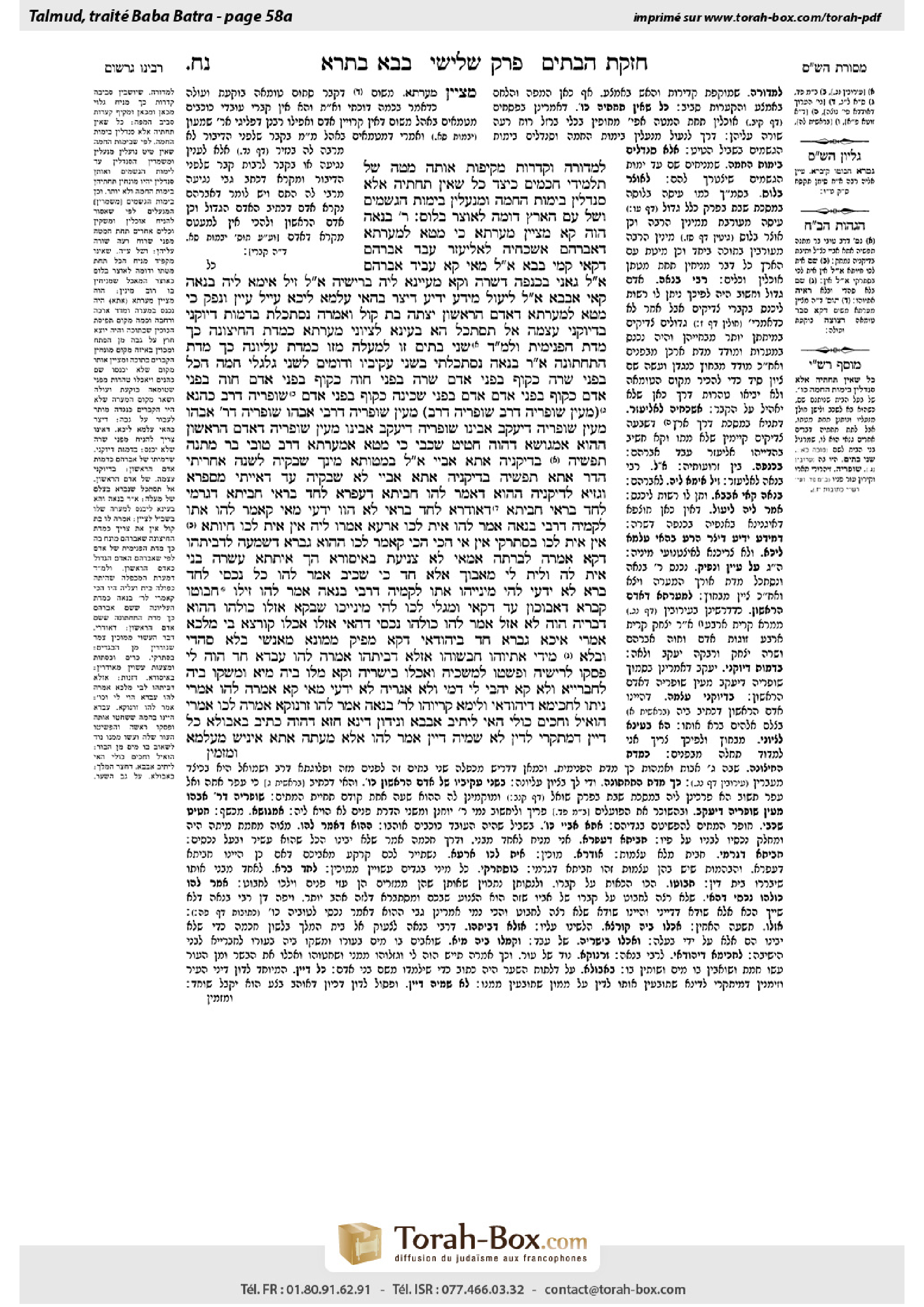
This page of Bava Batra includes the Aramaic text, an English translation and an AI-generated French translation, alongside the scan above.
בבא בתרא נ״ח א · Aramaic and Hebrew text
לִמְדוּרָה, וּקְדֵרוֹת מַקִּיפוֹת אוֹתָהּ.
מִטָּה שֶׁל תַּלְמִידֵי חֲכָמִים – כֵּיצַד? כֹּל שֶׁאֵין תַּחְתֶּיהָ אֶלָּא סַנְדָּלִין בִּימוֹת הַחַמָּה, וּמִנְעָלִין בִּימוֹת הַגְּשָׁמִים. וְשֶׁל עַם הָאָרֶץ – דּוֹמָה לְאוֹצָר בָּלוּס.
רַבִּי בְּנָאָה הֲוָה קָא מְצַיֵּין מְעָרָתָא. כִּי מְטָא לִמְעָרְתָּא דְאַבְרָהָם, אַשְׁכְּחֵיהּ לֶאֱלִיעֶזֶר עֶבֶד אַבְרָהָם דְּקָאֵי קַמֵּי בָּבָא. אֲמַר לֵיהּ: מַאי קָא עָבֵיד אַבְרָהָם? אֲמַר לֵיהּ: גָּאנֵי בְּכַנְפַהּ דְּשָׂרָה, וְקָא מְעַיְּינָא לֵיהּ בְּרֵישֵׁיהּ.
אֲמַר לֵיהּ, זִיל אֵימָא לֵיהּ: בְּנָאָה קָאֵי אַבָּבָא. אֲמַר לֵיהּ: לֵיעוּל – מִידָּע יְדִיעַ דְּיֵצֶר בְּהַאי עָלְמָא לֵיכָּא. עָיֵיל, עַיֵּין וּנְפַק.
כִּי מְטָא לִמְעָרְתָּא דְּאָדָם הָרִאשׁוֹן, יָצְתָה בַּת קוֹל וְאָמְרָה: ״נִסְתַּכַּלְתָּ בִּדְמוּת דְּיוֹקְנִי, בִּדְיוֹקְנִי עַצְמָהּ אַל תִּסְתַּכֵּל״. ״הָא בָּעֵינָא לְצַיּוֹנֵי מְעָרְתָּא!״ ״כְּמִדַּת הַחִיצוֹנָה כָּךְ מִדַּת הַפְּנִימִית. וּלְמַאן דְּאָמַר שְׁנֵי בָתִּים זוֹ לְמַעְלָה מִזּוֹ – כְּמִדַּת עֶלְיוֹנָה כָּךְ מִדַּת הַתַּחְתּוֹנָה״.
אָמַר רַבִּי בְּנָאָה: נִסְתַּכַּלְתִּי בִּשְׁנֵי עֲקֵיבָיו, וְדוֹמִים לִשְׁנֵי גַּלְגַּלֵּי חַמָּה. הַכֹּל בִּפְנֵי שָׂרָה – כְּקוֹף בִּפְנֵי אָדָם. שָׂרָה בִּפְנֵי חַוָּה – כְּקוֹף בִּפְנֵי אָדָם. חַוָּה בִּפְנֵי אָדָם – כְּקוֹף בִּפְנֵי אָדָם. אָדָם בִּפְנֵי שְׁכִינָה – כְּקוֹף בִּפְנֵי אָדָם.
שׁוּפְרֵיהּ דְּרַב כָּהֲנָא מֵעֵין שׁוּפְרֵיהּ דְּרַב, שׁוּפְרֵיהּ דְּרַב מֵעֵין שׁוּפְרֵיהּ דְּרַבִּי אֲבָהוּ, שׁוּפְרֵיהּ דְּרַבִּי אֲבָהוּ מֵעֵין שׁוּפְרֵיהּ דְּיַעֲקֹב אָבִינוּ, שׁוּפְרֵיהּ דְּיַעֲקֹב אָבִינוּ מֵעֵין שׁוּפְרֵיהּ דְּאָדָם הָרִאשׁוֹן.
הָהוּא אַמְגּוּשָׁא דַּהֲוָה חָטֵיט שָׁכְבֵי. כִּי מְטָא אַמְּעָרְתָּא דְּרַב טוֹבִי בַּר מַתְנָה, תַּפְשֵׂיהּ בְּדִיקְנֵיהּ. אֲתָא אַבָּיֵי, אֲמַר לֵיהּ: בְּמָטוּתָא מִינָּךְ, שִׁבְקֵיהּ. לְשָׁנָה אַחֲרִיתִי הֲדַר אֲתָא, תַּפְשֵׂיהּ בְּדִיקְנֵיהּ. אֲתָא אַבָּיֵי, לָא שִׁבְקֵיהּ עַד דְּאַיְיתִי מַסְפְּרָא וְגַזְּיֵהּ לְדִיקְנֵיהּ.
הָהוּא דַּאֲמַר לְהוּ: חָבִיתָא דְעַפְרָא לְחַד בְּרַאי, חָבִיתָא דְגַרְמֵי לְחַד בְּרַאי, חָבִיתָא דְאוּדְרָא לְחַד בְּרַאי. לָא הֲווֹ יָדְעִי מַאי קָאָמַר לְהוּ. אֲתוֹ לְקַמֵּיהּ דְּרַבִּי בְּנָאָה, אֲמַר לְהוּ: ״אִית לְכוּ אַרְעָא?״ אֲמַרוּ לֵיהּ: ״אִין״. ״אִית לְכוּ חֵיוָתָא?״ ״אִין״. ״אִית לְכוּ בִּסְתַּרְקֵי?״ ״אִין״. ״אִי הָכִי, הָכִי קָאָמַר לְכוּ״.
הָהוּא גַּבְרָא דְּשַׁמְעַהּ לִדְבֵיתְהוּ דְּקָא אָמְרָה לְבַרְתַּהּ: ״אַמַּאי לָא צְנִּיעַתְּ בְּאִיסּוּרָא? הָךְ אִיתְּתָא, עֲשָׂרָה בְּנֵי אִית לַהּ, וְלֵית לִי מֵאֲבוּךְ אֶלָּא חַד״. כִּי שָׁכֵיב, אֲמַר לְהוּ: ״כׇּל נִכְסַי לְחַד בְּרָא״.
לָא יָדְעִי לְהֵי מִינַּיְיהוּ. אֲתוֹ לְקַמֵּיהּ דְּרַבִּי בְּנָאָה, אֲמַר לְהוּ: זִילוּ חֲבוּטוּ קִבְרָא דַּאֲבוּכוֹן, עַד דְּקָאֵי וּמְגַלֵּי לְכוּ לְהֵי מִינַּיְיכוּ שְׁבַקא. אֲזַלוּ כּוּלְּהוּ, הָהוּא דִּבְרֵיהּ הֲוָה לָא אֲזַל. אֲמַר לְהוּ: כּוּלְּהוּ נִכְסֵי דְּהַאי. אֲזַלוּ אֲכַלוּ קוּרָצָא בֵּי מַלְכָּא, אָמְרִי: אִיכָּא גַּבְרָא חַד בִּיהוּדָאֵי, דְּקָא מַפֵּיק מָמוֹנָא מֵאִנָשֵׁי בְּלָא סָהֲדִי וּבְלָא מִידֵּי. אַתְיוּהוּ חַבְשׁוּהוּ.
אֲזַלָא דְּבֵיתְהוּ, אֲמַרָה לְהוּ: עַבְדָּא חַד הֲוָה לִי, פְּסַקוּ לְרֵישֵׁיהּ וּפְשַׁטוּ לְמַשְׁכֵּיהּ וַאֲכַלוּ בִּישְׂרֵיהּ, וְקָא מָלוּ בֵּיהּ מַיָּא וּמַשְׁקוּ בֵּיהּ לְחַבְרַיָּיא, וְלָא קָא יָהֲבִי לִי דְּמֵי וְלָא אַגְרֵיהּ.
לָא יָדְעִי מַאי קָא אָמְרָה לְהוּ. אָמְרִי: נַיְתוֹ לְחַכִּימָא דִיהוּדָאֵי, וְלֵימָא. קַרְיוּהוּ לְרַבִּי בְּנָאָה, אֲמַר לְהוּ: זַרְנוּקָא אָמְרָה לְכוּ. אָמְרִי: הוֹאִיל וְחַכִּים כּוּלֵּי הַאי, לִיתֵּיב אַבָּבָא וְנֵידוּן דִּינָא.
חֲזָא דַּהֲוָה כְּתִיב בַּאֲבוּלָּא: ״כֹּל דַּיָּין דְּמִתְקְרֵי לְדִין – לָא שְׁמֵיהּ דַּיָּין״. אֲמַר לְהוּ: אֶלָּא מֵעַתָּה, אֲתָא אִינִישׁ מֵעָלְמָא
Bava Batra 58a · English translation
to a bonfire, where the fire is in the center and pots surround it. Similarly, the table of an ignoramus is arranged with the food in the center and is surrounded by plates.
Rabbi Yoḥanan asked: How should the bed of Torah scholars be kept? He replied: It is acceptable as long as there is nothing except sandals beneath it during the summer, and shoes beneath it during the rainy season, i.e., winter. And the bed of an ignoramus is similar to a cluttered [balus] storehouse, as he keeps a wide array of items beneath it.
§ Having mentioned Rabbi Bena’a, the Gemara relates an incident in which he was involved. Rabbi Bena’a was marking burial caves for the purpose of helping to prevent the contracting of ritual impurity. When he arrived at the cave of Abraham, i.e., the Cave of Machpelah, he encountered Eliezer, the servant of Abraham, who was standing before the entrance. Rabbi Bena’a said to him: What is Abraham doing at this moment? Eliezer said to him: He is lying in the arms of Sarah, and she is examining his head.
Rabbi Bena’a said to him: Go tell him that Bena’a is standing at the entrance, so that he should assume an appropriate position to receive a visitor. Eliezer said to him: Let him, i.e., Rabbi Bena’a, enter, since it is known that there is no evil inclination in this higher world, so it is not inappropriate for Rabbi Bena’a to see Abraham and Sarah in this position. He entered, examined the cave in order to measure it, and exited.
When he arrived at the cave of Adam the first man, who is buried in the same area, a Divine Voice emerged and said: You gazed upon the likeness of My image, i.e., Abraham, who is similar to the image of Adam the first man. Do not gaze upon My image itself, i.e., Adam the first man, about whom the verse states that he was formed in the image of God (see Genesis 1:27). Rabbi Bena’a said: But I need to mark the cave. The voice said to him: As the measurements of the dimensions of the outer cave where Abraham is buried, so are the measurements of the dimensions of the inner cave, where Adam is buried. The Gemara notes: And according to the one who says that the Cave of Machpelah consists of two chambers, this one above that one, not two adjacent chambers, the voice said: As the measurements of the dimensions of the upper cave where Abraham is buried, so are the measurements of the dimensions of the lower cave. Therefore, there is no need to measure it.
Rabbi Bena’a says: I gazed at his, Adam’s, two heels, and they shone so brightly that they are similar to two suns. Along these lines, the Gemara states that all people compared to Sarah are like a monkey compared to a human, as Sarah was exceedingly beautiful; Sarah compared to Eve is like a monkey compared to a human; Eve compared to Adam is like a monkey compared to a human; and Adam compared to the Divine Presence is like a monkey compared to a human.
It was also stated that the beauty of Rav Kahana is a semblance of the beauty of Rav. The beauty of Rav is a semblance of the beauty of Rabbi Abbahu. The beauty of Rabbi Abbahu is a semblance of the beauty of Jacob our forefather. The beauty of Jacob our forefather is a semblance of the beauty of Adam the first man.
On the topic of burial caves, the Gemara relates that there was a certain magus [amgusha] who was rummaging through the graves of the dead. When he arrived at the burial cave of Rav Tovi bar Mattana, Rav Tovi grabbed him by his beard and would not release him. Abaye came and said to Rav Tovi: I beg of you to release him. The magus came again in another year, and Rav Tovi grabbed him by his beard. Abaye came and requested that he release him, but Rav Tovi did not release him, until Abaye brought a scissors and cut his beard.
§ The Gemara relates additional incidents involving Rabbi Bena’a: There was a certain individual who said to his family before he died: A barrel of earth to one of my sons, a barrel of bones to one of my sons, and a barrel of wads of wool to one of my sons. They did not know what he was saying to them. They came before Rabbi Bena’a for guidance. Rabbi Bena’a said to them: Do you have land that your father left as an inheritance? They said to him: Yes. He asked: Do you have livestock that your father left as an inheritance? They said: Yes. He asked: Do you have quilts [bistarkei] that your father left as an inheritance? They said: Yes. He said to them: If so, this is what he said to you, i.e., he meant that he is bequeathing land to one son, livestock to the second, and quilts to the third.
There was a certain man who heard his wife saying to her daughter: Why do you not act clandestinely when you engage in forbidden sexual intercourse? That woman has, i.e., I have, ten sons, and I have only one from your father, and no one knows. So too, you must be careful so that no one will discover your illicit behavior. Having overheard that only one son was his, when that man was dying he said to his family: All of my property is left to one son.
They did not know to which of them he intended to leave his property. They came before Rabbi Bena’a for guidance, and he said to the sons: Go strike your father’s grave, until he rises and reveals to you to which of you he left his property. They all went, but that one who was his son did not go. Rabbi Bena’a said to them: All of the property belongs to this son who did not go. The other brothers were angry. They went and slandered [akhlu kuretza] Rabbi Bena’a in the king’s house. They said: There is one man among the Jews who removes money from people without witnesses and without any evidence. The king’s guards brought Rabbi Bena’a and imprisoned him.
The wife of Rabbi Bena’a went and said to the guards: I had one servant. They cut off his head, and skinned him and ate his flesh, and they fill him with water and give their friends to drink from him, and they have not paid me his value nor have they rented him.
They did not know what she was saying to them. They said: Let us bring the wise man of the Jews, and let him say what she meant. They called Rabbi Bena’a, and he said to them: She spoke to you of a water skin [zarnuka]. In other words, she was referring to a goat she owned that was slaughtered, its meat eaten, and its skin made into a water skin that could be filled with drinking water. They said: Since he is so wise, let him sit at the gate where the judges congregate and render judgment.
Rabbi Bena’a saw that it was written upon the gate [be’abbula]: Any judge who is summoned to judgment is not considered a judge, as judges must be above reproach. He said to them: If that is so, then if a person comes from elsewhere
Bava Batra 58a · Traduction française (IA)
à un feu de camp, où le feu est au centre et les récipients l'entourent. De même, la table d'un ignorant est disposée avec les aliments au centre et entourée de plats.
Rabbi Yoḥanan demanda : Comment doit-on ranger le lit des savants de la Torah ? Il répondit : C'est acceptable tant qu'il n'y a rien d'autre que des sandales sous lui en été, et des chaussures sous lui en saison des pluies, c'est-à-dire l'hiver. Et le lit d'un ignorant est semblable à un entrepôt en désordre, car il garde une grande variété d'objets sous lui.
§ Ayant mentionné Rabbi Bena’a, le Guemara rapporte un incident dans lequel il était impliqué. Rabbi Bena’a marquait des grottes de sépulture afin d'aider à prévenir la contraction de l'impureté rituelle. Lorsqu'il arriva à la grotte d'Abraham, c'est-à-dire la Grotte de Machpelah, il rencontra Eliezer, le serviteur d'Abraham, qui était debout devant l'entrée. Rabbi Bena’a dit à lui : Qu'est-ce que Abraham fait à ce moment ? Eliezer dit à lui : Il est allongé dans les bras de Sarah, et elle examine sa tête.
Rabbi Bena’a dit à lui : Va lui dire que Bena’a est debout à l'entrée, afin qu'il assume une position appropriée pour recevoir un visiteur. Eliezer dit à lui : Laisse-le entrer, car il est connu qu'il n'y a pas de penchant mauvais dans ce monde supérieur, donc il n'est pas inapproprié que Rabbi Bena’a voie Abraham et Sarah dans cette position. Il entra, examina la grotte afin de mesurer, et sortit.
Lorsqu'il arriva à la grotte d'Adam, le premier homme, qui est enterré dans la même région, une Voix divine émergea et dit : Tu as regardé la ressemblance de Mon image, c'est-à-dire Abraham, qui est semblable à l'image d'Adam, le premier homme. Ne regarde pas Mon image elle-même, c'est-à-dire Adam, le premier homme, dont la Parashah dit qu'il a été formé à l'image de Dieu (voir Genèse 1:27). Rabbi Bena’a dit : Mais j'ai besoin de marquer la grotte. La voix dit à lui : Comme les mesures des dimensions de la grotte extérieure où Abraham est enterré, ainsi sont les mesures des dimensions de la grotte intérieure où Adam est enterré. Le Guemara note : Et selon celui qui dit que la Grotte de Machpelah consiste en deux chambres, celle-ci au-dessus de celle-là, et non deux chambres adjacentes, la voix dit : Comme les mesures des dimensions de la grotte supérieure où Abraham est enterré, ainsi sont les mesures des dimensions de la grotte inférieure. Donc, il n'est pas nécessaire de la mesurer.
Rabbi Bena’a dit : J'ai regardé ses deux chevilles, Adam, et elles brillaient si fort qu'elles ressemblent à deux soleils. Dans ce sens, le Guemara dit que tous les gens comparés à Sarah sont comme un singe comparé à un humain, car Sarah était extrêmement belle ; Sarah comparée à Ève est comme un singe comparé à un humain ; Ève comparée à Adam est comme un singe comparé à un humain ; et Adam comparé à la Divine Présence est comme un singe comparé à un humain.
Il a également été dit que la beauté de Rav Kahana est une semblance de la beauté de Rav. La beauté de Rav est une semblance de la beauté de Rabbi Abbahu. La beauté de Rabbi Abbahu est une semblance de la beauté de Jacob, notre père. La beauté de Jacob, notre père, est une semblance de la beauté d'Adam, le premier homme.
Sur le sujet des grottes de sépulture, la Guemara rapporte que certains magiciens fouillaient les tombes des morts. Lorsqu'il arriva à la grotte de Rav Tovi bar Mattana, Rav Tovi le saisit par la barbe et ne le relâcha pas. Abaye vint et dit à Rav Tovi : Je t'en prie, libère-le. Le magicien revint l'année suivante, et Rav Tovi le saisit à nouveau par la barbe. Abaye vint et demanda qu'il le libère, mais Rav Tovi ne le libéra pas, jusqu'à ce que Abaye apporte des ciseaux et coupe sa barbe.
§ La Guemara rapporte d'autres incidents concernant Rabbi Bena’a : Il y avait un certain individu qui dit à sa famille avant de mourir : Une barrique de terre à l'un de mes fils, une barrique d'os à l'un de mes fils, et une barrique de ballots de laine à l'un de mes fils. Ils ne savaient pas ce qu'il disait à eux. Ils vinrent devant Rabbi Bena’a pour obtenir des conseils. Rabbi Bena’a dit à eux : Avez-vous une terre que votre père a laissée en héritage ? Ils dirent : Oui. Il demanda : Avez-vous des bêtes que votre père a laissées en héritage ? Ils dirent : Oui. Il demanda : Avez-vous des couvertures que votre père a laissées en héritage ? Ils dirent : Oui. Il dit à eux : Si c'est le cas, c'est ce qu'il vous a dit, c'est-à-dire qu'il voulait vous léguer la terre à l'un de vos fils, les bêtes à l'autre, et les couvertures à l'autre.
Il y avait un certain homme qui avait entendu sa femme dire à sa fille : Pourquoi ne pas agir discrètement lorsqu'on commet un acte sexuel interdit ? Cette femme, c'est-à-dire moi, a dix fils, et j'ai seulement un de votre père, et personne ne le sait. De même, vous devez être prudent pour que personne ne découvre votre comportement illicite. Ayant entendu qu'il avait seulement un fils, lorsque cet homme mourait, il dit à sa famille : Tout mon bien est laissé à l'un de mes fils.
Ils ne savaient à quel fils il voulait léguer ses biens. Ils vinrent devant Rabbi Bena’a pour obtenir des conseils, et il dit aux fils : Allez frapper la tombe de votre père jusqu'à ce qu'il se lève et vous révèle à quel fils il a laissé ses biens. Ils allèrent tous, mais celui qui était son fils ne vint pas. Rabbi Bena’a dit à eux : Tout le bien appartient à ce fils qui n'est pas venu. Les autres frères furent en colère. Ils allèrent et diffamèrent Rabbi Bena’a dans la maison du roi. Ils dirent : Il y a un seul homme parmi les Juifs qui retire de l'argent des gens sans témoins et sans preuve. Les gardes du roi amenèrent Rabbi Bena’a et le firent emprisonner.
La femme de Rabbi Bena’a alla et dit aux gardes : J'avais un serviteur. Ils coupèrent sa tête, et la peau, et mangèrent sa chair, et ils le remplirent d'eau et donnèrent à leurs amis à boire, et ils n'ont pas payé sa valeur ni ne l'ont loué.
Ils ne savaient pas ce qu'elle leur disait. Ils dirent : Faisons venir le sage des Juifs, qu'il explique ce qu'elle voulait dire. Ils appelèrent Rabbi Bena’a, et il leur dit : Elle vous parlait d'une peau de sac [zarnuka]. En d'autres termes, elle faisait référence à une chèvre qu'elle possédait, tuée, sa viande mangée, et sa peau transformée en un sac pouvant être rempli d'eau potable. Ils dirent : Puisque il est si sage, qu'il siège à la porte où les juges se réunissent pour rendre leur jugement.
Rabbi Bena’a vit que cela était inscrit sur la porte [be’abbula] : Tout juge appelé à juger n'est pas considéré comme un juge, car les juges doivent être irréprochables. Il dit à eux : Si c'est ainsi, alors si une personne vient d'ailleurs,
Traduction française générée par IA à partir de l’édition anglaise de Sefaria. Vérifie toujours un passage avec le texte source.
Text from Sefaria: William Davidson Edition - Vocalized Aramaic (CC BY NC); William Davidson Edition - English (CC BY NC).