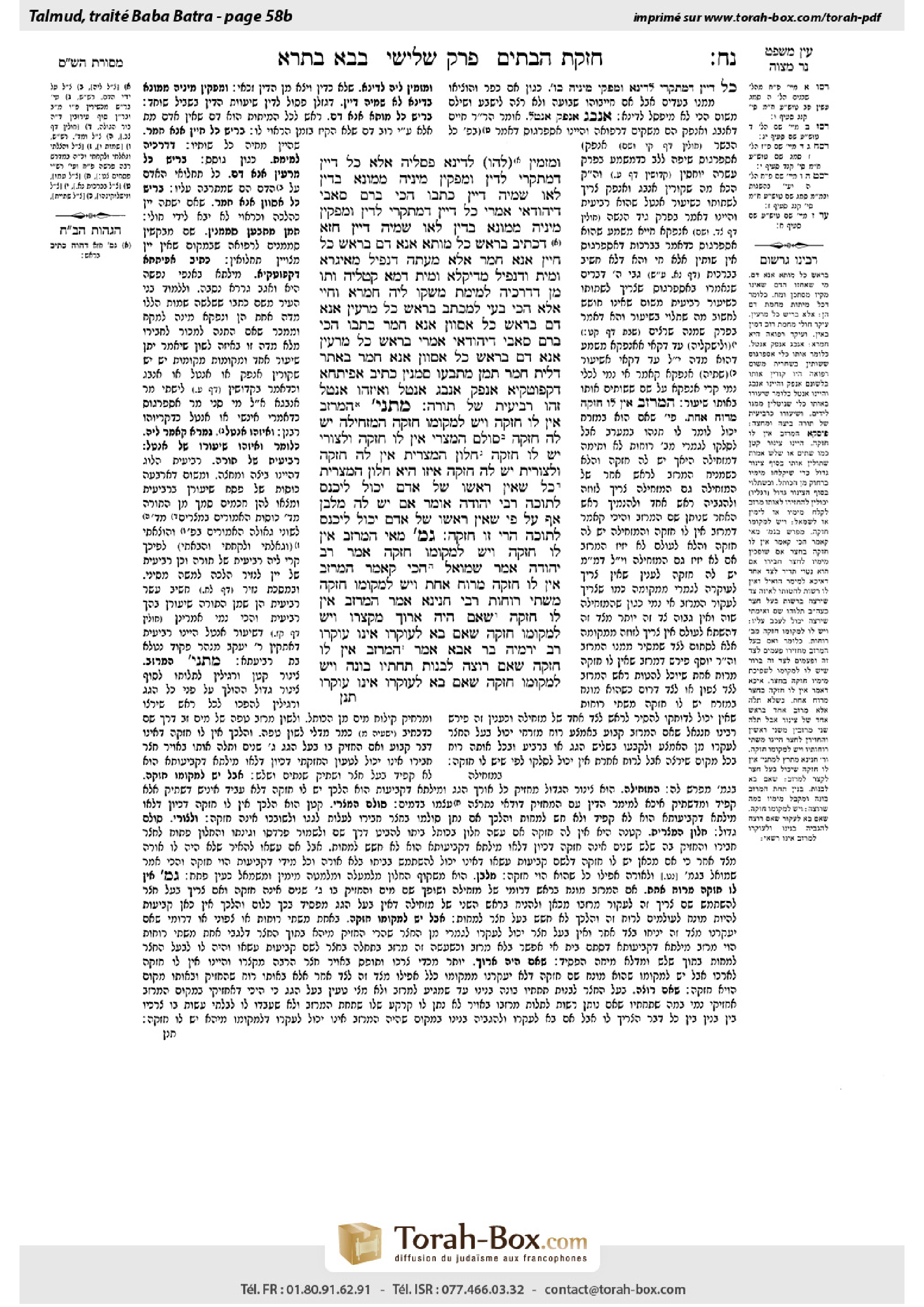
Bava Batra 58b: Talmud study for Daf Yomi
Study the Talmud for Daf Yomi with scanned pages, Hebrew text, English translations from Sefaria and AI-generated French translations.
Passage selection and English or AI-generated French translation are available where the scan has annotations. Daf Study is independent of Torah-Box and Sefaria.
Browse Bava Batra · בבא בתרא · All tractatesBava Batra 58b text and translations
This page of Bava Batra includes the Aramaic text, an English translation and an AI-generated French translation, alongside the scan above.
בבא בתרא נ״ח ב · Aramaic and Hebrew text
וּמַזְמֵין (לְהוּ) [לֵיהּ] לְדִינָא, פַּסְלֵיהּ?! אֶלָּא כֹּל דַּיָּין דְּמִתְקְרֵי לְדִין, וּמַפְּקִין מִינֵּיהּ מָמוֹנָא בְּדִין – לָאו שְׁמֵיהּ דַּיָּין. כְּתַבוּ הָכִי: ״בְּרַם סָאבֵי דִיהוּדָאֵי אָמְרִי: כֹּל דַּיָּין דְּמִתְקְרֵי לְדִין וּמַפְּקִין מִינֵּיהּ מָמוֹנָא בְּדִין – לָאו שְׁמֵיהּ דַּיָּין״.
חֲזָא דִּכְתִיב: ״בְּרֵאשׁ כֹּל מוֹתָא – אֲנָא דָּם, בְּרֵאשׁ כֹּל חַיִּין – אֲנָא חֲמַר״. אֶלָּא מֵעַתָּה, דְּנָפֵיל מֵאִיגָּרָא וּמִית, וּדְנָפֵיל מִדִּיקְלָא וּמִית, דְּמָא קַטְלֵיהּ?! וְתוּ, מַן דְּדַרְכֵּיהּ לְמֵימַת – מַשְׁקוּ לֵיהּ חַמְרָא, וְחָיֵי?! אֶלָּא הָכִי בָּעֵי לְמִכְתַּב: בְּרֵאשׁ כֹּל מַרְעִין – אֲנָא דָּם, בְּרֵאשׁ כֹּל אָסְווֹן – אֲנָא חֲמַר. כְּתַבוּ הָכִי: ״בְּרַם סָאבֵי דִיהוּדָאֵי אָמְרִי: בְּרֵאשׁ כֹּל מַרְעִין – אֲנָא דָּם, בְּרֵאשׁ כֹּל אָסְווֹן – אֲנָא חֲמַר, בַּאֲתַר דְּלֵית חֲמַר – תַּמָּן מִתְבָּעוּ סַמָּנִין״.
כְּתִיב אַפִּיתְחָא דְקַפּוֹטְקְיָא: ״אַנְפַּק, אַנְבַּג, אַנְטַל״. וְאֵיזֶהוּ אַנְטַל? זֶהוּ רְבִיעִית שֶׁל תּוֹרָה.
מַתְנִי׳ הַמַּרְזֵב אֵין לוֹ חֲזָקָה, וְיֵשׁ לִמְקוֹמוֹ חֲזָקָה. הַמַּזְחֵילָה יֵשׁ לָהּ חֲזָקָה.
סוּלָּם הַמִּצְרִי אֵין לוֹ חֲזָקָה, וְלַצּוֹרִי יֵשׁ לוֹ חֲזָקָה.
חַלּוֹן הַמִּצְרִית אֵין לָהּ חֲזָקָה, וְלַצּוֹרִית יֵשׁ לָהּ חֲזָקָה. אֵיזוֹ הִיא חַלּוֹן הַמִּצְרִית? כֹּל שֶׁאֵין רֹאשׁוֹ שֶׁל אָדָם יָכוֹל לִיכָּנֵס לְתוֹכָהּ. רַבִּי יְהוּדָה אוֹמֵר: אִם יֵשׁ לָהּ מַלְבֵּן – אַף עַל פִּי שֶׁאֵין רֹאשׁוֹ שֶׁל אָדָם יָכוֹל לִיכָּנֵס לְתוֹכָהּ, הֲרֵי זוֹ חֲזָקָה.
גְּמָ׳ מַאי ״הַמַּרְזֵב אֵין לוֹ חֲזָקָה, וְיֵשׁ לִמְקוֹמוֹ חֲזָקָה״? אָמַר רַב יְהוּדָה אָמַר שְׁמוּאֵל, הָכִי קָאָמַר: הַמַּרְזֵב אֵין לוֹ חֲזָקָה – מֵרוּחַ אַחַת, וְיֵשׁ לִמְקוֹמוֹ חֲזָקָה – מִשְׁתֵּי רוּחוֹת.
רַבִּי חֲנִינָא אָמַר: הַמַּרְזֵב אֵין לוֹ חֲזָקָה – שֶׁאִם הָיָה אָרוֹךְ מְקַצְּרוֹ, וְיֵשׁ לִמְקוֹמוֹ חֲזָקָה – שֶׁאִם בָּא לְעוֹקְרוֹ, אֵינוֹ עוֹקְרוֹ.
רַב יִרְמְיָה בַּר אַבָּא אָמַר: הַמַּרְזֵב אֵין לוֹ חֲזָקָה – שֶׁאִם רוֹצֶה לִבְנוֹת תַּחְתָּיו בּוֹנֶה, וְיֵשׁ לִמְקוֹמוֹ חֲזָקָה – שֶׁאִם בָּא לְעוֹקְרוֹ אֵינוֹ עוֹקְרוֹ.
Bava Batra 58b · English translation
and summons a judge to judgment, has he disqualified the judge even if he were later to be exonerated? Rather, it should say: Any judge who is summoned to judgment and money is lawfully taken from him, i.e., he was ordered to return someone’s property, is not considered a judge. When they heard this, they wrote this addendum to the original inscription: But the elders of the Jews say that any judge who is summoned to judgment and money is lawfully taken from him is not considered a judge.
Rabbi Bena’a also saw that it was written there: At the head of all death am I, blood, i.e., people die from an excess of blood; at the head of all life am I, wine, i.e., wine is what gives life. He said to them: If that is so, in the case of someone who falls from a roof and dies, or someone who falls from a palm tree and dies, was it blood that killed him? And furthermore, concerning someone who is on the way to death, can they give him a drink of wine and he will live? Rather, this is what should be written: At the head of all illness am I, blood; at the head of all healing am I, wine. When they heard this, they wrote this addendum to the original inscription: But the elders of the Jews say: At the head of all illness am I, blood; at the head of all healing am I, wine. In a place where there is no wine, herbs are required there as medicines.
Having related that incident, the Gemara notes that at the entrance of Kapotekiyya it was written: Anpak, anbag, antal, which are all names for the same measurement. And what is antal? It is the quarter-log of the Torah.
MISHNA: With regard to a spout protruding from one’s roof gutter draining water into another’s property, its owner has no means to establish an acquired privilege for its use, but he does have the means to establish an acquired privilege with regard to its place, as the Gemara will explain. With regard to a gutter pipe that traverses the length of the roof, one does have the means to establish an acquired privilege for its use.
With regard to an Egyptian ladder, which is small and portable, one has no means to establish an acquired privilege for its use. But with regard to a Tyrian ladder, which is large and fixed in place, one does have the means to establish an acquired privilege for its use.
With regard to an Egyptian window, one has no means to establish an acquired privilege for its use; but with regard to a Tyrian window, one does have the means to establish an acquired privilege for its use. What is the defining feature of an Egyptian window? It is any window that is so small that a person’s head is not able to fit inside it. Rabbi Yehuda says: If a window has a frame, even though a person’s head is not able to fit inside it, one does have the means to establish an acquired privilege for its use.
GEMARA: The Gemara asks: What is the meaning of the mishna’s statement: With regard to a spout, its owner has no means to establish an acquired privilege for its use, but he does have the means to establish an acquired privilege with regard to its place? Rav Yehuda said that Shmuel said: This is what it is saying: Concerning a spout, its owner has no means to establish an acquired privilege for its use with regard to one side, i.e., the owner of the field below has the right to move the spout from one place to another on one side of the roof, but he does have the means to establish an acquired privilege concerning its place with regard to two sides, i.e., the owner of the field below does not have the right to move it to another side of the roof.
Rabbi Ḥanina said there is a different explanation: With regard to a spout, its owner has no means to establish an acquired privilege for its size, as if it was long, the owner of the field below may shorten it, but one does have the means to establish an acquired privilege with regard to its place, as if the owner of the field below comes to remove it entirely, he may not remove it.
Rav Yirmeya bar Abba said there is a different explanation: With regard to a spout, its owner has no means to establish an acquired privilege for its use, as if the owner of the field below wishes to build beneath it, he may build, and the owner of the spout may not prevent him from doing so; but one does have the means to establish an acquired privilege with regard to its place, as if the owner of the field below comes to remove it entirely, he may not remove it.
Bava Batra 58b · Traduction française (IA)
et il convoque un juge à l'audience, a-t-il disqualifié le juge même s'il est ultérieurement réhabilité ? Plutôt, il devrait dire : Tout juge qui est convoqué à l'audience et dont des fonds sont légalement retirés, c'est-à-dire qu'il a été ordonné de rendre un bien à quelqu'un, n'est pas considéré comme un juge. Lorsqu'ils ont entendu cela, ils ont ajouté cette note à l'inscription originale : Mais les anciens des Juifs disent que tout juge qui est convoqué à l'audience et dont des fonds sont légalement retirés n'est pas considéré comme un juge.
Rabbi Bena’a a également constaté qu'il était écrit là : Au début de toute mort je suis, le sang, c'est-à-dire que les gens meurent à cause d'un excès de sang ; au début de toute vie je suis, le vin, c'est-à-dire que le vin est ce qui donne la vie. Il a dit à ceux-ci : Si c'est ainsi, dans le cas d'une personne tombant d'un toit et meurt, ou d'une personne tombant d'un palmier et meurt, c'était le sang qui l'a tué ? Et de plus, concernant une personne sur le chemin de la mort, peut-on lui donner un verre de vin et il vivra ? Plutôt, c'est ce qui devrait être écrit : Au début de toute maladie je suis, le sang ; au début de toute guérison je suis, le vin. Lorsqu'ils ont entendu cela, ils ont ajouté cette note à l'inscription originale : Mais les anciens des Juifs disent : Au début de toute maladie je suis, le sang ; au début de toute guérison je suis, le vin. Dans un lieu où il n'y a pas de vin, des herbes sont nécessaires là comme remèdes.
Ayant relaté cet incident, le Guemara note que, à l'entrée de Kapotekiyya, il était écrit : Anpak, anbag, antal, qui sont tous des noms pour la même mesure. Et qu'est-ce que antal ? C'est le quart-log de la Torah.
MICHNA : Concernant un robinet sortant d'une gouttière qui déverse de l'eau sur la propriété d'une autre personne, son propriétaire n'a pas le moyen d'établir un privilège acquis concernant son utilisation, mais il a le moyen d'établir un privilège acquis concernant sa place, comme le Guemara le précisera. Concernant un tuyau de gouttière traversant la longueur du toit, on a le moyen d'établir un privilège acquis concernant son utilisation.
Concernant une échelle égyptienne, qui est petite et portable, on n'a pas le moyen d'établir un privilège acquis concernant son utilisation. Mais concernant une échelle tyrienne, qui est grande et fixe, on a le moyen d'établir un privilège acquis concernant son utilisation.
Concernant une fenêtre égyptienne, on n'a pas le moyen d'établir un privilège acquis concernant son utilisation ; mais concernant une fenêtre tyrienne, on a le moyen d'établir un privilège acquis concernant son utilisation. Quelle est la caractéristique définissante d'une fenêtre égyptienne ? C'est toute fenêtre si petite que la tête d'une personne ne peut pas s'y engager. Rabbi Yéhuda dit : Si une fenêtre a un cadre, même si la tête d'une personne ne peut pas s'y engager, on a le moyen d'établir un privilège acquis concernant son utilisation.
GUEMARA : La Guemara pose la question : Quelle est la signification de l'affirmation de la mishna : Concernant un robinet, son propriétaire n'a pas le moyen d'établir un privilège acquis concernant son utilisation, mais il a le moyen d'établir un privilège acquis concernant sa place ? Rav Yéhuda a dit que Shmuel a dit : C'est ce que cela signifie : Concernant un robinet, son propriétaire n'a pas le moyen d'établir un privilège acquis concernant son utilisation concernant un côté, c'est-à-dire que le propriétaire du champ en dessous a le droit de déplacer le robinet d'un endroit à un autre sur un côté du toit, mais il a le moyen d'établir un privilège acquis concernant sa place concernant deux côtés, c'est-à-dire que le propriétaire du champ en dessous n'a pas le droit de le déplacer sur un autre côté du toit.
Rabbi Ḥanina a dit qu'il y a une autre explication : Concernant un robinet, son propriétaire n'a pas le moyen d'établir un privilège acquis concernant sa taille, car si le robinet est long, le propriétaire du champ en dessous peut le raccourcir, mais on a le moyen d'établir un privilège acquis concernant sa place, car si le propriétaire du champ en dessous vient à le retirer entièrement, il ne peut pas le retirer.
Rav Yirmeya bar Abba a dit qu'il y a une autre explication : Concernant un robinet, son propriétaire n'a pas le moyen d'établir un privilège acquis concernant son utilisation, car si le propriétaire du champ en dessous veut construire sous lui, il peut construire, et le propriétaire du robinet ne peut pas l'en empêcher ; mais on a le moyen d'établir un privilège acquis concernant sa place, car si le propriétaire du champ en dessous vient à le retirer entièrement, il ne peut pas le retirer.
Traduction française générée par IA à partir de l’édition anglaise de Sefaria. Vérifie toujours un passage avec le texte source.
Text from Sefaria: William Davidson Edition - Vocalized Aramaic (CC BY NC); William Davidson Edition - English (CC BY NC).