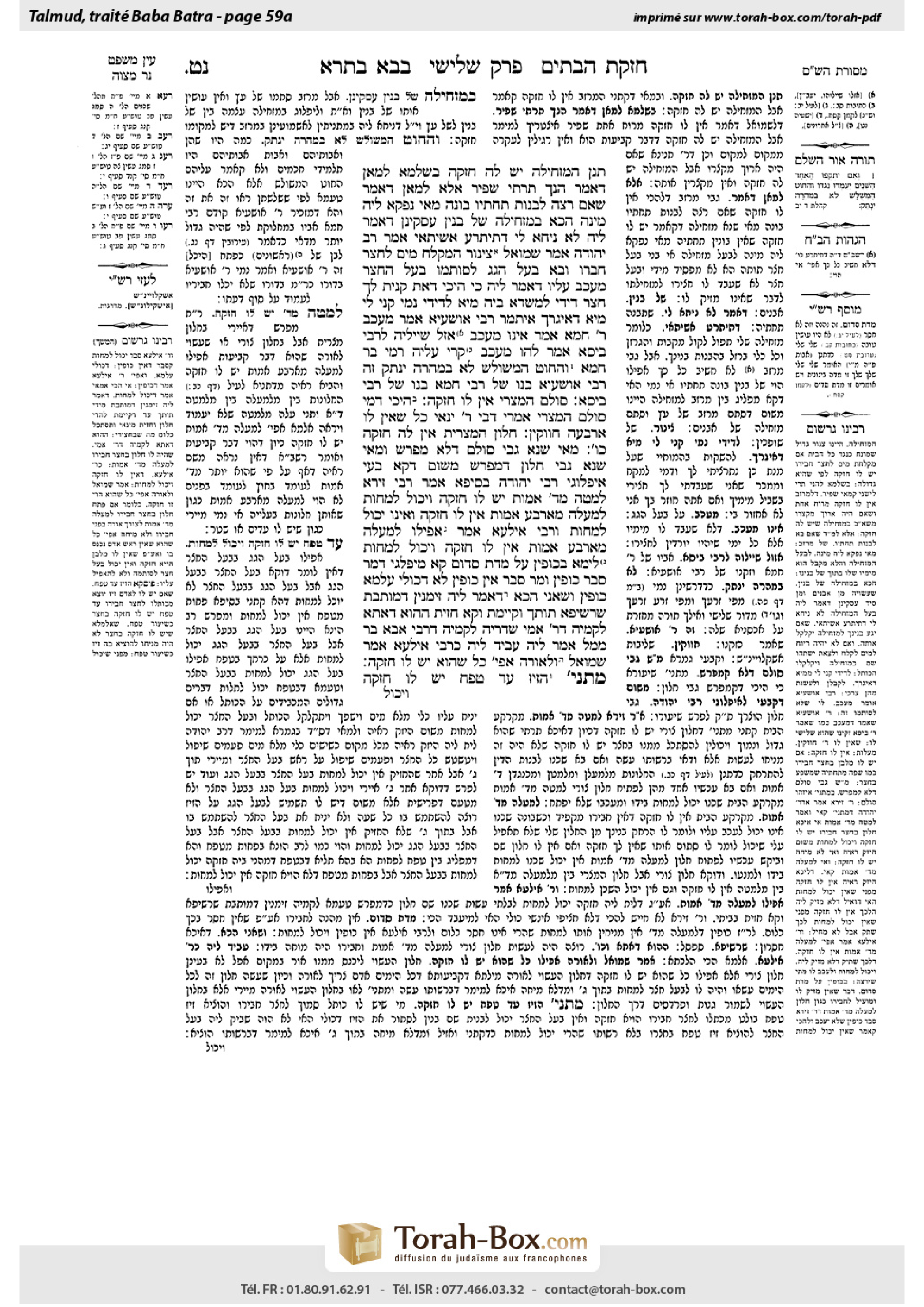
Bava Batra 59a: Talmud study for Daf Yomi
Study the Talmud for Daf Yomi with scanned pages, Hebrew text, English translations from Sefaria and AI-generated French translations.
Passage selection and English or AI-generated French translation are available where the scan has annotations. Daf Study is independent of Torah-Box and Sefaria.
Browse Bava Batra · בבא בתרא · All tractatesBava Batra 59a text and translations
This page of Bava Batra includes the Aramaic text, an English translation and an AI-generated French translation, alongside the scan above.
בבא בתרא נ״ט א · Aramaic and Hebrew text
תְּנַן: ״הַמַּזְחֵילָה יֵשׁ לָהּ חֲזָקָה״. בִּשְׁלָמָא לְמַאן דְּאָמַר הָנָךְ תַּרְתֵּי – שַׁפִּיר.
אֶלָּא לְמַאן דְּאָמַר שֶׁאִם רָצָה לִבְנוֹת תַּחְתָּיו בּוֹנֶה, מַאי נָפְקָא לֵיהּ מִינַּהּ?
הָכָא בְּמַזְחֵילָה שֶׁל בִּנְיָן עָסְקִינַן, דְּאָמַר לֵיהּ: לָא נִיחָא לִי דְּתִתְּרַע אֲשִׁיתַאי.
אָמַר רַב יְהוּדָה אָמַר שְׁמוּאֵל: צִינּוֹר הַמְקַלֵּחַ מַיִם לַחֲצַר חֲבֵרוֹ, וּבָא בַּעַל הַגָּג לְסוֹתְמוֹ, בַּעַל הֶחָצֵר מְעַכֵּב עָלָיו, דַּאֲמַר לֵיהּ: כִּי הֵיכִי דְּאַתְּ קַנְיָא לָךְ חָצֵר דִּידִי לְמִשְׁדֵּא בֵּיהּ מַיָּא, לְדִידִי נָמֵי קְנֵי לִי מַיָּא דְּאִיגָּרָךְ.
אִיתְּמַר, רַבִּי אוֹשַׁעְיָא אָמַר: מְעַכֵּב. רַבִּי חָמָא, אָמַר: אֵינוֹ מְעַכֵּב. אֲזַל שַׁיְילֵיהּ לְרַבִּי בֵּיסָא, אֲמַר לְהוּ: מְעַכֵּב. קָרֵי עֲלֵיהּ רָמֵי בַּר חָמָא: ״וְהַחוּט הַמְשֻׁלָּשׁ לֹא בִמְהֵרָה יִנָּתֵק״ – זֶה רַבִּי אוֹשַׁעְיָא בְּנוֹ שֶׁל רַבִּי חָמָא בְּנוֹ שֶׁל רַבִּי בֵּיסָא.
סוּלָּם הַמִּצְרִי אֵין לוֹ חֲזָקָה. הֵיכִי דָּמֵי סוּלָּם הַמִּצְרִי? אָמְרִי דְּבֵי רַבִּי יַנַּאי: כֹּל שֶׁאֵין לוֹ אַרְבָּעָה חֲווֹקִין.
חַלּוֹן הַמִּצְרִית אֵין לָהּ חֲזָקָה כּוּ׳. מַאי שְׁנָא גַּבֵּי סוּלָּם דְּלָא מְפָרֵשׁ, וּמַאי שְׁנָא גַּבֵּי חַלּוֹן דִּמְפָרֵשׁ? מִשּׁוּם דְּקָא בָּעֵי אִיפְּלוֹגֵי רַבִּי יְהוּדָה בְּסֵיפָא.
אָמַר רַבִּי זֵירָא: לְמַטָּה מֵאַרְבַּע אַמּוֹת – יֵשׁ לוֹ חֲזָקָה, וְיָכוֹל לְמַחוֹת; לְמַעְלָה מֵאַרְבַּע אַמּוֹת – אֵין לוֹ חֲזָקָה, וְאֵינוֹ יָכוֹל לְמַחוֹת. וְרַבִּי אִילְעָא אָמַר: אֲפִילּוּ לְמַעְלָה מֵאַרְבַּע אַמּוֹת – אֵין לוֹ חֲזָקָה, וְיָכוֹל לְמַחוֹת.
לֵימָא בְּכוֹפִין עַל מִדַּת סְדוֹם קָא מִיפַּלְגִי – דְּמָר סָבַר: כּוֹפִין, וּמַר סָבַר: אֵין כּוֹפִין?
לָא; דְּכוּלֵּי עָלְמָא כּוֹפִין, וְשָׁאנֵי הָכָא – דַּאֲמַר לֵיהּ: זִימְנִין דְּמוֹתְבַתְּ שַׁרְשִׁיפָא תּוּתָךְ, וְקָיְימַתְּ וְקָא חָזֵית. הָהוּא דַּאֲתָא לְקַמֵּיהּ דְּרַבִּי אַמֵּי. שַׁדְּרֵיהּ לְקַמֵּיהּ דְּרַבִּי אַבָּא בַּר מֶמֶל, אֲמַר לֵיהּ: עֲבֵיד לֵיהּ כְּרַבִּי אִילְעָא.
אָמַר שְׁמוּאֵל: וּלְאוֹרָה – אֲפִילּוּ כָּל שֶׁהוּא יֵשׁ לוֹ חֲזָקָה.
מַתְנִי׳ הַזִּיז; עַד טֶפַח – יֵשׁ לוֹ חֲזָקָה,
Bava Batra 59a · English translation
We learned in the mishna: With regard to a gutter pipe, one does have the means to establish an acquired privilege for its use. Granted, according to the one who says those first two explanations, i.e., Shmuel and Rabbi Ḥanina, it is well. The distinction between the halakha with regard to a spout and that of a gutter pipe is clear: Since the gutter pipe is fixed in place, there is an acquired privilege, and it may not be moved or shortened.
But according to Rav Yirmeya bar Abba, the one who says that the mishna means: If the owner of the field wishes to build beneath it he may build, what difference does it make to the owner of the gutter pipe if the owner of the field builds beneath it? Why would he have the right to prevent it?
The Gemara answers: Here we are dealing with a gutter pipe that is made of stone and is built into the walls of the building, in a case where the owner of the gutter pipe said to the owner of the field: It is not amenable to me that you build beneath my gutter pipe, as my walls will weaken as a result.
Rav Yehuda says that Shmuel says: With regard to a pipe from which water is draining into another’s courtyard and the owner of the roof comes to seal his drainage pipe, the owner of the courtyard can prevent him from doing so. As the owner of the field can say to him: Just as you have acquired my courtyard for the purpose of throwing your water into it, I have also acquired the water of your roof, and since I wish to use it, you may not seal the pipe.
It was stated that there is a dispute with regard to this issue, as Rabbi Oshaya says: The owner of the courtyard can prevent the owner of the roof from sealing the pipe, while Rabbi Ḥama, Rabbi Oshaya’s father, says: He cannot prevent it. Rabbi Oshaya went and asked Rabbi Ḥama’s father, Rabbi Bisa. Rabbi Bisa said to them: He can prevent it. Rami bar Ḥama read the verse about him: “And if a man prevail against him that is alone, two shall withstand him; and a threefold cord is not quickly broken” (Ecclesiastes 4:12), saying that this applies to Rabbi Oshaya, son of Rabbi Ḥama, son of Rabbi Bisa, three generations of Torah scholars in one family who knew one another and conversed with each other with regard to matters of halakha.
§ The mishna teaches that with regard to an Egyptian ladder, which is small and portable, one has no means to establish an acquired privilege for its use. The Gemara asks: What is an Egyptian ladder like? The members of the school of Rabbi Yannai say: It is any ladder that does not have four rungs.
The mishna teaches that with regard to an Egyptian window, one has no means to establish an acquired privilege for its use. The Gemara asks: What is different with regard to an Egyptian ladder, that the mishna does not explain what it is, and what is different with regard to an Egyptian window, that the mishna does explain what it is? The Gemara answers: It was necessary for the mishna to state the definition of an Egyptian window according to the unattributed opinion of the mishna because it wants to cite the dissenting opinion of Rabbi Yehuda in the latter clause.
With regard to windows, Rabbi Zeira says: If one built a large window at a height that is lower than four cubits from the ground, he has the means to establish an acquired privilege for its use, and therefore, his neighbor can protest the initial construction of the window. If one built a large window at a height that is above four cubits from the ground, he has no means to establish an acquired privilege for its use, and therefore his neighbor cannot protest its construction. And Rabbi Ile’a says: Even if it is built at a height that is above four cubits from the ground, he has no means to establish an acquired privilege for its use, but nevertheless, his neighbor can protest its construction.
The Gemara asks: Shall we say that they disagree with regard to whether there is coercion concerning conduct characteristic of Sodom? Perhaps their dispute is with regard to a circumstance where one will not suffer any loss while another gains some benefit, and the former desires to prevent the latter from gaining the benefit, if the former is coerced into not being evil without reason and consequently allows the latter to derive the benefit, counter to the behavior of the residents of Sodom. One Sage, Rabbi Zeira, holds that there is coercion, and therefore the neighbor who does not suffer any damage from a high window cannot protest, and one Sage, Rabbi Ile’a, holds that there is no coercion.
The Gemara rejects this: No, everyone agrees that there is coercion concerning conduct characteristic of Sodom, and it is different here, as according to the opinion of Rabbi Ile’a this is not conduct characteristic of Sodom, as the neighbor can say to the one who constructed the window: There are times when you place a bench beneath yourself, and you stand and see into my home. Therefore, I can protest. The Gemara relates that there was a certain individual who came before Rabbi Ami and presented this precise scenario. Rabbi Ami sent him before Rabbi Abba bar Memel to ask for a ruling. Rabbi Abba bar Memel said to him: Act in accordance with the opinion of Rabbi Ile’a.
Since the mishna cited a dispute with regard to the conditions under which an owner has acquired the privilege to use a window, the Gemara teaches that Shmuel says: And if a window was built for the purpose of enabling light to enter a dark room, then the owner of the window has the means to establish an acquired privilege for its use, whatever size it is, not only if it is a large window. And if the neighbor did not protest its construction, he cannot subsequently force the owner of the window to seal it.
MISHNA: With regard to a projection emerging from the wall of one’s house, overhanging a courtyard, one has the means to establish an acquired privilege for its use if it protrudes at least as far as a handbreadth,
Bava Batra 59a · Traduction française (IA)
Nous avons appris dans la Michna : Concernant un tuyau de gouttière, on peut établir un privilège acquis pour son utilisation. Cela est bien selon celui qui dit ces deux premières explications, c'est-à-dire Shmuel et Rabbi Ḥanina. La distinction entre la halakha concernant un robinet et celle concernant un tuyau de gouttière est claire : puisque le tuyau de gouttière est fixé en place, il y a un privilège acquis, et il ne peut être déplacé ou raccourci.
Mais selon Rav Yirmeya bar Abba, celui qui dit que la Michna signifie : Si l'propriétaire du champ veut construire sous lui, il peut le faire, quelle différence cela fait-il à l'propriétaire du tuyau de gouttière que l'propriétaire du champ construise sous lui ? Pourquoi aurait-il le droit de l'empêcher ?
La Guemara répond : Ici nous parlons d'un tuyau de gouttière en pierre construit dans les murs de l'immeuble, dans un cas où l'propriétaire du tuyau de gouttière a dit à l'propriétaire du champ : Ce n'est pas acceptable pour moi que tu construises sous mon tuyau de gouttière, car mes murs s'affaibliront en conséquence.
Rav Yehuda dit que Shmuel dit : Concernant un tuyau par lequel de l'eau s'écoule dans un autre jardin et dont l'propriétaire du toit vient boucher le tuyau, l'propriétaire du jardin peut l'empêcher. Car l'propriétaire du champ peut lui dire : Comme tu as acquis mon jardin à l'effet de jeter ton eau dedans, je t'ai aussi acquis l'eau de ton toit, et puisque je veux l'utiliser, tu ne peux pas boucher le tuyau.
Il a été dit qu'il y a un débat concernant cette question, car Rabbi Oshaya dit : L'owner du jardin peut empêcher l'owner du toit de boucher le tuyau, tandis que Rabbi Ḥama, le père de Rabbi Oshaya, dit : Il ne peut pas l'empêcher. Rabbi Oshaya est allé demander à Rabbi Bisa, le père de Rabbi Ḥama. Rabbi Bisa a dit à eux : Il peut l'empêcher. Rami bar Ḥama a lu la parole : « Et si un homme l'emporte contre celui qui est seul, deux résisteront à lui ; et un cordage de trois fils ne se brise pas facilement » (Ecclésiaste 4:12), disant que cela s'applique à Rabbi Oshaya, fils de Rabbi Ḥama, fils de Rabbi Bisa, trois générations de savants dans une même famille qui se connaissaient et discutaient sur les questions de halakha.
§ La Michna enseigne que concernant une échelle égyptienne, qui est petite et portable, on n'a pas le moyen d'établir un privilège acquis pour son utilisation. La Guemara demande : Qu'est-ce qu'une échelle égyptienne ? Les membres de l'école de Rabbi Yannai disent : C'est toute échelle qui n'a pas quatre barres.
La Michna enseigne que concernant une fenêtre égyptienne, on n'a pas le moyen d'établir un privilège acquis pour son utilisation. La Guemara demande : Qu'est-ce qui diffère concernant une échelle égyptienne, que la Michna ne précise pas ce qu'elle est, et qu'est-ce qui diffère concernant une fenêtre égyptienne, que la Michna précise ce qu'elle est ? La Guemara répond : Il était nécessaire que la Michna précise la définition d'une fenêtre égyptienne selon l'opinion non attribuée de la Michna, car elle veut citer l'opinion divergente de Rabbi Yehuda dans la clause suivante.
Concernant les fenêtres, Rabbi Zeira dit : Si l'on a construit une grande fenêtre à une hauteur inférieure à quatre coudées du sol, il a le moyen d'établir un privilège acquis pour son utilisation, et donc son voisin peut protester contre la construction initiale de la fenêtre. Si l'on a construit une grande fenêtre à une hauteur supérieure à quatre coudées du sol, il n'a pas le moyen d'établir un privilège acquis pour son utilisation, et donc son voisin ne peut pas protester contre sa construction. Et Rabbi Ile’a dit : Même si elle est construite à une hauteur supérieure à quatre coudées du sol, il n'a pas le moyen d'établir un privilège acquis pour son utilisation, mais néanmoins, son voisin peut protester contre sa construction.
La Guemara demande : Devons-nous dire qu'ils divergent concernant la coercition en ce qui concerne le comportement caractéristique de Sodome ? Peut-être leur débat porte sur un cas où l'un ne subit aucun préjudice tandis que l'autre en tire un bénéfice, et l'un désire empêcher l'autre de profiter de ce bénéfice, si l'un est contraint de ne pas être malveillant sans raison et permet ainsi à l'autre de tirer avantage, contrairement au comportement des habitants de Sodome. Un Sage, Rabbi Zeira, considère qu'il y a coercition, et donc le voisin qui ne subit aucun préjudice d'une fenêtre haute ne peut pas protester, et un Sage, Rabbi Ile’a, considère qu'il n'y a pas de coercition.
La Guemara rejette cette interprétation : Non, tout le monde convient qu'il y a coercition en ce qui concerne le comportement caractéristique de Sodome, et cela est différent ici, car selon l'opinion de Rabbi Ile’a, cela n'est pas un comportement caractéristique de Sodome, car le voisin peut dire à celui qui a construit la fenêtre : Il y a des moments où tu places un banc sous toi, et tu t'assieds et regardes dans mon maison. Donc, je peux protester. La Guemara rapporte qu'il y avait un certain individu qui s'est présenté devant Rabbi Ami et a présenté cette situation précise. Rabbi Ami l'a envoyé devant Rabbi Abba bar Memel pour demander un avis. Rabbi Abba bar Memel a dit à lui : Agis selon l'opinion de Rabbi Ile’a.
Puisque la Michna a cité un débat concernant les conditions sous lesquelles un propriétaire a acquis le privilège d'utiliser une fenêtre, la Guemara enseigne que Shmuel dit : Et si une fenêtre a été construite à l'effet de permettre à la lumière d'entrer dans une pièce sombre, alors le propriétaire de la fenêtre a le moyen d'établir un privilège acquis pour son utilisation, qu'elle soit grande ou petite, pas seulement si elle est une grande fenêtre. Et si le voisin n'a pas protesté contre sa construction, il ne peut pas ensuite forcer le propriétaire de la fenêtre à la boucher.
MICHNA : Concernant une projection sortant du mur d'une maison, surprenant un jardin, on a le moyen d'établir un privilège acquis pour son utilisation si elle dépasse d'au moins un tefach.
Traduction française générée par IA à partir de l’édition anglaise de Sefaria. Vérifie toujours un passage avec le texte source.
Text from Sefaria: William Davidson Edition - Vocalized Aramaic (CC BY NC); William Davidson Edition - English (CC BY NC).