Bava Batra 59b: Talmud study for Daf Yomi
Study the Talmud for Daf Yomi with scanned pages, Hebrew text, English translations from Sefaria and AI-generated French translations.
Passage selection and English or AI-generated French translation are available where the scan has annotations. Daf Study is independent of Torah-Box and Sefaria.
Browse Bava Batra · בבא בתרא · All tractatesBava Batra 59b text and translations
This page of Bava Batra includes the Aramaic text, an English translation and an AI-generated French translation, alongside the scan above.
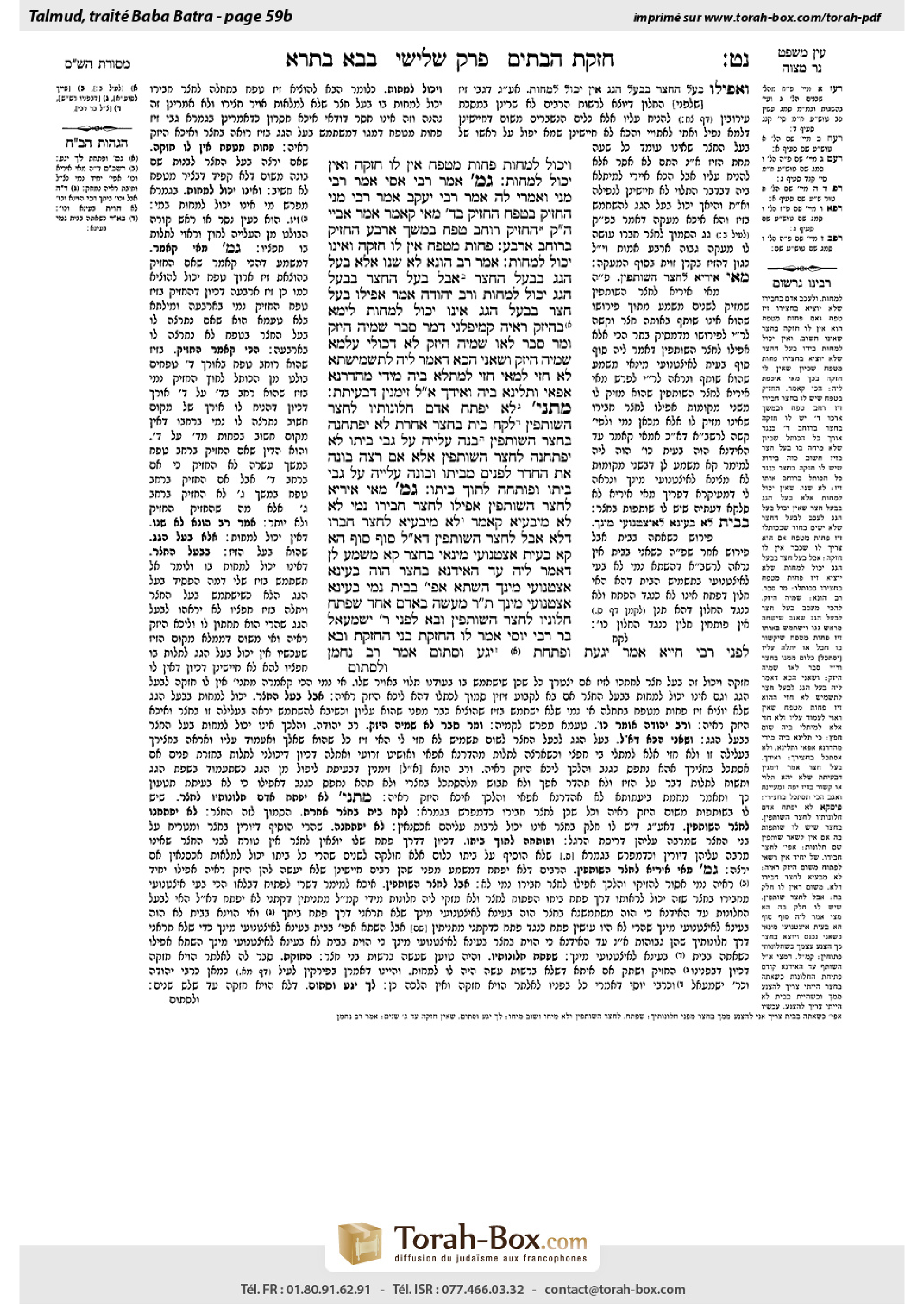
בבא בתרא נ״ט ב · Aramaic and Hebrew text
וְיָכוֹל לְמַחוֹת. פָּחוֹת מִטֶּפַח – אֵין לוֹ חֲזָקָה, וְאֵין יָכוֹל לְמַחוֹת.
גְּמָ׳ אָמַר רַבִּי אַסִּי אָמַר רַבִּי מָנִי, וְאָמְרִי לָהּ אָמַר רַבִּי יַעֲקֹב אָמַר רַבִּי מָנִי: הֶחְזִיק בְּטֶפַח – הֶחְזִיק בְּאַרְבַּע. מַאי קָאָמַר? אָמַר אַבָּיֵי, הָכִי קָאָמַר: הֶחְזִיק רוֹחַב טֶפַח בְּמֶשֶׁךְ אַרְבַּע – הֶחְזִיק בְּרוֹחַב אַרְבַּע.
פָּחוֹת מִטֶּפַח – אֵין לוֹ חֲזָקָה, וְאֵינוֹ יָכוֹל לְמַחוֹת. אָמַר רַב הוּנָא: לֹא שָׁנוּ אֶלָּא בַּעַל הַגָּג בְּבַעַל הֶחָצֵר, אֲבָל בַּעַל הֶחָצֵר בְּבַעַל הַגָּג – יָכוֹל לְמַחוֹת. וְרַב יְהוּדָה אָמַר: אֲפִילּוּ בַּעַל חָצֵר בְּבַעַל הַגָּג, אֵינוֹ יָכוֹל לְמַחוֹת.
לֵימָא בְּהֶיזֵּק רְאִיָּה קָמִיפַּלְגִי – דְּמָר סָבַר: שְׁמֵיהּ הֶיזֵּק, וּמָר סָבַר: לָאו שְׁמֵיהּ הֶיזֵּק?
לָא; דְּכוּלֵּי עָלְמָא שְׁמֵיהּ הֶיזֵּק; וְשָׁאנֵי הָכָא, דְּאָמַר לֵיהּ: לְתַשְׁמִישְׁתָּא – לָא חֲזֵי; לְמַאי חֲזֵי – לְמִתְלֵא בֵּיהּ מִידֵּי; מַהְדַּרְנָא אַפַּאי וְתָלֵינָא בֵּיהּ.
וְאִידַּךְ – אֲמַר לֵיהּ: זִימְנִין דִּבְעִיתַתְּ.
מַתְנִי׳ לֹא יִפְתַּח אָדָם חַלּוֹנוֹתָיו לַחֲצַר הַשּׁוּתָּפִין. לָקַח בַּיִת בְּחָצֵר אַחֶרֶת – לֹא יִפְתָּחֶנָּה בַּחֲצַר הַשּׁוּתָּפִין. בָּנָה עֲלִיָּיה עַל גַּבֵּי בֵּיתוֹ – לֹא יִפְתָּחֶנָּה לַחֲצַר הַשּׁוּתָּפִין; אֶלָּא אִם רָצָה – בּוֹנֶה אֶת הַחֶדֶר לְפָנִים מִבֵּיתוֹ, וּבוֹנֶה עֲלִיָּיה עַל גַּבֵּי בֵּיתוֹ, וּפוֹתְחָהּ לְתוֹךְ בֵּיתוֹ.
גְּמָ׳ מַאי אִירְיָא לַחֲצַר הַשּׁוּתָּפִין? אֲפִילּוּ לַחֲצַר חֲבֵירוֹ נָמֵי לָא!
לָא מִיבַּעְיָא קָאָמַר – לָא מִיבַּעְיָא לַחֲצַר חֲבֵרוֹ דְּלָא, אֲבָל לַחֲצַר הַשּׁוּתָּפִין, דְּאָמַר לֵיהּ: סוֹף סוֹף הָא קָא בָּעֵית אִצְטְנוֹעֵי מִינַּאי בֶּחָצֵר; קָא מַשְׁמַע לַן דַּאֲמַר לֵיהּ: עַד הָאִידָּנָא – בֶּחָצֵר הֲוָה בָּעֵינָא אִצְטְנוֹעֵי מִינָּךְ, הַשְׁתָּא – אֲפִילּוּ בַּבַּיִת נָמֵי בָּעֵינָא אִצְטְנוֹעֵי מִינָּךְ.
תָּנוּ רַבָּנַן: מַעֲשֶׂה בְּאָדָם אֶחָד שֶׁפָּתַח חַלּוֹנָיו לַחֲצַר הַשּׁוּתָּפִין; וּבָא לִפְנֵי רַבִּי יִשְׁמָעֵאל בַּר רַבִּי יוֹסֵי, אָמַר לוֹ: הֶחְזַקְתָּ בְּנִי, הֶחְזַקְתָּ; וּבָא לִפְנֵי רַבִּי חִיָּיא, אָמַר: יָגַעְתָּ וּפָתַחְתָּ, יְגַע וּסְתוֹם.
אָמַר רַב נַחְמָן:
Bava Batra 59b · English translation
and the owner of the courtyard can protest its construction. If it protrudes less than a handbreadth, the owner of the house has no means to establish an acquired privilege for its use, and the owner of the courtyard cannot protest its construction.
GEMARA: Rabbi Asi says that Rabbi Mani says, and some say that Rabbi Ya’akov says that Rabbi Mani says: If one established an acquired privilege with regard to a projection of a handbreadth, he has established an acquired privilege with regard to four handbreadths. The Gemara asks: What is he saying? Abaye said that this is what he is saying: If one established an acquired privilege with regard to a projection that measures one handbreadth wide by four handbreadths long, he has established an acquired privilege with regard to extending the projection to a width of four handbreadths.
The mishna teaches that if the projection protrudes less than a handbreadth the owner of the house has no means to establish an acquired privilege for its use, and the owner of the courtyard cannot protest. Rav Huna says: They taught only that the owner of the roof cannot protest the actions of the owner of the courtyard, i.e., he may not demand that the owner of the courtyard refrain from construction that interferes with the former’s use of the projection. But the owner of the courtyard can protest the actions of the owner of the roof, and demand that the latter not build a projection of any size, even less than a handbreadth. He can also demand that the owner of the roof not use an existing projection, since it leads to damage caused by sight. And Rav Yehuda says: Even the owner of the courtyard cannot protest the actions of the owner of the roof.
The Gemara suggests: Shall we say that they disagree with regard to damage caused by sight? As one Sage, Rav Huna, holds that it is considered to be damage, and therefore the owner of the courtyard can protest, since the owner of the roof has the means to see into the other’s courtyard when using this projection, and one Sage, Rav Yehuda, holds that it is not considered to be damage.
The Gemara rejects this: No, everyone agrees that damage caused by sight is considered to be damage. And Rav Yehuda holds it is different here, as the owner of the roof can say to the owner of the courtyard: The projection is not suitable for use, since it is too small for me to stand upon and look into the courtyard. For what purpose is it suitable? To hang items on it, and nothing more. I will turn my face away and hang items on it without looking into your courtyard.
And the other amora, Rav Huna, holds that the owner of the courtyard can say to the owner of the roof: There may be times when you are frightened due to the height of the projection, and you will look into my courtyard while using it.
MISHNA: A person may not open his windows, i.e., build an opening in a wall to use as a window, into a courtyard belonging to partners, i.e., a courtyard in which he is a partner. If he purchased a house in another, adjacent courtyard, he may not open the house into a courtyard belonging to partners. If he built a loft on top of his house, he may not open it into a courtyard belonging to partners. Rather, if he desired to build a loft, he may build a room within his house, or he may build a loft on top of his house, and open it into his house, not directly into the courtyard.
GEMARA: With regard to the mishna’s ruling that one may not open a window into a courtyard that he co-owns, the Gemara asks: Why did the mishna specifically render it prohibited for one to open a window into a courtyard belonging to partners? One may not open a window into another’s courtyard either, as it will lead to damage caused by sight.
The Gemara replies that the mishna is speaking utilizing the style of: It is not necessary, as follows: It is not necessary to say that it is not permitted for one to open a window into another’s courtyard, where he is certainly not allowed to look; but where one wants to open a window into a courtyard belonging to partners, where the owner of the window can say to the other partner: Ultimately, since you need to conceal yourself from me and conduct yourself modestly in the courtyard where I too am a partner and have the right to be present, why does it bother you if I open a window into there? Therefore, the mishna teaches us that the partner may say to him: Until now I needed to conceal myself from you only when we were both in the courtyard. Now I will need to conceal myself from you even in the house, as you can see into my house from your window.
The Sages taught in a baraita: There was an incident involving a person who opened his windows into a courtyard belonging to partners and came before Rabbi Yishmael bar Rabbi Yosei, who said to him: You have established an acquired privilege, my son; you have established an acquired privilege, and you may not be prevented from using the windows. And he came before Rabbi Ḥiyya, who said to him: You toiled and opened the windows; you must toil and seal them, as the partners have the right to prevent you from using these windows.
Rav Naḥman said:
Bava Batra 59b · Traduction française (IA)
et l'propriétaire du jardin peut protester contre sa construction. Si la projection dépasse moins d'une tefach, l'propriétaire de la maison n'a pas le moyen d'établir un droit acquis pour son usage, et l'propriétaire du jardin ne peut pas protester contre sa construction.
GUEMARA : Rabbi Asi dit que Rabbi Mani dit, et certains disent que Rabbi Ya'akov dit que Rabbi Mani dit : Si l'on a établi un droit acquis concernant une projection d'une tefach, l'on a établi un droit acquis concernant quatre tefach. La Guemara demande : De quoi parle-t-il ? Abaye dit que c'est ce qu'il dit : Si l'on a établi un droit acquis concernant une projection mesurant une tefach de largeur par quatre tefach de longueur, l'on a établi un droit acquis concernant l'extension de la projection à une largeur de quatre tefach.
La mitsna enseigne que si la projection dépasse moins d'une tefach, l'propriétaire de la maison n'a pas le moyen d'établir un droit acquis pour son usage, et l'propriétaire du jardin ne peut pas protester. Rav Huna dit : Ils ont enseigné seulement que l'propriétaire du toit ne peut pas protester contre les actions de l'propriétaire du jardin, c'est-à-dire qu'il ne peut pas exiger que l'propriétaire du jardin cesse de construire ce qui entrave l'usage de la projection par le premier. Mais l'propriétaire du jardin peut protester contre les actions de l'propriétaire du toit, et exiger que le second ne construise pas de projection de toute taille, même inférieure à une tefach. Il peut aussi exiger que l'propriétaire du toit ne utilise pas une projection existante, car cela entraîne un dommage causé par la vue. Et Rav Yehuda dit : Même l'propriétaire du jardin ne peut pas protester contre les actions de l'propriétaire du toit.
La Guemara suggère : Devons-nous dire qu'ils s'opposent concernant le dommage causé par la vue ? Comme un sage, Rav Huna, considère que cela constitue un dommage, et donc l'propriétaire du jardin peut protester, puisque l'propriétaire du toit a le moyen de voir dans le jardin de l'autre lorsqu'il utilise cette projection, et un sage, Rav Yehuda, considère que cela ne constitue pas un dommage.
La Guemara rejette cette idée : Non, tout le monde convient que le dommage causé par la vue constitue un dommage. Et Rav Yehuda considère que c'est différent ici, car l'propriétaire du toit peut dire à l'propriétaire du jardin : La projection n'est pas adaptée à l'usage, car elle est trop petite pour que je puisse m'y tenir et regarder dans le jardin. À quel usage est-elle adaptée ? À accrocher des objets dessus, et rien de plus. Je tournerai le dos et accrocherai des objets sans regarder dans votre jardin.
Et l'autre amora, Rav Huna, considère que l'propriétaire du jardin peut dire à l'propriétaire du toit : Il peut y avoir des moments où vous êtes effrayé à cause de la hauteur de la projection, et vous regarderez dans mon jardin en l'utilisant.
MICHNA : Une personne ne peut pas ouvrir ses fenêtres, c'est-à-dire construire une ouverture dans un mur pour l'utiliser comme fenêtre, dans un jardin appartenant à des partenaires, c'est-à-dire un jardin dans lequel il est partenaire. Si une personne a acheté une maison dans un autre jardin adjacent, elle ne peut pas ouvrir la maison dans un jardin appartenant à des partenaires. Si une personne a construit un étage au-dessus de sa maison, elle ne peut pas ouvrir l'étage dans un jardin appartenant à des partenaires. Plutôt, si une personne souhaite construire un étage, elle peut construire une pièce dans sa maison, ou construire un étage au-dessus de sa maison, et l'ouvrir dans sa maison, pas directement dans le jardin.
GUEMARA : Concernant la décision de la mitsna qui interdit d'ouvrir une fenêtre dans un jardin appartenant à des partenaires, la Guemara demande : Pourquoi la mitsna spécifie-t-elle que cela est interdit pour ouvrir une fenêtre dans un jardin appartenant à des partenaires ? On ne peut pas ouvrir une fenêtre dans le jardin d'autrui non plus, car cela entraînerait un dommage causé par la vue.
La Guemara répond que la mitsna parle en utilisant le style suivant : Il n'est pas nécessaire, comme suit : Il n'est pas nécessaire de dire que l'on ne peut pas ouvrir une fenêtre dans le jardin d'autrui, où l'on n'est certainement pas autorisé à regarder ; mais où l'on veut ouvrir une fenêtre dans un jardin appartenant à des partenaires, où l'propriétaire de la fenêtre peut dire au partenaire : Finalement, puisque tu dois te cacher de moi et te comporter modestement dans le jardin où je suis aussi un partenaire et ai le droit d'être présent, pourquoi t'embête-t-il que j'ouvre une fenêtre là ? Donc, la mitsna nous enseigne que le partenaire peut dire à lui : Jusqu'à présent j'avais besoin de me cacher de toi seulement quand nous étions tous les deux dans le jardin. Maintenant j'aurai besoin de me cacher de toi même dans la maison, car tu peux voir dans ma maison depuis ta fenêtre.
Les Sages ont enseigné dans une baraïta : Il y avait un incident concernant une personne qui avait ouvert ses fenêtres dans un jardin appartenant à des partenaires et était venu devant Rabbi Yishmael fils de Rabbi Yosei, qui lui a dit : Tu as établi un droit acquis, mon fils ; tu as établi un droit acquis, et tu ne peux pas être empêché d'utiliser les fenêtres. Et il est venu devant Rabbi Ḥiyya, qui lui a dit : Tu as travaillé et as ouvert les fenêtres ; tu dois travailler et les sceller, car les partenaires ont le droit de t'empêcher d'utiliser ces fenêtres.
Rav Naḥman a dit :
Traduction française générée par IA à partir de l’édition anglaise de Sefaria. Vérifie toujours un passage avec le texte source.
Text from Sefaria: William Davidson Edition - Vocalized Aramaic (CC BY NC); William Davidson Edition - English (CC BY NC).