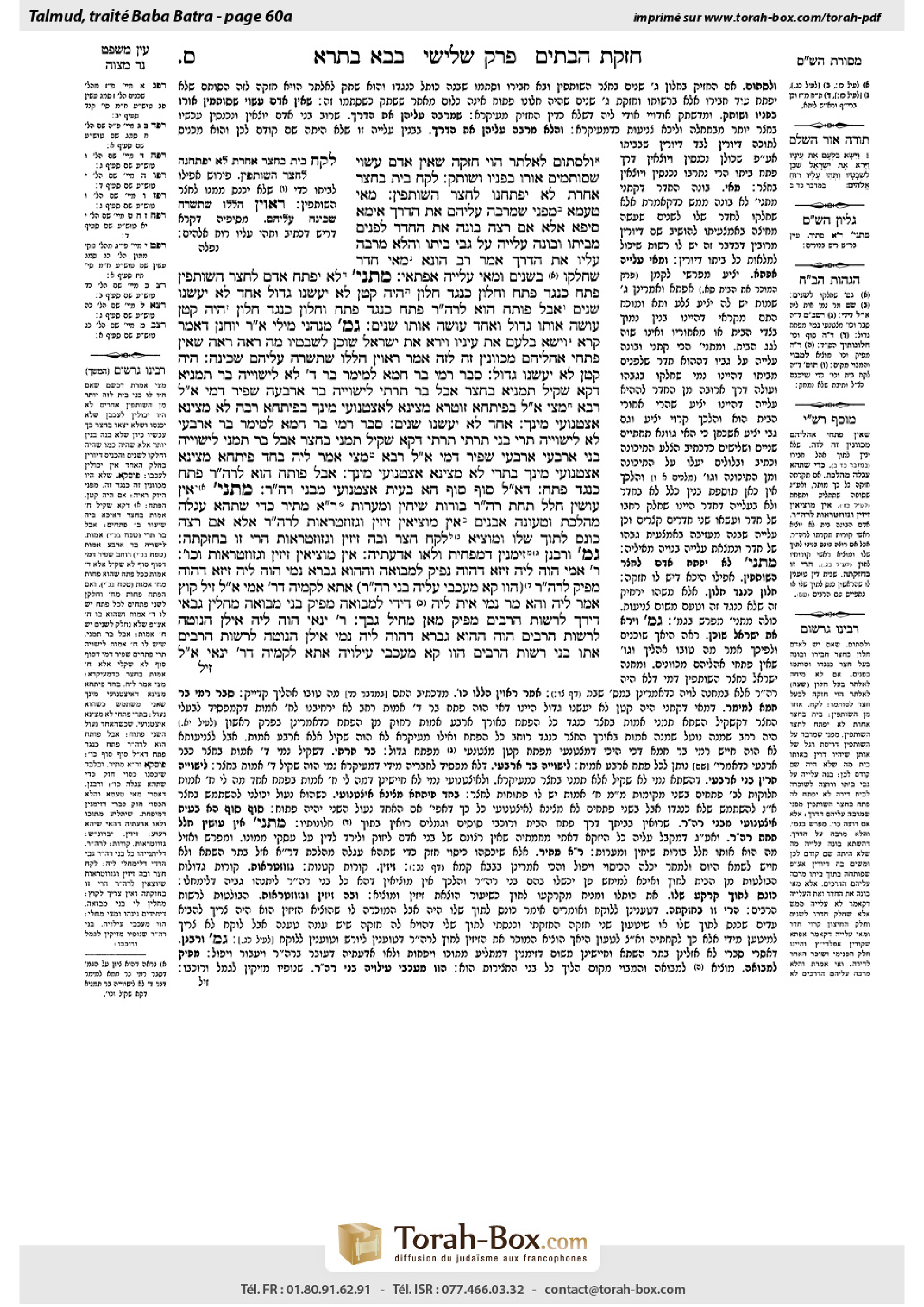
Bava Batra 60a: Talmud study for Daf Yomi
Study the Talmud for Daf Yomi with scanned pages, Hebrew text, English translations from Sefaria and AI-generated French translations.
Passage selection and English or AI-generated French translation are available where the scan has annotations. Daf Study is independent of Torah-Box and Sefaria.
Browse Bava Batra · בבא בתרא · All tractatesBava Batra 60a text and translations
This page of Bava Batra includes the Aramaic text, an English translation and an AI-generated French translation, alongside the scan above.
בבא בתרא ס׳ א · Aramaic and Hebrew text
וְלִסְתּוֹם – לְאַלְתַּר הָוֵי חֲזָקָה, שֶׁאֵין אָדָם עָשׂוּי שֶׁסּוֹתְמִים אוֹרוֹ בְּפָנָיו וְשׁוֹתֵק.
לָקַח בַּיִת בְּחָצֵר אַחֶרֶת – לֹא יִפְתָּחֶנּוּ לַחֲצַר הַשּׁוּתָּפִין. מַאי טַעְמָא? מִפְּנֵי שֶׁמַּרְבֶּה עֲלֵיהֶם אֶת הַדֶּרֶךְ.
אֵימָא סֵיפָא: אֶלָּא אִם רָצָה – בּוֹנֶה אֶת הַחֶדֶר לִפְנִים מִבֵּיתוֹ, וּבוֹנֶה עֲלִיָּיה עַל גַּבֵּי בֵּיתוֹ. וַהֲלֹא מַרְבֶּה עָלָיו אֶת הַדֶּרֶךְ! אָמַר רַב הוּנָא: מַאי חֶדֶר? שֶׁחֲלָקוֹ בִּשְׁנַיִם, וּמַאי עֲלִיָּיה? אַפְּתָאי.
מַתְנִי׳ לֹא יִפְתַּח אָדָם לַחֲצַר הַשּׁוּתָּפִין פֶּתַח כְּנֶגֶד פֶּתַח וְחַלּוֹן כְּנֶגֶד חַלּוֹן. הָיָה קָטָן – לֹא יַעֲשֶׂנּוּ גָּדוֹל, אֶחָד – לֹא יַעֲשֶׂנּוּ שְׁנַיִם. אֲבָל פּוֹתֵחַ הוּא לִרְשׁוּת הָרַבִּים פֶּתַח כְּנֶגֶד פֶּתַח וְחַלּוֹן כְּנֶגֶד חַלּוֹן. הָיָה קָטָן – עוֹשֶׂה אוֹתוֹ גָּדוֹל, וְאֶחָד – עוֹשֶׂה אוֹתוֹ שְׁנַיִם.
גְּמָ׳ מְנָהָנֵי מִילֵּי? אָמַר רַבִּי יוֹחָנָן, דְּאָמַר קְרָא: ״וַיִּשָּׂא בִלְעָם אֶת עֵינָיו, וַיַּרְא אֶת יִשְׂרָאֵל שֹׁכֵן לִשְׁבָטָיו״ – מָה רָאָה? רָאָה שֶׁאֵין פִּתְחֵי אׇהֳלֵיהֶם מְכֻוּוֹנִין זֶה לְזֶה, אָמַר: רְאוּיִן הַלָּלוּ שֶׁתִּשְׁרֶה עֲלֵיהֶם שְׁכִינָה.
הָיָה קָטָן – לֹא יַעֲשֶׂנּוּ גָּדוֹל. סָבַר רָמֵי בַּר חָמָא לְמֵימַר, בַּר אַרְבְּעֵי לָא לִישַׁוְּיֵיהּ בַּר תְּמָנְיָא – דְּקָא שָׁקֵיל תְּמָנְיָא בְּחָצֵר; אֲבָל בַּר תַּרְתֵּי לִישַׁוְּיֵיהּ בַּר אַרְבְּעֵי – שַׁפִּיר דָּמֵי; אֲמַר לֵיהּ רָבָא, מָצֵי אָמַר לֵיהּ: בְּפִיתְחָא זוּטְרָא מָצֵינָא לְאִצְטְנוֹעֵי מִינָּךְ, בְּפִיתְחָא רַבָּה לָא מָצֵינָא אִצְטְנוֹעֵי מִינָּךְ.
אֶחָד – לֹא יַעֲשֶׂנּוּ שְׁנַיִם. סָבַר רָמֵי בַּר חָמָא לְמֵימַר, בַּר אַרְבְּעֵי – לָא לִישַׁוְּיֵיהּ תְּרֵי בְּנֵי תַּרְתֵּי תַּרְתֵּי, דְּקָא שָׁקֵיל תַּמְנֵי בְּחָצֵר; אֲבָל בַּר תַּמְנֵי, לִישַׁוְּיֵיהּ בְּנֵי אַרְבְּעֵי אַרְבְּעֵי – שַׁפִּיר דָּמֵי; אֲמַר לֵיהּ רָבָא, מָצֵי אֲמַר לֵיהּ: בְּחַד פִּיתְחָא מָצֵינָא אִצְטְנוֹעֵי מִינָּךְ, בִּתְרֵי לָא מָצֵינָא אִצְטְנוֹעֵי מִינָּךְ.
אֲבָל פּוֹתֵחַ הוּא לִרְשׁוּת הָרַבִּים פֶּתַח כְּנֶגֶד פֶּתַח. דְּאָמַר לֵיהּ: סוֹף סוֹף, הָא בָּעֵית אִצְטְנוֹעֵי מִבְּנֵי רְשׁוּת הָרַבִּים.
מַתְנִי׳ אֵין עוֹשִׂין חָלָל תַּחַת רְשׁוּת הָרַבִּים – בּוֹרוֹת, שִׁיחִין וּמְעָרוֹת. רַבִּי אֱלִיעֶזֶר מַתִּיר כְּדֵי שֶׁתְּהֵא עֲגָלָה מְהַלֶּכֶת וּטְעוּנָה אֲבָנִים. אֵין מוֹצִיאִין זִיזִין וּגְזוּזְטְרָאוֹת לִרְשׁוּת הָרַבִּים, אֶלָּא אִם רָצָה – כּוֹנֵס לְתוֹךְ שֶׁלּוֹ, וּמוֹצִיא. לָקַח חָצֵר וּבָהּ זִיזִין וּגְזוּזְטְרָאוֹת – הֲרֵי זוֹ בְּחֶזְקָתָהּ.
גְּמָ׳ וְרַבָּנַן – זִימְנִין דְּמִפְּחִית וְלָאו אַדַּעְתֵּיהּ.
אֵין מוֹצִיאִין זִיזִין וּגְזוּזְטְרָאוֹת וְכוּ׳. רַבִּי אַמֵּי הֲוָה לֵיהּ זִיזָא דַּהֲוָה נָפֵיק לִמְבוֹאָה; וְהַהוּא גַּבְרָא נָמֵי הֲוָה לֵיהּ זִיזָא, דַּהֲוָה מַפֵּיק לִרְשׁוּת הָרַבִּים. הֲווֹ קָא מְעַכְּבִי עֲלֵיהּ בְּנֵי רְשׁוּת הָרַבִּים. אֲתָא לְקַמֵּיהּ דְּרַבִּי אַמֵּי, אֲמַר לֵיהּ: זִיל קוֹץ.
אֲמַר לֵיהּ: וְהָא מָר נָמֵי אִית לֵיהּ! דִּידִי לִמְבוֹאָה מַפֵּיק – בְּנֵי מְבוֹאָה מָחֲלִין גַּבַּאי; דִּידָךְ לִרְשׁוּת הָרַבִּים מַפֵּיק, מַאן מָחֵיל גַּבָּךְ?
רַבִּי יַנַּאי הֲוָה לֵיהּ אִילָן הַנּוֹטֶה לִרְשׁוּת הָרַבִּים. הֲוָה הָהוּא גַּבְרָא דַּהֲוָה לֵיהּ נָמֵי אִילָן הַנּוֹטֶה לִרְשׁוּת הָרַבִּים, אֲתוֹ בְּנֵי רְשׁוּת הָרַבִּים הֲווֹ קָא מְעַכְּבִי עִילָּוֵיהּ. אֲתָא לְקַמֵּיהּ דְּרַבִּי יַנַּאי, אֲמַר לֵיהּ:
Bava Batra 60a · English translation
And to seal, i.e., if one sealed another’s window in his presence, there is an acquired privilege established immediately to keep the window sealed, as it is not common behavior for a person to have his source of light sealed in his presence and remain silent. The fact that he did not immediately protest indicates that the one who sealed the window had the legal right to do so unilaterally, or that the owner of the window agreed.
§ The mishna teaches that if one purchased a house in another, adjacent courtyard, he may not open the house into a courtyard belonging to partners. The Gemara explains: What is the reason for this? Because by adding residents to the courtyard it increases their traffic, and the residents of the courtyard do not wish to be disturbed by additional people passing through.
The Gemara questions this. But say the last clause of the mishna: Rather, if he desired to build a loft, he may build a room within his house, or he may build a loft above his house, and have it open into his house, not directly into the courtyard. But if he does so, isn’t there still a concern that it increases the traffic? Rav Huna said as an explanation: What does the mishna mean when it says that he may build a room? It means that he may divide an existing room in two. And what is the loft to which the mishna is referring? It is an internal story created by dividing an existing space into two stories.
MISHNA: A person may not open an entrance opposite another entrance or a window opposite another window toward a courtyard belonging to partners, so as to ensure that the residents will enjoy a measure of privacy. If there was a small entrance he may not enlarge it. If there was one entrance he may not fashion it into two. But one may open an entrance opposite another entrance or a window opposite another window toward the public domain. Similarly, if there was a small entrance he may enlarge it, and if there was one entrance he may fashion it into two.
GEMARA: The Gemara asks: From where are these matters, i.e., that one may not open an entrance opposite another entrance, or a window opposite another window, derived? Rabbi Yoḥanan says that the verse states: “And Balaam lifted up his eyes, and he saw Israel dwelling tribe by tribe; and the spirit of God came upon him” (Numbers 24:2). The Gemara explains: What was it that Balaam saw that so inspired him? He saw that the entrances of their tents were not aligned with each other, ensuring that each family enjoyed a measure of privacy. And he said: If this is the case, these people are worthy of having the Divine Presence rest on them.
The mishna teaches that if there was a small entrance he may not enlarge it. Rami bar Ḥama thought to say this means that if the entrance was the width of four cubits, one may not fashion it to the width of eight cubits, as he would then be allowed to take eight corresponding cubits in the courtyard. The halakha is that one is entitled to utilize the area of the courtyard up to a depth of four cubits along the width of the opening. But if the entrance was the width of two cubits and one wishes to fashion it to the width of four cubits, one may well do so, as in any event he already had the right to use an area of four cubits by four cubits in front of the entrance. Rava said to him: This is not so, as his neighbor can say to him: I can conceal myself from you with there being a small entrance, but I cannot conceal myself from you with there being a large entrance.
The mishna teaches that if there was one entrance he may not fashion it into two. In this case as well, Rami bar Ḥama thought to say that this means if the entrance was the width of four cubits he may not make it into two openings, each the width of two cubits, as he would then be allowed to take eight corresponding cubits in the courtyard, four for each entrance. But if it was the width of eight cubits and he wishes to make it into two openings, each the width of four cubits, he may well do so, as in any event he already had the right to use an area of eight cubits by four cubits in front of his entrance. Rava said to him: This is not so, as his neighbor can say to him: I can conceal myself from you with there being one entrance, but I cannot conceal myself from you with there being two entrances.
The mishna teaches: But one may open an entrance opposite another entrance or a window opposite another window toward the public domain. Why is this so? Because he can say to the one who wishes to protest: Ultimately, you must conceal yourself from the people of the public domain. Since you cannot stop them from passing by and therefore cannot engage in behavior that requires privacy with your entrance open, it is of no consequence to you if I open an entrance as well.
MISHNA: One may not form an empty space beneath the public domain by digging pits, ditches, or caves. Rabbi Eliezer deems it permitted for one to do so, provided that he places a covering strong enough that a wagon laden with stones would be able to tread on it without breaking it, therefore ensuring that the empty space will not cause any damage to those in the public domain. One may not extend projections or balconies [ugzuztraot] into the public domain. Rather, if he desired to build one he may draw back into his property by moving his wall, and extend the projection to the end of his property line. If one purchased a courtyard in which there are projections and balconies extending into the public domain, this courtyard retains its presumptive status, i.e., the owner has the acquired privilege of their use, and the court does not demand their removal.
GEMARA: The Gemara asks: Rabbi Eliezer’s opinion that if the covering of the space is strong enough to support a wagon laden with stones then it is permitted to dig out the empty space, is eminently reasonable; but what do the Rabbis hold? The Gemara answers: There are times when the cover erodes over time, and he is not aware, thereby potentially causing damage to those in the public domain.
The mishna teaches that one may not extend projections or balconies into the public domain. The Gemara relates: Rabbi Ami had a projection that protruded into an alleyway, and a certain man also had a projection that protruded into the public domain, and the general public was preventing the man from leaving it there, as it interfered with traffic. He came before Rabbi Ami, who said to him: Go sever your projection.
The man said to him: But the Master also has a similar projection. Rabbi Ami said to him: It is different, as mine protrudes into an alleyway, where a limited number of people live, and the residents of the alleyway waive their right to protest to me. Yours protrudes into the public domain, which does not belong to any specific individuals. Who can waive their right to protest to you?
The Gemara relates: Rabbi Yannai had a tree that was leaning into the public domain. There was a certain man who also had a tree that was leaning into the public domain, and the general public was preventing him from leaving it there, insisting he cut it down, as required by the mishna (27b). He came before Rabbi Yannai, who said to him:
Bava Batra 60a · Traduction française (IA)
Et pour sceller, c'est-à-dire, si l'on scelle la fenêtre d'une autre personne devant lui, il y a un privilège acquis immédiatement pour garder la fenêtre scellée, car il n'est pas courant qu'une personne ait sa source de lumière scellée devant elle et reste muette. Le fait qu'il n'ait pas immédiatement protesté indique que celui qui a scellé la fenêtre avait le droit légal de le faire unilatéralement, ou que le propriétaire de la fenêtre a accepté.
§ La Michna enseigne que si l'on achète une maison dans un autre cour, adjacent, on ne peut pas ouvrir la maison vers un cour appartenant à des partenaires. La Guemara explique : De quelle raison cette règle découle-t-elle ? Parce qu'en ajoutant des habitants au cour, cela augmente leur trafic, et les habitants du cour ne souhaitent pas être dérangés par des personnes supplémentaires passant par là.
La Guemara questionne cela. Mais disons la dernière partie de la Michna : Plutôt, si l'on souhaitait construire un étage, on peut construire une pièce dans sa maison, ou construire un étage au-dessus de sa maison, et l'ouvrir vers sa maison, pas directement vers le cour. Mais si l'on fait cela, n'y a-t-il pas encore une préoccupation concernant l'augmentation du trafic ? Rav Huna a expliqué ainsi : De quoi la Michna parle-t-elle lorsqu'elle dit qu'on peut construire une pièce ? Elle signifie qu'on peut diviser une pièce existante en deux. Et quel est l'étage auquel la Michna fait référence ? C'est une histoire interne créée en divisant un espace existant en deux étages.
MICHNA : Une personne ne peut pas ouvrir une entrée opposée à une autre entrée ou une fenêtre opposée à une autre fenêtre vers un cour appartenant à des partenaires, afin de garantir que les habitants profiteront d'une mesure de confidentialité. Si l'entrée était petite, on ne peut pas l'agrandir. Si l'entrée était une, on ne peut pas la faire devenir deux. Mais on peut ouvrir une entrée opposée à une autre entrée ou une fenêtre opposée à une autre fenêtre vers le domaine public. De même, si l'entrée était petite, on peut l'agrandir, et si l'entrée était une, on peut la faire devenir deux.
GUEMARA : La Guemara pose la question : D'où ces règles, c'est-à-dire que l'on ne peut pas ouvrir une entrée opposée à une autre entrée, ou une fenêtre opposée à une autre fenêtre, sont-elles dérivées ? Rabbi Yoḥanan dit que la versette stipule : « Et Balaam leva les yeux, et il vit Israël habitant par tribu, et l'esprit de Dieu vint sur lui » (Nombres 24:2). La Guemara explique : Qu'est-ce que Balaam a vu qui l'a ainsi inspiré ? Il a vu que les entrées de leurs tentes n'étaient pas alignées les unes avec les autres, assurant ainsi que chaque famille profiterait d'une mesure de confidentialité. Et il a dit : Si c'est le cas, ces gens sont dignes de ce que la Présence Divine repose sur eux.
La mitsva enseigne que si l'entrée était petite, on ne peut pas l'agrandir. Rami bar Ḥama pensait que cela signifiait que si l'entrée avait une largeur de quatre coudées, on ne pouvait pas la faire devenir une largeur de huit coudées, car cela permettrait alors à l'individu d'utiliser huit coudées correspondantes dans le cour, quatre pour chaque entrée. La halakha est que l'on a le droit d'utiliser l'espace du cour jusqu'à une profondeur de quatre coudées le long de la largeur de l'ouverture. Mais si l'entrée avait une largeur de deux coudées et qu'on souhaitait la faire devenir une largeur de quatre coudées, on peut le faire, car on avait déjà le droit d'utiliser une surface de quatre coudées par quatre coudées devant l'entrée. Rava a dit à lui : Ce n'est pas ainsi, car son voisin peut lui dire : Je peux me cacher de toi avec une petite entrée, mais je ne peux pas me cacher de toi avec une grande entrée.
La mitsva enseigne que si l'entrée était une, on ne peut pas la faire devenir deux. Dans ce cas également, Rami bar Ḥama pensait que cela signifiait que si l'entrée avait une largeur de quatre coudées, on ne pouvait pas la faire devenir deux ouvertures, chacune de deux coudées, car cela permettrait alors à l'individu d'utiliser huit coudées correspondantes dans le cour, quatre pour chaque entrée. Mais si l'entrée avait une largeur de huit coudées et qu'on souhaitait la faire devenir deux ouvertures, chacune de quatre coudées, on peut le faire, car on avait déjà le droit d'utiliser une surface de huit coudées par quatre coudées devant son entrée. Rava a dit à lui : Ce n'est pas ainsi, car son voisin peut lui dire : Je peux me cacher de toi avec une seule entrée, mais je ne peux pas me cacher de toi avec deux entrées.
La mitsva enseigne : Mais on peut ouvrir une entrée opposée à une autre entrée ou une fenêtre opposée à une autre fenêtre vers le domaine public. Pourquoi est-ce ainsi ? Parce qu'on peut dire à celui qui souhaite protester : Finalement, vous devez vous cacher des habitants du domaine public. Car vous ne pouvez pas empêcher qu'ils passent par là et donc ne pouvez pas engager un comportement nécessitant la confidentialité avec votre entrée ouverte, il n'y a donc pas d'importance pour vous si j'ouvre une entrée également.
MITSVA : On ne peut pas créer un espace vide sous le domaine public en creusant des puits, des fossés ou des grottes. Rabbi Eliezer considère que cela est permis, à condition qu'on place une couverture suffisamment solide pour que l'on puisse y faire rouler un chariot chargé de pierres sans qu'elle ne se brise, garantissant ainsi que l'espace vide ne causera pas de dommages à ceux du domaine public. On ne peut pas étendre des projections ou des balcons [ugzuztraot] vers le domaine public. Plutôt, si l'on souhaitait construire un tel élément, on peut reculer dans sa propriété en déplaçant son mur, et étendre la projection jusqu'à la limite de sa propriété. Si l'on a acheté un cour qui contient des projections et des balcos s'étendant vers le domaine public, ce cour conserve son statut présomptif, c'est-à-dire que le propriétaire a le privilège acquis d'utiliser ces éléments, et la cour ne demande pas leur retrait.
GUEMARA : La Guemara pose la question : L'opinion de Rabbi Eliezer selon laquelle si la couverture de l'espace est suffisamment solide pour supporter un chariot chargé de pierres, il est permis de creuser l'espace vide, est tout à fait raisonnable ; mais qu'en est-il selon les Rabbins ? La Guemara répond : Il y a des moments où la couverture s'érode avec le temps, et l'individu n'en est pas conscient, ce qui pourrait potentiellement causer des dommages à ceux du domaine public.
La Michna enseigne qu'on ne peut pas édifier de balcons ou de prolongements vers le domaine public. La Guemara rapporte : Rabbi Ami avait un balcon qui dépassait dans une cour, et un certain homme avait aussi un balcon qui dépassait dans le domaine public, et le public empêchait cet homme de le laisser ainsi, car cela gênait la circulation. Il vint devant Rabbi Ami, qui lui dit : Va, coupe ton balcon.
L'homme lui dit : Mais le Maître a aussi un tel balcon. Rabbi Ami lui dit : C'est différent, car le mien dépassait dans une cour, où vivent un petit nombre de personnes, et les habitants de la cour renoncent à leur droit de protester contre moi. Le tien dépassait dans le domaine public, qui n'appartient à personne en particulier. Qui peut renoncer à leur droit de protester contre toi ?
La Guemara rapporte : Rabbi Yannai avait un arbre qui penchait vers le domaine public. Il y avait un certain homme qui avait aussi un arbre qui penchait vers le domaine public, et le public l'empêchait de le laisser ainsi, exigeant qu'il le coupe, selon la Michna (27b). Il vint devant Rabbi Yannai, qui lui dit :
Traduction française générée par IA à partir de l’édition anglaise de Sefaria. Vérifie toujours un passage avec le texte source.
Text from Sefaria: William Davidson Edition - Vocalized Aramaic (CC BY NC); William Davidson Edition - English (CC BY NC).