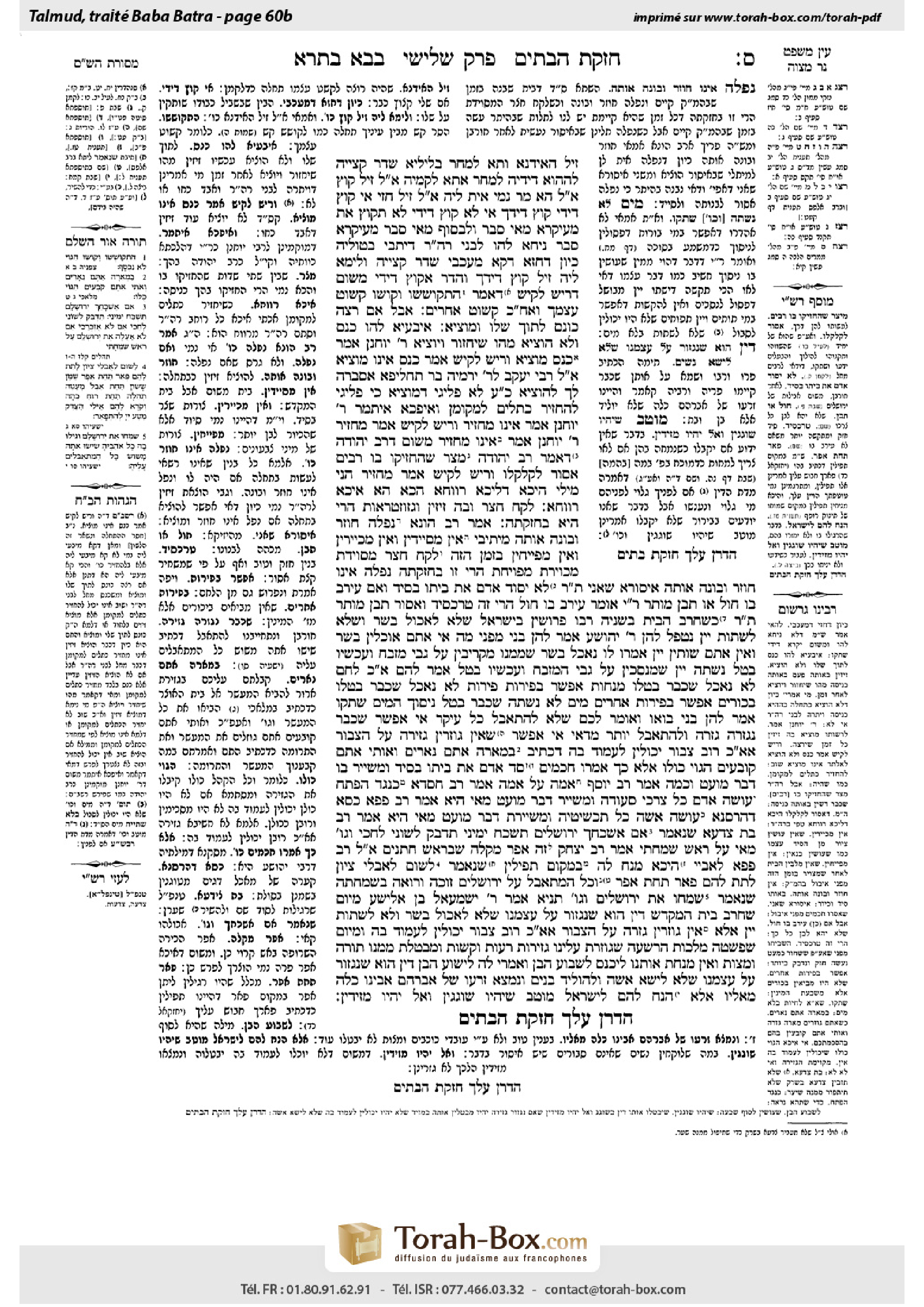
Bava Batra 60b: Talmud study for Daf Yomi
Study the Talmud for Daf Yomi with scanned pages, Hebrew text, English translations from Sefaria and AI-generated French translations.
Passage selection and English or AI-generated French translation are available where the scan has annotations. Daf Study is independent of Torah-Box and Sefaria.
Browse Bava Batra · בבא בתרא · All tractatesBava Batra 60b text and translations
This page of Bava Batra includes the Aramaic text, an English translation and an AI-generated French translation, alongside the scan above.
בבא בתרא ס׳ ב · Aramaic and Hebrew text
זִיל הָאִידָּנָא וְתָא לִמְחַר. בְּלֵילְיָא, שַׁדַּר קַצְיֵיהּ לְהָהוּא דִּידֵיהּ.
לִמְחַר אֲתָא לְקַמֵּיהּ, אֲמַר לֵיהּ: זִיל קוֹץ. אָמַר לֵיהּ: הָא מָר נָמֵי אִית לֵיהּ! אָמַר לֵיהּ: זִיל חֲזִי; אִי קוּץ דִּידִי – קוֹץ דִּידָךְ, אִי לָא קוּץ דִּידִי – לָא תִּקּוֹץ אַתְּ.
מֵעִיקָּרָא מַאי סְבַר וּלְבַסּוֹף מַאי סְבַר? מֵעִיקָּרָא סְבַר: נִיחָא לְהוּ לִבְנֵי רְשׁוּת הָרַבִּים, דְּיָתְבִי בְּטוּלֵּיהּ. כֵּיוָן דַּחֲזָא דְּקָא מְעַכְּבִי, שַׁדַּר קַצְיֵיהּ. וְלֵימָא לֵיהּ: זִיל קוֹץ דִּידָךְ, וַהֲדַר אֶקּוֹץ דִּידִי! מִשּׁוּם דְּרֵישׁ לָקִישׁ, דְּאָמַר: ״הִתְקוֹשְׁשׁוּ וָקוֹשּׁוּ״ – קְשׁוֹט עַצְמְךָ וְאַחַר כָּךְ קְשׁוֹט אֲחֵרִים.
אֲבָל אִם רָצָה – כּוֹנֵס לְתוֹךְ שֶׁלּוֹ וּמוֹצִיא. אִיבַּעְיָא לְהוּ: כָּנַס וְלֹא הוֹצִיא, מַהוּ שֶׁיַּחֲזוֹר וְיוֹצִיא? רַבִּי יוֹחָנָן אָמַר: כָּנַס – מוֹצִיא. וְרֵישׁ לָקִישׁ אָמַר: כָּנַס – אֵינוֹ מוֹצִיא.
אֲמַר לֵיהּ רַבִּי יַעֲקֹב לְרַבִּי יִרְמְיָה בַּר תַּחְלִיפָא, אַסְבְּרַהּ לָךְ: לְהוֹצִיא – כּוּלֵּי עָלְמָא לָא פְּלִיגִי דְּמוֹצִיא, כִּי פְּלִיגִי – לְהַחֲזִיר כְּתָלִים לִמְקוֹמָן; וְאִיפְּכָא אִיתְּמַר – רַבִּי יוֹחָנָן אָמַר: אֵינוֹ מַחְזִיר, וְרֵישׁ לָקִישׁ אָמַר: מַחְזִיר.
רַבִּי יוֹחָנָן אָמַר: אֵינוֹ מַחְזִיר – מִשּׁוּם דְּרַב יְהוּדָה, דְּאָמַר רַב יְהוּדָה: מֶצֶר שֶׁהֶחֱזִיקוּ בּוֹ רַבִּים, אָסוּר לְקַלְקְלוֹ. וְרֵישׁ לָקִישׁ אָמַר: מַחְזִיר – הָנֵי מִילֵּי הֵיכָא דְּלֵיכָּא רַוְוחָא, הָכָא הָא אִיכָּא רַוְוחָא.
לָקַח חָצֵר וּבָהּ זִיזִין וּגְזוּזְטְרָאוֹת – הֲרֵי הִיא בְּחֶזְקָתָהּ. אָמַר רַב הוּנָא: נָפְלָה, חוֹזֵר וּבוֹנֶה אוֹתָהּ.
מֵיתִיבִי: אֵין מְסַיְּידִין וְאֵין מְכַיְּירִין וְאֵין מְפַיְּיחִין בַּזְּמַן הַזֶּה. לָקַח חָצֵר מְסוּיֶּדֶת, מְכוּיֶּרֶת, מְפוּיַּחַת – הֲרֵי זוֹ בְּחֶזְקָתָהּ. נָפְלָה – אֵינוֹ חוֹזֵר וּבוֹנֶה אוֹתָהּ!
אִיסּוּרָא שָׁאנֵי.
תָּנוּ רַבָּנַן: לֹא יָסוּד אָדָם אֶת בֵּיתוֹ בְּסִיד. וְאִם עֵירַב בּוֹ חוֹל אוֹ תֶּבֶן – מוּתָּר. רַבִּי יְהוּדָה אוֹמֵר: עֵירַב בּוֹ חוֹל – הֲרֵי זֶה טְרַכְסִיד, וְאָסוּר; תֶּבֶן – מוּתָּר.
תָּנוּ רַבָּנַן: כְּשֶׁחָרַב הַבַּיִת בַּשְּׁנִיָּה, רַבּוּ פְּרוּשִׁין בְּיִשְׂרָאֵל שֶׁלֹּא לֶאֱכוֹל בָּשָׂר וְשֶׁלֹּא לִשְׁתּוֹת יַיִן. נִטְפַּל לָהֶן רַבִּי יְהוֹשֻׁעַ, אָמַר לָהֶן: בָּנַי, מִפְּנֵי מָה אִי אַתֶּם אוֹכְלִין בָּשָׂר וְאֵין אַתֶּם שׁוֹתִין יַיִן? אָמְרוּ לוֹ: נֹאכַל בָּשָׂר – שֶׁמִּמֶּנּוּ מַקְרִיבִין עַל גַּבֵּי מִזְבֵּחַ, וְעַכְשָׁיו בָּטֵל? נִשְׁתֶּה יַיִן – שֶׁמְּנַסְּכִין עַל גַּבֵּי הַמִּזְבֵּחַ, וְעַכְשָׁיו בָּטֵל?
אָמַר לָהֶם: אִם כֵּן, לֶחֶם לֹא נֹאכַל – שֶׁכְּבָר בָּטְלוּ מְנָחוֹת! אֶפְשָׁר בְּפֵירוֹת. פֵּירוֹת לֹא נֹאכַל – שֶׁכְּבָר בָּטְלוּ בִּכּוּרִים! אֶפְשָׁר בְּפֵירוֹת אֲחֵרִים. מַיִם לֹא נִשְׁתֶּה – שֶׁכְּבָר בָּטֵל נִיסּוּךְ הַמַּיִם! שָׁתְקוּ.
אָמַר לָהֶן: בָּנַי, בּוֹאוּ וְאוֹמַר לָכֶם: שֶׁלֹּא לְהִתְאַבֵּל כׇּל עִיקָּר אִי אֶפְשָׁר – שֶׁכְּבָר נִגְזְרָה גְּזֵרָה; וּלְהִתְאַבֵּל יוֹתֵר מִדַּאי אִי אֶפְשָׁר – שֶׁאֵין גּוֹזְרִין גְּזֵירָה עַל הַצִּבּוּר, אֶלָּא אִם כֵּן רוֹב צִבּוּר יְכוֹלִין לַעֲמוֹד בָּהּ – דִּכְתִיב: ״בַּמְּאֵרָה אַתֶּם נֵאָרִים, וְאֹתִי אַתֶּם קֹבְעִים; הַגּוֹי כֻּלּוֹ״ –
אֶלָּא כָּךְ אָמְרוּ חֲכָמִים: סָד אָדָם אֶת בֵּיתוֹ בְּסִיד, וּמְשַׁיֵּיר בּוֹ דָּבָר מוּעָט; וְכַמָּה? אָמַר רַב יוֹסֵף: אַמָּה עַל אַמָּה. אָמַר רַב חִסְדָּא: כְּנֶגֶד הַפֶּתַח.
עוֹשֶׂה אָדָם כׇּל צׇרְכֵי סְעוּדָה, וּמְשַׁיֵּיר דָּבָר מוּעָט; מַאי הִיא? אָמַר רַב פָּפָּא: כָּסָא דְהַרְסָנָא.
עוֹשָׂה אִשָּׁה כׇּל תַּכְשִׁיטֶיהָ, וּמְשַׁיֶּירֶת דָּבָר מוּעָט; מַאי הִיא? אָמַר רַב: בַּת צִדְעָא. שֶׁנֶּאֱמַר: ״אִם אֶשְׁכָּחֵךְ יְרוּשָׁלִָם, תִּשְׁכַּח יְמִינִי. תִּדְבַּק לְשׁוֹנִי לְחִכִּי וְגוֹ׳״.
מַאי ״עַל רֹאשׁ שִׂמְחָתִי״? אָמַר רַב יִצְחָק: זֶה אֵפֶר מִקְלֶה שֶׁבְּרֹאשׁ חֲתָנִים. אֲמַר לֵיהּ רַב פָּפָּא לְאַבָּיֵי: הֵיכָא מַנַּח לֵהּ? בִּמְקוֹם תְּפִילִּין, שֶׁנֶּאֱמַר: ״לָשׂוּם לַאֲבֵלֵי צִיּוֹן, לָתֵת לָהֶם פְּאֵר תַּחַת אֵפֶר״.
וְכׇל הַמִּתְאַבֵּל עַל יְרוּשָׁלַיִם – זוֹכֶה וְרוֹאֶה בְּשִׂמְחָתָהּ, שֶׁנֶּאֱמַר: ״שִׂמְחוּ אֶת יְרוּשָׁלַםִ וְגוֹ׳״.
תַּנְיָא, אָמַר רַבִּי יִשְׁמָעֵאל בֶּן אֱלִישָׁע: מִיּוֹם שֶׁחָרַב בֵּית הַמִּקְדָּשׁ, דִּין הוּא שֶׁנִּגְזוֹר עַל עַצְמֵנוּ שֶׁלֹּא לֶאֱכוֹל בָּשָׂר וְלֹא לִשְׁתּוֹת יַיִן; אֶלָּא אֵין גּוֹזְרִין גְּזֵרָה עַל הַצִּבּוּר אֶלָּא אִם כֵּן רוֹב צִבּוּר יְכוֹלִין לַעֲמוֹד בָּהּ.
וּמִיּוֹם שֶׁפָּשְׁטָה מַלְכוּת הָרְשָׁעָה, שֶׁגּוֹזֶרֶת עָלֵינוּ גְּזֵירוֹת רָעוֹת וְקָשׁוֹת, וּמְבַטֶּלֶת מִמֶּנּוּ תּוֹרָה וּמִצְוֹת, וְאֵין מַנַּחַת אוֹתָנוּ לִיכָּנֵס לִשְׁבוּעַ הַבֵּן, וְאָמְרִי לַהּ: לִישׁוּעַ הַבֵּן; דִּין הוּא שֶׁנִּגְזוֹר עַל עַצְמֵנוּ שֶׁלֹּא לִישָּׂא אִשָּׁה וּלְהוֹלִיד בָּנִים, וְנִמְצָא זַרְעוֹ שֶׁל אַבְרָהָם אָבִינוּ כָּלֶה מֵאֵלָיו;
אֶלָּא הַנַּח לָהֶם לְיִשְׂרָאֵל – מוּטָב שֶׁיִּהְיוּ שׁוֹגְגִין, וְאַל יִהְיוּ מְזִידִין.
הַדְרָן עֲלָךְ חֶזְקַת הַבָּתִּים
Bava Batra 60b · English translation
Go now, and come tomorrow. At night, Rabbi Yannai sent and had someone cut down that tree that belonged to him.
The next day, that man came before Rabbi Yannai, who said to him: Go, cut down your tree. The man said to him: But the Master also has a tree that leans into the public domain. Rabbi Yannai said to him: Go and see: If mine is cut down, then cut yours down. If mine is not cut down, you do not have to cut yours down, either.
The Gemara asks: At the outset what did Rabbi Yannai hold, and ultimately, what did he hold? The Gemara replies: At the outset, he held that the general public is amenable to having the tree there, as they sit in its shade. Once he saw that they were preventing someone else who owned a tree from keeping his, he understood that it was only out of respect that they did not object to his tree being there. He therefore sent someone to cut it down. The Gemara asks: But why did he tell the man to return the next day? Let him say to him: Go cut down your tree, and then I will cut mine down. The Gemara answers: Because of the statement of Reish Lakish, who said: The verse states: “Gather yourselves together and gather [hitkosheshu vakoshu]” (Zephaniah 2:1), and this can be explained homiletically to mean: Adorn [keshot] yourself and afterward adorn others, i.e., act properly before requiring others to do so.
§ The mishna teaches that one may not extend projections or balconies into the public domain. Rather, if he desired to build one he may draw back into his property by moving his wall, and extend the projection to the end of his property line. A dilemma was raised before the Sages: If one drew back into his property but did not extend the projection at that time, what is the halakha concerning whether he may return and extend it at a later date? Rabbi Yoḥanan says: If one drew back into his property, he may extend it even later, and Reish Lakish says: If one drew back into his property but did not build the projection at that time, he may not extend it later.
The Gemara presents an alternative version of the dispute: Rabbi Ya’akov said to Rabbi Yirmeya bar Taḥlifa: I will explain the matter to you. To later extend a projection, everyone agrees that he may extend it, since he is adding within his own property. Where they disagree is with regard to whether he may return the walls to their prior place. And with regard to this disagreement the opposite was stated: Rabbi Yoḥanan says he may not return the walls to their prior place, and Reish Lakish says he may return them.
Rabbi Ya’akov explains their reasoning: Rabbi Yoḥanan says that he may not return the walls to their prior place because of the statement of Rav Yehuda, as Rav Yehuda says: With regard to a path that the public has established as a public thoroughfare, it is prohibited to ruin it, i.e., to prevent people from using it. Once the public has become accustomed to using the place where his wall had stood, he may not repossess that space. And Reish Lakish says that he may return the walls to their prior place, because that matter applies in a case where there is no space, i.e., if he were to move back the wall there would be no space for the public to walk, but here there is space, since they can still walk through the public domain.
The mishna teaches that if one purchased a courtyard in which there are projections and balconies extending into the public domain, this courtyard retains its presumptive status, allowing the owner to use the projections. Rav Huna says: If the wall of the courtyard fell, he may return and build it as it was, including the projections or balconies.
The Gemara raises an objection based on that which is taught in a baraita (Tosefta 9:17): One may not plaster, and one may not tile, and one may not paint [mefayyeḥin] images in the present, as a sign of mourning for the destruction of the Temple. But if one purchased a courtyard that was plastered, tiled, or painted with images, this courtyard retains its presumptive status, and it is assumed that it was done in a permitted manner. If it then fell, he may not return and build it in its previous form. This indicates that one may not rebuild a building in a manner that is prohibited, even if there was an acquired privilege to maintain it in that manner.
The Gemara answers: A case of forbidden matters is different, i.e., in the case of the baraita, he may not rebuild it because it is prohibited for him to do so. In this mishna, the issue is encroachment upon the rights of others, and once he had an acquired privilege to use the projections or balconies, he maintains that right.
§ With regard to the ruling of the above-quoted baraita, the Sages taught (Tosefta, Sota 15:9): A person may not plaster his house with plaster, but if he mixed sand or straw into the plaster, which dulls its luster, it is permitted. Rabbi Yehuda says: If he mixed sand into it, it is white cement [terakesid], which is of a higher quality than standard plaster, and it is prohibited, but if he mixed in straw, it is permitted.
§ Having mentioned the prohibition against plastering, which is a sign of mourning over the destruction of the Temple, the Gemara discusses related matters. The Sages taught in a baraita (Tosefta, Sota 15:11): When the Temple was destroyed a second time, there was an increase in the number of ascetics among the Jews, whose practice was to not eat meat and to not drink wine. Rabbi Yehoshua joined them to discuss their practice. He said to them: My children, for what reason do you not eat meat and do you not drink wine? They said to him: Shall we eat meat, from which offerings are sacrificed upon the altar, and now the altar has ceased to exist? Shall we drink wine, which is poured as a libation upon the altar, and now the altar has ceased to exist?
Rabbi Yehoshua said to them: If so, we will not eat bread either, since the meal-offerings that were offered upon the altar have ceased. They replied: You are correct. It is possible to subsist with produce. He said to them: We will not eat produce either, since the bringing of the first fruits have ceased. They replied: You are correct. We will no longer eat the produce of the seven species from which the first fruits were brought, as it is possible to subsist with other produce. He said to them: If so, we will not drink water, since the water libation has ceased. They were silent, as they realized that they could not survive without water.
Rabbi Yehoshua said to them: My children, come, and I will tell you how we should act. To not mourn at all is impossible, as the decree was already issued and the Temple has been destroyed. But to mourn excessively as you are doing is also impossible, as the Sages do not issue a decree upon the public unless a majority of the public is able to abide by it, as it is written: “You are cursed with the curse, yet you rob Me, even this whole nation” (Malachi 3:9), indicating that the prophet rebukes the people for neglecting observances only if they were accepted by the whole nation.
Rabbi Yehoshua continues: Rather, this is what the Sages said: A person may plaster his house with plaster, but he must leave over a small amount in it without plaster to remember the destruction of the Temple. The Gemara interjects: And how much is a small amount? Rav Yosef said: One cubit by one cubit. Rav Ḥisda said: This should be opposite the entrance, so that it is visible to all.
Rabbi Yehoshua continues: The Sages said that a person may prepare all that he needs for a meal, but he must leave out a small item to remember the destruction of the Temple. The Gemara interjects: What is this small item? Rav Pappa said: Something akin to small, fried fish.
Rabbi Yehoshua continues: The Sages said that a woman may engage in all of her cosmetic treatments, but she must leave out a small matter to remember the destruction of the Temple. The Gemara interjects: What is this small matter? Rav said: She does not remove hair from the place on the temple from which women would remove hair. The source for these practices is a verse, as it is stated: “If I forget you, Jerusalem, let my right hand forget its cunning. Let my tongue cleave to the roof of my mouth, if I remember you not; if I set not Jerusalem above my highest joy” (Psalms 137:5–6).
The Gemara asks: What is the meaning of: Above my highest [rosh] joy? Rav Yitzḥak says: This is referring to the burnt ashes that are customarily placed on the head [rosh] of bridegrooms at the time of their wedding celebrations, to remember the destruction of the Temple. Rav Pappa said to Abaye: Where are they placed? Abaye replied: On the place where phylacteries are placed, as it is stated: “To appoint to them that mourn in Zion, to give to them a garland in place of ashes” (Isaiah 61:3). Since phylacteries are referred to as a garland (see Ezekiel 24:17), it may be inferred from this verse that the ashes were placed in the same place as the phylacteries.
The baraita continues: And anyone who mourns for the destruction of Jerusalem will merit and see its joy, as it is stated: “Rejoice with Jerusalem, and be glad with her, all that love her; rejoice for joy with her, all that mourn for her” (Isaiah 66:10).
It is taught in a baraita (Tosefta, Sota 15:10) that Rabbi Yishmael ben Elisha said: From the day that the Temple was destroyed, by right, we should decree upon ourselves not to eat meat and not to drink wine, but the Sages do not issue a decree upon the public unless a majority of the public is able to abide by it.
And from the day that the wicked kingdom, i.e., Rome, spread, who decree evil and harsh decrees upon us, and nullify Torah study and the performance of mitzvot for us, and do not allow us to enter the celebration of the first week of a son, i.e., circumcision, and some say: To enter the celebration of the salvation of a firstborn son; by right we should each decree upon ourselves not to marry a woman and not to produce offspring, and it will turn out that the descendants of Abraham our forefather will cease to exist on their own, rather than being forced into a situation where there are sons who are not circumcised.
But concerning a situation such as this, the following principle is applied: Leave the Jews alone and do not impose decrees by which they cannot abide. It is better that they be unwitting sinners, who do not know that what they are doing is improper considering the circumstances, and not be intentional wrongdoers, who marry and procreate despite knowing that they should not.
Bava Batra 60b · Traduction française (IA)
Allez maintenant, et revenez demain. La nuit, le maître Yannai envoya quelqu'un couper cet arbre qui lui appartenait.
Le lendemain, cet homme vint devant le maître Yannai, qui lui dit : Allez, coupez votre arbre. L'homme lui dit : Mais le maître a aussi un arbre qui penche dans le domaine public. Le maître Yannai lui dit : Allez voir : Si le mien est coupé, alors coupez le vôtre. Si le mien n'est pas coupé, vous n'avez pas besoin de couper le vôtre non plus.
La Guemara demande : Au début, quel était l'opinion du maître Yannai, et finalement, quelle était-elle ? La Guemara répond : Au début, il pensait que le public était d'accord pour laisser l'arbre là, car ils s'assoyaient à l'ombre. Une fois qu'il vit qu'ils empêchaient quelqu'un d'autre, qui possédait un arbre, de le garder, il comprit qu'ils ne s'opposaient pas à son arbre uniquement par respect. Il envoya donc quelqu'un le couper. La Guemara demande : Mais pourquoi a-t-il dit à l'homme de revenir le lendemain ? Laissez-lui dire : Allez couper votre arbre, et alors je couperai le mien. La Guemara répond : À cause de la déclaration de Reish Lakish, qui dit : L'Écriture dit : « Rassemblez-vous et rassemblez [hitkosheshu vakoshu] » (Zéphanie 2:1), et cela peut être expliqué par allégorie pour signifier : Adonnez-vous [keshot] et ensuite adonnez les autres, c'est-à-dire agissez correctement avant de demander aux autres de le faire.
§ La Michna enseigne qu'on ne peut pas étendre des balcons ou des projections dans le domaine public. Plutôt, si l'on voulait construire un tel balcon, on peut reculer son mur dans sa propriété et étendre la projection jusqu'à la limite de sa propriété. Un dilemme fut soulevé devant les Sages : Si l'on recula dans sa propriété mais ne construisit pas la projection à ce moment-là, quelle est la halakha concernant la possibilité de l'étendre plus tard ? Rabbi Yoḥanan dit : Si l'on recula dans sa propriété, on peut étendre la projection même plus tard, et Reish Lakish dit : Si l'on recula dans sa propriété mais ne construisit pas la projection à ce moment-là, on ne peut pas l'étendre plus tard.
La Guemara présente une version alternative du débat : Rabbi Ya’akov dit à Rabbi Yirmeya bar Taḥlifa : Je vais vous expliquer la question. Pour étendre une projection plus tard, tout le monde convient qu'on peut le faire, car on ajoute dans sa propre propriété. L'endroit où ils divergent est concernant la possibilité de remettre les murs à leur place initiale. Et concernant ce débat, l'opposé fut dit : Rabbi Yoḥanan dit qu'on ne peut pas remettre les murs à leur place initiale, et Reish Lakish dit qu'on peut les remettre.
Rabbi Ya’akov explique leur raisonnement : Rabbi Yoḥanan dit qu'il ne peut pas remettre les murs à leur ancienne place en raison de la déclaration de Rav Yehuda, car Rav Yehuda dit : En ce qui concerne un chemin que le public a établi comme une voie publique, il est interdit de le détruire, c'est-à-dire d'empêcher les gens de l'utiliser. Une fois que le public s'est habitué à utiliser la place où se trouvait son mur, il ne peut pas reprendre possession de cet espace. Et Reish Lakish dit qu'il peut remettre les murs à leur ancienne place, car cette affaire s'applique à un cas où il n'y a pas d'espace, c'est-à-dire si on déplaçait le mur, il n'y aurait plus d'espace pour que le public marche, mais ici il y a de l'espace, car ils peuvent encore marcher dans le domaine public.
La mitsna enseigne que si l'on achète un courtil dans lequel il y a des prolongements et des balcons s'étendant dans le domaine public, ce courtil conserve son statut présomptif, permettant à l'acheteur d'utiliser les prolongements. Rav Huna dit : Si le mur du courtil s'effondre, il peut revenir et le reconstruire tel qu'il était, y compris les prolongements ou les balcons.
Le Guemara soulève une objection basée sur ce qui est enseigné dans une baraïta (Tosefta 9:17) : On ne peut pas enduire, on ne peut pas carreler, et on ne peut pas peindre des images dans le présent, comme signe de deuil pour la destruction du Temple. Mais si l'on achète un courtil qui a été enduit, carrelé ou peint avec des images, ce courtil conserve son statut présomptif, et on suppose qu'il a été fait de manière permise. Si ensuite il s'effondre, il ne peut pas revenir et le reconstruire dans sa forme précédente. Cela montre qu'on ne peut pas reconstruire un bâtiment de manière interdite, même si l'on avait acquis le droit de le maintenir ainsi.
Le Guemara répond : Le cas des choses interdites est différent, c'est-à-dire, dans le cas de la baraïta, il ne peut pas le reconstruire car il est interdit de le faire. Dans cette mitsna, la question est l'encroachment sur les droits d'autrui, et une fois qu'il avait acquis le droit d'utiliser les prolongements ou les balcons, il conserve ce droit.
§ En ce qui concerne la décision de la baraïta mentionnée ci-dessus, les Sages ont enseigné (Tosefta, Sota 15:9) : Une personne ne peut pas enduire sa maison, mais si elle mélange du sable ou de la paille dans l'enduit, ce qui assombrit son éclat, cela est permis. Rabbi Yehuda dit : Si elle mélange du sable, cela est du ciment blanc [terakesid], qui est de meilleure qualité que l'enduit ordinaire, et cela est interdit, mais si elle mélange de la paille, cela est permis.
§ Ayant mentionné l'interdiction d'enduire, qui est un signe de deuil pour la destruction du Temple, le Guemara discute des questions connexes. Les Sages ont enseigné dans une baraïta (Tosefta, Sota 15:11) : Lorsque le Temple a été détruit une deuxième fois, il y a eu une augmentation du nombre d'ascètes parmi les Juifs, dont la pratique était de ne pas manger de viande et de ne pas boire du vin. Rabbi Yehoshua a rejoint leur groupe pour discuter de leur pratique. Il leur a dit : Mes enfants, pourquoi ne mangez-vous pas de viande et ne buvez-vous pas de vin ? Ils lui ont répondu : Devons-nous manger de la viande, de laquelle des offrandes sont sacrifiées sur l'autel, et maintenant l'autel n'existe plus ? Devons-nous boire du vin, qui est versé comme libation sur l'autel, et maintenant l'autel n'existe plus ?
Rabbi Yehoshua dit à ceux-ci : Si c'est ainsi, nous ne mangerons pas de pain non plus, car les offrandes de table offertes sur l'autel ont cessé. Ils répondirent : Vous avez raison. Il est possible de subsister avec les produits. Il dit à ceux-ci : Nous ne mangerons pas non plus de produits, car l'offrande des premiers fruits a cessé. Ils répondirent : Vous avez raison. Nous ne mangerons plus les produits des sept espèces desquels les premiers fruits étaient offerts, car il est possible de subsister avec d'autres produits. Il dit à ceux-ci : Si c'est ainsi, nous ne boirons pas d'eau non plus, car la libation d'eau a cessé. Ils restèrent silencieux, car ils réalisèrent qu'ils ne pouvaient pas survivre sans eau.
Rabbi Yehoshua dit à ceux-ci : Mes enfants, venez, je vais vous dire comment nous devons agir. Ne pas pleurer du tout est impossible, car l'édit a déjà été prononcé et le Temple a été détruit. Mais pleurer excessivement comme vous le faites est également impossible, car les Sages ne prononcent pas un édit public à moins qu'une majorité du public puisse le respecter, comme il est écrit : « Vous êtes maudits par la malédiction, et pourtant vous me volez, même cette nation tout entière » (Michna, Lévitique 3:9), indiquant que le prophète réprimande le peuple pour l'oubli des commandements seulement si ceux-ci étaient acceptés par toute la nation.
Rabbi Yehoshua continue : Plutôt, c'est ce que les Sages ont dit : Une personne peut enduire sa maison de plâtre, mais il doit laisser un petit espace non enduit pour se souvenir de la destruction du Temple. La Guemara interrompt : Et combien est-ce que ce petit espace ? Rav Yosef dit : Un cubit par un cubit. Rav Ḥisda dit : Cela doit être opposé à l'entrée, afin qu'il soit visible à tous.
Rabbi Yehoshua continue : Les Sages ont dit qu'une personne peut préparer tout ce dont elle a besoin pour un repas, mais elle doit laisser de côté un petit objet pour se souvenir de la destruction du Temple. La Guemara interrompt : Quel est ce petit objet ? Rav Pappa dit : Quelque chose semblable à de petits poissons frits.
Rabbi Yehoshua continue : Les Sages ont dit qu'une femme peut entreprendre toutes ses soins cosmétiques, mais elle doit laisser de côté un petit détail pour se souvenir de la destruction du Temple. La Guemara interrompt : Quel est ce petit détail ? Rav dit : Elle ne retire pas les cheveux de la place du temple d'où les femmes retiraient les cheveux. La source de ces pratiques est un verset, comme il est dit : « Si je t'oublie, Jérusalem, que mon droit main oublie son astuce. Que ma langue s'attache au plafond de ma bouche, si je ne te pense pas ; si je ne mets pas Jérusalem au-dessus de ma joie la plus haute » (Psaumes 137:5–6).
La Guemara demande : Quelle est la signification de : Au-dessus de ma joie la plus haute ? Rav Yitzḥak dit : Cela fait référence aux cendres brûlées qui sont habituellement placées sur la tête des mariés lors de leurs cérémonies de mariage, pour se souvenir de la destruction du Temple. Rav Pappa dit à Abaye : Où sont-ils placés ? Abaye répondit : Sur la place où les phylactères sont placés, comme il est dit : « Pour appointer à ceux qui pleurent à Zion, pour leur donner un diadème à la place des cendres » (Isaïe 61:3). Puisque les phylactères sont appelés un diadème (voir Ezéchiel 24:17), il peut être inféré de ce verset que les cendres étaient placées à la même place que les phylactères.
La baraïta continue : Et celui qui pleure la destruction de Jérusalem mérite et verra sa joie, comme il est dit : « Réjouissez-vous avec Jérusalem, et soyez joyeux avec elle, tous ceux qui l'aiment ; réjouissez-vous pour la joie avec elle, tous ceux qui pleurent pour elle » (Isaïe 66:10).
Il est enseigné dans une baraïta (Tosefta, Sota 15:10) que Rabbi Yishmael ben Elisha a dit : Depuis le jour où le Temple a été détruit, par droit, nous devrions décréter sur nous-mêmes de ne pas manger de viande et de ne pas boire de vin, mais les Sages ne prononcent pas un édit public à moins qu'une majorité du public puisse le respecter.
Et depuis le jour où le royaume maléfique, c'est-à-dire Rome, s'est étendu, qui décrète des édits mauvais et durs contre nous, et annule l'étude de la Torah et la pratique des commandements pour nous, et ne nous permet pas d'entrer dans la célébration de la première semaine d'un fils, c'est-à-dire la circoncision, et certains disent : Entrer dans la célébration de la sauvegarde d'un premier-né ; par droit nous devrions chacun décréter sur nous-mêmes de ne pas épouser une femme et de ne pas avoir d'enfants, et cela entraînerait que les descendants d'Abraham notre père cesseront d'exister de leur propre volonté, plutôt que d'être mis dans une situation où il y a des fils non circoncis.
Mais concernant une situation telle que celle-ci, le principe suivant est appliqué : Laissez les Juifs tranquilles et ne pas imposer d'édits par lesquels ils ne peuvent pas vivre. Il est préférable qu'ils soient des pécheurs inconscients, qui ne savent pas que ce qu'ils font est inapproprié en raison des circonstances, et non des fauteurs intentionnels, qui épousent et procréent sachant qu'ils ne devraient pas le faire.
Traduction française générée par IA à partir de l’édition anglaise de Sefaria. Vérifie toujours un passage avec le texte source.
Text from Sefaria: William Davidson Edition - Vocalized Aramaic (CC BY NC); William Davidson Edition - English (CC BY NC).