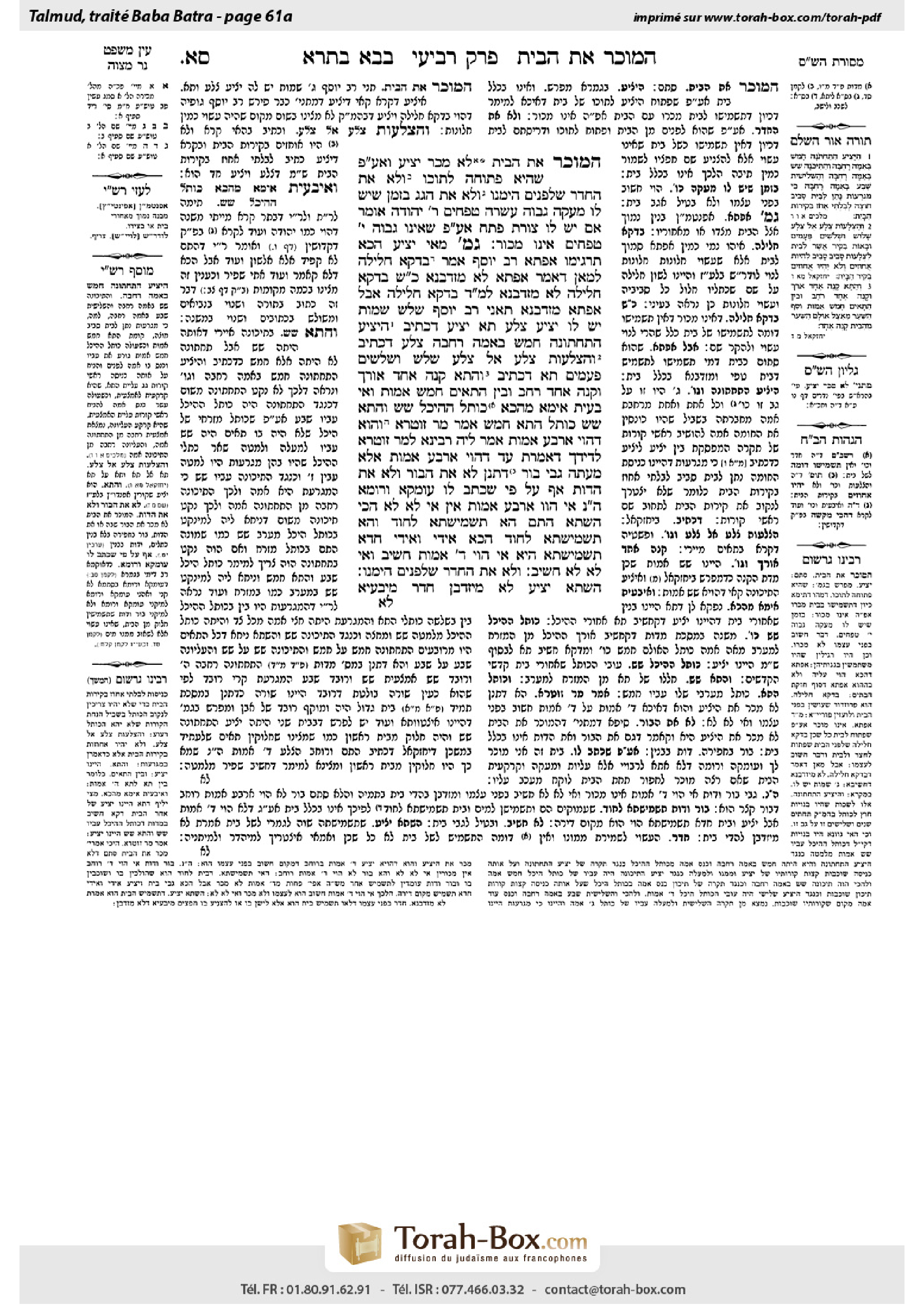
Bava Batra 61a: Talmud study for Daf Yomi
Study the Talmud for Daf Yomi with scanned pages, Hebrew text, English translations from Sefaria and AI-generated French translations.
Passage selection and English or AI-generated French translation are available where the scan has annotations. Daf Study is independent of Torah-Box and Sefaria.
Browse Bava Batra · בבא בתרא · All tractatesBava Batra 61a text and translations
This page of Bava Batra includes the Aramaic text, an English translation and an AI-generated French translation, alongside the scan above.
בבא בתרא ס״א א · Aramaic and Hebrew text
הַמּוֹכֵר אֶת הַבַּיִת – לֹא מָכַר יָצִיעַ, וְאַף עַל פִּי שֶׁהִיא פְּתוּחָה לְתוֹכוֹ; וְלֹא אֶת הַחֶדֶר שֶׁלְּפָנִים הֵימֶנּוּ; וְלֹא אֶת הַגָּג – בִּזְמַן שֶׁיֵּשׁ לוֹ מַעֲקֶה גָּבוֹהַּ עֲשָׂרָה טְפָחִים. רַבִּי יְהוּדָה אוֹמֵר: אִם יֵשׁ לוֹ צוּרַת פֶּתַח, אַף עַל פִּי שֶׁאֵינוֹ גָּבוֹהַּ עֲשָׂרָה טְפָחִים – אֵינוֹ מָכוּר.
גְּמָ׳ מַאי ״יָצִיעַ״? הָכָא תַּרְגִּימוּ: אַפְּתָא. רַב יוֹסֵף אָמַר: בַּדְקָא חֲלִילָה. לְמַאן דְּאָמַר אַפְּתָא לָא מִזְדַּבְּנָא – כׇּל שֶׁכֵּן בַּדְקָא חֲלִילָה לָא מִזְדַּבְּנָא; לְמַאן דְּאָמַר בַּדְקָא חֲלִילָה – אֲבָל אַפְּתָא מִזְדַּבְּנָא.
תָּאנֵי רַב יוֹסֵף: שָׁלֹשׁ שֵׁמוֹת יֵשׁ לוֹ – יָצִיעַ, צֵלָע, תָּא. יָצִיעַ – דִּכְתִיב: ״הַיָּצִיעַ הַתַּחְתֹּנָה חָמֵשׁ בָּאַמָּה רׇחְבָּהּ״. צֵלָע – דִּכְתִיב: ״וְהַצְּלָעוֹת צֵלָע אֶל צֵלָע שָׁלֹשׁ וּשְׁלֹשִׁים פְּעָמִים״. תָּא – דִּכְתִיב: ״וְהַתָּא קָנֶה אֶחָד אֹרֶךְ וְקָנֶה אֶחָד רֹחַב, וּבֵין הַתָּאִים חָמֵשׁ אַמּוֹת״. וְאִי בָּעֵית אֵימָא, מֵהָכָא: ״כּוֹתֶל הַהֵיכָל שֵׁשׁ, וְהַתָּא שֵׁשׁ, כּוֹתֶל הַתָּא חָמֵשׁ״.
אָמַר מָר זוּטְרָא: וְהוּא דְּהָוֵי אַרְבַּע אַמּוֹת.
אֲמַר לֵיהּ רָבִינָא לְמָר זוּטְרָא: לְדִידָךְ דְּאָמְרַתְּ עַד דְּהָוֵי אַרְבַּע אַמּוֹת; אֶלָּא מֵעַתָּה, גַּבֵּי בוֹר דִּתְנַן: לֹא אֶת הַבּוֹר וְלֹא אֶת הַדּוּת – אַף עַל פִּי שֶׁכָּתַב לוֹ עוּמְקָא וְרוּמָא; הָכִי נָמֵי אִי הָווּ אַרְבַּע אַמּוֹת – אִין, אִי לָא – לָא?
הָכִי הַשְׁתָּא?! הָתָם – הָא תַּשְׁמִישְׁתָּא לְחוּד, וְהָא תַּשְׁמִישְׁתָּא לְחוּד; הָכָא – אִידֵּי וְאִידֵּי חֲדָא תַּשְׁמִישְׁתָּא הִיא; אִי הָוֵי אַרְבַּע אַמּוֹת – חֲשִׁיב, וְאִי לָא – לָא חֲשִׁיב.
וְלֹא אֶת הַחֶדֶר שֶׁלִּפְנִים הֵימֶנּוּ. הַשְׁתָּא יָצִיעַ לָא מִיזְדַּבַּן, חֶדֶר מִיבַּעְיָא?!
Bava Batra 61a · English translation
MISHNA: One who sells a house without specifying what is included in the sale has not sold the gallery, an extension built above or alongside the main building, and this is so even if the gallery is attached to the house and opens into it. Nor has he sold the room behind the house, even if it is accessible only from inside the house. He has also not sold the roof when it has a parapet ten handbreadths high, as such a roof is considered a separate entity and is therefore not included in the sale of the house. Rabbi Yehuda says: If the parapet has the form of a doorway, that is, if it consists of two upright posts with a beam crossing over them, then even if the parapet is not ten handbreadths high, the roof is not sold together with the house, unless it is specifically included in the sale.
GEMARA: What is a gallery? Here in Babylonia they interpreted this as referring to an attic [apta]. Rav Yosef said: It means a windowed structure [bidka ḥalila] attached to the main building. The Gemara notes that according to the one who says that an attic is not sold together with a house, all the more so is a windowed structure attached to the house not sold together with a house, as it is certainly considered a separate entity and not part of the main building. But according to the one who says that a gallery is a windowed structure attached to the house, it is only such a structure that is not included in the sale of the house, but an attic is sold together with a house.
Rav Yosef taught: A small structure attached to a building has three names in the Bible: Gallery [yatzia], side chamber [tzela], and cell [ta]. Such a structure is called a gallery, as it is written: “The bottommost gallery [hayyatzia] was five cubits wide” (I Kings 6:6). It is also called a side chamber, as it is written: “And the side chambers [vehatzelaot] were one over another, thirty-three times” (Ezekiel 41:6). Additionally, it is called a cell, as it is written: “And the cell [vehata] was one reed long, and one reed wide; and the space between the cells was five cubits” (Ezekiel 40:7). And if you wish, say instead that it can be seen that a small structure attached to a building is called a cell from here, as was taught in the mishna (Middot 4:7): The wall of the Sanctuary was six cubits wide, and the cell [vehata] in back of it was six cubits wide, and the wall of the cell was five cubits wide.
§ Relating to the mishna’s statement that a gallery is not included in the sale of a house, Mar Zutra said: And that is the halakha only when the gallery has an area of at least four by four cubits.
Ravina said to Mar Zutra: According to your opinion, that you say a gallery is not excluded from the sale of a house unless it is at least four by four cubits in size, there is a difficulty. As if that is so, then with regard to the exclusion of a pit or a cistern from the sale of a house, about which we learned in a mishna (64a): One who sells a house has sold neither the pit nor the cistern, even if he writes for the buyer in the bill of sale that he is selling him the depth and the height of the house; so too, should we say that only if they have an area of at least four by four cubits, yes, they are excluded from the sale of the house, but if not, no, they are not excluded? This is difficult, as a pit is not four cubits wide, and consequently, it would never be excluded.
Mar Zutra responded: How can these cases be compared? There, in that mishna, this, the excavations, have a discrete use, to store water, and they cannot possibly be used as living quarters, and that, the house, has a discrete use, to serve as living quarters, and so they are considered separate entities even if the excavation is not four cubits wide. But here, in the case of a gallery, both this, the gallery, and that, the house, have the same use, and so if the gallery is at least four by four cubits it is deemed significant and considered a separate entity, but if it is not four by four cubits, it is not deemed significant in its own right, but simply another part of the house.
The mishna teaches that one who sells a house without specifying what is included in the sale has not sold the gallery, nor has he sold the room behind the house, even if it is accessible only from it. The Gemara asks: Now that the mishna taught that a gallery is not sold along with the house, is it necessary to teach that a room behind the house is not included in such a sale?
Bava Batra 61a · Traduction française (IA)
MICHNA : Celui qui vend une maison sans préciser ce qui est inclus dans la vente n'a pas vendu la galerie, une extension construite au-dessus ou à côté de la maison principale, et cela même si la galerie est attachée à la maison et s'ouvre dans celle-ci. Il n'a pas non plus vendu la pièce derrière la maison, même si celle-ci est accessible uniquement depuis l'intérieur de la maison. Il n'a pas non plus vendu le toit lorsqu'il possède un parapet de dix paumes de haut, car un tel toit est considéré comme une entité distincte et n'est donc pas inclus dans la vente de la maison. Rabbi Yehuda dit : Si le parapet a la forme d'une porte, c'est-à-dire s'il est constitué de deux poteaux verticaux avec une poutre traversant entre eux, alors même si le parapet n'est pas de dix paumes de haut, le toit n'est pas vendu avec la maison, à moins qu'il ne soit spécifiquement inclus dans la vente.
GUEMARA : Qu'est-ce qu'une galerie ? Ici en Babylone, on l'interprète comme désignant une salle de stockage [apta]. Rav Yosef dit : Cela signifie une structure fenestrée [bidka ḥalila] attachée à la maison principale. La Guemara note que selon celui qui dit qu'une salle de stockage n'est pas vendue avec une maison, encore davantage une structure fenestrée attachée à la maison n'est pas vendue avec la maison, car elle est certainement considérée comme une entité distincte et non partie de la maison principale. Mais selon celui qui dit qu'une galerie est une structure fenestrée attachée à la maison, c'est uniquement ce genre de structure qui n'est pas inclus dans la vente de la maison, mais une salle de stockage est vendue avec la maison.
Rav Yosef enseigna : Une petite structure attachée à un bâtiment a trois noms dans la Bible : galerie [yatzia], chambre latérale [tzela], et cellule [ta]. Une telle structure est appelée une galerie, car il est écrit : « La galerie inférieure [hayyatzia] était large de cinq coudées » (I Rois 6:6). Elle est aussi appelée une chambre latérale, car il est écrit : « Et les chambres latérales [vehatzelaot] étaient l'une au-dessus de l'autre, trente-trois fois » (Ezéchiel 41:6). De plus, elle est appelée une cellule, car il est écrit : « Et la cellule [vehata] était longue d'une coudée et large d'une coudée ; et l'espace entre les cellules était de cinq coudées » (Ezéchiel 40:7). Et si vous le souhaitez, dites plutôt que l'on peut voir qu'une petite structure attachée à un bâtiment est appelée une cellule d'ici, comme cela a été enseigné dans la mitsva (Middot 4:7) : La muraille du Sanctuaire était large de six coudées, et la cellule [vehata] derrière elle était large de six coudées, et la muraille de la cellule était large de cinq coudées.
§ En ce qui concerne l'affirmation de la mitsva que la galerie n'est pas incluse dans la vente d'une maison, Mar Zutra dit : Et cela est la halakha uniquement lorsque la galerie a une surface d'au moins quatre coudées par quatre coudées.
Ravina dit à Mar Zutra : Selon votre opinion, que vous dites qu'une galerie n'est pas exclue de la vente d'une maison à moins qu'elle ait une surface d'au moins quatre coudées par quatre coudées, il y a une difficulté. Car si c'est ainsi, alors concernant l'exclusion d'une fosse ou d'un puits de la vente d'une maison, comme nous l'avons appris dans une mitsva (64a) : Celui qui vend une maison n'a pas vendu la fosse ni le puits, même s'il écrit à l'acheteur dans le contrat de vente qu'il lui vend la profondeur et la hauteur de la maison ; de même, devrions-nous dire qu'ils sont exclus de la vente de la maison uniquement s'ils ont une surface d'au moins quatre coudées par quatre coudées, mais s'ils n'en ont pas, ils ne sont pas exclus ? Cela est difficile, car une fosse n'est pas large de quatre coudées, et par conséquent, elle ne serait jamais exclue.
Mar Zutra répondit : Comment peuvent ces cas être comparés ? Là, dans cette mitsva, ces excavations ont une utilisation distincte, pour stocker de l'eau, et elles ne peuvent pas être utilisées comme des logements, et celle-ci, la maison, a une utilisation distincte, pour servir de logement, et donc elles sont considérées comme des entités distinctes même si l'excavation n'est pas large de quatre coudées. Mais ici, dans le cas d'une galerie, à la fois celle-ci, la galerie, et celle-là, la maison, ont la même utilisation, et donc si la galerie est large d'au moins quatre coudées par quatre coudées, elle est considérée comme importante et comme une entité distincte, mais si elle n'est pas large de quatre coudées par quatre coudées, elle n'est pas considérée comme importante en elle-même, mais simplement une autre partie de la maison.
La mitsva enseigne que celui qui vend une maison sans préciser ce qui est inclus dans la vente n'a pas vendu la galerie, ni n'a vendu la pièce derrière la maison, même si celle-ci est accessible uniquement depuis celle-ci. La Guemara pose la question : Maintenant que la mitsva a enseigné que la galerie n'est pas vendue avec la maison, est-il nécessaire d'enseigner que la pièce derrière la maison n'est pas incluse dans telle vente ?
Traduction française générée par IA à partir de l’édition anglaise de Sefaria. Vérifie toujours un passage avec le texte source.
Text from Sefaria: William Davidson Edition - Vocalized Aramaic (CC BY NC); William Davidson Edition - English (CC BY NC).