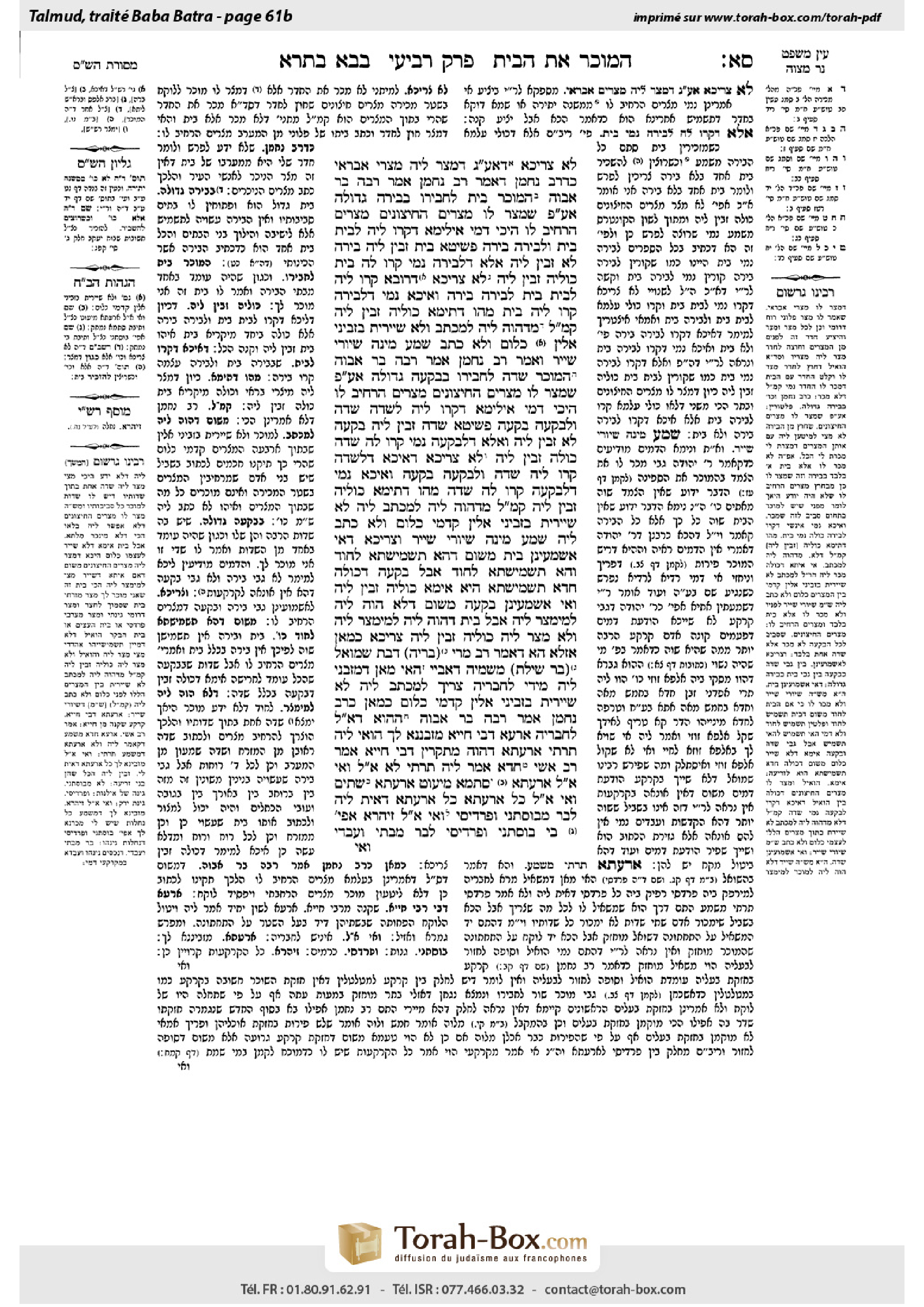
Bava Batra 61b: Talmud study for Daf Yomi
Study the Talmud for Daf Yomi with scanned pages, Hebrew text, English translations from Sefaria and AI-generated French translations.
Passage selection and English or AI-generated French translation are available where the scan has annotations. Daf Study is independent of Torah-Box and Sefaria.
Browse Bava Batra · בבא בתרא · All tractatesBava Batra 61b text and translations
This page of Bava Batra includes the Aramaic text, an English translation and an AI-generated French translation, alongside the scan above.
בבא בתרא ס״א ב · Aramaic and Hebrew text
לָא צְרִיכָא, דְּאַף עַל גַּב דִּמְצַר לֵיהּ מִצְרֵי אַבָּרַאי –
כִּדְרַב נַחְמָן, דְּאָמַר רַב נַחְמָן אָמַר רַבָּה בַּר אֲבוּהּ: הַמּוֹכֵר בַּיִת לַחֲבֵירוֹ בְּבִירָה גְּדוֹלָה, אַף עַל פִּי שֶׁמָּצַר לוֹ מְצָרִים הַחִיצוֹנִים – מְצָרִים הִרְחִיב לוֹ.
הֵיכִי דָמֵי? אִילֵּימָא דְּקָרוּ לֵיהּ לְבַיִת ״בַּיִת״ וּלְבִירָה ״בִּירָה״, פְּשִׁיטָא – בַּיִת זַבֵּין לֵיהּ, בִּירָה לָא זַבֵּין לֵיהּ! אֶלָּא דִּלְבִירָה נָמֵי קָרוּ לַהּ ״בַּיִת״? כּוּלֵּיהּ זַבֵּין לֵיהּ!
לָא צְרִיכָא, דְּרוּבָּא קָרוּ לֵיהּ לְבַיִת ״בַּיִת״ לְבִירָה ״בִּירָה״, וְאִיכָּא נָמֵי דִּלְבִירָה קָרוּ לֵיהּ ״בַּיִת״; מַהוּ דְּתֵימָא כּוּלֵּיהּ זַבֵּין לֵיהּ, קָא מַשְׁמַע לַן – מִדַּהֲוָה לֵיהּ לְמִכְתַּב: ״וְלָא שַׁיַּירִית בִּזְבִינִי אִלֵּין כְּלוּם״, וְלָא כְּתַב, שְׁמַע מִינַּהּ שַׁיּוֹרֵי שַׁיַּיר.
וְאָמַר רַב נַחְמָן אָמַר רַבָּה בַּר אֲבוּהּ: הַמּוֹכֵר שָׂדֶה לַחֲבֵירוֹ בְּבִקְעָה גְּדוֹלָה, אַף עַל פִּי שֶׁמָּצַר לוֹ מְצָרִים הַחִיצוֹנִים – מְצָרִים הִרְחִיב לוֹ.
הֵיכִי דָמֵי? אִילֵּימָא דְּקָרוּ לֵיהּ לְשָׂדֶה ״שָׂדֶה״ וּלְבִקְעָה ״בִּקְעָה״, פְּשִׁיטָא – שָׂדֶה זַבֵּין לֵיהּ, בִּקְעָה לָא זַבֵּין לֵיהּ! וְאֶלָּא דִּלְבִקְעָה נָמֵי קָרוּ לַהּ ״שָׂדֶה״? כּוּלָּהּ זַבֵּין לֵיהּ!
לָא צְרִיכָא, דְּאִיכָּא דִּלְשָׂדֶה קָרוּ לֵיהּ ״שָׂדֶה״ וּלְבִקְעָה ״בִּקְעָה״, וְאִיכָּא נָמֵי דִּלְבִקְעָה קָרוּ לַהּ ״שָׂדֶה״; מַהוּ דְּתֵימָא כּוּלֵּיהּ זַבֵּין לֵיהּ, קָא מַשְׁמַע לַן – מִדַּהֲוָה לֵיהּ לְמִכְתַּב לֵיהּ: ״לָא שַׁיַּירִית בִּזְבִינֵי אִלֵּין קֳדָמַי כְּלוּם״, וְלָא כְּתַב לֵיהּ, שְׁמַע מִינַּהּ שַׁיּוֹרֵי שַׁיַּיר.
וּצְרִיכָא; דְּאִי אַשְׁמְעִינַן בַּיִת – מִשּׁוּם דְּהָא תַּשְׁמִישְׁתָּא לְחוֹד וְהָא תַּשְׁמִישְׁתָּא לְחוֹד, אֲבָל בִּקְעָה – דְּכוּלַּהּ חֲדָא תַּשְׁמִישְׁתָּא הִיא, אֵימָא כּוּלֵּיהּ זַבֵּין לֵיהּ;
וְאִי אַשְׁמְעִינַן בִּקְעָה – מִשּׁוּם דְּלָא הֲוָה לֵיהּ לְמִימְצַר לֵיהּ, אֲבָל בַּיִת – דַּהֲוָה לֵיהּ לְמִימְצַר לֵיהּ וְלָא מְצַר לֵיהּ, כּוּלֵּיהּ זַבֵּין לֵיהּ; צְרִיכָא.
כְּמַאן אָזְלָא הָא דְּאָמַר רַב מָרִי בְּרֵיהּ דְּבַת שְׁמוּאֵל (בַּר שִׁילַת) מִשְּׁמֵיהּ דְּאַבָּיֵי: הַאי מַאן דִּמְזַבְּנִי לֵיהּ מִידֵּי לְחַבְרֵיהּ, צְרִיךְ לְמִכְתַּב לֵיהּ: ״לָא שַׁיַּירִית בִּזְבִינִי אִלֵּין קֳדָמַי כְּלוּם״, כְּמַאן? כְּרַב נַחְמָן אָמַר רַבָּה בַּר אֲבוּהּ.
הָהוּא דְּאָמַר לֵיהּ לְחַבְרֵיהּ: ״אַרְעָא דְּבֵי חִיָּיא מְזַבֵּנְנָא לָךְ״. הֲוַאי לֵיהּ תַּרְתֵּי אַרְעָתָא דַּהֲוָה מִתְקַרְיָן ״דְּבֵי חִיָּיא״. אָמַר רַב אָשֵׁי: חֲדָא אֲמַר לֵיהּ, תַּרְתֵּי לָא אֲמַר לֵיהּ.
וְאִי אֲמַר לֵיהּ: ״אַרְעָתָא״ סְתָמָא – מִיעוּט אַרְעָתָא שְׁתַּיִם. וְאִי אָמַר לֵיהּ: ״כֹּל אַרְעָתָא״ – כֹּל אַרְעָתָא דְּאִית לֵיהּ, לְבַר מִבּוּסְתָּנֵי וּפַרְדֵּיסֵי. וְאִי אֲמַר לֵיהּ: ״זִיהֲרָא״ – אֲפִילּוּ בֵּי בוּסְתָּנֵי וּפַרְדֵּיסֵי, לְבַר מִבָּתֵּי וְעַבְדֵי.
Bava Batra 61b · English translation
No, this ruling is necessary to teach that the room behind the house is excluded from the sale of the house even if the seller delineated the boundaries of the house for the buyer in the bill of sale by listing places outside the room, e.g., noting the houses that border the property being sold. Even though this might suggest that the room is included in the sale, the mishna teaches that it is not.
This is in accordance with the opinion of Rav Naḥman, as Rav Naḥman says that Rabba bar Avuh says: With regard to one who sells a residence to another in a large building [bira] containing several residences, even if he delineates for him the external boundaries of the large building, he did not sell him the entire building, but rather he enlarged upon the boundaries for him. That is, the seller did not mean to delineate the precise borders of what he was selling; rather, he delineated the boundaries in a broad manner, giving the general location of the specific residence subject to the transaction.
With regard to Rav Naḥman’s statement, the Gemara inquires: What are the circumstances of the case? If we say that this is referring to a place where they call a residence a residence, and a building a building, and they always differentiate between the two terms, it is obvious that he did not intend to sell him the entire building but merely enlarged upon the boundaries for him, as he sold him a residence and did not sell him a large building. Rather, explain that this is referring to a place where they also call a building a residence. But in that case, why not say that the seller sold him the entire building, since he delineated the external boundaries of the large building?
The Gemara answers: No, Rav Naḥman’s ruling is necessary in a place where most of the people call a residence a residence, and a building they call a building, but there are also some people who call a building a residence. Lest you say that since the seller delineated the building’s external boundaries, this indicates that he meant to sell him the entire building, Rav Naḥman teaches us that this is not so. As, if the seller intended to sell him the entire building, he would have written in the bill of sale: And I have not withheld anything for myself in this sale, but if he did not write this clause, conclude from it that the seller withheld something for himself and did not mean to sell everything located within the delineated boundaries.
And in a similar fashion, Rav Naḥman says that Rabba bar Avuh says: With regard to one who sells a field to another in a large expanse of fields, even if he delineates for him the external boundaries of the large expanse of fields he did not sell him the entire expanse of fields; rather, he enlarged upon the boundaries for him. That is, the seller did not mean to delineate the precise borders of what was being sold; rather, he delineated the boundaries in a broad manner, giving the general location of the particular field he was selling.
The Gemara inquires: What are the circumstances of the case? If we say that this is referring to a place where they call a field a field, and an expanse of fields an expanse of fields, and always differentiate between the two terms, it is obvious the he did not intend to sell him the entire expanse of fields, as he sold him a field and did not sell him an expanse of fields. Rather, explain that this is referring to a place where they also call an expanse of fields a field. But in that case, why not say that the seller sold him the entire expanse of fields, since he delineated the external boundaries of the expanse of fields?
The Gemara answers: No, Rav Naḥman’s ruling is necessary in a place where there are some people who call a field a field, and an expanse of fields they call an expanse of fields, but there are also some people who call an expanse of fields a field. Lest you say that since the seller delineated the expanse’s external boundaries, this indicates that he meant to sell him the entire expanse, Rav Naḥman teaches us that this is not so. As, if the seller intended to sell him the entire expanse, he would have written for him in the bill of sale: And I have not withheld anything for myself in this sale, but since he did not write this clause for him, conclude from it that the seller withheld something for himself and did not mean to sell everything located within the delineated boundaries.
The Gemara notes: And it was necessary for Rav Naḥman to teach the halakha in both cases, even though the two rulings appear to be the same. As had he taught us the halakha only in the case of the residence, that he did not sell him the entire building even if he delineated the building’s external boundaries, I might have said that this is due to the fact that this, the residence, has a discrete use, separate from that of the rest of the building, and that, the building, has a discrete use. But as for an expanse of fields, all of which has a single use, since it can be sown with grain in its entirety, say that the seller sold him the entire expanse.
And had Rav Naḥman taught us the halakha only in the case of an expanse of fields, that he did not sell him the entire expanse even if he delineated its external boundaries, I might have said that this is due to the fact that the seller had no way to delineate the particular field’s boundaries, since all of the fields are similar, and they all belong to the seller. But as for a residence, with regard to which the seller had a way to delineate its borders, through the use of descriptive terms that would isolate it from the rest of the building, but he did not delineate them, I might say that he sold him the entire building. Therefore, it was necessary to mention both cases explicitly.
The Gemara asks: In accordance with whose opinion is that which Rav Mari, son of the daughter of Shmuel, said in the name of Abaye: One who sells something to another must write for him in the bill of sale: I have not withheld anything for myself in this sale. In accordance with whose opinion is that? It is in accordance with the opinion of Rav Naḥman, who says that Rabba bar Avuh says that even when the seller delineates the boundaries of what he is selling, he does not necessarily mean to sell everything included within those boundaries. Inserting this clause in the bill of sale removes uncertainties that could lead to conflict.
The Gemara relates: There was a certain man who said to another: I am selling you land of the house of Ḥiyya, but there were two plots of land that were called that of the house of Ḥiyya, and the Sages deliberated as to whether both were included in this sale or only one. Rav Ashi said: He said to him that he was selling him one plot of land, and he did not say to him that he was selling him two plots of land, as he employed a singular term. Therefore, only one is included in the sale.
And if he said to him: I am selling you fields, without specifying how many, the minimum number of fields that would justify being called fields in the plural is two, and therefore the seller has to give the buyer only two of his fields, even if he owns many fields. And if he said to him: I am selling you all of my fields, what he means is that he is selling him all the fields that he owns, excluding his orchards [bustanei] and vineyards. And if he said to him: I am selling you my landed property, what he means is that he is selling him even his orchards and vineyards, but excluding his houses and Canaanite slaves.
Bava Batra 61b · Traduction française (IA)
Non, cette décision est nécessaire pour enseigner que la pièce située derrière la maison est exclue de la vente de la maison, même si le vendeur a indiqué les limites de la maison pour l'acheteur dans le contrat de vente en mentionnant des lieux en dehors de la pièce, par exemple, en notant les maisons qui bordent la propriété vendue. Bien que cela puisse suggérer que la pièce est incluse dans la vente, la Michna enseigne qu'elle ne l'est pas.
Cela s'accorde avec l'opinion de Rav Naḥman, car Rav Naḥman dit que Rabba bar Avuh a affirmé : En ce qui concerne celui qui vend une résidence à un autre dans un grand immeuble [bira] contenant plusieurs résidences, même s'il indique pour lui les limites externes du grand immeuble, il n'a pas vendu l'ensemble de l'immeuble, mais plutôt il a élargi les limites pour lui. C'est-à-dire que le vendeur n'avait pas l'intention d'indiquer les frontières précises de ce qu'il vendait ; il indiquait les limites de manière générale, donnant la localisation générale de la résidence spécifique concernée par la transaction.
En ce qui concerne l'affirmation de Rav Naḥman, la Guemara pose la question : Quelles sont les circonstances de ce cas ? Si nous disons que cela se réfère à un lieu où on appelle une résidence une résidence et un immeuble un immeuble, et qu'on distingue toujours entre ces deux termes, il est évident qu'il n'avait pas l'intention de vendre l'ensemble de l'immeuble, mais simplement d'élargir les limites pour lui, car il lui a vendu une résidence et non un grand immeuble. Plutôt, expliquez que cela se réfère à un lieu où on appelle aussi un immeuble une résidence. Mais dans ce cas, pourquoi ne pas dire que le vendeur a vendu l'ensemble de l'immeuble, puisqu'il a indiqué les limites externes du grand immeuble ?
La Guemara répond : Non, la décision de Rav Naḥman est nécessaire dans un lieu où la plupart des gens appellent une résidence une résidence et un immeuble un immeuble, mais il y a aussi des gens qui appellent un immeuble une résidence. De peur que vous ne disiez que, puisque le vendeur a indiqué les limites externes de l'immeuble, cela indique qu'il voulait vendre l'ensemble de l'immeuble, Rav Naḥman nous enseigne que ce n'est pas le cas. En effet, si le vendeur avait l'intention de vendre l'ensemble de l'immeuble, il aurait écrit dans le contrat de vente : « Et je n'ai rien réservé pour moi-même dans cette vente », mais si cette clause n'est pas écrite, on en conclut que le vendeur a réservé quelque chose pour lui-même et n'avait pas l'intention de vendre tout ce qui se trouve dans les limites indiquées.
De manière similaire, Rav Naḥman dit que Rabba bar Avuh a affirmé : En ce qui concerne celui qui vend un champ à un autre dans une grande étendue de champs, même s'il indique pour lui les limites externes de cette grande étendue de champs, il n'a pas vendu l'ensemble de cette étendue de champs ; plutôt, il a élargi les limites pour lui. C'est-à-dire que le vendeur n'avait pas l'intention d'indiquer les frontières précises de ce qu'il vendait ; il indiquait les limites de manière générale, donnant la localisation générale du champ spécifique qu'il vendait.
La Guemara pose la question : Quelles sont les circonstances de ce cas ? Si nous disons que cela se réfère à un lieu où on appelle un champ un champ et une étendue de champs une étendue de champs, et qu'on distingue toujours entre ces deux termes, il est évident qu'il n'avait pas l'intention de vendre l'ensemble de l'étendue de champs, car il lui a vendu un champ et non une étendue de champs. Plutôt, expliquez que cela se réfère à un lieu où on appelle aussi une étendue de champs un champ. Mais dans ce cas, pourquoi ne pas dire que le vendeur a vendu l'ensemble de l'étendue de champs, puisqu'il a indiqué les limites externes de l'étendue de champs ?
La Guemara répond : Non, la décision de Rav Naḥman est nécessaire dans un lieu où il y a des gens qui appellent un champ un champ et une étendue de champs une étendue de champs, mais il y a aussi des gens qui appellent une étendue de champs un champ. De peur que vous ne disiez que, puisque le vendeur a indiqué les limites externes de l'étendue, cela indique qu'il voulait vendre l'ensemble de l'étendue, Rav Naḥman nous enseigne que ce n'est pas le cas. En effet, si le vendeur avait l'intention de vendre l'ensemble de l'étendue, il aurait écrit dans le contrat de vente : « Et je n'ai rien réservé pour moi-même dans cette vente », mais puisque cette clause n'est pas écrite, on en conclut que le vendeur a réservé quelque chose pour lui-même et n'avait pas l'intention de vendre tout ce qui se trouve dans les limites indiquées.
La Guemara note : Il était nécessaire que Rav Naḥman enseigne la halakha dans les deux cas, même si les deux décisions semblent être identiques. Car s'il nous avait enseigné la halakha uniquement dans le cas de la résidence, qu'il n'avait pas vendu l'ensemble de l'immeuble même s'il avait indiqué les limites externes de l'immeuble, je pourrais avoir pensé que cela était dû au fait que cette résidence a une utilisation distincte, différente de celle du reste de l'immeuble, et que l'immeuble a une utilisation distincte. Mais concernant une étendue de champs, où toute l'étendue a une seule utilisation, puisqu'elle peut être semée entièrement en céréales, on dit que le vendeur a vendu l'ensemble de l'étendue.
Et s'il avait enseigné la halakha uniquement dans le cas d'une étendue de champs, qu'il n'avait pas vendu l'ensemble de l'étendue même s'il avait indiqué ses limites externes, je pourrais avoir pensé que cela était dû au fait que le vendeur n'avait pas de moyen d'indiquer les limites du champ spécifique, puisque tous les champs sont semblables et appartiennent tous au vendeur. Mais concernant une résidence, où le vendeur avait un moyen d'indiquer ses limites, grâce à des termes descriptifs qui l'isolent du reste de l'immeuble, mais qu'il n'a pas indiqué ces limites, je pourrais dire qu'il a vendu l'ensemble de l'immeuble. Par conséquent, il était nécessaire de mentionner les deux cas explicitement.
La Guemara pose la question : Selon l'opinion de qui est-ce que Rav Mari, fils de la fille de Shmuel, a dit en nom d'Abaye : Celui qui vend quelque chose à un autre doit écrire dans le contrat de vente : « Je n'ai pas caché quelque chose pour moi-même dans cette vente » ? Selon l'opinion de qui est-ce ? C'est selon l'opinion de Rav Naḥman, qui dit que Rabba bar Avuh a affirmé que même lorsque le vendeur délimite les limites de ce qu'il vend, il ne veut pas nécessairement vendre tout ce qui est inclus dans ces limites. L'insertion de cette clause dans le contrat de vente élimine les incertitudes qui pourraient entraîner des conflits.
La Guemara rapporte : Il y avait un certain homme qui a dit à un autre : « Je vends à toi la terre de la maison d'Ḥiyya », mais il y avait deux parcelles de terre qui portaient le nom de « la maison d'Ḥiyya », et les Sages ont débattu sur le fait de savoir si les deux étaient incluses dans cette vente ou seulement l'une. Rav Ashi a dit : Il a dit à lui qu'il vendait à lui une parcelle de terre, et il n'a pas dit qu'il vendait à lui deux parcelles de terre, car il a employé un terme singulier. Par conséquent, seule une est incluse dans la vente.
Et si il a dit à lui : « Je vends à toi des champs », sans préciser combien, le nombre minimum de champs qui justifie d'utiliser le pluriel « champs » est deux, et par conséquent le vendeur doit donner au acheteur seulement deux de ses champs, même s'il possède beaucoup de champs. Et si il a dit à lui : « Je vends à toi tous mes champs », ce qu'il veut dire est qu'il vend à lui tous les champs qu'il possède, en excluant ses vergers et ses vignobles. Et si il a dit à lui : « Je vends à toi ma propriété terrienne », ce qu'il veut dire est qu'il vend à lui même ses vergers et ses vignobles, mais en excluant ses maisons et ses esclaves cananéens.
Traduction française générée par IA à partir de l’édition anglaise de Sefaria. Vérifie toujours un passage avec le texte source.
Text from Sefaria: William Davidson Edition - Vocalized Aramaic (CC BY NC); William Davidson Edition - English (CC BY NC).