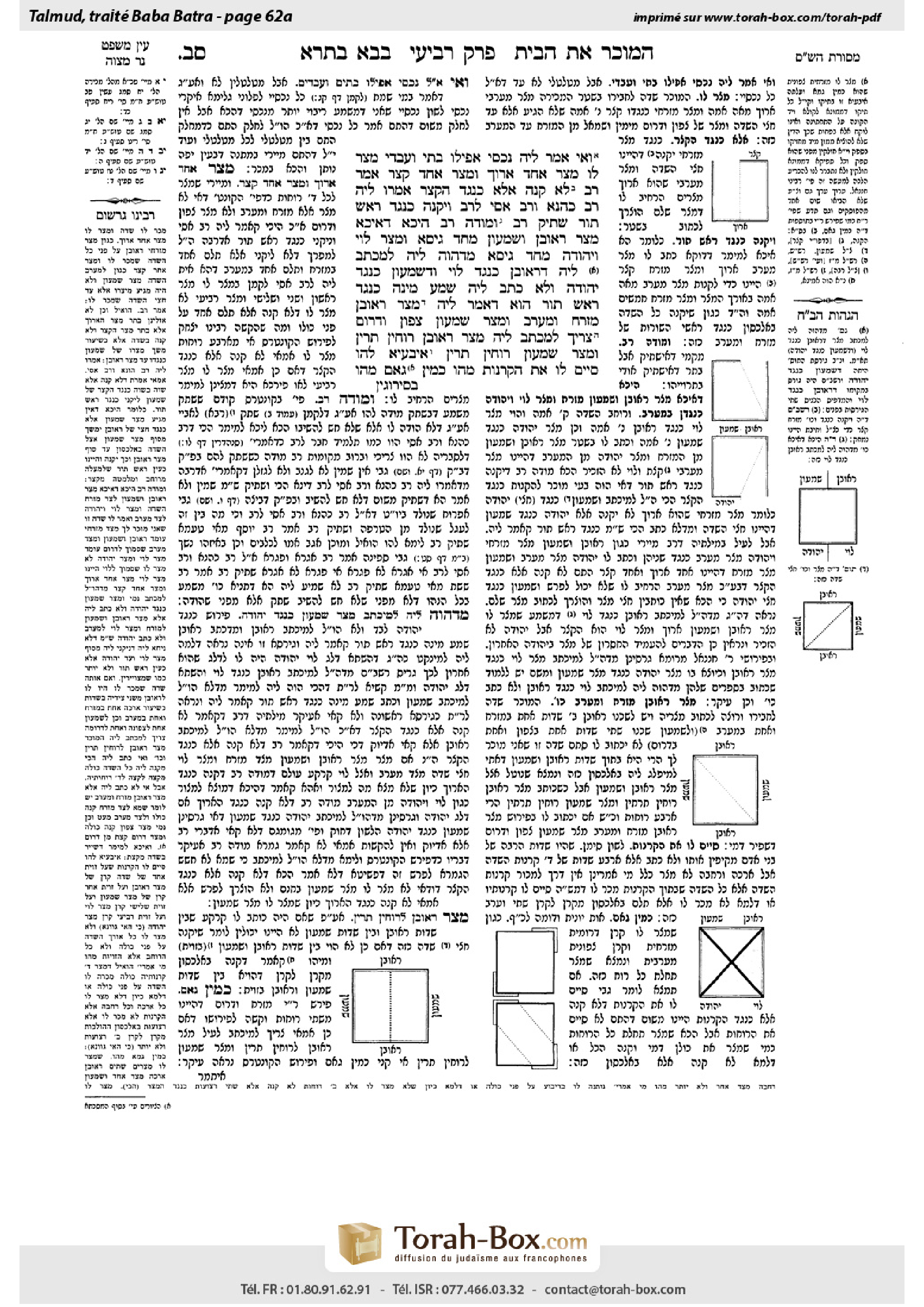
Bava Batra 62a: Talmud study for Daf Yomi
Study the Talmud for Daf Yomi with scanned pages, Hebrew text, English translations from Sefaria and AI-generated French translations.
Passage selection and English or AI-generated French translation are available where the scan has annotations. Daf Study is independent of Torah-Box and Sefaria.
Browse Bava Batra · בבא בתרא · All tractatesBava Batra 62a text and translations
This page of Bava Batra includes the Aramaic text, an English translation and an AI-generated French translation, alongside the scan above.
בבא בתרא ס״ב א · Aramaic and Hebrew text
וְאִי אֲמַר לֵיה:ּ ״נִכְסֵי״ – אֲפִילּוּ בָּתֵּי וְעַבְדֵי.
מָצַר לוֹ מֶצֶר אֶחָד אָרוֹךְ וּמֶצֶר אֶחָד קָצָר – אָמַר רַב: לֹא קָנָה אֶלָּא כְּנֶגֶד הַקָּצָר.
אֲמַרוּ לֵיהּ רַב כָּהֲנָא וְרַב אַסִּי לְרַב: וְיִקְנֶה כְּנֶגֶד רֹאשׁ תּוֹר! שְׁתֵיק רַב.
וּמוֹדֶה רַב, הֵיכָא דְּאִיכָּא מֶצֶר רְאוּבֵן וְשִׁמְעוֹן מֵחַד גִּיסָא, וּמֶצֶר לֵוִי וִיהוּדָה מֵחַד גִּיסָא; מִדַּהֲוָה לֵיהּ לְמִכְתַּב לֵיהּ דִּרְאוּבֵן כְּנֶגֶד לֵוִי וּדְשִׁמְעוֹן כְּנֶגֶד יְהוּדָה, וְלָא כְּתַב לֵיהּ; שְׁמַע מִינַּהּ כְּנֶגֶד רֹאשׁ תּוֹר הוּא דַּאֲמַר לֵיהּ.
מֶצֶר רְאוּבֵן מִזְרָח וּמַעֲרָב, וּמֶצֶר שִׁמְעוֹן צָפוֹן וְדָרוֹם – צְרִיךְ לְמִכְתַּב לֵיהּ: ״מֶצֶר רְאוּבֵן רוּחִין תְּרֵין, וּמֶצֶר שִׁמְעוֹן רוּחִין תְּרֵין״.
אִיבַּעְיָא לְהוּ: סִיֵּים לוֹ אֶת הַקְּרָנוֹת, מַהוּ? כְּמִין גַּאם, מַהוּ?
Bava Batra 62a · English translation
And if he said to him: I am selling you my property, it means that he is selling him even his houses and his Canaanite slaves.
§ The Gemara continues its examination of the concept of delineating boundaries in a wide manner, and considers the following case: If in the bill of sale the seller delineated one boundary line on one side of the field long, and the other boundary line on the opposite side of the field he delineated short, Rav said: The buyer acquires only a width of land corresponding to the short border, as it is assumed that the short boundary line delineates the actual size of the field that was sold to him, while the long boundary line was merely intended to point to the field under discussion. That is to say, the seller delineated the boundaries in a broad manner, but did not intend to include everything found within those boundaries in the sale.
Rav Kahana and Rav Asi said to Rav: But let him also acquire the triangular plot [rosh tor] bounded by the diagonal line connecting the end of the short border and the end of the long border. Rav was silent and did not respond.
And Rav concedes that where there is a boundary line defined by the fields of Reuven and Shimon on one side of the field being sold, and a boundary line defined by the fields of Levi and Yehuda on the other side, and in the bill of sale the seller describes the field being sold as bordered by the fields of Reuven and Shimon on one side but mentions only the field of Levi on the other side, since had he intended to sell only half the field he should have written for the buyer in the bill of sale that the field is bordered by the field of Reuven on the one side, which is opposite that of Levi on the other, or by the field of Shimon on the one side, which is opposite that of Yehuda on the other, but he did not write that for him, one can conclude from it that he is telling him that he is selling him not only the area between the fields of Reuven and Levi, but also the triangular plot bounded by the diagonal line connecting the end of Shimon’s field to the end of Levi’s field.
The Gemara continues: If the field being sold is bounded by the fields of Reuven on the east and the west, and it is bounded by the fields of Shimon on the north and the south, it is not enough to designate the field for the buyer as the field between the fields of Reuven and Shimon, but it is necessary to write for him in the bill of sale that the field is bounded by the fields of Reuven on two sides, and it is bounded by the fields of Shimon on two sides. Otherwise, all that the buyer acquires is a triangular plot bounded by one of Reuven’s fields and one of Shimon’s fields, and the boundary is the diagonal line connecting the end of Reuven’s field to the end of Shimon’s field.
A dilemma was raised before the Sages: If the seller defined for the buyer only the corners of the field being sold, what is the halakha? Does this mean that he is selling him only the corners of the field or the entire field marked by those corners? A second dilemma was also raised: If he defined the boundaries of the field in a shape resembling the Greek letter gamma [gam], or the English letter L, noting the boundaries on two adjacent sides that meet at a right angle, what is the halakha? Does this mean that he is selling him the entire field, or only the triangular plot marked by those boundaries and the diagonal line running from the end of one to the end of the other?
Bava Batra 62a · Traduction française (IA)
Et s'il lui dit : Je vends à toi ma propriété, cela signifie qu'il lui vend même ses maisons et ses esclaves cananéens.
§ La Guemara continue son examen du concept de délimiter les limites de manière large, et considère le cas suivant : Si dans le contrat de vente, le vendeur délimite une seule ligne de limite sur un côté du champ, longue, et la deuxième ligne de limite sur l'autre côté du champ, courte, Rav dit : L'acheteur acquiert seulement une largeur de terrain correspondant à la limite courte, car on suppose que la ligne de limite courte délimite la taille réelle du champ qui lui est vendu, tandis que la ligne de limite longue n'était qu'intendue pour indiquer le champ en question. C'est-à-dire, le vendeur délimite les limites de manière large, mais n'avait pas l'intention d'inclure tout ce qui se trouve à l'intérieur de ces limites dans la vente.
Rav Kahana et Rav Asi dirent à Rav : Mais qu'il acquière aussi la parcelle triangulaire [rosh tor] délimitée par la ligne diagonale reliant la fin de la limite courte et la fin de la limite longue. Rav resta silencieux et ne répondit pas.
Et Rav reconnaît que lorsqu'il y a une ligne de limite définie par les champs de Réouven et de Shimon sur un côté du champ vendu, et une ligne de limite définie par les champs de Lévi et de Yéhuda sur l'autre côté, et que dans le contrat de vente, le vendeur décrit le champ vendu comme étant limité par les champs de Réouven et de Shimon sur un côté, mais mentionne seulement le champ de Lévi sur l'autre côté, puisque s'il avait voulu vendre seulement la moitié du champ, il aurait dû écrire dans le contrat de vente que le champ est limité par le champ de Réouven sur un côté, qui est opposé à celui de Lévi sur l'autre, ou par le champ de Shimon sur un côté, qui est opposé à celui de Yéhuda sur l'autre, mais il n'a pas écrit cela pour lui, on peut conclure de cela qu'il lui dit qu'il lui vend non seulement la zone entre les champs de Réouven et de Lévi, mais aussi la parcelle triangulaire délimitée par la ligne diagonale reliant la fin du champ de Shimon à la fin du champ de Lévi.
La Guemara continue : Si le champ vendu est limité par les champs de Réouven à l'est et à l'ouest, et par les champs de Shimon au nord et au sud, il n'est pas suffisant de désigner le champ pour l'acheteur comme étant le champ entre les champs de Réouven et de Shimon, il est nécessaire d'écrire dans le contrat de vente que le champ est limité par les champs de Réouven sur deux côtés et par les champs de Shimon sur deux côtés. Sinon, tout ce que l'acheteur acquiert est une parcelle triangulaire délimitée par l'un des champs de Réouven et l'un des champs de Shimon, et la limite est la ligne diagonale reliant la fin du champ de Réouven à la fin du champ de Shimon.
Un dilemme a été soulevé devant les Sages : Si le vendeur définit pour l'acheteur seulement les coins du champ vendu, quelle est la halakha ? Cela signifie-t-il qu'il lui vend seulement les coins du champ ou l'ensemble du champ marqué par ces coins ? Un deuxième dilemme a également été soulevé : Si le vendeur définit les limites du champ dans une forme ressemblant à la lettre grecque gamma [gam], ou à la lettre anglaise L, en notant les limités sur deux côtés adjacents qui se rejoignent à un angle droit, quelle est la halakha ? Cela signifie-t-il qu'il lui vend l'ensemble du champ, ou seulement la parcelle triangulaire marquée par ces limites et la ligne diagonale qui relie la fin d'un à la fin de l'autre ?
Traduction française générée par IA à partir de l’édition anglaise de Sefaria. Vérifie toujours un passage avec le texte source.
Text from Sefaria: William Davidson Edition - Vocalized Aramaic (CC BY NC); William Davidson Edition - English (CC BY NC).