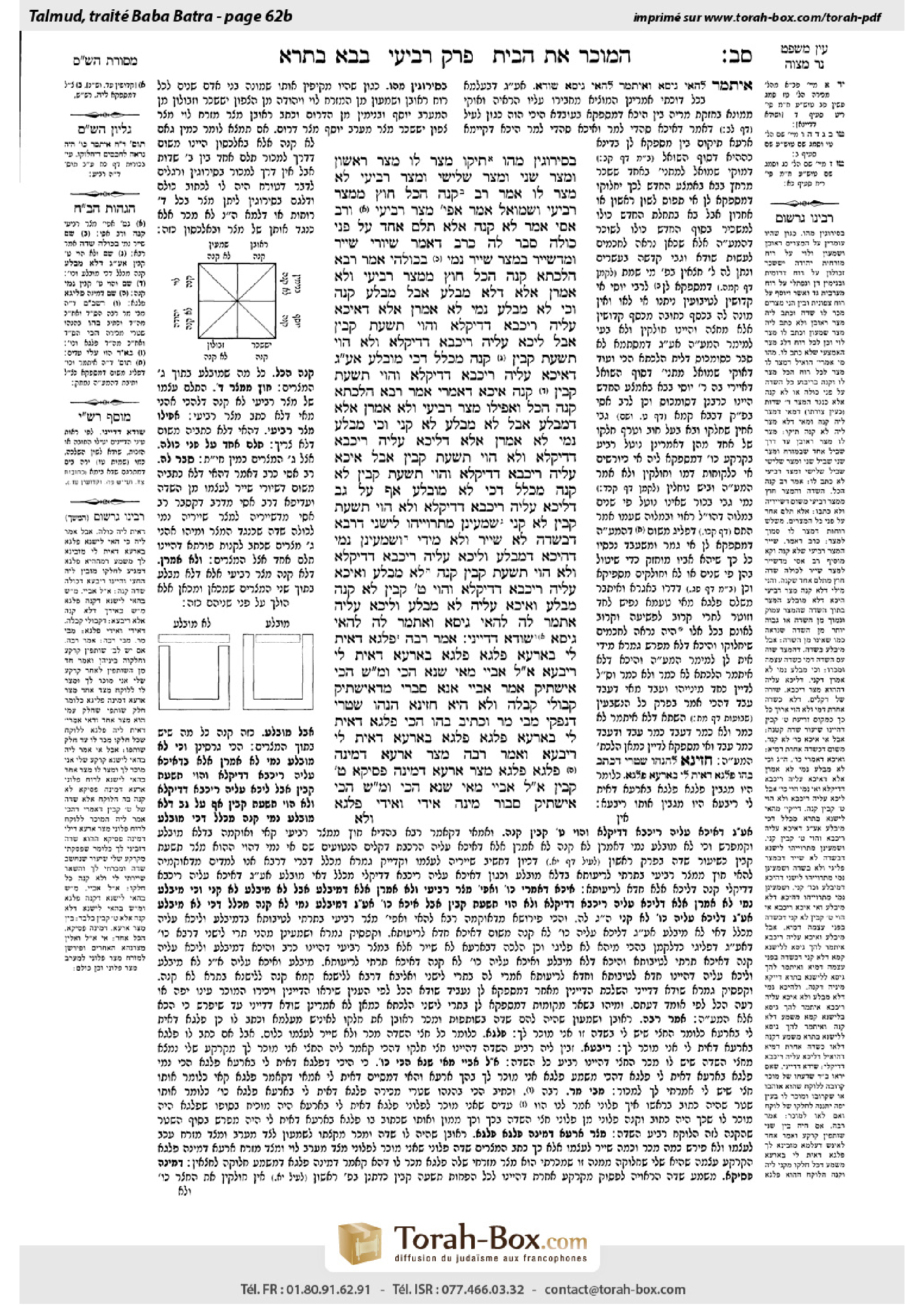
Bava Batra 62b: Talmud study for Daf Yomi
Study the Talmud for Daf Yomi with scanned pages, Hebrew text, English translations from Sefaria and AI-generated French translations.
Passage selection and English or AI-generated French translation are available where the scan has annotations. Daf Study is independent of Torah-Box and Sefaria.
Browse Bava Batra · בבא בתרא · All tractatesBava Batra 62b text and translations
This page of Bava Batra includes the Aramaic text, an English translation and an AI-generated French translation, alongside the scan above.
בבא בתרא ס״ב ב · Aramaic and Hebrew text
בְּסֵירוּגִין, מַהוּ? תֵּיקוּ.
מָצַר לוֹ מֶצֶר רִאשׁוֹן וּמֶצֶר שֵׁנִי וּמֶצֶר שְׁלִישִׁי, וּמֶצֶר רְבִיעִי לֹא מָצַר לוֹ – אָמַר רַב: קָנָה הַכֹּל, חוּץ מִמֶּצֶר רְבִיעִי. וּשְׁמוּאֵל אָמַר: אֲפִילּוּ מֶצֶר רְבִיעִי. וְרַב אַסִּי אָמַר: לֹא קָנָה אֶלָּא תֶּלֶם אֶחָד עַל פְּנֵי כּוּלָּהּ –
סָבַר לַהּ כְּרַב, דְּאָמַר: שַׁיּוֹרֵי שַׁיַּיר; וּמִדְּשַׁיַּיר בְּמֶצֶר, שַׁיַּיר נָמֵי בְּכוּלְּהִי.
אָמַר רָבָא, הִלְכְתָא: קָנָה הַכֹּל חוּץ מִמֶּצֶר רְבִיעִי. וְלָא אֲמַרַן אֶלָּא דְּלָא מַבְלַע, אֲבָל מַבְלַע – קָנָה.
וְכִי לָא מַבְלַע נָמֵי לָא אֲמַרַן אֶלָּא דְּאִיכָּא עֲלֵיהּ רִיכְבָּא דְּדִיקְלָא, וְהָוֵי תִּשְׁעַת קַבִּין; אֲבָל לֵיכָּא עֲלֵיהּ רִיכְבָּא דְּדִיקְלָא, וְלָא הָוֵי תִּשְׁעַת קַבִּין – קָנָה. מִכְּלָל דְּכִי מוּבְלַע – אַף עַל גַּב דְּאִיכָּא עֲלֵיהּ רִיכְבָּא דְּדִיקְלָא, וְהָוֵי תִּשְׁעַת קַבִּין – קָנָה.
אִיכָּא דְּאָמְרִי: אָמַר רָבָא, הִלְכְתָא: קָנָה הַכֹּל וַאֲפִילּוּ מֶצֶר רְבִיעִי. וְלָא אֲמַרַן אֶלָּא דְּמַבְלַע, אֲבָל לָא מַבְלַע – לָא קְנֵי.
וְכִי מַבְלַע נָמֵי לָא אֲמַרַן אֶלָּא דְּלֵיכָּא עֲלֵיהּ רִיכְבָּא דְּדִיקְלָא, וְלָא הָוֵי תִּשְׁעַת קַבִּין; אֲבָל אִיכָּא עֲלֵיהּ רִיכְבָּא דְּדִיקְלָא, וְהָוֵי תִּשְׁעַת קַבִּין – לֹא קָנָה. מִכְּלָל דְּכִי לָא מוּבְלָע – אַף עַל גַּב דְּלֵיכָּא עֲלֵיהּ רִיכְבָּא דְּדִיקְלָא, וְלָא הָוֵי תִּשְׁעַת קַבִּין – לָא קָנֵי.
שָׁמְעִינַן מִתַּרְוַיְיהוּ לִישָּׁנֵי דְּרָבָא, דִּבְשָׂדֶה לָא שַׁיַּיר וְלָא מִידֵּי. וְשָׁמְעִינַן נָמֵי, דְּהֵיכָא דְּמַבְלַע, וְלֵיכָּא עֲלֵיהּ רִיכְבָּא דְּדִיקְלָא, וְלָא הָוֵי תִּשְׁעַת קַבִּין – קָנָה. לָא מַבְלַע, וְאִיכָּא עֲלֵיהּ רִיכְבָּא דְּדִיקְלָא, וְהָוֵי תִּשְׁעַת קַבִּין – לֹא קָנָה.
מַבְלַע וְאִיכָּא עֲלֵיהּ; לָא מַבְלַע וְלֵיכָּא עֲלֵיהּ – אִתְּמַר לַהּ לְהַאי גִּיסָא, וְאִתְּמַר לַהּ לְהַאי גִּיסָא. שׁוּדָא דְּדַיָּינֵי.
אָמַר רַבָּה: ״פַּלְגָא דְּאִית לִי בְּאַרְעָא״ – פַּלְגָא. ״פַּלְגָא בְּאַרְעָא דְּאִית לִי״ – רִיבְעָא. אֲמַר לֵיהּ אַבָּיֵי: מַאי שְׁנָא הָכִי וּמַאי שְׁנָא הָכִי? אִישְׁתִּיק.
אָמַר אַבָּיֵי, אֲנָא סָבְרִי: מִדְּאִישְׁתִּיק – קַבּוֹלֵי קַבְּלַהּ. וְלָא הִיא; חָזֵינָא הָנְהוּ שְׁטָרֵי דְּנָפְקִי מִבֵּי מָר, וּכְתִיב בְּהוּ הָכִי: ״פַּלְגָא דְּאִית לִי בְּאַרְעָא״ – פַּלְגָא, ״פַּלְגָא בְּאַרְעָא דְּאִית לִי״ – רִיבְעָא.
וְאָמַר רַבָּה: ״מֶצֶר אַרְעָא דְּמִינַּהּ פַּלְגָא״ – פַּלְגָא. ״מֶצֶר אַרְעָא דְּמִינַּהּ פְּסִיקָא״ – תִּשְׁעָה קַבִּין.
אֲמַר לֵיהּ אַבָּיֵי: מַאי שְׁנָא הָכִי וּמַאי שְׁנָא הָכִי? אִישְׁתִּיק. סְבוּר מִינָּה, אִידֵּי וְאִידֵּי פַּלְגָא;
Bava Batra 62b · English translation
A third dilemma was also raised before the Sages: If the seller defined the boundaries of the property he is selling in an alternating fashion, mentioning only some of the fields bordering each side of the field being sold, while omitting others, what is the halakha? No resolution was found for these questions, and these dilemmas shall stand unresolved.
§ The Gemara raises a similar dilemma. If, in the bill of sale, the seller delineated for the buyer the field’s first boundary, its second boundary, and its third boundary, but he did not delineate its fourth boundary at all, Rav says: The buyer acquires the entire field, except for the one furrow along which the fourth boundary runs, which is usually differentiated in some way from the field itself. And Shmuel says: The buyer acquires even the furrow along which the fourth boundary runs. And Rav Asi says: He acquires only the width of one furrow along the entire perimeter of the three boundaries specified by the seller.
The Gemara explains Rav Asi’s opinion: He holds in accordance with the opinion of Rav, who said that by failing to delineate the fourth boundary, the seller withheld some part of the field, i.e., one furrow, for himself. But Rav Asi takes this further and says that since he withheld some part of the field for himself at the fourth boundary, he withheld also some portion of the entire field, and therefore the buyer acquires only that which is adjacent to the specified boundaries.
Rava said: The halakha is that the buyer acquires the entire field except for the one furrow along which the fourth boundary runs, in accordance with the opinion of Rav. And we said this only in a case where the fourth boundary is not included within the space between two adjacent boundaries, but rather juts out beyond them. But when it is included within the space delineated by the other boundaries, the buyer acquires it as well.
Rava adds: And even when it is not included in that space, we said that the buyer does not acquire it only in a case where there is a row of trees on it, or it is an area fit for sowing nine kav of seed. But where there is no row of trees on it, and it is not an area fit for sowing nine kav of seed, the buyer acquires it along with the rest of the field. By inference one derives from here that when the fourth border is included within the space delineated by the two adjacent boundaries, even if there is a row of trees on it and it is an area fit for sowing nine kav, the buyer acquires it.
There are those who say that Rava’s ruling and the conclusion drawn from it are as follows: Rava said: The halakha is that the buyer acquires the entire field, and he acquires even the furrow along which the fourth boundary runs, in accordance with the opinion of Shmuel. And we said this only in a case where the fourth boundary is included within the space delineated by the two adjacent boundaries. But when it is not included within those boundaries, the buyer does not acquire it.
Rava adds: And even when it is included within the adjoining boundaries, we said that the buyer acquires it only in a case where there is no row of trees on it, and it is not an area fit for sowing nine kav of seed. But where there is a row of trees on it, or it is an area fit for sowing nine kav of seed, the buyer does not acquire it. By inference one derives from here that when the fourth boundary is not included within the two adjacent boundaries, even if there is no row of trees on it and it is not an area fit for sowing nine kav of seed, the buyer does not acquire it.
We conclude according to both versions of the statement of Rava that even if the seller withheld something for himself along the fourth boundary, he did not withhold anything at all in the field itself. And we also conclude according to both versions that where the fourth boundary is included within the space defined by the two adjacent boundaries, and there is no row of trees on it and it is not an area fit for sowing nine kav of seed, the buyer acquires it. And furthermore, we conclude according to both versions that if the fourth boundary is not included within the two adjacent boundaries, and there is a row of trees on it, or it is an area fit for sowing nine kav of seed, the buyer does not acquire it.
If the fourth boundary is included within the two adjacent boundaries, and there is a row of trees on it or it is fit for sowing nine kav of seed, or if the fourth boundary is not included within the two adjacent boundaries, and there is no row of trees on it nor is it fit for sowing nine kav, the ruling in these cases was stated in this direction, that the land adjacent to the fourth boundary is acquired by the buyer, and it was stated in that direction, that this land is not acquired by the buyer, depending upon which version of Rava’s statement is accepted. Since there is no clear ruling in these cases, the decision is left to the discretion of the judges, who must rule in accordance with what appears to them to be the intention of the seller.
§ Rabba said: If one owns a field in partnership with another, and he says to a third person: I am selling you the half that I have in this land, he means to sell him half of that field, i.e., his entire share. If he says to the buyer: I am selling you half of the land that I have, he means to sell him one-quarter of that field, i.e., half of his share. Abaye said to him: What is different about this wording and what is different about that wording, that you rule differently in the two cases? Rabba was silent, offering no reply.
Abaye said: I had assumed that since he was silent, he must have accepted my opinion and retracted his statement; but that is not so. As on another occasion I saw certain bills of sale that issued from my Master’s house, that is, they were issued under the auspices of my master Rabba, in which it was written: The half that I have in this land, and it was clear from another clause in the bill that half of the field was being sold. And there was another bill of sale in which it was written: Half of the land that I have, and it was clear from another clause in the bill that one-quarter of the field was being sold.
And Rabba also said: If one sold land to another and delineated boundaries on three sides of the field, and with regard to the fourth side he wrote in the bill of sale: The boundary of the field is the land through which the field is halved, he has sold him half of the field. If he writes with regard to the fourth boundary: The boundary of the field is the land from which a plot can be set apart, he has sold him only an area fit for sowing nine kav of seed, as that is the minimum size of a plot of land defined as a field.
Abaye said to him: What is different about this wording, and what is different about that wording, that you rule differently in the two cases? Rabba was silent, and did not respond. The Sages understood from this silence that Abaye understood that Rabba retracted his ruling and conceded that in both this case and that case, the buyer acquires half of the field.
Bava Batra 62b · Traduction française (IA)
Un troisième dilemme a également été soulevé devant les Sages : Si le vendeur définissait les limites de la propriété qu'il vendait de manière alternée, en mentionnant seulement certains des champs limitant chaque côté du champ vendu, tout en omettant d'autres, quelle est la halakha ? Aucune solution n'a été trouvée pour ces questions, et ces dilemmes resteront sans réponse.
§ La Guemara soulève un dilemme similaire. Si, dans le contrat de vente, le vendeur délimitait pour l'acheteur la première limite du champ, sa deuxième limite, et sa troisième limite, mais qu'il n'avait pas délimité sa quatrième limite du tout, Rav dit : L'acheteur acquiert l'ensemble du champ, sauf la seule rangée le long de laquelle court la quatrième limite, qui est généralement différenciée d'une certaine manière du champ lui-même. Et Shmuel dit : L'acheteur acquiert même la rangée le long de laquelle court la quatrième limite. Et Rav Asi dit : Il acquiert seulement la largeur d'une rangée le long de l'ensemble des trois limites spécifiées par le vendeur.
La Guemara explique l'opinion de Rav Asi : Il suit l'opinion de Rav, qui disait que par l'omission de délimiter la quatrième limite, le vendeur avait caché une partie du champ, c'est-à-dire une rangée, pour lui-même. Mais Rav Asi va plus loin et dit que puisqu'il avait caché une partie du champ pour lui-même à la quatrième limite, il avait également caché une portion de l'ensemble du champ, et par conséquent l'acheteur acquiert seulement ce qui est adjacent aux limites spécifiées.
Rava dit : La halakha est que l'acheteur acquiert l'ensemble du champ sauf la seule rangée le long de laquelle court la quatrième limite, conformément à l'opinion de Rav. Et nous avons dit cela uniquement dans le cas où la quatrième limite n'est pas incluse dans l'espace entre deux limites adjacentes, mais plutôt sort de ce cadre. Mais lorsque celle-ci est incluse dans l'espace délimité par les autres limites, l'acheteur l'acquiert également.
Rava ajoute : Et même lorsque celle-ci n'est pas incluse dans cet espace, nous avons dit que l'acheteur ne l'acquiert pas uniquement dans le cas où il y a une rangée d'arbres sur elle, ou si c'est une zone adaptée à la semence de neuf kav. Mais où il n'y a pas de rangée d'arbres sur elle, et qu'il ne s'agit pas d'une zone adaptée à la semence de neuf kav, l'acheteur l'acquiert avec le reste du champ. Par déduction, on en tire que lorsque la quatrième limite est incluse dans l'espace délimité par les deux limites adjacentes, même s'il y a une rangée d'arbres sur elle et qu'il s'agit d'une zone adaptée à la semence de neuf kav, l'acheteur l'acquiert.
Certains disent que la décision de Rava et la conclusion tirée de celle-ci sont les suivantes : Rava dit : La halakha est que l'acheteur acquiert l'ensemble du champ, et il acquiert même la rangée le long de laquelle court la quatrième limite, conformément à l'opinion de Shmuel. Et nous avons dit cela uniquement dans le cas où la quatrième limite est incluse dans l'espace délimité par les deux limites adjacentes. Mais lorsque celle-ci n'est pas incluse dans ces limites, l'acheteur ne l'acquiert pas.
Rava ajoute : Et même lorsque celle-ci est incluse dans les limites adjacentes, nous avons dit que l'acheteur l'acquiert uniquement dans le cas où il n'y a pas de rangée d'arbres sur elle, et qu'il ne s'agit pas d'une zone adaptée à la semence de neuf kav. Mais où il y a une rangée d'arbres sur elle, ou qu'il s'agit d'une zone adaptée à la semence de neuf kav, l'acheteur ne l'acquiert pas. Par déduction, on en tire que lorsque la quatrième limite n'est pas incluse dans les deux limites adjacentes, même s'il n'y a pas de rangée d'arbres sur elle et qu'il ne s'agit pas d'une zone adaptée à la semence de neuf kav, l'acheteur ne l'acquiert pas.
Nous concluons selon les deux versions de l'expression de Rava que même si le vendeur avait caché quelque chose pour lui-même le long de la quatrième limite, il n'avait pas caché quoi que ce soit dans le champ lui-même. Et nous concluons également selon les deux versions que lorsque la quatrième limite est incluse dans l'espace défini par les deux limites adjacentes, et qu'il n'y a pas de rangée d'arbres sur elle et qu'il ne s'agit pas d'une zone adaptée à la semence de neuf kav, l'acheteur l'acquiert. Et de plus, nous concluons selon les deux versions que si la quatrième limite n'est pas incluse dans les deux limites adjacentes, et qu'il y a une rangée d'arbres sur elle, ou qu'il s'agit d'une zone adaptée à la semence de neuf kav, l'acheteur ne l'acquiert pas.
Si la quatrième limite est incluse dans les deux limites adjacentes, et qu'il y a une rangée d'arbres sur elle ou qu'il s'agit d'une zone adaptée à la semence de neuf kav, ou si la quatrième limite n'est pas incluse dans les deux limites adjacentes, et qu'il n'y a pas de rangée d'arbres sur elle ni qu'il ne s'agit pas d'une zone adaptée à la semence de neuf kav, la décision dans ces cas a été formulée dans cette direction, que la terre adjacente à la quatrième limite est acquise par l'acheteur, et a été formulée dans cette direction, que cette terre n'est pas acquise par l'acheteur, selon la version de la déclaration de Rava acceptée. Puisque il n'y a pas de décision claire dans ces cas, la décision est laissée à la discrétion des juges, qui doivent trancher selon ce qui leur semble être l'intention du vendeur.
§ Rabba dit : Si l'on possède un champ en partage avec un autre, et qu'il dit à un troisième : Je vends à toi la moitié que j'ai dans ce terrain, il veut vendre à l'acheteur la moitié de ce champ, c'est-à-dire sa part entière. Si il dit à l'acheteur : Je vends à toi la moitié du terrain que j'ai, il veut vendre à l'acheteur un quart de ce champ, c'est-à-dire la moitié de sa part. Abaye dit à lui : Quelle est la différence entre ces deux formulations et quelle est la différence entre ces deux formulations, que vous tranchiez différemment dans les deux cas ? Rabba restait silencieux, ne donnant pas de réponse.
Abaye a dit : J'avais supposé que puisque l'on était silencieux, il avait dû accepter mon opinion et rétracter son déclaration ; mais ce n'est pas le cas. Un autre jour, j'ai vu certains actes de vente sortant de la maison de mon maître, c'est-à-dire, émis sous la tutelle de mon maître Rabba, dans lesquels il était écrit : La moitié que j'ai dans cette terre, et il était clair d'une autre clause de l'acte que la moitié du champ était vendue. Et il y avait un autre acte de vente dans lequel il était écrit : La moitié de la terre que j'ai, et il était clair d'une autre clause de l'acte que un quart du champ était vendu.
Et Rabba a aussi dit : Si l'on vend un champ à un autre et qu'on délimite les bornes sur trois côtés du champ, et concernant le quatrième côté on écrit dans l'acte de vente : La borne du champ est la terre par laquelle le champ est divisé, on a vendu à l'acheteur la moitié du champ. Si on écrit concernant la quatrième borne : La borne du champ est la terre d'où on peut dégager une parcelle, on a vendu à l'acheteur seulement une surface adaptée à la semence de neuf kav, car c'est la taille minimale d'une parcelle de terre définie comme un champ.
Abaye a dit à lui : Qu'est-ce qui diffère dans cette formulation et dans celle-ci, qui fait que vous rendez un jugement différent dans les deux cas ? Rabba a gardé le silence et n'a pas répondu. Les Sages ont compris à partir de ce silence que Abaye comprenait que Rabba avait rétracté son jugement et avait admis que dans les deux cas, l'acheteur acquiert la moitié du champ.
Traduction française générée par IA à partir de l’édition anglaise de Sefaria. Vérifie toujours un passage avec le texte source.
Text from Sefaria: William Davidson Edition - Vocalized Aramaic (CC BY NC); William Davidson Edition - English (CC BY NC).