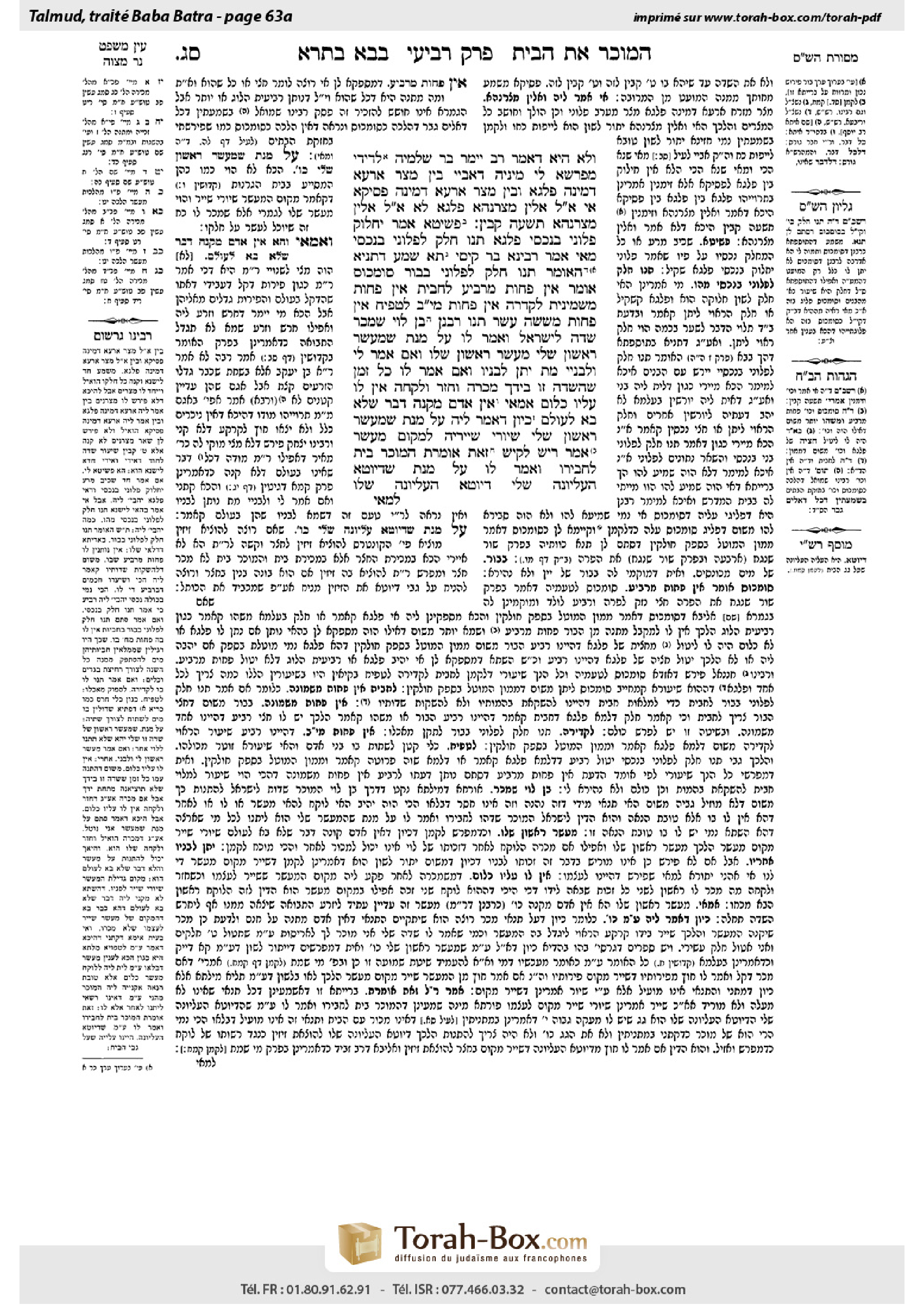
Bava Batra 63a: Talmud study for Daf Yomi
Study the Talmud for Daf Yomi with scanned pages, Hebrew text, English translations from Sefaria and AI-generated French translations.
Passage selection and English or AI-generated French translation are available where the scan has annotations. Daf Study is independent of Torah-Box and Sefaria.
Browse Bava Batra · בבא בתרא · All tractatesBava Batra 63a text and translations
This page of Bava Batra includes the Aramaic text, an English translation and an AI-generated French translation, alongside the scan above.
בבא בתרא ס״ג א · Aramaic and Hebrew text
וְלָא הִיא, דְּאָמַר רַב יֵימַר בַּר שֶׁלֶמְיָה: לְדִידִי מִפָּרְשָׁא לִי מִינֵּיהּ דְּאַבָּיֵי: בֵּין ״מֶצֶר אַרְעָא דְּמִינַּהּ פַּלְגָא״, וּבֵין ״מֶצֶר אַרְעָא דְּמִינַּהּ פְּסִיקָא״ – אִי אֲמַר לֵיהּ: ״אִלֵּין מִצְרָנַהָא״ – פַּלְגָא, לָא אֲמַר לֵיהּ: ״אִלֵּין מִצְרָנַהָא״ – תִּשְׁעָה קַבִּין.
פְּשִׁיטָא – אָמַר: ״יַחֲלוֹק פְּלוֹנִי בִּנְכָסַי״ – פַּלְגָא. ״תְּנוּ חֵלֶק לִפְלוֹנִי בִּנְכָסַי״ – מַאי?
אָמַר רָבִינָא בַּר קִיסִי, תָּא שְׁמַע: דְּתַנְיָא, הָאוֹמֵר: ״תְּנוּ חֵלֶק לִפְלוֹנִי בְּבוֹר״ – סוֹמְכוֹס אוֹמֵר: אֵין פָּחוֹת מֵרְבִיעַ. ״לְחָבִית״ – אֵין פָּחוֹת מִשְּׁמִינִית. ״לִקְדֵרָה״ – אֵין פָּחוֹת מִשְּׁנֵים עָשָׂר. ״לְטָפִיחַ״ – אֵין פָּחוֹת מִשִּׁשָּׁה עָשָׂר.
תָּנוּ רַבָּנַן: בֶּן לֵוִי שֶׁמָּכַר שָׂדֶה לְיִשְׂרָאֵל, וְאָמַר לוֹ: ״עַל מְנָת שֶׁמַּעֲשֵׂר רִאשׁוֹן שֶׁלִּי״ – מַעֲשֵׂר רִאשׁוֹן שֶׁלּוֹ. וְאִם אָמַר: ״לִי וּלְבָנַיי״ – מֵת, יִתֵּן לְבָנָיו.
וְאִם אָמַר לוֹ: ״כׇּל זְמַן שֶׁהַשָּׂדֶה זוֹ בְּיָדְךָ״ – מְכָרָהּ וְחָזַר וּלְקָחָהּ, אֵין לוֹ עָלָיו כְּלוּם.
אַמַּאי? אֵין אָדָם מַקְנֶה דָּבָר שֶׁלֹּא בָּא לָעוֹלָם! כֵּיוָן דְּאָמַר לֵיהּ: ״עַל מְנָת שֶׁמַּעֲשֵׂר רִאשׁוֹן שֶׁלִּי״ – שַׁיּוֹרֵי שַׁיְּירֵיהּ לִמְקוֹם מַעֲשֵׂר.
אָמַר רֵישׁ לָקִישׁ: זֹאת אוֹמֶרֶת, הַמּוֹכֵר בַּיִת לַחֲבֵירוֹ, וְאָמַר לוֹ: ״עַל מְנָת שֶׁדְּיוֹטָא הָעֶלְיוֹנָה שֶׁלִּי״ – דְּיוֹטָא הָעֶלְיוֹנָה שֶׁלּוֹ.
Bava Batra 63a · English translation
But that is not so, as Rav Yeimar bar Shelemya said: The matter was explained to me by Abaye, as follows: Whether the seller writes with regard to the fourth boundary: The boundary of the field is the land through which the field is halved, or he writes: The boundary of the field is the land through which a plot can be set apart, if he said to the buyer: These are its boundaries, he has sold him half of the field. But if he did not say to the buyer: These are its boundaries, he has sold him only an area fit for sowing nine kav of seed.
§ The Gemara raises a question about a similar case: It is obvious that if one said: So-and-so should share in my property, he means to give him half of the property. If he said: Give so-and-so a portion of my property, what is the halakha? What portion of the property must he give him?
Ravina bar Kisi said: Come and hear a proof concerning the halakha in this case, as it is taught in a baraita: With regard to one who says: Give so-and-so a portion of my cistern for his water needs, Sumakhos says: He must give him not less than one-quarter of the water in the cistern. If he qualifies his words and says: Give so-and-so a portion of my cistern’s water for his barrel, he must give him not less than one-eighth of the water. If he says: Give him a portion for his pot, he must give him not less than one-twelfth of the water. And if he says: Give him for his cup, he must give him not less than one-sixteenth of the water. In any event, this baraita indicates that the unqualified phrase: Give so-and-so a portion, should be understood to mean: Give him one-quarter.
The Gemara now considers another case in which the seller withholds something for himself in a sale. The Sages taught in a baraita: With regard to a Levite who sold a field to an Israelite and said to him: I am selling you this field on the condition that the first tithe from the produce growing in the field, which must be given to a Levite, is mine, and it will be given to me every year and not to any other Levite, the first tithe is his. And if he said: I am selling you the field on the condition that the tithe will be given to me and to my sons, then if he dies, the buyer must give the tithe to his sons.
But if the seller said to the buyer: This stipulation will remain in force as long as this field is in your possession, then if the buyer sold it and afterward bought it back again, the seller has no claim on him. Since the field left the buyer’s possession in the interim, the seller no longer has a claim to the tithe.
The Gemara challenges the halakha taught in the baraita: Why should the seller ever have a right to the tithe after he has sold the field? After all, a person cannot transfer ownership of an object that has not yet come into the world. How, then, can the seller acquire a portion of the produce that does not yet exist? The Gemara answers that since the seller said to the buyer: I am selling you this field on the condition that the first tithe is mine, it is as if he withheld the site where the tithe is grown for himself when he sold the field, and that site already exists.
Reish Lakish said: That is to say that with regard to one who sells a house to another and says to him: I am selling you this house on the condition that the upper story [deyota] is mine, the upper story is his.
Bava Batra 63a · Traduction française (IA)
Mais cela n'est pas ainsi, comme l'a dit Rav Yéimar bar Shélémya : La question a été expliquée à moi par Abaye, comme suit : Lorsqu'un vendeur écrit concernant la quatrième limite : La limite du champ est la terre par laquelle le champ est divisé en deux, ou s'il écrit : La limite du champ est la terre par laquelle on peut délimiter une parcelle, si il dit au acheteur : Celles sont ses limites, il lui a vendu la moitié du champ. Mais si il n'a pas dit au acheteur : Celles sont ses limites, il lui a vendu seulement une surface suffisante pour semer neuf kav de grain.
§ La Guemara soulève une question concernant un cas similaire : Il est évident que si l'on dit : Tel-qui devrait partager ma propriété, on entend donner la moitié de la propriété. Si l'on dit : Donne à tel-qui une part de ma propriété, quelle est la halakha ? Quelle part de la propriété doit-on lui donner ?
Ravina bar Kisi a dit : Viens écouter une preuve concernant la halakha dans ce cas, comme il est enseigné dans une baraïta : Concernant celui qui dit : Donne à tel-qui une part de mon cistern pour ses besoins en eau, Sumakhos dit : Il doit lui donner au moins un quart de l'eau du cistern. Si il précise ses paroles et dit : Donne à tel-qui une part de l'eau de mon cistern pour son tonneau, il doit lui donner au moins un huitième de l'eau. Si il dit : Donne lui une part pour son pot, il doit lui donner au moins un douzième de l'eau. Et si il dit : Donne lui une part pour sa tasse, il doit lui donner au moins un seizième de l'eau. En tout cas, cette baraïta indique que la phrase non qualifiée : Donne à tel-qui une part, doit être entendue comme : Donne lui un quart.
La Guemara examine maintenant un autre cas où le vendeur retient quelque chose pour lui-même dans une vente. Les Sages ont enseigné dans une baraïta : Concernant un Lévi qui vend un champ à un Israélite et lui dit : Je vends ce champ à condition que la première dîme des produits cultivés dans le champ, qui doit être donnée à un Lévi, m'appartienne, et qu'elle soit donnée à moi chaque année et non à aucun autre Lévi, la première dîme est sienne. Et s'il dit : Je vends ce champ à condition que la dîme soit donnée à moi et à mes fils, alors si il meurt, l'acheteur doit donner la dîme à ses fils.
Mais si le vendeur dit à l'acheteur : Cette stipulation restera en vigueur tant que ce champ est en votre possession, alors si l'acheteur le revend et après l'achète à nouveau, le vendeur n'a plus de revendication contre lui. Puisque le champ a quitté la possession de l'acheteur pendant l'intervalle, le vendeur n'a plus de revendication sur la dîme.
La Guemara remet en question la halakha enseignée dans la baraïta : Pourquoi le vendeur devrait-il avoir un droit sur la dîme après avoir vendu le champ ? Après tout, une personne ne peut pas transférer la propriété d'un objet qui n'existe pas encore. Comment, alors, le vendeur peut-il acquérir une part des produits qui n'ont pas encore existé ? La Guemara répond que puisque le vendeur a dit à l'acheteur : Je vends ce champ à condition que la première dîme m'appartienne, c'est comme s'il avait caché le lieu où la dîme est cultivée pour lui-même lorsqu'il a vendu le champ, et ce lieu existe déjà.
Reish Lakish a dit : Cela signifie que concernant celui qui vend une maison à un autre et lui dit : Je vends cette maison à condition que l'étage supérieur m'appartienne, l'étage supérieur est sien.
Traduction française générée par IA à partir de l’édition anglaise de Sefaria. Vérifie toujours un passage avec le texte source.
Text from Sefaria: William Davidson Edition - Vocalized Aramaic (CC BY NC); William Davidson Edition - English (CC BY NC).