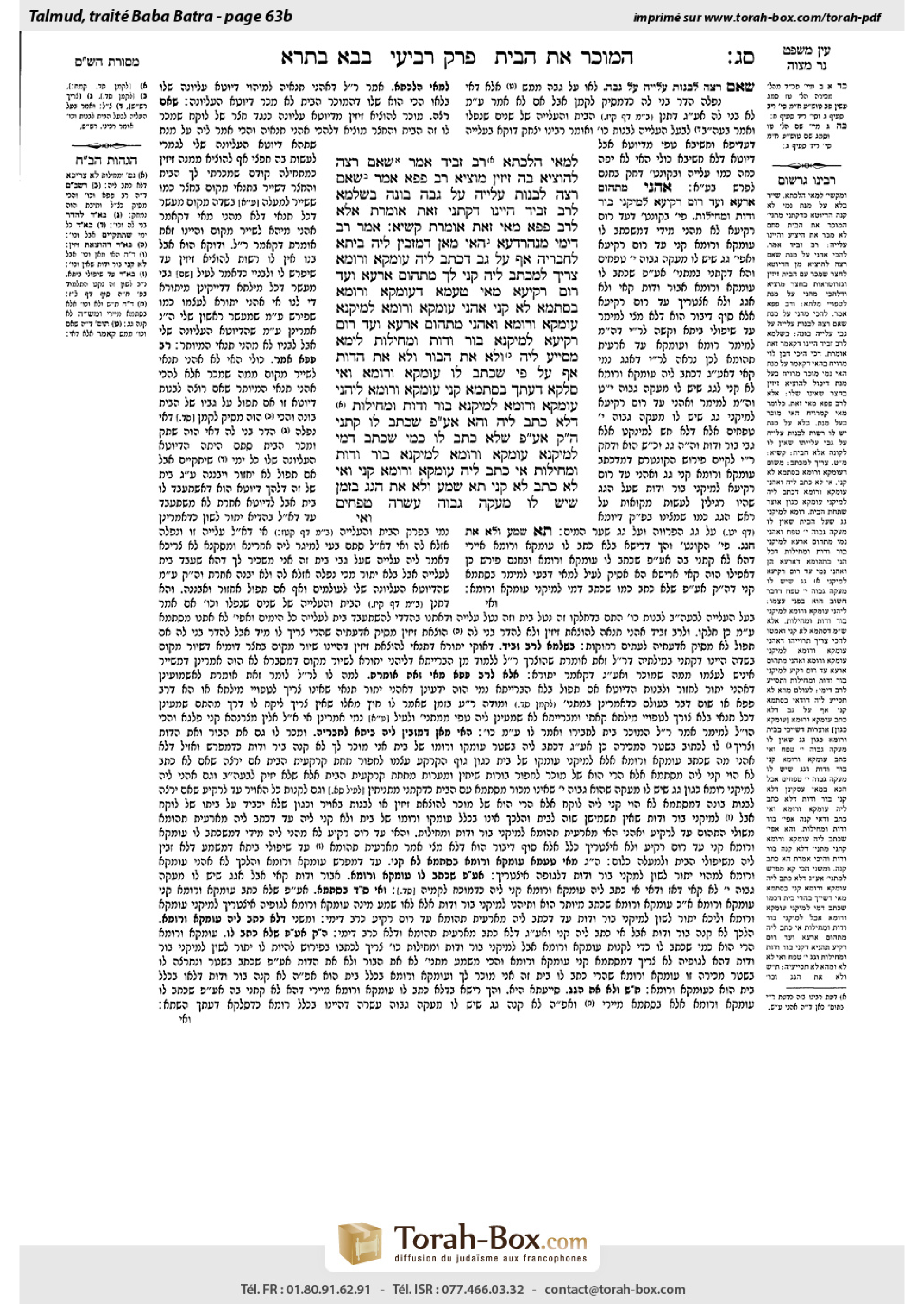
Bava Batra 63b: Talmud study for Daf Yomi
Study the Talmud for Daf Yomi with scanned pages, Hebrew text, English translations from Sefaria and AI-generated French translations.
Passage selection and English or AI-generated French translation are available where the scan has annotations. Daf Study is independent of Torah-Box and Sefaria.
Browse Bava Batra · בבא בתרא · All tractatesBava Batra 63b text and translations
This page of Bava Batra includes the Aramaic text, an English translation and an AI-generated French translation, alongside the scan above.
בבא בתרא ס״ג ב · Aramaic and Hebrew text
לְמַאי הִלְכְתָא? רַב זְבִיד אָמַר: שֶׁאִם רָצָה לְהוֹצִיא בָּהּ זִיזִין, מוֹצִיא. רַב פָּפָּא אָמַר: שֶׁאִם רָצָה לִבְנוֹת עֲלִיָּיה עַל גַּבָּהּ, בּוֹנֶה.
בִּשְׁלָמָא לְרַב זְבִיד, הַיְינוּ דְּקָתָנֵי ״זֹאת אוֹמֶרֶת״; אֶלָּא לְרַב פָּפָּא, מַאי ״זֹאת אוֹמֶרֶת״? קַשְׁיָא.
אָמַר רַב דִּימִי מִנְּהַרְדְּעָא: הַאי מַאן דִּמְזַבֵּין לֵיהּ בֵּיתָא לְחַבְרֵיהּ, אַף עַל גַּב דִּכְתַב לֵיהּ: ״עוּמְקָא וְרוּמָא״, צָרִיךְ לְמִכְתַּב לֵיהּ: ״קְנִי לָךְ מִתְּהוֹם אַרְעָא וְעַד רוּם רְקִיעָא״. מַאי טַעְמָא? דְּעוּמְקָא וְרוּמָא בִּסְתָמָא לָא קָנֵי; אַהֲנִי ״עוּמְקָא וְרוּמָא״ לְמִיקְנֵא עוּמְקָא וְרוּמָא, וְאַהֲנִי ״מִתְּהוֹם אַרְעָא וְעַד רוּם רְקִיעָא״ לְמִיקְנֵא בּוֹר וָדוּת וּמְחִילּוֹת.
לֵימָא מְסַיַּיע לֵיהּ: וְלֹא אֶת הַבּוֹר וְלֹא אֶת הַדּוּת – אַף עַל פִּי שֶׁכָּתַב לוֹ ״עוּמְקָא וְרוּמָא״. וְאִי סָלְקָא דַּעְתָּךְ בִּסְתָמָא קָנֵי עוּמְקָא וְרוּמָא, לַיהֲנֵי ״עוּמְקָא וְרוּמָא״ לְמִיקְנֵא בּוֹר וָדוּת וּמְחִילּוֹת! דְּלָא כְּתַב לֵיהּ.
וְהָא ״אַף עַל פִּי שֶׁכָּתַב לוֹ״ קָתָנֵי! הָכִי קָאָמַר: אַף עַל פִּי שֶׁלֹּא כָּתַב לוֹ, כְּמִי שֶׁכָּתַב דָּמֵי – לְמִיקְנֵא עוּמְקָא וְרוּמָא. לְמִיקְנֵא בּוֹר וָדוּת וּמְחִילּוֹת – אִי כְּתַב לֵיהּ: ״עוּמְקָא וְרוּמָא״ – קָנֵי, וְאִי לָא כָּתַב – לָא קָנֵי.
תָּא שְׁמַע: וְלֹא אֶת הַגָּג – בִּזְמַן שֶׁיֵּשׁ לוֹ מַעֲקֶה גָּבוֹהַּ עֲשָׂרָה טְפָחִים.
Bava Batra 63b · English translation
With regard to what halakha did Reish Lakish say this? In any case the upper story is his, as when he sold the house, it was only the lower story that he sold to the buyer. Rav Zevid says: He said this to teach the halakha that if the seller wishes to extend from the upper story projections over the courtyard, which was included in the sale, he may extend them. Rav Pappa says: He said this to teach the halakha that if this upper story collapses and the seller wishes to build an upper story on top of it to replace it, he may build it.
The Gemara asks: Granted, according to Rav Zevid, this explanation is consistent with that which Reish Lakish teaches, which begins with: That is to say. As according to Rav Zevid, Reish Lakish infers from the ruling of the baraita about tithes that even though the seller of the house did not explicitly withhold anything for himself, the court interprets his use of his superfluous stipulation as an indication that he wished to withhold for himself the space over the courtyard for the projections. But according to Rav Pappa, what did Reish Lakish mean when he said his statement that begins with the phrase: That is to say? The seller’s right to rebuild the upper story after it collapses is not derived from the superfluous stipulation that he attached to the transaction, and it is not inferred from the baraita. The Gemara concludes: Indeed, Rav Pappa’s interpretation is difficult, as it does not account for the wording of Reish Lakish’s statement.
§ The Gemara discusses what is included in the wordings of various contracts. Rav Dimi from Neharde’a said: Concerning this one who sells a house to another and wants the sale to include the entire property, even if he writes for the buyer in the bill of sale: I am selling you the depth and the height of the house, he must also write for him: Acquire for yourself the property from the depth of the earth up to the height of the sky. What is the reason for this addition? The reason is that the buyer does not acquire the depth and the height of the property without explicit specification, and therefore, unless the matter has been explicitly stipulated, the buyer may not dig under the house or build above it. The words: The depth and the height, effect the acquisition of the depth and the height of the house for the buyer, allowing him to dig below or build above the house. And the additional phrase: From the depth of the earth up to the height of the sky, effects the acquisition of the pit and the cistern and the tunnels associated with the house.
The Gemara proposes: Let us say that the mishna (64a) supports Rav Dimi’s opinion: One who sells a house has sold neither the pit nor the cistern, even if he writes for the buyer in the bill of sale that he is selling him the depth and the height of the house. As if it enters your mind to say that the buyer acquires the depth and the height of the house even without the specification that the depth and the height of the house are included in the sale, let the phrase the depth and the height effect the acquisition of the pit and the cistern and the tunnels, as he attached an additional stipulation to the transaction. The Gemara rejects this opinion: The mishna is referring to a case where the seller did not write these words for him.
The Gemara asks: But this line of reasoning is difficult, as the mishna explicitly teaches that the pit and the cistern are not sold even if the seller writes for the buyer that he is selling him the depth and the height of the house. The Gemara answers that this is what the mishna is saying: Even though the seller did not write these words for him in the bill of sale, for the purpose of acquiring the depth and the height of the house, it is considered as if he wrote them, as it is assumed that they were omitted by accident. By contrast, for the purpose of acquiring the pit and the cistern and the tunnels, if the seller explicitly wrote for him the words the depth and the height, the buyer acquires them, but if he did not write that phrase in the bill of sale, the buyer does not acquire them. No proof can be derived from this mishna.
§ The Gemara now considers a different mishna. Come and hear what was taught in the mishna (61a): One who sells his house without explicitly stating what is included in the sale has not sold the roof along with the house when it has a parapet ten handbreadths high, as such a roof is considered a separate entity and is not included in the sale of the house.
Bava Batra 63b · Traduction française (IA)
Concernant quelle halakha Reish Lakish a-t-il dit cela ? En tout cas, l'étage supérieur est à lui, car lorsqu'il a vendu la maison, il n'avait vendu que l'étage inférieur à l'acheteur. Rav Zevid dit : Il a dit cela pour enseigner la halakha selon laquelle si le vendeur souhaite étendre des projections depuis l'étage supérieur sur la cour, qui était inclus dans la vente, il peut les étendre. Rav Pappa dit : Il a dit cela pour enseigner la halakha selon laquelle si cet étage supérieur s'effondre et que le vendeur souhaite reconstruire un étage supérieur dessus pour le remplacer, il peut le reconstruire.
Le Guemara pose la question : Cela est admis selon Rav Zevid, cette explication est cohérente avec ce que Reish Lakish enseigne, qui commence par : C'est-à-dire. Selon Rav Zevid, Reish Lakish déduit de la décision de la baraïta concernant les dîmes que même si le vendeur de la maison n'avait pas explicitement réservé quelque chose pour lui-même, la cour interprète son stipulation superflue comme un signe qu'il souhaitait réservé pour lui-même l'espace au-dessus de la cour pour les projections. Mais selon Rav Pappa, que voulait dire Reish Lakish lorsqu'il a dit cette déclaration qui commence par la phrase : C'est-à-dire ? Le droit du vendeur de reconstruire l'étage supérieur après son effondrement ne provient pas de la stipulation superflue qu'il a attaché à la transaction, et il n'est pas déduit de la baraïta. Le Guemara conclut : En effet, l'interprétation de Rav Pappa est difficile, car elle ne tient pas compte du wording de la déclaration de Reish Lakish.
§ Le Guemara discute de ce qui est inclus dans les formulations de divers contrats. Rav Dimi de Neharde’a dit : Concernant celui qui vend une maison à un autre et veut que la vente inclue toute la propriété, même s'il écrit pour l'acheteur dans le contrat de vente : Je vous vends la profondeur et la hauteur de la maison, il doit aussi écrire pour lui : Acquière pour toi la propriété depuis la profondeur de la terre jusqu'à la hauteur du ciel. Quelle est la raison de cette addition ? La raison est que l'acheteur ne peut acquérir la profondeur et la hauteur de la propriété sans spécification explicite, et par conséquent, sauf si la matière a été explicitement stipulée, l'acheteur ne peut pas creuser sous la maison ou construire au-dessus d'elle. Les mots : La profondeur et la hauteur, permettent l'acquisition de la profondeur et de la hauteur de la maison pour l'acheteur, lui permettant de creuser sous ou de construire au-dessus de la maison. Et la phrase supplémentaire : De la profondeur de la terre jusqu'à la hauteur du ciel, permet l'acquisition du puits et du réservoir ainsi que des tunnels associés à la maison.
Le Guemara propose : Disons que la mishna (64a) soutient l'opinion de Rav Dimi : Celui qui vend une maison n'a pas vendu le puits ni le réservoir, même s'il écrit pour l'acheteur dans le contrat de vente qu'il lui vend la profondeur et la hauteur de la maison. Comme si cela vous venait à l'esprit de dire que l'acheteur acquiert la profondeur et la hauteur de la maison sans la spécification que la profondeur et la hauteur de la maison sont incluses dans la vente, disons que la phrase profondeur et hauteur permet l'acquisition du puits et du réservoir ainsi que des tunnels, car il a ajouté une stipulation supplémentaire au contrat. Le Guemara rejette cette opinion : La mishna fait référence à un cas où le vendeur n'a pas écrit ces mots pour lui.
Le Guemara pose la question : Mais cette ligne de raisonnement est difficile, car la mishna enseigne explicitement que les puits et les réservoirs ne sont pas vendus même si le vendeur écrit pour l'acheteur qu'il lui vend la profondeur et la hauteur de la maison. Le Guemara répond que c'est ce que la mishna dit : Même si le vendeur n'a pas écrit ces mots pour lui dans le contrat de vente, pour l'acquisition de la profondeur et de la hauteur de la maison, on considère qu'il les a écrits, car on suppose qu'ils ont été omis par accident. À l'inverse, pour l'acquisition des puits et des réservoirs ainsi que des tunnels, si le vendeur écrit explicitement les mots profondeur et hauteur, l'acheteur les acquiert, mais si le vendeur n'a pas écrit cette phrase dans le contrat de vente, l'acheteur ne les acquiert pas. Aucune preuve ne peut être tirée de cette mishna.
§ Le Guemara considère maintenant une autre mishna. Vient écouter ce qui a été enseigné dans la mishna (61a) : Celui qui vend sa maison sans préciser explicitement ce qui est inclus dans la vente n'a pas vendu le toit avec la maison lorsqu'il a un parapet de dix tefachim de haut, car un tel toit est considéré comme une entité séparée et n'est pas inclus dans la vente de la maison.
Traduction française générée par IA à partir de l’édition anglaise de Sefaria. Vérifie toujours un passage avec le texte source.
Text from Sefaria: William Davidson Edition - Vocalized Aramaic (CC BY NC); William Davidson Edition - English (CC BY NC).