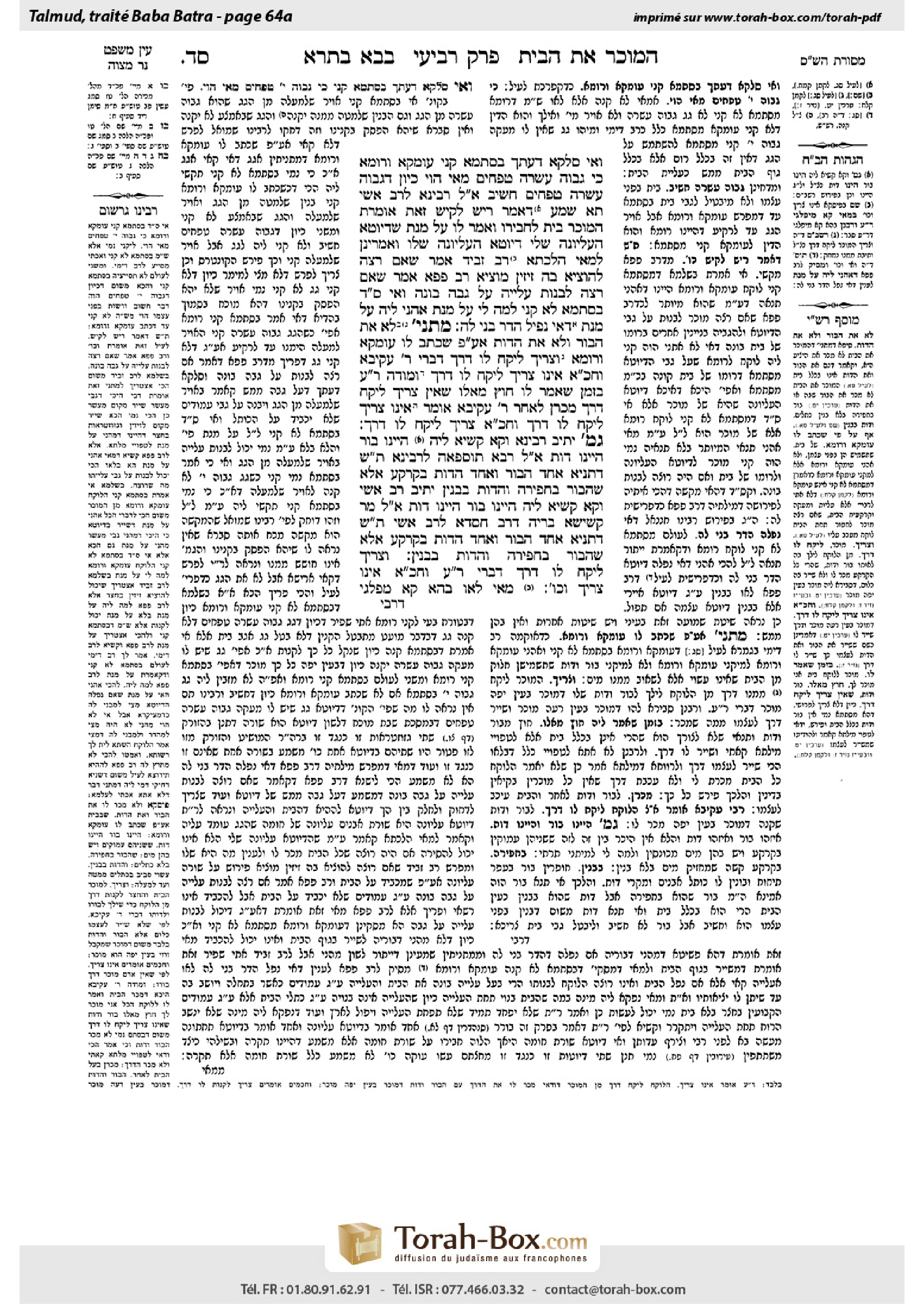
Bava Batra 64a: Talmud study for Daf Yomi
Study the Talmud for Daf Yomi with scanned pages, Hebrew text, English translations from Sefaria and AI-generated French translations.
Passage selection and English or AI-generated French translation are available where the scan has annotations. Daf Study is independent of Torah-Box and Sefaria.
Browse Bava Batra · בבא בתרא · All tractatesBava Batra 64a text and translations
This page of Bava Batra includes the Aramaic text, an English translation and an AI-generated French translation, alongside the scan above.
בבא בתרא ס״ד א · Aramaic and Hebrew text
וְאִי סָלְקָא דַּעְתָּךְ בִּסְתָמָא קָנֵי עוּמְקָא וְרוּמָא, כִּי גָּבוֹהַּ עֲשָׂרָה טְפָחִים מַאי הָוֵי? כֵּיוָן דְּגָבוֹהַּ עֲשָׂרָה טְפָחִים – חֲשִׁיב.
אֲמַר לֵיהּ רָבִינָא לְרַב אָשֵׁי, תָּא שְׁמַע: דְּאָמַר רֵישׁ לָקִישׁ, זֹאת אוֹמֶרֶת: הַמּוֹכֵר בַּיִת לַחֲבֵירוֹ, וְאָמַר לוֹ: ״עַל מְנָת שֶׁדְּיוֹטָא הָעֶלְיוֹנָה שֶׁלִּי״ – דְּיוֹטָא הָעֶלְיוֹנָה שֶׁלּוֹ. וְאָמְרִינַן, לְמַאי הִלְכְתָא? רַב זְבִיד אָמַר: שֶׁאִם רָצָה לְהוֹצִיא בָּהּ זִיזִין – מוֹצִיא. רַב פָּפָּא אָמַר: שֶׁאִם רָצָה לִבְנוֹת עֲלִיָּיה עַל גַּבָּהּ – בּוֹנֶה.
וְאִי סָלְקָא דַּעְתָּךְ: בִּסְתָמָא לָא קָנֵי, לְמָה לִי ״עַל מְנָת״? אַהֲנִי לֵיהּ ״עַל מְנָת״ – דְּאִי נָפֵיל, הָדַר בָּנֵי לָהּ.
מַתְנִי׳ לֹא אֶת הַבּוֹר וְלֹא אֶת הַדּוּת – אַף עַל פִּי שֶׁכָּתַב לוֹ עוּמְקָא וְרוּמָא. וְצָרִיךְ לִיקַּח לוֹ דֶּרֶךְ, דִּבְרֵי רַבִּי עֲקִיבָא. וַחֲכָמִים אוֹמְרִים: אֵינוֹ צָרִיךְ לִיקַּח לוֹ דֶּרֶךְ.
וּמוֹדֶה רַבִּי עֲקִיבָא בִּזְמַן שֶׁאָמַר לוֹ ״חוּץ מֵאֵלּוּ״, שֶׁאֵין צָרִיךְ לִיקַּח דֶּרֶךְ.
מְכָרָן לְאַחֵר – רַבִּי עֲקִיבָא אוֹמֵר: אֵינוֹ צָרִיךְ לִיקַּח לוֹ דֶּרֶךְ, וַחֲכָמִים אוֹמְרִים: צָרִיךְ לִיקַּח לוֹ דֶּרֶךְ.
גְּמָ׳ יְתֵיב רָבִינָא וְקָא קַשְׁיָא לֵיהּ: הַיְינוּ בּוֹר – הַיְינוּ דּוּת! אֲמַר לֵיהּ רָבָא תּוֹסְפָאָה לְרָבִינָא: תָּא שְׁמַע, דְּתַנְיָא: אֶחָד הַבּוֹר וְאֶחָד הַדּוּת – בְּקַרְקַע, אֶלָּא שֶׁהַבּוֹר בַּחֲפִירָה וְהַדּוּת בְּבִנְיָן. יָתֵיב רַב אָשֵׁי וְקָא קַשְׁיָא לֵיהּ: הַיְינוּ בּוֹר – הַיְינוּ דּוּת! אֲמַר לֵיהּ מָר קַשִּׁישָׁא בְּרֵיהּ דְּרַב חִסְדָּא לְרַב אָשֵׁי: תָּא שְׁמַע, דְּתַנְיָא: אֶחָד הַבּוֹר וְאֶחָד הַדּוּת – בַּקַּרְקַע, אֶלָּא שֶׁהַבּוֹר בַּחֲפִירָה וְהַדּוּת בְּבִנְיָן.
וְצָרִיךְ לִיקַּח לוֹ דֶּרֶךְ, דִּבְרֵי רַבִּי עֲקִיבָא. וַחֲכָמִים אוֹמְרִים: אֵינוֹ צָרִיךְ וְכוּ׳. מַאי, לָאו בְּהָא קָא מִפַּלְגִי –
Bava Batra 64a · English translation
And if it enters your mind to say that when a house is sold without specification, the buyer acquires the depth and the height of the house, then even when it has a parapet ten handbreadths high, what of it? Why shouldn’t the buyer acquire the roof? The Gemara answers: Since the parapet is ten handbreadths high, the roof is significant in its own right, and therefore, unless it is specifically included in the sale, the buyer does not acquire such a roof along with the house.
Ravina said to Rav Ashi: Come and hear another proof, as Reish Lakish says: That is to say that with regard to one who sells a house to another and says to him: I am selling you this house on the condition that the upper story is mine, the upper story is his. And in the Gemara’s examination of Reish Lakish’s statement, we said: With regard to what halakha did Reish Lakish say this? In any case the upper story is his, as when he sold the house it was only the lower story that he sold to the buyer. Rav Zevid says: He said this to teach the halakha that if the seller wishes to extend from the upper story projections over the courtyard, which was included in the sale, he may extend them. Rav Pappa says: He said this to teach the halakha that if this upper story collapses and the seller wishes to build an upper story on top of it to replace it, he may build it.
And if it enters your mind to say that when a house is sold without specification, the buyer does not acquire the depth and the height of a house, Rav Pappa’s statement is puzzling. As why do I need the seller to stipulate that he is selling the house on the condition that the upper story is his when in any event the space above the house remains in the seller’s possession? The Gemara answers: Stipulating that he is selling the house on the condition that the upper story is his benefits him in that if the upper story collapses, he may rebuild it. Without this stipulation the seller could not rebuild it, even if the sale did not include the depth and the height of the house.
MISHNA: One who sells a house without specification has sold neither the pit nor the cistern [dut], even if he writes for the buyer in the bill of sale that he is selling him the depth and the height of the house, as anything that is not part of the house, like pits and cisterns, must be explicitly mentioned in the contract or else they remain in the seller’s possession. And therefore the seller must purchase for himself a path through the buyer’s domain to reach whatever remains his, because he has sold the area of the house along with the house itself, and he no longer has permission to walk there. This is the statement of Rabbi Akiva. And the Rabbis say: The seller need not purchase for himself a path through the buyer’s domain, as this is certainly included in what he has withheld for himself from the sale.
And Rabbi Akiva concedes that when the seller says to the buyer in the bill of sale: I am selling you this house apart from the pit and the cistern, he need not purchase for himself a path through the buyer’s domain. Since the seller unnecessarily emphasized that the pit and the cistern are not included in the sale, he presumably intended to reserve for himself the right of access to them.
If the seller kept the house, but sold the pit and the cistern to another, Rabbi Akiva says: The buyer need not purchase for himself a path through the seller’s domain to reach what he has bought. But the Rabbis say: He must purchase for himself a path through the seller’s domain.
GEMARA: It is related that Ravina once sat and examined the matter and posed a difficulty: A pit is the same as a cistern. Why, then, was it necessary to mention both of them? Rava Tosfa’a said to Ravina: Come and hear a solution to this question, as it is taught in a baraita: Both a pit and a cistern are dug out in the ground; the difference is only that a pit is constructed through digging alone, while a cistern is subsequently finished on the inside by building masonry walls. It is similarly related that Rav Ashi once sat and posed a difficulty: A pit is the same as a cistern. Mar Kashisha, son of Rav Ḥisda, said to Rav Ashi: Come and hear a solution to this question, as it is taught in a baraita: Both a pit and a cistern are dug in the ground, the difference is only that a pit is constructed through digging alone, while a cistern is subsequently finished on the inside by building masonry walls.
§ The mishna teaches: And the seller must purchase for himself a path through the buyer’s domain; this is the statement of Rabbi Akiva. And the Rabbis say: The seller need not purchase such a path. What, is it not about this issue, which will immediately be explained, that Rabbi Akiva and the Rabbis disagree?
Bava Batra 64a · Traduction française (IA)
Et si cela entre dans votre pensée de dire que lorsqu'une maison est vendue sans précision, l'acheteur acquiert la profondeur et la hauteur de la maison, alors même s'il possède un parapet de dix paumes de haut, qu'est-ce que cela change ? Pourquoi ne devrait-il pas acquérir le toit ? La Guemara répond : Puisque le parapet est de dix paumes de haut, le toit est important en soi, et par conséquent, à moins qu'il ne soit spécifiquement inclus dans la vente, l'acheteur ne possède pas ce toit avec la maison.
Ravina dit à Rav Ashi : Viens entendre un autre argument, comme Reish Lakish dit : Cela signifie que concernant celui qui vend une maison à un autre et lui dit : Je te vends cette maison sous la condition que l'étage supérieur est à moi, l'étage supérieur est à lui. Et dans l'examen de la Guemara sur l'affirmation de Reish Lakish, nous disons : Concernant quelle halakha Reish Lakish a-t-il dit cela ? En tout cas, l'étage supérieur est à lui, car lorsqu'il a vendu la maison, il n'avait vendu que l'étage inférieur à l'acheteur. Rav Zevid dit : Il a dit cela pour enseigner la halakha que si le vendeur souhaite étendre des projections depuis l'étage supérieur sur la cour, qui était inclus dans la vente, il peut les étendre. Rav Pappa dit : Il a dit cela pour enseigner la halakha que si cet étage s'effondre et que le vendeur souhaite construire un étage supérieur dessus pour le remplacer, il peut le construire.
Et si cela entre dans votre pensée de dire que lorsqu'une maison est vendue sans précision, l'acheteur ne possède pas la profondeur et la hauteur de la maison, la déclaration de Rav Pappa est troublante. Car pourquoi ai-je besoin que le vendeur stipule qu'il vend la maison sous la condition que l'étage supérieur est à lui, si en tout cas l'espace au-dessus de la maison reste en possession du vendeur ? La Guemara répond : Stipuler que le vendeur vend la maison sous la condition que l'étage supérieur est à lui est avantageux pour lui, car s'il s'effondre, il peut le reconstruire. Sans cette stipulation, le vendeur ne pourrait pas le reconstruire, même si la vente n'incluait pas la profondeur et la hauteur de la maison.
MICHNA : Celui qui vend une maison sans précision n'a pas vendu la fosse ni le puits [dut], même s'il écrit à l'acheteur dans le contrat de vente qu'il lui vend la profondeur et la hauteur de la maison, car tout ce qui n'est pas partie de la maison, comme les fosses et les puits, doit être explicitement mentionné dans le contrat, sinon ils restent en possession du vendeur. Et par conséquent, le vendeur doit acheter pour lui-même un chemin à travers le domaine de l'acheteur pour accéder à ce qui lui reste, car il a vendu la surface de la maison ainsi que la maison elle-même, et il n'a plus le droit de marcher là. C'est la déclaration de Rabbi Akiva. Et les Rabbins disent : Le vendeur n'a pas besoin d'acheter pour lui-même un chemin à travers le domaine de l'acheteur, car cela est certainement inclus dans ce qu'il a réservé pour lui-même de la vente.
Et Rabbi Akiva reconnaît que lorsque le vendeur dit à l'acheteur dans le contrat de vente : Je te vends cette maison en dehors de la fosse et du puits, il n'a pas besoin d'acheter pour lui-même un chemin à travers le domaine de l'acheteur. Puisque le vendeur a inutilement souligné que la fosse et le puits ne sont pas inclus dans la vente, il a probablement voulu réservé pour lui-même le droit d'accès à ces lieux.
Si le vendeur a gardé la maison, mais a vendu la fosse et le puits à un autre, Rabbi Akiva dit : L'acheteur n'a pas besoin d'acheter pour lui-même un chemin à travers le domaine du vendeur pour accéder à ce qu'il a acheté. Mais les Rabbins disent : Il doit acheter pour lui-même un chemin à travers le domaine du vendeur.
GUEMARA : Il est rapporté que Ravina s'était assis et avait examiné la question, puis avait posé un doute : Une fosse est la même qu'un puits. Pourquoi, alors, fallait-il mentionner les deux ? Rava Tosfa’a a dit à Ravina : Viens entendre une solution à cette question, car il est enseigné dans une baraïta : Les fosse et le puits sont creusés dans le sol ; la différence est seulement que la fosse est construite par le seul acte de creusement, tandis que le puits est ensuite achevé à l'intérieur en construisant des murs en pierre. Il est également rapporté que Rav Ashi s'était assis et avait posé un doute : Une fosse est la même qu'un puits. Mar Kashisha, fils de Rav Ḥisda, a dit à Rav Ashi : Viens entendre une solution à cette question, car il est enseigné dans une baraïta : Les fosse et le puits sont creusés dans le sol ; la différence est seulement que la fosse est construite par le seul acte de creusement, tandis que le puits est ensuite achevé à l'intérieur en construisant des murs en pierre.
§ La Michna enseigne : Et le vendeur doit acheter pour lui-même un chemin à travers le domaine de l'acheteur ; c'est la déclaration de Rabbi Akiva. Et les Rabbins disent : Le vendeur n'a pas besoin d'acheter un tel chemin. Qu'est-ce que cela n'est pas concernant cette question, qui sera immédiatement expliquée, où Rabbi Akiva et les Rabbins s'opposent ?
Traduction française générée par IA à partir de l’édition anglaise de Sefaria. Vérifie toujours un passage avec le texte source.
Text from Sefaria: William Davidson Edition - Vocalized Aramaic (CC BY NC); William Davidson Edition - English (CC BY NC).