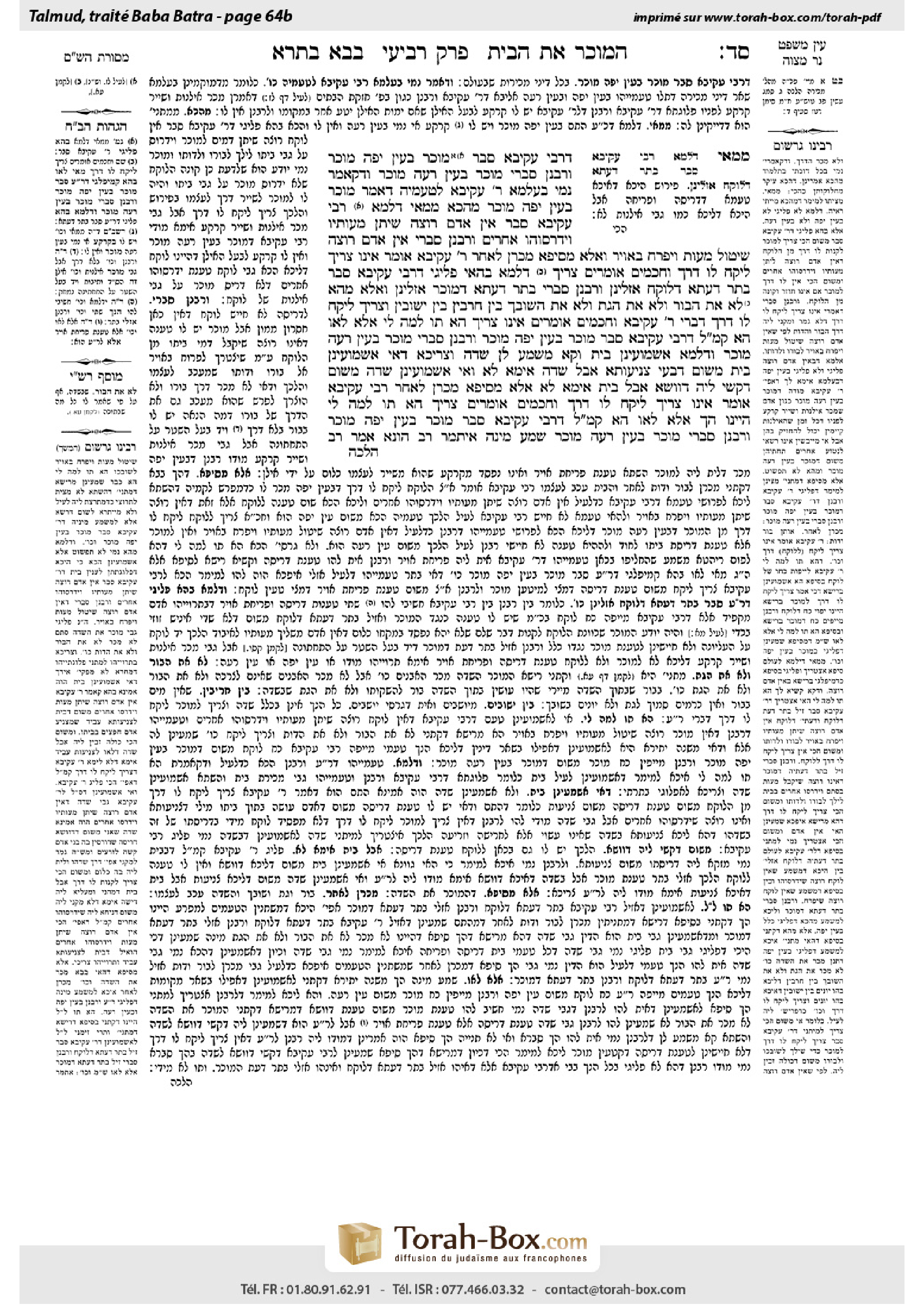
Bava Batra 64b: Talmud study for Daf Yomi
Study the Talmud for Daf Yomi with scanned pages, Hebrew text, English translations from Sefaria and AI-generated French translations.
Passage selection and English or AI-generated French translation are available where the scan has annotations. Daf Study is independent of Torah-Box and Sefaria.
Browse Bava Batra · בבא בתרא · All tractatesBava Batra 64b text and translations
This page of Bava Batra includes the Aramaic text, an English translation and an AI-generated French translation, alongside the scan above.
בבא בתרא ס״ד ב · Aramaic and Hebrew text
דְּרַבִּי עֲקִיבָא סָבַר: מוֹכֵר בְּעַיִן יָפָה מוֹכֵר, וְרַבָּנַן סָבְרִי: מוֹכֵר בְּעַיִן רָעָה מוֹכֵר; וּדְקָאָמַר נָמֵי בְּעָלְמָא ״רַבִּי עֲקִיבָא לְטַעְמֵיהּ, דְּאָמַר מוֹכֵר בְּעַיִן יָפָה מוֹכֵר״ – מֵהָכָא.
מִמַּאי? דִּלְמָא רַבִּי עֲקִיבָא סָבַר: אֵין אָדָם רוֹצֶה שֶׁיִּתֵּן מְעוֹתָיו וְיִדְרְסוּהוּ אֲחֵרִים, וְרַבָּנַן סָבְרִי: אֵין אָדָם רוֹצֶה שֶׁיִּטּוֹל מָעוֹת וְיִפְרַח בָּאֲוִיר!
וְאֶלָּא מִסֵּיפָא – מְכָרָן לְאַחֵר, רַבִּי עֲקִיבָא אוֹמֵר: אֵינוֹ צָרִיךְ לִיקַּח לוֹ דֶּרֶךְ, וַחֲכָמִים אוֹמְרִים: צָרִיךְ.
דִּלְמָא בְּהַאי פְּלִיגִי – דְּרַבִּי עֲקִיבָא סָבַר: בָּתַר דַּעְתָּא דְלוֹקֵחַ אָזְלִינַן; וְרַבָּנַן סָבְרִי: בָּתַר דַּעְתָּא דְמוֹכֵר אָזְלִינַן!
אֶלָּא מֵהָא – לָא אֶת הַבּוֹר וְלֹא אֶת הַגַּת וְלֹא אֶת הַשּׁוֹבָךְ, בֵּין חֲרֵבִין בֵּין יְשׁוּבִין; וְצָרִיךְ לִיקַּח לוֹ דֶּרֶךְ, דִּבְרֵי רַבִּי עֲקִיבָא. וַחֲכָמִים אוֹמְרִים: אֵינוֹ צָרִיךְ.
הָא תּוּ לְמָה לִי? אֶלָּא לָאו הָא קָא מַשְׁמַע לַן – דְּרַבִּי עֲקִיבָא סָבַר: מוֹכֵר בְּעַיִן יָפָה מוֹכֵר, וְרַבָּנַן סָבְרִי: מוֹכֵר בְּעַיִן רָעָה מוֹכֵר?
וְדִלְמָא אַשְׁמְעִינַן בַּיִת, וְקָא מַשְׁמַע לַן שָׂדֶה; וּצְרִיכָא, דְּאִי אַשְׁמְעִינַן בַּיִת – מִשּׁוּם דְּבָעֵי צְנִיעוּתָא, אֲבָל שָׂדֶה – אֵימָא לָא;
וְאִי אַשְׁמְעִינַן שָׂדֶה – מִשּׁוּם דְּקָשֵׁי לֵיהּ דַּוְושָׁא; אֲבָל בַּיִת – אֵימָא לָא.
אֶלָּא מִסֵּיפָא – מְכָרָן לְאַחֵר, רַבִּי עֲקִיבָא אוֹמֵר: אֵינוֹ צָרִיךְ לִיקַּח לוֹ דֶּרֶךְ, וַחֲכָמִים אוֹמְרִים: צָרִיךְ.
הָא תּוּ לְמָה לִי? הַיְינוּ הָךְ! אֶלָּא לָאו הָא קָא מַשְׁמַע לַן – דְּרַבִּי עֲקִיבָא סָבַר: מוֹכֵר בְּעַיִן יָפָה מוֹכֵר, וְרַבָּנַן סָבְרִי: מוֹכֵר בְּעַיִן רָעָה מוֹכֵר? שְׁמַע מִינַּהּ.
אִיתְּמַר, רַב הוּנָא אָמַר רַב:
Bava Batra 64b · English translation
As Rabbi Akiva holds that one who sells, sells generously, so that whatever is not explicitly excluded from the sale is assumed to be sold, while the Rabbis hold that one who sells, sells sparingly, so that whatever is not explicitly included in the sale is assumed to be unsold. And perhaps that which is also stated generally: Rabbi Akiva conforms to his standard line of reasoning, as he says that one who sells, sells generously, is derived from here.
The Gemara rejects this opinion and asks: From where do you arrive at such a conclusion? Perhaps Rabbi Akiva and the Rabbis do not disagree whether, in principle, a person who sells, sells generously or sparingly, but rather their disagreement is limited to this specific case. As Rabbi Akiva holds that a person does not want to spend his money on the purchase of a house and then have others tread upon his property, and therefore he says that the seller must purchase for himself a path through the buyer’s domain to reach his pit. And the Rabbis hold that a person does not want to receive money for the sale of his house and then have to fly through the air in order to reach his pit, and therefore they say that the seller presumably withheld for himself a path to his pit.
Rather, the proof is from the last clause of the mishna, which states: If the seller kept the house but sold the pit and the cistern to another, Rabbi Akiva says: The buyer need not purchase for himself a path through the seller’s domain. But the Rabbis say: He must purchase for himself a path through the seller’s domain. The tanna’im seem to disagree as to whether a person who sells, sells generously or sparingly.
The Gemara rejects this proof as well: Perhaps they disagree about the following: Rabbi Akiva holds that we follow the intention of the buyer, as we assume that he would not have bought the pit if he would have to fly through the air to get there. And the Rabbis hold that we follow the intention of the seller, as presumably he would not have sold the pit if the buyer had the right to tread upon the seller’s property to reach it.
Rather, the proof that these tanna’im disagree whether one who sells, sells generously or sparingly is from this mishna (71a), which teaches: One who sells a field, even if he states that he is selling everything in it to the buyer, has sold neither the cistern, nor the winepress, nor the dovecote, whether it is abandoned or utilized, as these items are not part of the field itself. And the seller must purchase for himself a path through the buyer’s domain to reach whatever remains his. This is the statement of Rabbi Akiva. And the Rabbis say: The seller need not purchase a path through the buyer’s domain.
The Gemara explains the proof: Why do I need this ruling as well, seeing that this case involving the sale of a field appears to be identical to that involving the sale of a house? Rather, is it not teaching us that Rabbi Akiva holds that one who sells, sells generously, and therefore the seller must purchase for himself a path to his property, while the Rabbis hold that one who sells, sells sparingly, and therefore the purchase of such a path is not necessary?
The Gemara rejects this opinion: Perhaps the first mishna taught us this dispute with regard to a house, and the later mishna teaches us this dispute with regard to a field. And while this may seem redundant, both rulings are necessary, as had the mishna taught us this halakha only with regard to a house, I would have said that the buyer is particular about people passing through his house, because he desires privacy there. And it is for this reason that Rabbi Akiva says that in the absence of an explicit stipulation, the seller must purchase for himself a path to the pit. But in the case of a field, which is exposed to all, say that the buyer is not concerned about privacy.
And, conversely, had the mishna taught us this halakha only with regard to a field, I would have said that the buyer is particular about people passing through his field, because treading upon the field is detrimental to it. And it is for this reason that Rabbi Akiva says that the seller must purchase for himself a path to the pit. But in the case of a house, which is not adversely affected by treading through it, say that the buyer is not opposed to the seller passing through.
Rather, the proof that Rabbi Akiva and the Rabbis disagree whether one who sells, sells generously or sparingly is from the latter clause of that mishna (71a), which teaches: But if the seller kept the field but sold the cistern and winepress to another person, Rabbi Akiva says: The buyer need not purchase for himself a path through the seller’s domain to reach what he has bought, since a seller sells generously. But the Rabbis say: He must purchase for himself a path through the seller’s domain.
The Gemara explains the proof: Why do I also need this, seeing as this case involving the sale of a pit or a winepress in a field is identical to that involving the sale of a pit or a cistern in a house? Rather, is it not teaching us that Rabbi Akiva holds that one who sells, sells generously, while the Rabbis hold that one who sells, sells sparingly? The Gemara affirms: Conclude from the latter clauses of these mishnayot that this is so.
It was stated that the amora’im disagree about how the halakha should be decided with regard to this issue. Rav Huna says that Rav says:
Bava Batra 64b · Traduction française (IA)
Comme Rabbi Akiva affirme que celui qui vend vend généreusement, de sorte que tout ce qui n'est pas explicitement exclu de la vente est considéré comme vendu, tandis que les Rabbins affirment que celui qui vend vend parcimonieusement, de sorte que tout ce qui n'est pas explicitement inclus dans la vente est considéré comme non vendu. Et peut-être que cela est également dit généralement : Rabbi Akiva suit sa ligne de raisonnement habituelle, car il dit que celui qui vend vend généreusement, est tiré de là.
La Guemara rejette cet avis et pose la question : D'où tirez-vous une telle conclusion ? Peut-être que Rabbi Akiva et les Rabbins ne s'opposent pas sur le fait que, en principe, une personne qui vend vend généreusement ou parcimonieusement, mais plutôt leur désaccord est limité à ce cas spécifique. Comme Rabbi Akiva affirme que la personne ne veut pas dépenser son argent pour l'achat d'une maison et ensuite avoir d'autres marcher sur sa propriété, et donc il dit que le vendeur doit acheter lui-même un chemin à travers le domaine de l'acheteur pour atteindre son puits. Et les Rabbins affirment que la personne ne veut pas recevoir de l'argent pour la vente de sa maison et ensuite avoir à voler dans l'air pour atteindre son puits, et donc ils disent que le vendeur a probablement gardé pour lui-même un chemin vers son puits.
Plutôt, la preuve provient de la dernière phrase de la Michna, qui stipule : Si le vendeur a gardé la maison mais a vendu le puits et le cistern à un autre, Rabbi Akiva dit : L'acheteur n'a pas besoin d'acheter lui-même un chemin à travers le domaine du vendeur pour atteindre ce qu'il possède. Mais les Rabbins disent : Il doit acheter lui-même un chemin à travers le domaine du vendeur. Les tannaïm semblent s'opposer sur le fait que si une personne vend, elle vend généreusement ou parcimonieusement.
La Guemara rejette cette preuve également : Peut-être qu'ils s'opposent sur la suivante : Rabbi Akiva affirme que nous suivons l'intention de l'acheteur, car nous supposons qu'il n'aurait pas acheté le puits s'il devait traverser l'air pour y arriver. Et les Rabbins affirment que nous suivons l'intention du vendeur, car probablement il n'aurait pas vendu le puits si l'acheteur avait le droit de marcher sur le domaine du vendeur pour y arriver.
Plutôt, la preuve que ces tannaïm s'opposent sur le fait que celui qui vend vend généreusement ou parcimonieusement provient de cette Michna (71a), qui enseigne : Celui qui vend un champ, même s'il déclare vendre tout ce qui y est contenu à l'acheteur, n'a pas vendu le puits, ni la vigne, ni le poulaillers, qu'il soit abandonné ou utilisé, car ces objets ne font pas partie du champ lui-même. Et le vendeur doit acheter lui-même un chemin à travers le domaine de l'acheteur pour atteindre ce qui lui reste. C'est l'avis de Rabbi Akiva. Et les Rabbins disent : Le vendeur n'a pas besoin d'acheter un chemin à travers le domaine de l'acheteur.
La Guemara explique la preuve : Pourquoi ai-je besoin de cette décision également, vu que ce cas concernant la vente d'un champ semble être identique à celui concernant la vente d'une maison ? Plutôt, n'est-ce pas enseignant que Rabbi Akiva affirme que celui qui vend vend généreusement, et donc le vendeur doit acheter lui-même un chemin vers sa propriété, tandis que les Rabbins affirment que celui qui vend vend parcimonieusement, et donc l'achat d'un tel chemin n'est pas nécessaire ?
La Guemara rejette cet avis : Peut-être que la première Michna nous a appris ce débat concernant une maison, et la Michna ultérieure nous a appris ce débat concernant un champ. Et bien que cela puisse sembler redondant, ces deux décisions sont nécessaires, car si la Michna nous avait appris cette halakha uniquement concernant une maison, j'aurais dit que l'acheteur est particulier sur les personnes passant par sa maison, car il désire la confidentialité là. Et c'est pour cette raison que Rabbi Akiva dit que, en l'absence d'une stipulation explicite, le vendeur doit acheter lui-même un chemin vers son puits. Mais dans le cas d'un champ, qui est exposé à tous, disent que l'acheteur n'est pas préoccupé par la confidentialité.
Et inversement, si la Michna nous avait appris cette halakha uniquement concernant un champ, j'aurais dit que l'acheteur est particulier sur les personnes passant par son champ, car marcher sur le champ est nuisible. Et c'est pour cette raison que Rabbi Akiva dit que le vendeur doit acheter lui-même un chemin vers son puits. Mais dans le cas d'une maison, qui n'est pas affectée négativement par la marche dessus, disent que l'acheteur n'est pas opposé à la marche du vendeur.
Plutôt, la preuve que Rabbi Akiva et les Rabbins s'opposent sur le fait que si une personne vend, elle vend généreusement ou parcimonieusement provient de la dernière phrase de cette Michna (71a), qui enseigne : Mais si le vendeur a gardé le champ mais a vendu le puits et la vigne à une autre personne, Rabbi Akiva dit : L'acheteur n'a pas besoin d'acheter lui-même un chemin à travers le domaine du vendeur pour atteindre ce qu'il a acheté, car le vendeur vend généreusement. Mais les Rabbins disent : Il doit acheter lui-même un chemin à travers le domaine du vendeur.
La Guemara explique la preuve : Pourquoi ai-je besoin de cela également, vu que ce cas concernant la vente d'un puits ou d'une vigne dans un champ est identique à celui concernant la vente d'un puits ou d'un cistern dans une maison ? Plutôt, n'est-ce pas enseigné que Rabbi Akiva affirme que celui qui vend vend généreusement, tandis que les Rabbins affirment que celui qui vend vend parcimonieusement ? La Guemara confirme : Concluez à partir des dernières phrases de ces mitsvot que c'est ainsi.
Il a été dit que les amoraïm s'opposent sur la manière dont la halakha devrait être décidée concernant cette question. Rav Huna dit que Rav dit :
Traduction française générée par IA à partir de l’édition anglaise de Sefaria. Vérifie toujours un passage avec le texte source.
Text from Sefaria: William Davidson Edition - Vocalized Aramaic (CC BY NC); William Davidson Edition - English (CC BY NC).