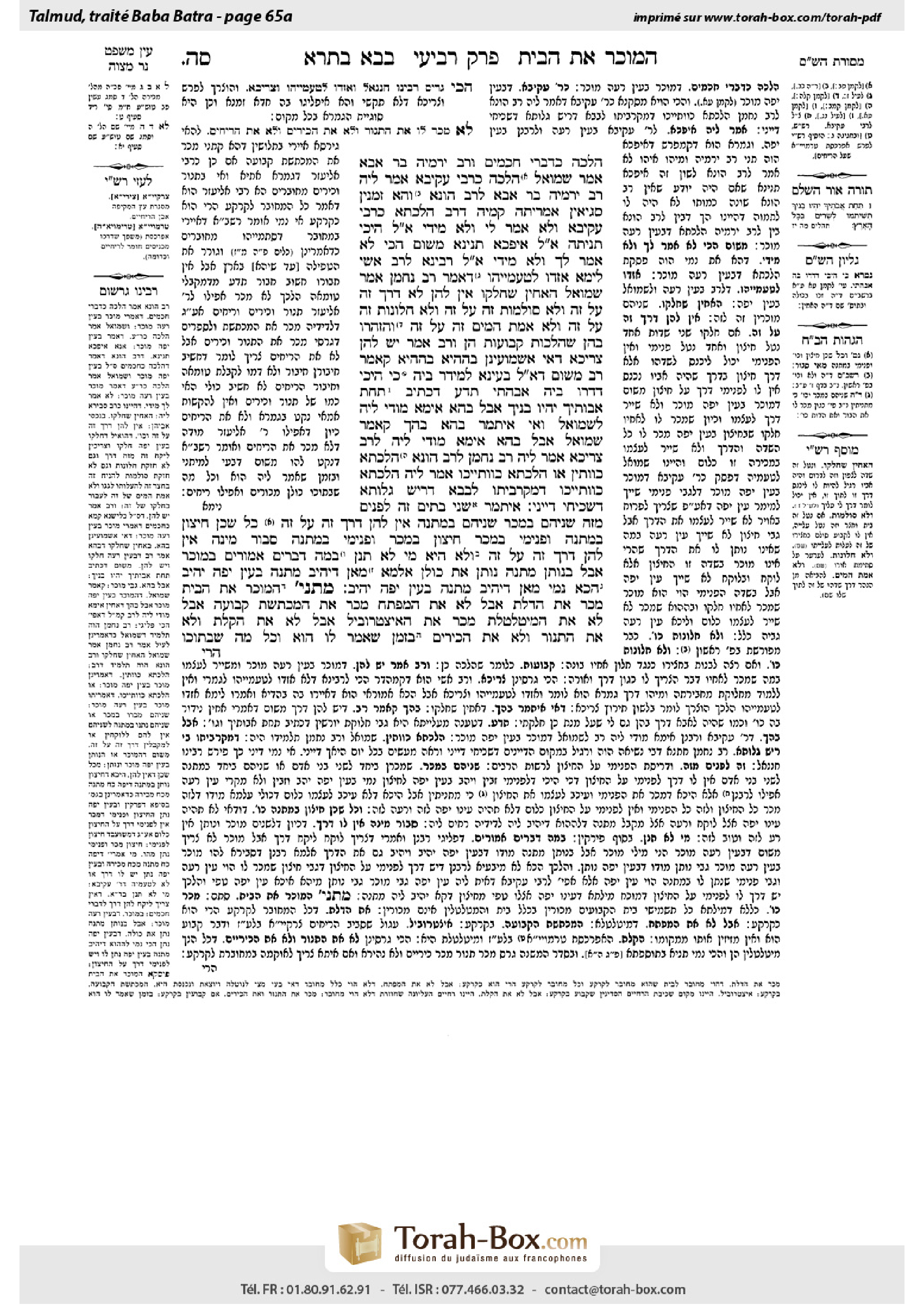
Bava Batra 65a: Talmud study for Daf Yomi
Study the Talmud for Daf Yomi with scanned pages, Hebrew text, English translations from Sefaria and AI-generated French translations.
Passage selection and English or AI-generated French translation are available where the scan has annotations. Daf Study is independent of Torah-Box and Sefaria.
Browse Bava Batra · בבא בתרא · All tractatesBava Batra 65a text and translations
This page of Bava Batra includes the Aramaic text, an English translation and an AI-generated French translation, alongside the scan above.
בבא בתרא ס״ה א · Aramaic and Hebrew text
הֲלָכָה כְּדִבְרֵי חֲכָמִים. וְרַב יִרְמְיָה בַּר אַבָּא אָמַר שְׁמוּאֵל: הֲלָכָה כְּרַבִּי עֲקִיבָא. אֲמַר לֵיהּ רַב יִרְמְיָה בַּר אַבָּא לְרַב הוּנָא: ״וְהָא זִמְנִין סַגִּיאִין אַמְרִיתַהּ קַמֵּיהּ דְּרַב: הִלְכְתָא כְּרַבִּי עֲקִיבָא, וְלָא אֲמַר לִי וְלָא מִידֵּי!״ אֲמַר לֵיהּ: ״הֵיכִי תְּנִיתַהּ?״ אֲמַר לֵיהּ: ״אִיפְּכָא תָּנֵינָא״. ״מִשּׁוּם הָכִי לָא אֲמַר לָךְ וְלָא מִידֵּי״.
אֲמַר לֵיהּ רָבִינָא לְרַב אָשֵׁי: לֵימָא אָזְדוּ לְטַעְמַיְיהוּ –
דְּאָמַר רַב נַחְמָן אָמַר שְׁמוּאֵל: הָאַחִין שֶׁחָלְקוּ – אֵין לָהֶן לֹא דֶּרֶךְ זֶה עַל זֶה, וְלֹא סוּלָּמוֹת זֶה עַל זֶה, וְלֹא חַלּוֹנוֹת זֶה עַל זֶה, וְלֹא אַמַּת הַמַּיִם זֶה עַל זֶה.
וְהִזָּהֲרוּ בָּהֶן, שֶׁהֲלָכוֹת קְבוּעוֹת הֵן. וְרַב אָמַר: יֵשׁ לָהֶן.
צְרִיכָא; דְּאִי אַשְׁמְעִינַן בְּהָהִיא – בְּהָהִיא קָאָמַר רַב, מִשּׁוּם דַּאֲמַר לֵיהּ: בָּעֵינָא לְמֵידַר בֵּיהּ כִּי הֵיכִי דְּדָרוּ בֵּיהּ אֲבָהָתִי; תִּדַּע, דִּכְתִיב: ״תַּחַת אֲבֹתֶיךָ יִהְיוּ בָנֶיךָ״; אֲבָל בְּהָא – אֵימָא מוֹדֵי לֵיהּ לִשְׁמוּאֵל;
וְאִי אִיתְּמַר בְּהָא – בְּהָךְ קָאָמַר שְׁמוּאֵל, אֲבָל בְּהָא – אֵימָא מוֹדֵי לֵיהּ לְרַב; צְרִיכָא.
אֲמַר לֵיהּ רַב נַחְמָן לְרַב הוּנָא: הִלְכְתָא כְּווֹתִין, אוֹ הִלְכְתָא כְּווֹתַיְיכוּ? אֲמַר לֵיהּ: הִלְכְתָא כְּווֹתַיְיכוּ, דִּמְקָרְבִיתוּ לְבָבָא דְּרֵישׁ גָּלוּתָא, דִּשְׁכִיחִי דַּיָּינֵי.
אִיתְּמַר: שְׁנֵי בָתִּים זֶה לְפָנִים מִזֶּה; שְׁנֵיהֶם בְּמֶכֶר, שְׁנֵיהֶם בְּמַתָּנָה – אֵין לָהֶן דֶּרֶךְ זֶה עַל זֶה. כׇּל שֶׁכֵּן חִיצוֹן בְּמַתָּנָה וּפְנִימִי בְּמֶכֶר.
חִיצוֹן בְּמֶכֶר וּפְנִימִי בְּמַתָּנָה – סְבוּר מִינַּהּ: אֵין לָהֶן דֶּרֶךְ זֶה עַל זֶה;
וְלָא הִיא – מִי לָא תְּנַן: בַּמֶּה דְּבָרִים אֲמוּרִים – בְּמוֹכֵר, אֲבָל בְּנוֹתֵן מַתָּנָה – נוֹתֵן אֶת כּוּלָּן? אַלְמָא מַאן דְּיָהֵיב מַתָּנָה – בְּעַיִן יָפָה יָהֵיב; הָכָא נָמֵי, מַאן דְּיָהֵיב מַתָּנָה – בְּעַיִן יָפָה יָהֵיב.
מַתְנִי׳ הַמּוֹכֵר אֶת הַבַּיִת – מָכַר אֶת הַדֶּלֶת, אֲבָל לֹא אֶת הַמַּפְתֵּחַ; מָכַר אֶת הַמַּכְתֶּשֶׁת קְבוּעָה, אֲבָל לֹא אֶת הַמִּיטַּלְטֶלֶת; מָכַר אֶת הָאִיצְטְרוֹבֵיל, אֲבָל לֹא אֶת הַקֶּלֶת; וְלֹא אֶת הַתַּנּוּר וְלֹא אֶת הַכִּירַיִם. בִּזְמַן שֶׁאָמַר לוֹ: ״הוּא וְכׇל מַה שֶׁבְּתוֹכוֹ״ –
Bava Batra 65a · English translation
The halakha is in accordance with the statement of the Rabbis, while Rav Yirmeya bar Abba says that Shmuel says: The halakha is in accordance with the opinion of Rabbi Akiva. Rav Yirmeya bar Abba said to Rav Huna: But many times I said before Rav that the halakha is in accordance with the opinion of Rabbi Akiva, and never did he say anything to me, which indicates that he holds that the halakha is in accordance with the opinion of Rabbi Akiva and not that of the Rabbis. Rav Huna said to him: How did you teach the mishna before Rav? Rav Yirmeya bar Abba said to him: I taught it with the opposite attributions, that is to say, the opinion that is attributed in the mishna to Rabbi Akiva, I would teach in the name of the Rabbis. Rav Huna said to him: Due to that reason, he never said anything to you, as Rav agreed with the version that you attributed to Rabbi Akiva.
With regard to the opinions of Rav and Shmuel, Ravina said to Rav Ashi: Shall we say that Rav and Shmuel, in their opinions stated with regard to this matter, each follow their general lines of reasoning, as they appear to have disagreed about this same issue in another context as well?
As Rav Naḥman says that Shmuel says: With regard to brothers who divided their father’s estate between them, they do not have a right of way against each other, i.e., to walk through the other’s property to reach his own, even though this is how the place was used in their father’s lifetime; nor do they have the right of ladders against each other, i.e., the right to set up a ladder in the other’s property in order to get to his own; nor do they have the right of windows against each other, i.e., the right to prevent the other from building a wall facing his windows; nor do they have the right of a water channel against each other, i.e., the right to pass a water channel through the other’s property.
Rav Naḥman continues: And be careful with these rulings, since they are established halakhot. And Rav says: They do retain all of these privileges. Consequently, Rav and Shmuel appear to be following their general lines of reasoning here, as Shmuel holds that when the brothers, who are like sellers, divide their father’s estate, they transfer property to each other generously without retaining privileges in each other’s property, while Rav holds that they transfer the property sparingly.
The Gemara comments: Nevertheless, it was necessary to teach this disagreement in both cases, as the halakha in the one case cannot be derived from the halakha in the other. As had we been taught this dispute only in that case, of the brothers who divided their father’s estate, I would have said that only in that case does Rav say that they retain all of the earlier privileges, because one brother can say to the other: I wish to live in this house just as my ancestors, who had all of those privileges, lived in it. Know that there is substance to this claim, as it is written: “Instead of your fathers shall be your sons” (Psalms 45:17). But in this case of an ordinary house sale, say that he concedes to Shmuel that a seller sells generously.
And if the dispute was stated only in this case of an ordinary house sale, I would have said that only in this case does Shmuel say that a seller sells generously and does not withhold a path for himself, but in that case, of the brothers who divided their father’s estate, say that he concedes to Rav that the desire to live there just as his ancestors did supersedes the seller’s general tendency to sell generously. Therefore, it was necessary to teach this dispute in both cases.
As for the ruling itself, Rav Naḥman, who was a disciple of Shmuel, said to Rav Huna: Is the halakha in accordance with our opinion, or is the halakha in accordance with your opinion? Rav Huna said to him: The halakha is in accordance with your opinion, as you are near the gate of the Exilarch, where the judges are frequently found, and therefore you are more proficient in monetary law.
§ It was stated: If there are two residences, one situated behind the other, and the owner transferred ownership of the two of them, each one to a different person, by means of a sale, or if he transferred ownership of the two of them, each to a different person, as a gift, they do not have a right of way against each other. That is, the one who acquired the inner residence may not pass through the outer residence, since each of them received equal privileges from the previous owner. And all the more so is this the halakha if the outer residence was transferred by means of a gift, and the inner residence was transferred by means of a sale, as it may be assumed that a gift is made in a more generous manner than is a sale.
As for the case where the outer residence was transferred by means of a sale, and the inner residence was transferred by means of a gift, some Sages at first understood from here that they do not have a right of way against each other, that is, that the recipient of the inner residence may not pass through the outer residence.
But that is not so, as didn’t we learn in a mishna (71a): In what case is this statement, that these items are excluded, said? It is said with regard to one who sells a field, but with regard to one who gives it away as a gift, it is assumed that he gives all of it, including everything found in the field. Apparently, one who gives property as a gift gives it more generously than does one who sells it, as gifts are generally given to friends to whom one wishes to transfer as many privileges as possible. Here too, then, one who gives property as a gift gives it more generously than does one who sells it, and so the recipient of the inner residence acquires a right of way through the outer apartment.
MISHNA: One who sells a house has, as part of the sale, sold also the door, but not the key. He has sold the mortar that is fixed in the ground, but not the portable one. He has sold the immovable lower millstone [ha’itzterobil], but not the portable upper stone [hakelet], the funnel into which one pours the grain to be ground. And he has sold neither the oven nor the double stove, as they are deemed movable. When the seller says to the buyer: I am selling you it, and everything that is in it,
Bava Batra 65a · Traduction française (IA)
La halakha suit l'opinion des Rabbins, tandis que Rav Yirmeya bar Abba dit que Shmuel dit : La halakha suit l'opinion de Rabbi Akiva. Rav Yirmeya bar Abba dit à Rav Huna : Mais souvent j'ai dit devant Rav que la halakha suit l'opinion de Rabbi Akiva, et jamais il ne m'a répondu, ce qui montre qu'il considère que la halakha suit l'opinion de Rabbi Akiva et non celle des Rabbins. Rav Huna dit à lui : Comment as-tu enseigné la halakha devant Rav ? Rav Yirmeya bar Abba dit à lui : J'ai enseigné avec les attributions opposées, c'est-à-dire, l'opinion attribuée dans la mitsva à Rabbi Akiva, j'ai enseigné en nom des Rabbins. Rav Huna dit à lui : À cause de cela, il ne t'a jamais répondu, car Rav était d'accord avec la version que tu attribuas à Rabbi Akiva.
Concernant les opinions de Rav et de Shmuel, Ravina dit à Rav Ashi : Devons-nous dire que Rav et Shmuel, dans leurs opinions exprimées concernant cette question, suivent chacun leurs lignes de raisonnement générales, car ils semblent avoir divergé sur cette même question dans un autre contexte également ?
Rav Naḥman dit que Shmuel dit : Concernant des frères qui ont divisé la propriété de leur père entre eux, ils n'ont pas le droit de passage les uns envers les autres, c'est-à-dire de marcher à travers la propriété de l'autre pour atteindre leur propre propriété, même si c'est ainsi que la propriété était utilisée durant la vie de leur père ; ni n'ont-ils le droit de échelle les uns envers les autres, c'est-à-dire le droit de poser une échelle dans la propriété de l'autre pour atteindre leur propre propriété ; ni n'ont-ils le droit de fenêtre les uns envers les autres, c'est-à-dire le droit d'empêcher l'autre de construire un mur face à leurs fenêtres ; ni n'ont-ils le droit de canal d'eau les uns envers les autres, c'est-à-dire le droit de faire passer un canal d'eau à travers la propriété de l'autre.
Rav Naḥman continue : Soyez attentifs à ces décrets, car ils sont des halakhot établies. Et Rav dit : Ils conservent tous ces privilèges. Ainsi, Rav et Shmuel semblent suivre leurs lignes de raisonnement générales ici, car Shmuel considère que lorsque les frères, qui sont comme des vendeurs, divisent la propriété de leur père, ils transfèrent la propriété les uns aux autres de manière généreuse sans conserver de privilèges dans la propriété de l'autre, tandis que Rav considère qu'ils transfèrent la propriété de manière parcimonieuse.
La Guemara commente : Toutefois, il était nécessaire d'enseigner ce désaccord dans les deux cas, car la halakha dans l'un ne peut être dérivée de la halakha dans l'autre. Si nous avions été enseignés ce débat uniquement dans le cas des frères qui avaient divisé la propriété de leur père, j'aurais dit que seul dans ce cas Rav dit qu'ils conservent tous les privilèges antérieurs, car un frère peut dire à l'autre : Je veux vivre dans cette maison comme mes ancêtres, qui avaient tous ces privilèges, vivaient. Sachez qu'il y a substance à cette revendication, car il est écrit : « Au lieu de vos pères seront vos fils » (Psaumes 45:17). Mais dans ce cas d'une vente ordinaire de maison, disons qu'il concède à Shmuel que le vendeur vend de manière généreuse.
Et si le débat avait été énoncé uniquement dans ce cas de vente ordinaire de maison, j'aurais dit que seul dans ce cas Shmuel dit que le vendeur vend de manière généreuse et ne retire pas un chemin pour lui-même, mais dans ce cas des frères qui avaient divisé la propriété de leur père, disons qu'il concède à Rav que le désir de vivre là comme ses ancêtres l'a supplanté dans la tendance générale du vendeur à vendre de manière généreuse. Ainsi, il était nécessaire d'enseigner ce débat dans les deux cas.
Concernant la décision elle-même, Rav Naḥman, qui était un disciple de Shmuel, dit à Rav Huna : La halakha suit-elle notre opinion, ou suit-elle votre opinion ? Rav Huna répondit à lui : La halakha suit votre opinion, car vous êtes près de la porte de l'Exilarch, où les juges sont fréquemment trouvés, et donc vous êtes plus compétent en droit des choses.
§ Il a été dit : Si deux résidences, l'une située derrière l'autre, sont transférées par l'propriétaire, chacune à une personne différente, par un acte de vente, ou si l'propriétaire transfère les deux résidences, chacune à une personne différente, par un don, ils n'ont pas le droit de passage les uns envers les autres. C'est-à-dire, celui qui a acquis la résidence intérieure ne peut pas passer par la résidence extérieure, car chacun d'eux a reçu des privilèges égaux de l'ancien propriétaire. Et encore plus encore est-ce la halakha si la résidence extérieure a été transférée par un don, et la résidence intérieure par une vente, car on peut supposer qu'un don est fait de manière plus généreuse qu'une vente.
Concernant le cas où la résidence extérieure a été transférée par une vente, et la résidence intérieure par un don, certains Sages ont d'abord compris d'ici qu'ils n'ont pas le droit de passage les uns envers les autres, c'est-à-dire que le receveur de la résidence intérieure ne peut pas passer par la résidence extérieure.
Mais cela n'est pas vrai, car n'avons-nous pas appris dans une mitsna (71a) : Dans quel cas cette déclaration, que ces objets sont exclus, est-elle dite ? Elle est dite concernant celui qui vend un champ, mais concernant celui qui le donne en don, on suppose qu'il donne tout, y compris tout ce qui est trouvé dans le champ. Apparemment, celui qui donne une propriété en don la donne de manière plus généreuse que celui qui la vend, car les dons sont généralement donnés aux amis auxquels on souhaite transférer autant de privilèges que possible. Ici aussi, donc, celui qui donne une propriété en don la donne de manière plus généreuse que celui qui la vend, et ainsi le receveur de la résidence intérieure acquiert le droit de passage à travers la résidence extérieure.
MICHA : Celui qui vend une maison vend, avec la maison, la porte, mais pas la clé. Il vend le mortier fixé au sol, mais pas celui qui est portable. Il vend la meule inférieure immobile [ha’itzterobil], mais pas la meule supérieure portable [hakelet], le tuyau dans lequel on verse le grain à moudre. Il ne vend ni le four ni la cuisinière double, car ils sont considérés comme mobiles. Lorsque le vendeur dit à l'acheteur : Je te vends cela, et tout ce qui est dedans,
Traduction française générée par IA à partir de l’édition anglaise de Sefaria. Vérifie toujours un passage avec le texte source.
Text from Sefaria: William Davidson Edition - Vocalized Aramaic (CC BY NC); William Davidson Edition - English (CC BY NC).