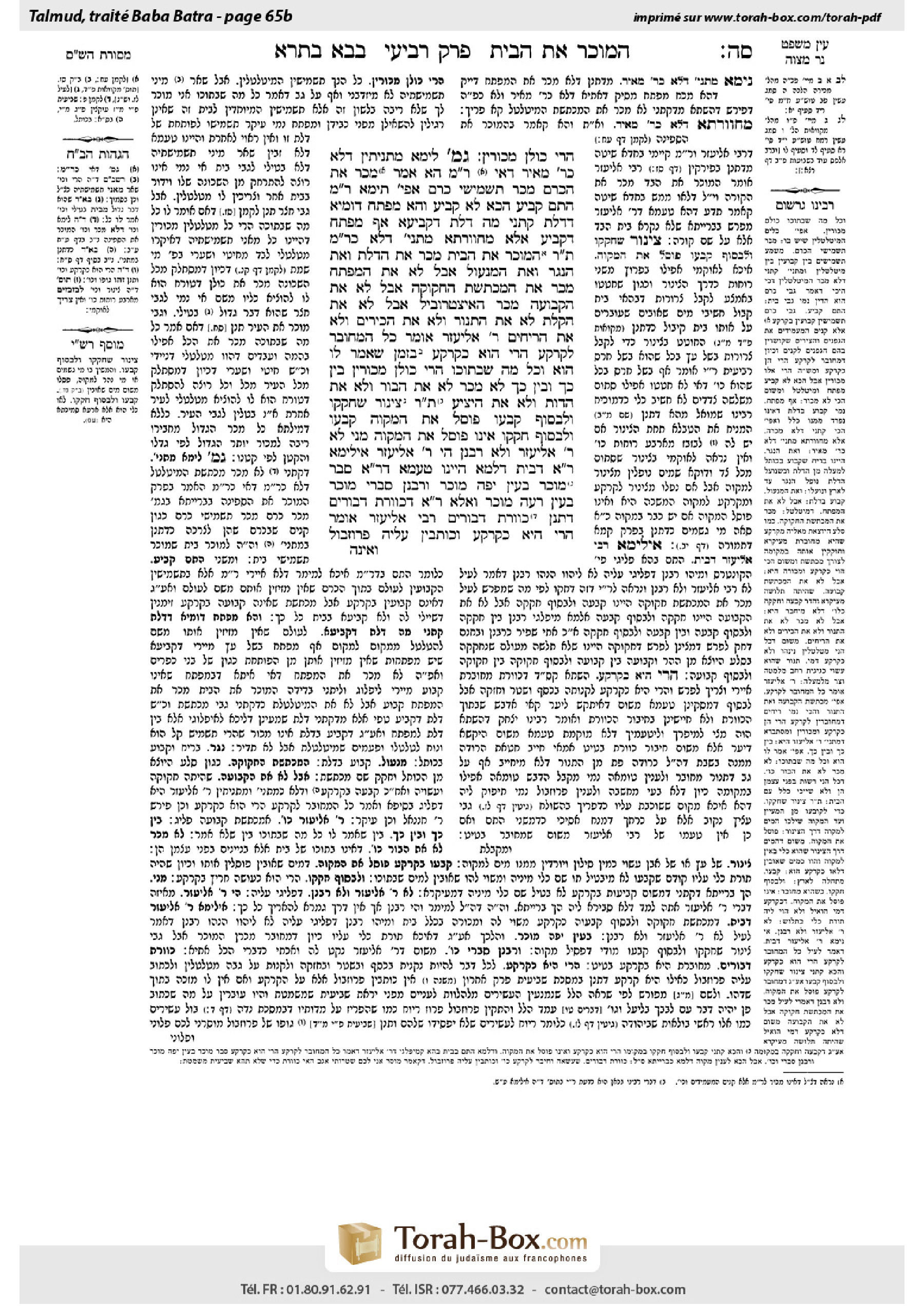
Bava Batra 65b: Talmud study for Daf Yomi
Study the Talmud for Daf Yomi with scanned pages, Hebrew text, English translations from Sefaria and AI-generated French translations.
Passage selection and English or AI-generated French translation are available where the scan has annotations. Daf Study is independent of Torah-Box and Sefaria.
Browse Bava Batra · בבא בתרא · All tractatesBava Batra 65b text and translations
This page of Bava Batra includes the Aramaic text, an English translation and an AI-generated French translation, alongside the scan above.
בבא בתרא ס״ה ב · Aramaic and Hebrew text
הֲרֵי כּוּלָּן מְכוּרִין.
גְּמָ׳ לֵימָא מַתְנִיתִין דְּלָא כְּרַבִּי מֵאִיר – דְּאִי רַבִּי מֵאִיר, הָא אָמַר: מָכַר אֶת הַכֶּרֶם – מָכַר תַּשְׁמִישֵׁי כֶרֶם!
אֲפִילּוּ תֵּימָא רַבִּי מֵאִיר – הָתָם קְבִיעַ, הָכָא לָא קְבִיעַ. וְהָא מַפְתֵּחַ דּוּמְיָא דְּדֶלֶת קָתָנֵי – מָה דֶּלֶת דִּקְבִיעָא, אַף מַפְתֵּחַ דִּקְבִיעַ! אֶלָּא מְחַוַּורְתָּא, מַתְנִיתִין דְּלָא כְּרַבִּי מֵאִיר.
תָּנוּ רַבָּנַן: הַמּוֹכֵר אֶת הַבַּיִת – מָכַר אֶת הַדֶּלֶת וְאֶת הַנֶּגֶר וְאֶת הַמַּנְעוּל, אֲבָל לֹא אֶת הַמַּפְתֵּחַ; מָכַר אֶת הַמַּכְתֶּשֶׁת הַחֲקוּקָה, אֲבָל לֹא אֶת הַקְּבוּעָה; מָכַר הָאִיצְטְרוֹבֵיל, אֲבָל לֹא אֶת הַקֶּלֶת, לֹא אֶת הַתַּנּוּר, וְלֹא אֶת הַכִּירַיִם, וְלֹא אֶת הָרֵיחַיִם. רַבִּי אֱלִיעֶזֶר אוֹמֵר: כׇּל הַמְחוּבָּר לַקַּרְקַע – הֲרֵי הוּא כַּקַּרְקַע.
בִּזְמַן שֶׁאָמַר לוֹ: ״הוּא וְכׇל מַה שֶּׁבְּתוֹכוֹ״ – הֲרֵי כּוּלָּן מְכוּרִין. בֵּין כָּךְ וּבֵין כָּךְ – לֹא מָכַר לֹא אֶת הַבּוֹר, וְלֹא אֶת הַדּוּת, וְלֹא אֶת הַיָּצִיעַ.
תָּנוּ רַבָּנַן: צִינּוֹר שֶׁחֲקָקוֹ וּלְבַסּוֹף קְבָעוֹ – פּוֹסֵל אֶת הַמִּקְוֶה. קְבָעוֹ וּלְבַסּוֹף חֲקָקוֹ – אֵינוֹ פּוֹסֵל אֶת הַמִּקְוֶה. מַנִּי? לָא רַבִּי אֱלִיעֶזֶר וְלָא רַבָּנַן.
הֵי רַבִּי אֱלִיעֶזֶר? אִילֵימָא רַבִּי אֱלִיעֶזֶר דְּבַיִת – דִּלְמָא הַיְינוּ טַעְמָא, דְּרַבִּי אֱלִיעֶזֶר סָבַר: מוֹכֵר בְּעַיִן יָפָה מוֹכֵר, וְרַבָּנַן סָבְרִי: מוֹכֵר בְּעַיִן רָעָה מוֹכֵר!
וְאֶלָּא רַבִּי אֱלִיעֶזֶר דְּכַוֶּורֶת דְּבוֹרִים? דִּתְנַן: כַּוֶּורֶת דְּבוֹרִים – רַבִּי אֱלִיעֶזֶר אוֹמֵר: הֲרֵי הִיא כַּקַּרְקַע – וְכוֹתְבִין עָלֶיהָ פְּרוֹזְבּוּל,
Bava Batra 65b · English translation
all these components are sold as part of the sale of the house.
GEMARA: The Gemara suggests: Let us say that the mishna that distinguishes between different types of household items is not in accordance with the opinion of Rabbi Meir. As if it is in accordance with the opinion of Rabbi Meir, doesn’t he say in a baraita (78b): If one sold a vineyard, he has sold all of the utensils of the vineyard, including the movable ones? The same should be true for the sale of a house.
The Gemara answers: You may even say that the mishna was taught in accordance with the opinion of Rabbi Meir, as a distinction can be made between the two cases. There, in the case of a vineyard, the reference is to utensils that are fixed in the vineyard and never removed from it, and therefore they are included in the sale, while here, in the case of a house, the mishna is referring to utensils that are not fixed in the house, and therefore they are not part of the sale. The Gemara objects: But doesn’t the mishna teach the halakha governing a key in similar fashion to the halakha governing the door, indicating that just as a door is fixed in the house, so too, a key is fixed in the house? Rather, it is clear that the mishna is not in accordance with the opinion of Rabbi Meir.
The Sages taught in a baraita (Tosefta 3:1): One who sells a house has sold the door and the door bolt and the lock, but he has not sold the key. He has sold the mortar that was hollowed out of the ground but not the mortar that was fixed to the ground after its construction. He has sold the immovable lower millstone but not the portable upper stone. And he has sold neither the oven, nor the double stove, nor the hand mill. Rabbi Eliezer says: The principle is that any item attached to the ground is considered like the ground and included in the sale.
When the seller says to the buyer: I am selling you it and everything that is in it, all these components are sold along with the house. Both in this case and in that case he did not sell the pit or the cistern or the gallery, as they are considered separate entities that are not at all part of the house.
§ The Sages taught in a baraita: A duct that one hollowed out and afterward attached to the ground or to a building invalidates a ritual bath through the water it channels to the bath. The water in a ritual bath must be gathered directly from rain or a stream, not drawn with vessels. If one hollowed out a log and used it to channel water into the bath, this is considered drawn water, as he used a vessel. By contrast, if one attached it first and afterward hollowed it out, it does not invalidate the ritual bath. Before the log was hollowed out, it was already attached to and considered part of the ground, and therefore the act of hollowing it out does not turn it into a vessel. The Gemara asks: Whose opinion is this? It appears to be neither the opinion of Rabbi Eliezer, nor that of the Rabbis.
The Gemara clarifies the question: To which opinion of Rabbi Eliezer is this referring? If we say it is referring to the opinion of Rabbi Eliezer in the aforementioned baraita with regard to the sale of a house, that any item attached to the ground is considered part of the house and is sold along with it, there is a difficulty. As perhaps this is the reasoning employed in the dispute with regard to the sale of a house, that Rabbi Eliezer holds that one who sells, sells generously anything that is attached to the ground, while the Rabbis hold that one who sells, sells sparingly, selling only utensils that serve an intrinsic function in the house and nothing else, even if they are attached to the ground. But this teaches us nothing about the opinions of Rabbi Eliezer and the Rabbis with respect to a ritual bath.
But rather, the reference must be to the opinion of Rabbi Eliezer concerning a beehive. As we learned in a mishna (Shevi’it 10:7): With regard to a beehive attached to the ground by clay, Rabbi Eliezer says: It is like land, and therefore one may write a document that prevents the Sabbatical Year from canceling an outstanding debt [prosbol] based upon it. Such a document cannot be written unless the borrower owns some land, and a beehive is considered like land for this purpose.
Bava Batra 65b · Traduction française (IA)
tous ces éléments sont vendus comme partie de la vente de la maison.
GUEMARA : La Guemara suggère : Supposons que la Michna qui distingue différents types d'objets de maison n'est pas en conformité avec l'opinion de Rabbi Meir. Comme si elle était en conformité avec l'opinion de Rabbi Meir, ne dit-il pas dans une baraïta (78b) : Si l'on vend un domaine viticole, l'on vend tous les ustensiles du domaine viticole, y compris ceux qui sont mobiles ? La même chose devrait s'appliquer à la vente d'une maison.
La Guemara répond : On peut même dire que la Michna a été enseignée en conformité avec l'opinion de Rabbi Meir, car une distinction peut être faite entre les deux cas. Là, dans le cas d'un domaine viticole, la référence est à des ustensiles fixés dans le domaine viticole et jamais retirés, et donc inclus dans la vente, tandis que ici, dans le cas d'une maison, la Michna fait référence à des ustensiles non fixés dans la maison et donc non inclus dans la vente. La Guemara s'oppose à cela en disant : Mais ne dit pas la Michna la même chose concernant la clef, de manière similaire à la halakha concernant la porte, indiquant que justement la porte est fixée dans la maison, de même que la clef ? Plutôt, il est clair que la Michna n'est pas en conformité avec l'opinion de Rabbi Meir.
Les Sages ont enseigné dans une baraïta (Tosefta 3:1) : Celui qui vend une maison a vendu la porte, le verrou et la serrure, mais pas la clef. Il a vendu le mortier creusé dans le sol, mais pas celui fixé au sol après sa construction. Il a vendu le moulin inférieur immobile, mais pas le moulin supérieur portable. Et il n'a pas vendu la cuisinière, la cuisinière double, ni le moulin à main. Rabbi Eliezer dit : Le principe est que tout objet attaché au sol est considéré comme faisant partie du sol et est inclus dans la vente.
Lorsque le vendeur dit à l'acheteur : Je te vends cela et tout ce qui est dedans, tous ces composants sont vendus avec la maison. À la fois dans ce cas et dans celui-ci, il n'a pas vendu le puits, le cistern ou la galerie, car ils sont considérés comme des entités distinctes et ne font pas partie de la maison.
§ Les Sages ont enseigné dans une baraïta : Un conduit que l'on a creusé et ensuite attaché au sol ou à un bâtiment invalidate un bain rituel par l'eau qu'il conduit vers le bain. L'eau d'un bain rituel doit être recueillie directement de la pluie ou d'un cours d'eau, pas tirée avec des récipients. Si l'on a creusé un tronc et l'a utilisé pour conduire l'eau vers le bain, cela est considéré comme de l'eau tirée, car l'on a utilisé un récipient. À l'inverse, si l'on l'a d'abord attaché et ensuite creusé, cela ne invalidate pas le bain rituel. Avant que le tronc ne soit creusé, il était déjà attaché au sol et considéré comme faisant partie du sol, et donc l'acte de le creuser ne le transforme pas en un récipient. La Guemara pose la question : De quelle opinion s'agit-il ? Il semble que ce ne soit ni l'opinion de Rabbi Eliezer, ni celle des Sages.
La Guemara clarifie la question : À quelle opinion de Rabbi Eliezer cette référence fait-elle ? Si nous disons qu'il s'agit de l'opinion de Rabbi Eliezer dans la baraïta mentionnée précédemment concernant la vente d'une maison, que tout objet attaché au sol est considéré comme faisant partie de la maison et est vendu avec elle, il y a une difficulté. Car peut-être cette est la raison du débat concernant la vente d'une maison, que Rabbi Eliezer considère que celui qui vend vend généreusement tout ce qui est attaché au sol, tandis que les Sages considèrent que celui qui vend vend parcimonieusement, vendant uniquement les ustensiles qui servent d'une fonction intrinsèque à la maison et rien d'autre, même s'ils sont attachés au sol. Mais cela nous apprend rien sur les opinions de Rabbi Eliezer et des Sages concernant un bain rituel.
Mais plutôt, la référence doit être à l'opinion de Rabbi Eliezer concernant une ruche. Comme nous l'avons appris dans une Michna (Shevi’it 10:7) : Concernant une ruche attachée au sol par de la terre, Rabbi Eliezer dit : Elle est comme la terre, et donc l'on peut écrire un document qui empêche l'année sabbatique de supprimer une dette en suspens [prosbol] en se basant sur elle. Un tel document ne peut être écrit que si le prêteur possède une terre, et une ruche est considérée comme de la terre à cet effet.
Traduction française générée par IA à partir de l’édition anglaise de Sefaria. Vérifie toujours un passage avec le texte source.
Text from Sefaria: William Davidson Edition - Vocalized Aramaic (CC BY NC); William Davidson Edition - English (CC BY NC).