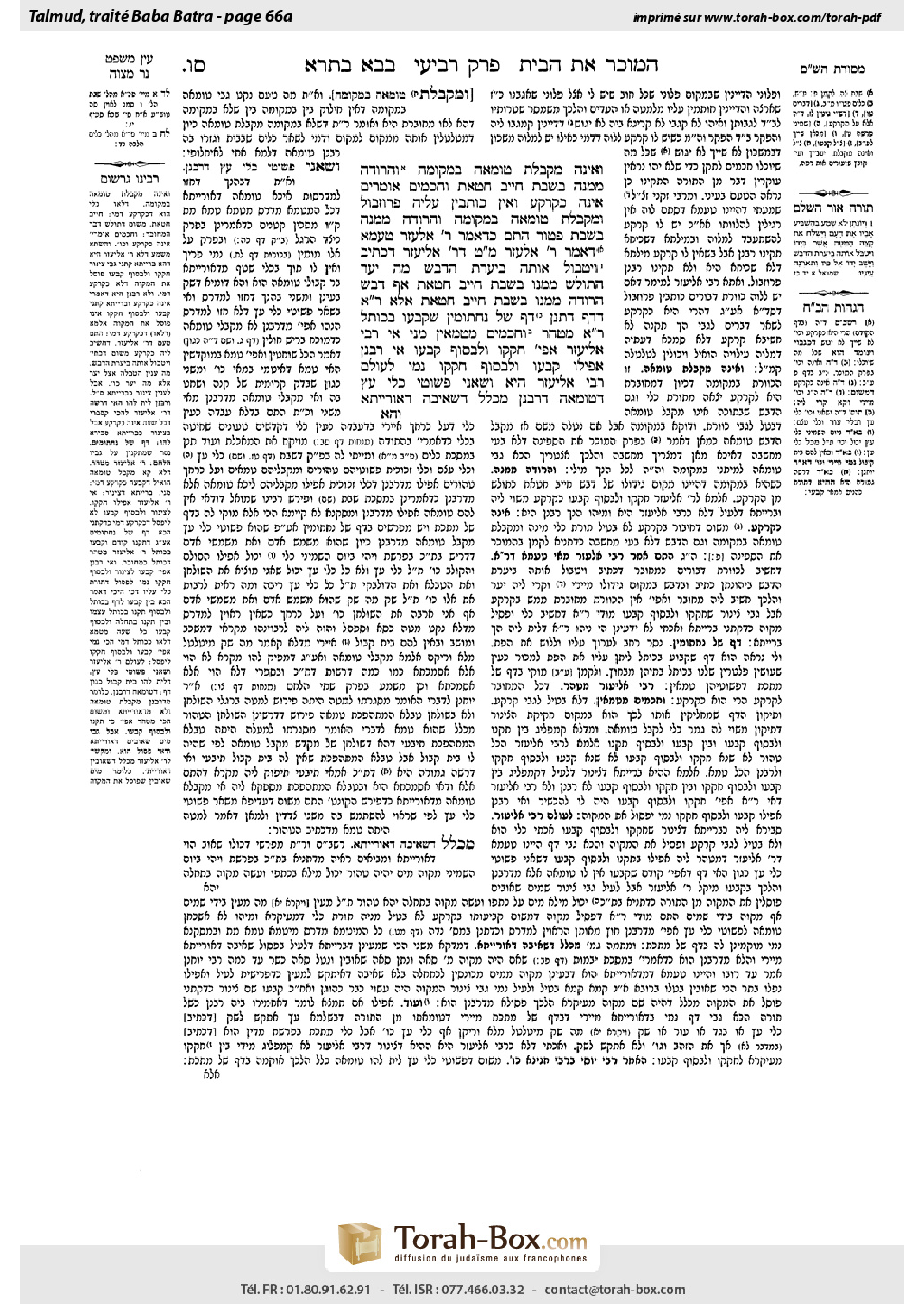
Bava Batra 66a: Talmud study for Daf Yomi
Study the Talmud for Daf Yomi with scanned pages, Hebrew text, English translations from Sefaria and AI-generated French translations.
Passage selection and English or AI-generated French translation are available where the scan has annotations. Daf Study is independent of Torah-Box and Sefaria.
Browse Bava Batra · בבא בתרא · All tractatesBava Batra 66a text and translations
This page of Bava Batra includes the Aramaic text, an English translation and an AI-generated French translation, alongside the scan above.
בבא בתרא ס״ו א · Aramaic and Hebrew text
וְאֵינָהּ מְקַבֶּלֶת טוּמְאָה בִּמְקוֹמָהּ, וְהָרוֹדֶה מִמֶּנָּה בְּשַׁבָּת – חַיָּיב חַטָּאת.
וַחֲכָמִים אוֹמְרִים: אֵינָהּ כַּקַּרְקַע – וְאֵין כּוֹתְבִין עָלֶיהָ פְּרוֹזְבּוּל, וּמְקַבֶּלֶת טוּמְאָה בִּמְקוֹמָהּ, וְהָרוֹדֶה מִמֶּנָּה בְּשַׁבָּת – פָּטוּר.
הָתָם – כִּדְאָמַר רַבִּי אֶלְעָזָר טַעְמָא, דְּאָמַר רַבִּי אֶלְעָזָר: מַאי טַעְמָא דְּרַבִּי אֱלִיעֶזֶר? דִּכְתִיב: ״וַיִּטְבֹּל אוֹתָהּ בְּיַעְרַת הַדְּבָשׁ״;
מָה יַעַר – הַתּוֹלֵשׁ מִמֶּנּוּ בְּשַׁבָּת חַיָּיב חַטָּאת, אַף דְּבַשׁ – הָרוֹדֶה מִמֶּנּוּ בְּשַׁבָּת חַיָּיב חַטָּאת!
אֶלָּא רַבִּי אֱלִיעֶזֶר דְּדַף. דִּתְנַן: דַּף שֶׁל נַחְתּוֹמִין שֶׁקְּבָעוֹ בַּכּוֹתֶל – רַבִּי אֱלִיעֶזֶר מְטַהֵר, וַחֲכָמִים מְטַמְּאִין.
מַנִּי? אִי רַבִּי אֱלִיעֶזֶר – אֲפִילּוּ חֲקָקוֹ וּלְבַסּוֹף קְבָעוֹ! אִי רַבָּנַן – אֲפִילּוּ קְבָעוֹ וּלְבַסּוֹף חֲקָקוֹ נָמֵי!
לְעוֹלָם רַבִּי אֱלִיעֶזֶר הִיא, וְשָׁאנֵי פְּשׁוּטֵי כְלֵי עֵץ – דְּטוּמְאָה דְּרַבָּנַן.
מִכְּלָל דִּשְׁאִיבָה דְּאוֹרָיְיתָא?!
Bava Batra 66a · English translation
And such a beehive is not susceptible to ritual impurity as long as it is fixed in its place. And one who removes honey from it on Shabbat is liable to bring a sin-offering, as he is likened to one who harvests produce attached to the ground.
But the Rabbis say: Such a beehive is not like land, and therefore one may not write a prosbol based upon it, and it is susceptible to ritual impurity even when it is fixed in its place, and one who removes honey from it on Shabbat is exempt from bringing a sin-offering. This mishna suggests that Rabbi Eliezer holds that a vessel that was affixed to the ground is considered like land for all purposes. This contradicts the baraita that states that if one hollowed out a pipe and then affixed it to the ground, it is still considered a vessel, and water flowing through it is considered drawn water that invalidates a ritual bath. This indicates that the baraita was not taught in accordance with the opinion of Rabbi Eliezer.
The Gemara rejects this opinion, stating that there, in the mishna, Rabbi Eliezer treats the beehive like land for the reason that Rabbi Elazar stated, and not because he holds that all vessels that are affixed to the ground are considered like land. As Rabbi Elazar stated: What is the reasoning for the statement of Rabbi Eliezer with regard to one who removes honey from a beehive? His rationale is as it is written: “And he put forth the end of the rod that was in his hand and dipped it in the honeycomb [ya’arat hadevash]” (I Samuel 14:27).
Rabbi Eliezer understands that since the Hebrew words used here for honeycomb can also mean honey forest, the verse comes to teach that just as with regard to a forest, one who picks anything from a tree on Shabbat is liable to bring a sin-offering, so too, with regard to a beehive containing honey, one who removes honey from it on Shabbat is liable to bring a sin-offering, as the beehive is treated like land. Consequently, Rabbi Eliezer relies here on a special derivation, which does not necessarily apply to other vessels. Therefore, nothing can be learned from this about Rabbi Eliezer’s opinion with regard to the pipe in the baraita.
Rather, the reference with regard to the hollowed-out duct must be to the opinion of Rabbi Eliezer concerning a baker’s board on which he kneads the dough, as we learned in a mishna (Kelim 15:2): With regard to a baker’s board [daf shel naḥtomin] that was affixed to the wall, Rabbi Eliezer renders it not susceptible to ritual impurity, while the Rabbis render it susceptible to ritual impurity. This seems to indicate that, according to Rabbi Eliezer, anything that is affixed to the ground or to something else that is affixed to the ground is treated like land, and therefore it cannot become ritually impure.
Having concluded that this is the dispute between Rabbi Eliezer and the Rabbis that was referred to previously, the Gemara repeats the question raised earlier about the ruling in the baraita with regard to a duct: Whose opinion is it? It appears to be neither that of Rabbi Eliezer nor that of the Rabbis. As if it is the opinion of Rabbi Eliezer, then even if one hollowed out a duct and afterward he fixed it to the ground, water flowing through it should not be considered drawn water that invalidates a ritual bath, as according to Rabbi Eliezer, a baker’s board that was first a vessel, but then became fixed in a wall, is treated like land. And if it is the opinion of the Rabbis, then even if he first fixed the duct to the ground and only afterward he hollowed it out, the duct should also be treated like a vessel, and the water flowing through it should be considered drawn water, as the Rabbis do not differentiate with regard to the stage at which the baker’s board was affixed to the wall.
The Gemara responds: Actually, one can explain that the baraita is in accordance with the opinion of Rabbi Eliezer, but the halakha governing flat wooden vessels without a receptacle, such as a baker’s board, is different, as they are vessels susceptible to ritual impurity only by rabbinic law, but by Torah law they are not vessels susceptible to ritual impurity. Therefore, Rabbi Eliezer agrees that when the baker’s board is affixed to the wall, it is no longer subject to the rabbinic decree. A hollowed-out duct, however, is a vessel susceptible to ritual impurity by Torah law, and it remains so even if afterward it was affixed to the ground. Therefore, the water flowing through it invalidates a ritual bath.
The Gemara asks: By inference, from the fact that Rabbi Eliezer is more stringent in the case of the duct and distinguishes between a duct that was first hollowed out and only afterward affixed to the ground, and one that was first affixed to the ground and only afterward hollowed out, does it not follow that the halakha governing drawn water, i.e., that drawn water added to a ritual bath that does not already contain the necessary quantity of water invalidates it, applies by Torah law?
Bava Batra 66a · Traduction française (IA)
Et un tel rucher n'est pas sujet à la souillure rituelle tant qu'il est fixé à son lieu. Et celui qui enlève du miel de lui le sabbat est tenu de présenter un sacrifice expiatoire, car il est comparé à celui qui récolte des fruits attachés au sol.
Mais les Sages disent : Ce rucher n'est pas comme la terre, et par conséquent on ne peut pas écrire un prosboul en fonction de lui, et il est sujet à la souillure rituelle même lorsqu'il est fixé à son lieu, et celui qui enlève du miel de lui le sabbat est exempt de présenter un sacrifice expiatoire. Cette mitsna suggère que Rabbi Eliezer considère qu'un récipient fixé au sol est considéré comme la terre pour tous les usages. Cela contredit la baraïta qui stipule que si l'on a creusé un tuyau et l'a ensuite fixé au sol, il est encore considéré comme un récipient, et l'eau qui coule à travers est considérée comme de l'eau tirée qui invalidate un mikvé. Cela indique que la baraïta n'a pas été enseignée selon l'opinion de Rabbi Eliezer.
Le Guemara rejette cette opinion, en disant que là, dans la mitsna, Rabbi Eliezer traite le rucher comme la terre pour la raison que Rabbi Eléazar a énoncée, et non parce qu'il considère que tous les récipients fixés au sol sont considérés comme la terre. Comme Rabbi Eléazar a dit : Quel est le raisonnement de la déclaration de Rabbi Eliezer concernant celui qui enlève du miel d'un rucher ? Son raisonnement est comme il est écrit : « Et il tendit l'extrémité du bâton qui était en sa main et le plongea dans le miel [ya’arat hadevash] » (I Samuel 14:27).
Rabbi Eliezer comprend que puisque les mots hébreux utilisés ici pour le miel peuvent aussi signifier la forêt de miel, la versette vient enseigner que tout comme avec la forêt, celui qui ramasse quelque chose d'un arbre le sabbat est tenu de présenter un sacrifice expiatoire, de même, avec le rucher contenant du miel, celui qui enlève du miel de lui le sabbat est tenu de présenter un sacrifice expiatoire, car le rucher est traité comme la terre. Ainsi, Rabbi Eliezer s'appuie ici sur une dérivation spéciale, qui ne s'applique pas nécessairement aux autres récipients. Par conséquent, rien ne peut être tiré de cela concernant l'opinion de Rabbi Eliezer concernant le tuyau dans la baraïta.
Plutôt, la référence concernant le tuyau creusé doit être à l'opinion de Rabbi Eliezer concernant la planche de boulanger sur laquelle il pétrit la pâte, comme nous l'avons appris dans une mitsva (Kelim 15:2) : Concernant la planche de boulanger [daf shel naḥtomin] qui était fixée au mur, Rabbi Eliezer la considère comme non sujet à la souillure rituelle, tandis que les Sages la considèrent comme sujet à la souillure rituelle. Cela semble indiquer que, selon Rabbi Eliezer, toute chose fixée au sol ou à quelque chose d'autre fixé au sol est traitée comme la terre, et par conséquent elle ne peut pas devenir souillée rituellement.
Ayant conclu que c'est le débat entre Rabbi Eliezer et les Rabbins qui a été mentionné précédemment, le Guemara répète la question soulevée plus tôt concernant le jugement dans la baraïta concernant le tuyau : De quel opinion s'agit-il ? Il semble qu'il ne s'agisse ni de celle de Rabbi Eliezer ni de celle des Rabbins. Comme si c'était l'opinion de Rabbi Eliezer, alors même si l'on avait creusé un tuyau et ensuite l'avait fixé au sol, l'eau qui coule à travers ne devrait pas être considérée comme de l'eau tirée qui invalide un mikvé, car selon Rabbi Eliezer, une planche de boulanger qui était d'abord un récipient mais ensuite fixée au mur est traitée comme la terre. Et si c'était l'opinion des Rabbins, alors même si l'on avait d'abord fixé le tuyau au sol et ensuite l'avait creusé, le tuyau devrait également être traité comme un récipient, et l'eau qui coule à travers devrait être considérée comme de l'eau tirée, car les Rabbins ne font pas de distinction concernant la période où la planche de boulanger a été fixée au mur.
Le Guemara répond : En réalité, on peut expliquer que la baraïta est en conformité avec l'opinion de Rabbi Eliezer, mais la halakha concernant les récipients en bois plat sans récipient, tels que la planche de boulanger, est différente, car ils sont des récipients soumis à la souillure rituelle uniquement par la loi rabbinique, mais pas par la loi de la Torah. Par conséquent, Rabbi Eliezer accepte que lorsque la planche de boulanger est fixée au mur, elle n'est plus soumise au décret rabbinique. Un tuyau creusé, cependant, est un récipient soumis à la souillure rituelle par la loi de la Torah, et il reste ainsi même si ensuite il a été fixé au sol. Par conséquent, l'eau qui coule à travers invalide un mikvé.
Le Guemara pose la question : Par déduction, du fait que Rabbi Eliezer est plus strict concernant le tuyau et distingue entre un tuyau qui a été d'abord creusé et ensuite fixé au sol, et un tuyau qui a été d'abord fixé au sol et ensuite creusé, ne suit-il pas que la halakha concernant l'eau tirée, c'est-à-dire que l'eau tirée ajoutée à un mikvé qui ne contient pas déjà la quantité nécessaire d'eau l'invalidate, s'applique par la loi de la Torah ?
Traduction française générée par IA à partir de l’édition anglaise de Sefaria. Vérifie toujours un passage avec le texte source.
Text from Sefaria: William Davidson Edition - Vocalized Aramaic (CC BY NC); William Davidson Edition - English (CC BY NC).