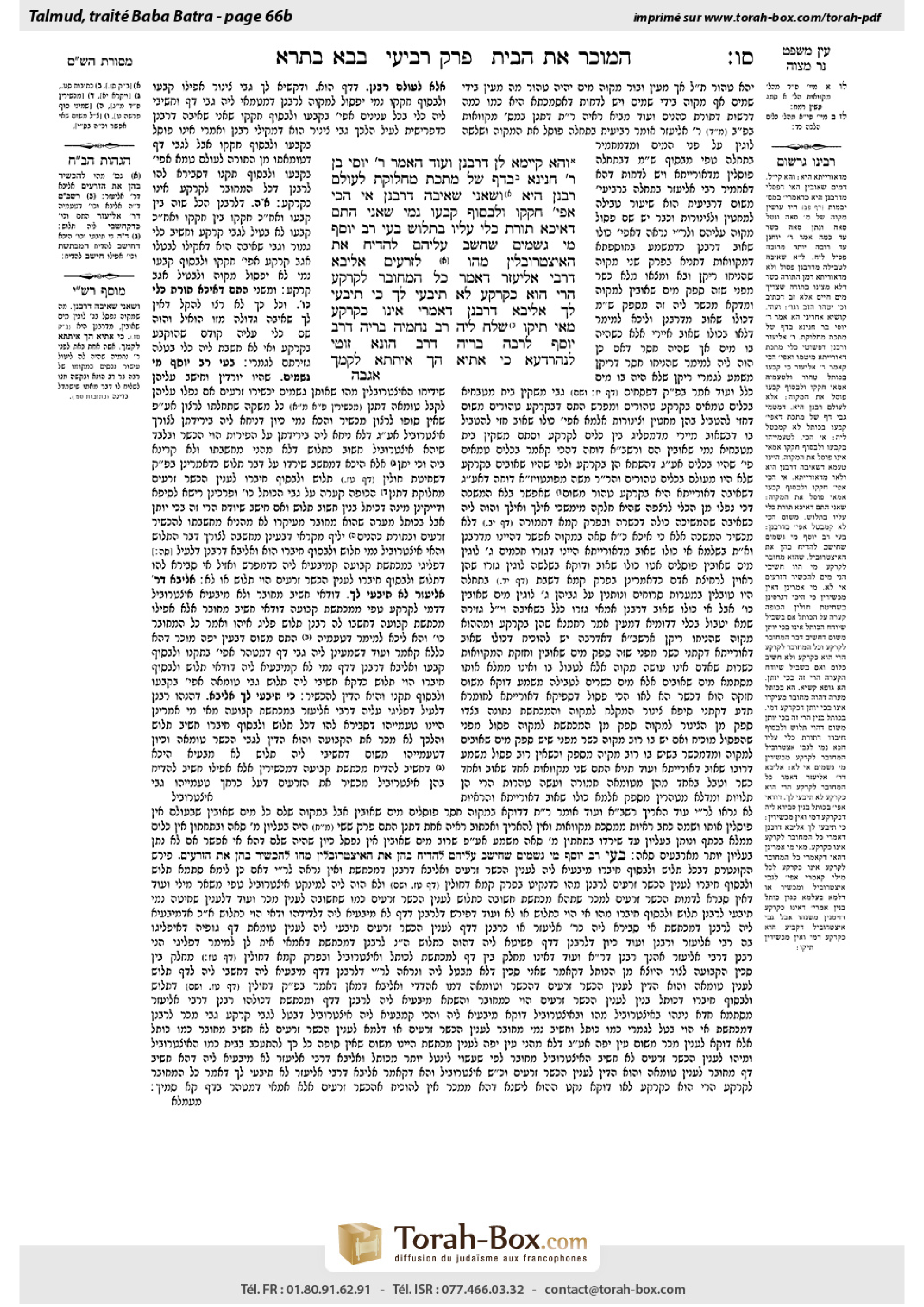
Bava Batra 66b: Talmud study for Daf Yomi
Study the Talmud for Daf Yomi with scanned pages, Hebrew text, English translations from Sefaria and AI-generated French translations.
Passage selection and English or AI-generated French translation are available where the scan has annotations. Daf Study is independent of Torah-Box and Sefaria.
Browse Bava Batra · בבא בתרא · All tractatesBava Batra 66b text and translations
This page of Bava Batra includes the Aramaic text, an English translation and an AI-generated French translation, alongside the scan above.
בבא בתרא ס״ו ב · Aramaic and Hebrew text
וְהָא קַיְימָא לַן: דְּרַבָּנַן! וְעוֹד, הָאָמַר רַבִּי יוֹסֵי בֶּן רַבִּי חֲנִינָא: בְּדַף שֶׁל מַתֶּכֶת מַחְלוֹקֶת!
לְעוֹלָם רַבָּנַן הִיא, וְשָׁאנֵי שְׁאִיבָה דְּרַבָּנַן.
אִי הָכִי, אֲפִילּוּ חֲקָקוֹ וּלְבַסּוֹף קְבָעוֹ נָמֵי! שָׁאנֵי הָתָם, דְּאִיכָּא תּוֹרַת כְּלִי עָלָיו בְּתָלוּשׁ.
בָּעֵי רַב יוֹסֵף: מֵי גְשָׁמִים שֶׁחִשֵּׁב עֲלֵיהֶם לְהַדִּיחַ אֶת הָאִיצְטְרוֹבְלִין, מַהוּ לִזְרָעִים?
אַלִּיבָּא דְּרַבִּי אֱלִיעֶזֶר, דְּאָמַר: כׇּל הַמְחוּבָּר לַקַּרְקַע – הֲרֵי הוּא כַּקַּרְקַע, לָא תִּיבְּעֵי לָךְ; כִּי תִּיבְּעֵי לָךְ – אַלִּיבָּא דְּרַבָּנַן, דְּאָמְרִי: אֵינוֹ כַּקַּרְקַע. מַאי? תֵּיקוּ.
שְׁלַח לֵיהּ רַב נְחֶמְיָה בְּרֵיהּ דְּרַב יוֹסֵף לְרַבָּה בְּרֵיהּ דְּרַב הוּנָא זוּטֵי, לִנְהַרְדְּעָא: כִּי אָתְיָא הָךְ אִיתְּתָא לְקַמָּךְ,
Bava Batra 66b · English translation
But this is difficult, as we maintain that the halakha that drawn water invalidates a ritual bath applies only by rabbinic decree. And furthermore, doesn’t Rabbi Yosei ben Rabbi Ḥanina say that the dispute between Rabbi Eliezer and the Rabbis is with regard to a board of metal, and a metal vessel, even if it is flat and lacks a receptacle, is susceptible to ritual impurity by Torah law? This means that, according to Rabbi Eliezer, even a vessel that is susceptible to ritual impurity by Torah law loses its status as a vessel when it is affixed to the ground. Consequently, the question returns: Whose opinion is cited in the baraita that states that if one first hollowed out a duct and afterward fixed it to the ground, it is still considered a vessel and water flowing through it invalidates a ritual bath, but if he first fixed it to the ground and afterward hollowed it out, the water flowing through it does not invalidate a ritual bath?
The Gemara answers: Actually, one can explain that the baraita is in accordance with the opinion of the Rabbis, who deem the baker’s metal board susceptible to ritual impurity even when it is fixed to a wall, but the halakha governing drawn water added to a deficient ritual bath is different, because drawn water invalidates a deficient ritual bath only by rabbinic law, and therefore the Rabbis were lenient.
The Gemara asks: If so, then even if one first hollowed out the duct and only afterward fixed it to the ground, water flowing through it should not invalidate the ritual bath as well. The Gemara answers: It is different there, where the duct was hollowed out before being affixed to the ground, as the duct had the status of a vessel when it was still detached from the ground, and therefore the Rabbis were not willing to be lenient to such an extent and rule that water flowing through the duct does not invalidate a ritual bath.
§ Rav Yosef raises a dilemma: With regard to rainwater that was falling and the owner consciously desired that it should fall so that it would wash his immovable lower millstones, what is the halakha with regard to the seeds in the millstones? The verse “But if any water be put upon the seed…it shall be unclean to you” (Leviticus 11:38) teaches that seeds and other food become susceptible to ritual purity only after they have been detached from the ground, and water, or another of the seven liquids specified in the mishna (Makhshirin 6:4), has been put on them. The food must be exposed to the liquid willfully by the owner; that is, he must desire or at least be pleased that the food should become wet. Rav Yosef asks about a case where the owner wants the rain to fall on the millstones: Does that water make the seeds upon which it falls susceptible to ritual impurity?
The Gemara clarifies Rav Yosef’s question: Do not raise this dilemma according to the opinion of Rabbi Eliezer, who says: Anything attached to the ground has the same legal status as the ground. Since the lower millstones are attached to the ground, they therefore have the same legal status as the ground, and water that falls on the ground, even if it is pleasing to the owner, does not make food susceptible to ritual impurity. When should you raise this dilemma? Raise it according to the opinion of the Rabbis, who say: It does not have the same legal status as the ground. What is the halakha with respect to imparting susceptibility to ritual impurity? The Gemara concludes: An answer to this question was not found; therefore, the dilemma shall stand unresolved.
§ Rav Neḥemya, son of Rav Yosef, sent a message to Rabba son of Rav Huna the Short at Neharde’a: When this woman bearing this letter comes before you,
Bava Batra 66b · Traduction française (IA)
Mais cela est difficile, car nous maintenons que la halakha selon laquelle l'eau tirée invalidate un mikvé s'applique uniquement par décision rabbinique. Et de plus, n'est-ce pas que Rabbi Yosei fils de Rabbi Ḥanina dise que le débat entre Rabbi Eliezer et les Rabbins concerne un plan de métal et un récipient métallique, même s'il est plat et n'a pas de récipient, est susceptible de souillure rituelle selon la loi de la Torah ? Cela signifie que, selon Rabbi Eliezer, même un récipient susceptible de souillure rituelle selon la loi de la Torah perd son statut de récipient lorsqu'il est fixé au sol. Ainsi, la question revient : Quel est l'avis cité dans la baraïta qui dit que si l'on a d'abord creusé un canal et ensuite l'a fixé au sol, il est encore considéré comme un récipient et que l'eau qui y circule invalidate un mikvé, mais si l'on a d'abord fixé le canal au sol et ensuite l'a creusé, l'eau qui y circule ne invalidate pas un mikvé ?
La Guemara répond : En réalité, on peut expliquer que la baraïta suit l'opinion des Rabbins, qui considèrent le plan de métal du boulanger comme susceptible de souillure rituelle même s'il est fixé à un mur, mais la halakha concernant l'eau tirée ajoutée à un mikvé déficient est différente, car l'eau tirée invalidate un mikvé déficient uniquement par la loi rabbinique, et par conséquent les Rabbins ont été cléments.
La Guemara pose la question : Si c'est ainsi, alors même si l'on a d'abord creusé le canal et seulement ensuite l'a fixé au sol, l'eau qui y circule ne devrait pas invalidate le mikvé non plus. La Guemara répond : C'est différent dans ce cas, où le canal avait été creusé avant d'être fixé au sol, car le canal avait le statut de récipient lorsqu'il était encore détaché du sol, et par conséquent les Rabbins n'étaient pas prêts à être aussi cléments et à décider que l'eau qui y circule ne invalidate pas un mikvé.
§ Rav Yosef soulève un dilemme : En ce qui concerne l'eau de pluie qui tombait et dont l'propriétaire souhaitait délibérément qu'elle tombe afin de laver ses moulin à pierre fixe, quelle est la halakha concernant les graines dans les moulin à pierre ? La verset « Mais si l'on verse de l'eau sur les graines… cela sera impur pour vous » (Lévitique 11:38) enseigne que les graines et d'autres aliments deviennent susceptibles de souillure rituelle uniquement après avoir été détachés du sol, et que de l'eau, ou l'un des sept liquides spécifiés dans la mishna (Makhshirin 6:4), ait été versé dessus. L'aliment doit être exposé au liquide de manière volontaire par l'propriétaire ; c'est-à-dire qu'il doit désirer ou au moins être content que l'aliment devienne mouillé. Rav Yosef pose la question concernant un cas où l'propriétaire veut que la pluie tombe sur les moulin à pierre : Cette eau rend-elle les graines sur lesquelles elle tombe susceptibles de souillure rituelle ?
La Guemara clarifie la question de Rav Yosef : Ne soulève pas ce dilemme selon l'opinion de Rabbi Eliezer, qui dit : Tout ce qui est attaché au sol a le même statut juridique que le sol. Puisque les moulin à pierre inférieurs sont attachés au sol, ils ont donc le même statut juridique que le sol, et l'eau qui tombe sur le sol, même si elle est agréable à l'propriétaire, ne rend pas les aliments susceptibles de souillure rituelle. Quand devrait-on soulever ce dilemme ? Souleve-le selon l'opinion des Rabbins, qui disent : Il n'a pas le même statut juridique que le sol. Quelle est la halakha concernant la transmission de la souillure rituelle ? La Guemara conclut : Une réponse à cette question n'a pas été trouvée ; par conséquent, ce dilemme restera sans réponse.
§ Rav Néchemyah, fils de Rav Yosef, a envoyé un message à Rabba fils de Rav Huna le Court à Nehardea : Lorsque cette femme portant cette lettre viendra devant vous,
Traduction française générée par IA à partir de l’édition anglaise de Sefaria. Vérifie toujours un passage avec le texte source.
Text from Sefaria: William Davidson Edition - Vocalized Aramaic (CC BY NC); William Davidson Edition - English (CC BY NC).