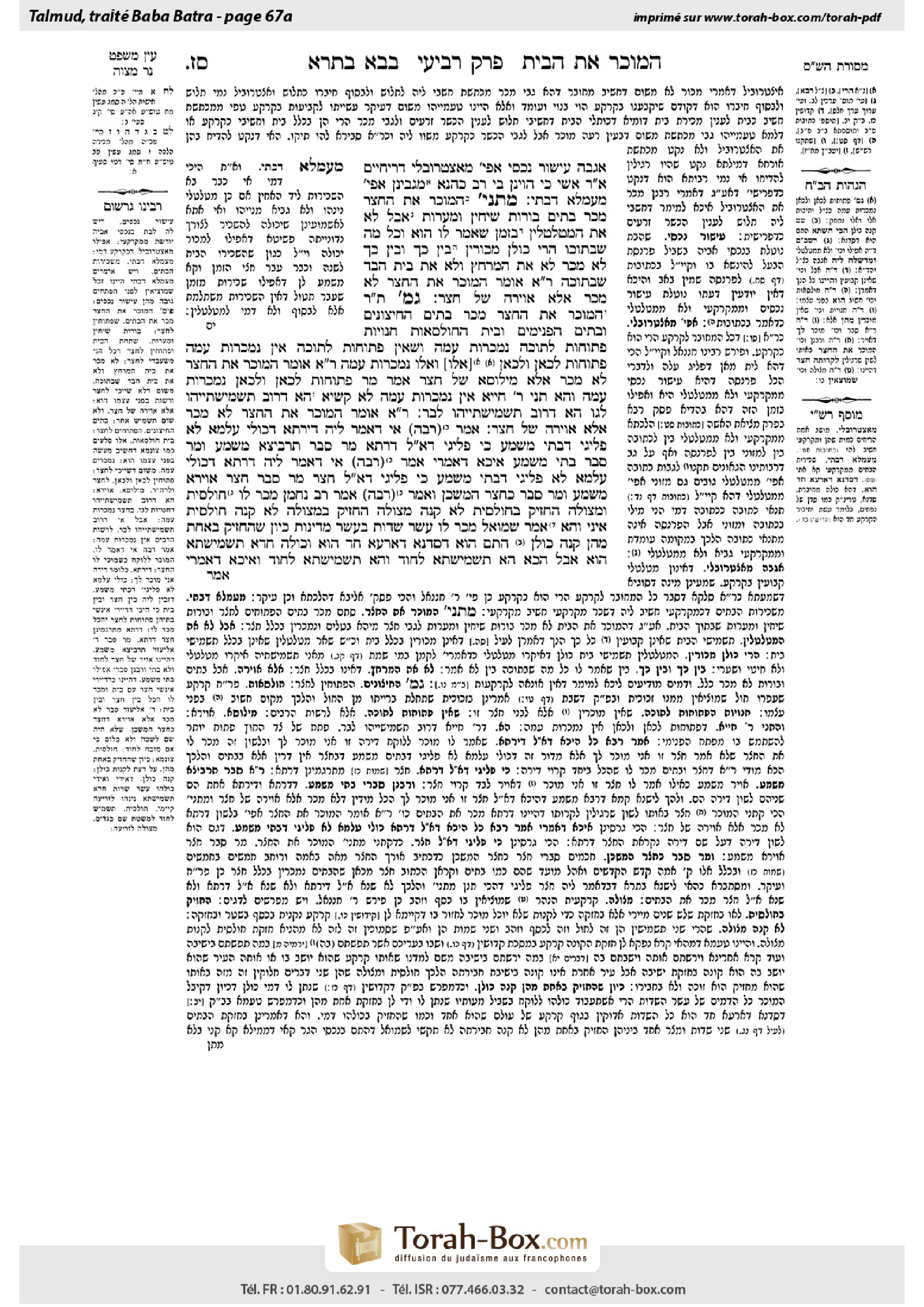
Bava Batra 67a: Talmud study for Daf Yomi
Study the Talmud for Daf Yomi with scanned pages, Hebrew text, English translations from Sefaria and AI-generated French translations.
Passage selection and English or AI-generated French translation are available where the scan has annotations. Daf Study is independent of Torah-Box and Sefaria.
Browse Bava Batra · בבא בתרא · All tractatesBava Batra 67a text and translations
This page of Bava Batra includes the Aramaic text, an English translation and an AI-generated French translation, alongside the scan above.
בבא בתרא ס״ז א · Aramaic and Hebrew text
אַגְבַּהּ עִישּׂוּר נִכְסֵי, אֲפִילּוּ מֵאִצְטְרוֹבְלֵי דְרֵיחַיִים. אָמַר רַב אָשֵׁי: כִּי הֲוֵינַן בֵּי רַב כָּהֲנָא, מַגְבֵּינַן אֲפִילּוּ מֵעַמְלָא דְבָתֵּי.
מַתְנִי׳ הַמּוֹכֵר אֶת הֶחָצֵר – מָכַר בָּתִּים, בּוֹרוֹת, שִׁיחִין וּמְעָרוֹת; אֲבָל לֹא אֶת הַמִּטַּלְטְלִין. בִּזְמַן שֶׁאָמַר לוֹ: ״הוּא וְכׇל מַה שֶּׁבְּתוֹכוֹ״ – הֲרֵי כּוּלָּן מְכוּרִין. בֵּין כָּךְ וּבֵין כָּךְ – לֹא מָכַר לֹא אֶת הַמֶּרְחָץ, וְלֹא אֶת בֵּית הַבַּד שֶׁבְּתוֹכָהּ. רַבִּי אֱלִיעֶזֶר אוֹמֵר: הַמּוֹכֵר אֶת הֶחָצֵר – לֹא מָכַר אֶלָּא אֲוִירָהּ שֶׁל חָצֵר.
גְּמָ׳ תָּנוּ רַבָּנַן: הַמּוֹכֵר אֶת הֶחָצֵר – מָכַר בָּתִּים הַחִיצוֹנִים, וּבָתִּים הַפְּנִימִים, וּבֵית הַחוֹלְסָאוֹת. חֲנוּיוֹת פְּתוּחוֹת לְתוֹכָהּ – נִמְכָּרוֹת עִמָּהּ, וְשֶׁאֵין פְּתוּחוֹת לְתוֹכָהּ – אֵין נִמְכָּרוֹת עִמָּהּ. פְּתוּחוֹת לְכָאן וּלְכָאן – [אֵלּוּ] וְאֵלּוּ נִמְכָּרוֹת עִמָּהּ. רַבִּי אֱלִיעֶזֶר אוֹמֵר: הַמּוֹכֵר אֶת הֶחָצֵר – לֹא מָכַר אֶלָּא מִילוּסָא שֶׁל חָצֵר.
אָמַר מָר: פְּתוּחוֹת לְכָאן וּלְכָאן – נִמְכָּרוֹת עִמָּהּ. וְהָא תָּנֵי רַבִּי חִיָּיא: אֵין נִמְכָּרוֹת עִמָּהּ! לָא קַשְׁיָא; הָא דְּרוֹב תַּשְׁמִישְׁתַּיְיהוּ לְגוֹ, הָא דְּרוֹב תַּשְׁמִישְׁתַּיְיהוּ לְבַר.
רַבִּי אֱלִיעֶזֶר אוֹמֵר: הַמּוֹכֵר אֶת הֶחָצֵר – לֹא מָכַר אֶלָּא אֲוִירָהּ שֶׁל חָצֵר. אָמַר רַבָּה: אִי דַּאֲמַר לֵיהּ: ״דֵּירְתָּא״ – דְּכוּלֵּי עָלְמָא לָא פְּלִיגִי דְּבָתֵּי מַשְׁמַע. כִּי פְּלִיגִי – דַּאֲמַר לֵיהּ: ״דָּרְתָּא״; מָר סָבַר: תַּרְבִּיצָא מַשְׁמַע, וּמָר סָבַר: בָּתֵּי מַשְׁמַע.
אִיכָּא דְּאָמְרִי, אָמַר רַבָּה: אִי דַּאֲמַר לֵיהּ ״דָּרְתָּא״ – דְּכוּלֵּי עָלְמָא לָא פְּלִיגִי דְּבָתֵּי מַשְׁמַע. כִּי פְּלִיגִי, דַּאֲמַר לֵיהּ: ״חָצֵר״; מָר סָבַר: חָצֵר – אַוֵּירָא מַשְׁמַע, וּמָר סָבַר: כַּחֲצַר הַמִּשְׁכָּן.
וְאָמַר רַבָּה אָמַר רַב נַחְמָן: מָכַר לוֹ חוֹלְסִית וּמְצוּלָה; הֶחְזִיק בַּחוֹלְסִית – לֹא קָנָה מְצוּלָה, הֶחְזִיק בַּמְּצוּלָה – לֹא קָנָה חוֹלְסִית. אִינִי?! וְהָא אָמַר שְׁמוּאֵל: מָכַר לוֹ עֶשֶׂר שָׂדוֹת בְּעֶשֶׂר מְדִינוֹת, כֵּיוָן שֶׁהֶחְזִיק בְּאַחַת מֵהֶן – קָנָה כּוּלָּן!
הָתָם הוּא דְּסַדָּנָא דְאַרְעָא חַד הוּא, וְכוּלַּהּ חֲדָא תַּשְׁמִישְׁתָּא הוּא; אֲבָל הָכָא – הָא תַּשְׁמִישְׁתָּא לְחוֹד, וְהָא תַּשְׁמִישְׁתָּא לְחוֹד.
וְאִיכָּא דְּאָמְרִי,
Bava Batra 67a · English translation
collect for her one-tenth of her father’s estate, in keeping with the rabbinic ordinance that states that if a man dies, his sons are obligated to give his daughter a tenth of his landed properties as a dowry, and collect it even from his immovable lower millstones, as they too are considered landed property. Rav Ashi said: When we were students in Rav Kahana’s house we would collect for this purpose even from the rent of houses; since this money is earned from real estate, it too has the status of landed property and is included in the dowry calculations.
MISHNA: One who sells a courtyard without specifying what is included in the sale has sold with it the houses, pits, ditches, and caves found in the courtyard, but he has not sold the movable property. When the seller says to the buyer: I am selling you it and everything that is in it, all these components are sold along with the courtyard, even the movable property. Both in this case, where he executes the sale without specification, and in that case, where he adds the phrase that includes the movable property, he has not sold the bathhouse, nor has he sold the olive press that is in the courtyard, as each is an entity with a discrete purpose and not an integral part of the courtyard. Rabbi Eliezer says: One who sells a courtyard without specifying what is included in the sale has sold only the airspace, i.e., the open space, of the courtyard, but nothing found in the courtyard, not even the houses.
GEMARA: The Sages taught in a baraita (Tosefta, 3:1): One who sells a courtyard has sold with it the outer houses that can be accessed directly from the courtyard, and the inner houses that can be entered only via the outer houses, and the area of the sand fields [uveit haḥolsaot]. As for the stores, those that open into the courtyard are sold along with it; those that do not open into it, but rather open into the public domain, even if they are located in the courtyard, are not sold along with it; and those that open both into this courtyard and into that other public domain are grouped together with those that open into this courtyard alone, and both these and those are sold with it. Rabbi Eliezer says: One who sells a courtyard without specifying what is included in the sale has sold only the open space of the courtyard.
The Master said in the baraita: Stores that open both into this courtyard and into that public domain are sold along with the courtyard. The Gemara raises an objection: But didn’t Rabbi Ḥiyya teach a baraita that states that such stores are not sold with the courtyard? The Gemara answers that this is not difficult: This baraita, that teaches that the stores are sold along with the courtyard, is referring to a case where the majority of their use is from within, i.e., the stores are mainly accessed from within the courtyard, while that baraita of Rabbi Ḥiyya, that teaches that the stores are not sold along with the courtyard, is referring to a case where the majority of their use is from without, i.e., the stores are accessed mainly from the public domain.
The mishna teaches, and it was similarly taught in the baraita, that Rabbi Eliezer says: One who sells a courtyard has sold only the airspace of the courtyard, and he has sold nothing found in the courtyard, not even the houses. To clarify the disagreement between the unattributed opinion in the mishna and Rabbi Eliezer, Rabba said: If the seller said to the buyer that he is selling him dirata, i.e., the place of residence, everyone agrees that he means to sell the houses and that they are also included in the sale. When they disagree, it is where he said to him that he is selling him darta, i.e., the courtyard. One Sage, Rabbi Eliezer, holds that he means to sell only the garden, i.e., the space between the houses, and one Sage, the unattributed first opinion in the mishna, holds that he means to sell also the houses.
Some state a different version of this discussion, according to which Rabba says: If the seller says to the buyer that he is selling him darta, everyone agrees that he means to sell also the houses and that they are included in the sale. When they disagree, it is where he said to him that he is selling him the ḥatzer, the Hebrew term for courtyard. One Sage, Rabbi Eliezer, holds that when he says ḥatzer, he means to sell him only the airspace, i.e., the open space of the courtyard itself, and one Sage, the unattributed first opinion in the mishna, holds that houses are also included in the sale, just as the courtyard of the Tabernacle included the Tabernacle itself.
§ And Rabba says that Rav Naḥman says: If one sold another a sand field for glass making, and a pond for fishing or some other purpose, if the buyer took possession of the sand field in order to finalize the transaction, he has not acquired the pond and must therefore perform a separate act of acquisition for it. Conversely, if he took possession of the pond, he has not acquired the sand field. The Gemara asks: Is that so? But doesn’t Shmuel say: If one sold another ten fields in ten different regions, all in a single bill of sale, once he takes possession of one of them, he has acquired them all; and the two cases seem to be analogous.
The Gemara rejects the parallel: There, in the case of the ten fields, the land is all located in one geographic block, and it all has one use, i.e., to be farmed. The buyer, therefore, acquires all of the fields when he takes possession of one of them, even if they are not adjacent. But here, in the case of the sand field and the pond, this, the sand field, has a distinct use, i.e., to supply sand for glass making, and that, the pond, has a distinct use, i.e., for fishing. Therefore, taking possession of one of them does not effect a transfer of the other.
And some state a different version of the previous discussion.
Bava Batra 67a · Traduction française (IA)
On collecte pour elle un dixième des biens immobiliers de son père, conformément à l'ordonnance rabbinique stipulant que si un homme meurt, ses fils sont tenus de donner à sa fille un dixième de ses biens immobiliers en dot, et on le collecte même sur ses moulinettes inférieures immobiles, car elles aussi sont considérées comme des biens immobiliers. Rav Ashi a dit : Lorsque nous étions étudiants chez Rav Kahana, nous collections pour cela même les loyers des maisons ; puisque cet argent provient de biens immobiliers, il a aussi le statut de biens immobiliers et est inclus dans les calculs de la dot.
MICHNA : Celui qui vend un jardin sans préciser ce qui est inclus dans la vente a vendu avec lui les maisons, les puits, les fossés et les grottes trouvés dans le jardin, mais il n'a pas vendu les biens mobiliers. Lorsque le vendeur dit à l'acheteur : Je te vends cela et tout ce qui est dedans, tous ces composants sont vendus avec le jardin, même les biens mobiliers. Dans ce cas-ci, où il exécute la vente sans précision, et dans celui-ci, où il ajoute la formule incluant les biens mobiliers, il n'a pas vendu la salle de bain, ni le pressoir d'olive qui est dans le jardin, car chacun est un être à usage distinct et non une partie intégrante du jardin. Rabbi Eliezer dit : Celui qui vend un jardin sans préciser ce qui est inclus dans la vente a vendu seulement l'espace aérien, c'est-à-dire l'espace ouvert, du jardin, mais rien trouvé dans le jardin, pas même les maisons.
GUEMARA : Les Sages ont enseigné dans une baraïta (Tosefta, 3:1) : Celui qui vend un jardin a vendu avec lui les maisons externes qui peuvent être accessibles directement depuis le jardin, et les maisons internes qui peuvent être entrées uniquement via les maisons externes, ainsi que la zone des champs de sable [uveit haḥolsaot]. En ce qui concerne les boutiques, celles qui s'ouvrent sur le jardin sont vendues avec lui ; celles qui ne s'ouvrent pas sur le jardin, mais plutôt sur le domaine public, même si elles sont situées dans le jardin, ne sont pas vendues avec lui ; et celles qui s'ouvrent à la fois sur ce jardin et sur un autre domaine public sont regroupées avec celles qui s'ouvrent uniquement sur ce jardin, et les deux, ainsi que celles-ci, sont vendues avec lui. Rabbi Eliezer dit : Celui qui vend un jardin sans préciser ce qui est inclus dans la vente a vendu seulement l'espace ouvert du jardin.
Le Maître a dit dans la baraïta : Les boutiques qui s'ouvrent à la fois sur ce jardin et sur ce domaine public sont vendues avec le jardin. La Guemara soulève une objection : Mais n'a-t-il pas enseigné Rabbi Ḥiyya une baraïta qui stipule que ces boutiques ne sont pas vendues avec le jardin ? La Guemara répond que cela n'est pas difficile : cette baraïta, qui enseigne que les boutiques sont vendues avec le jardin, fait référence à un cas où l'usage principal est à l'intérieur, c'est-à-dire que les boutiques sont principalement accessibles depuis l'intérieur du jardin, tandis que cette baraïta de Rabbi Ḥiyya, qui enseigne que les boutiques ne sont pas vendues avec le jardin, fait référence à un cas où l'usage principal est à l'extérieur, c'est-à-dire que les boutiques sont principalement accessibles depuis le domaine public.
La mishna enseigne, et cela a été également enseigné dans la baraïta, que Rabbi Eliezer dit : Celui qui vend un jardin a vendu seulement l'espace aérien du jardin, et il n'a vendu rien trouvé dans le jardin, pas même les maisons. Pour clarifier le désaccord entre l'opinion non attribuée de la mishna et Rabbi Eliezer, Rabba a dit : Si le vendeur dit au acheteur qu'il lui vend dirata, c'est-à-dire le lieu de résidence, tout le monde convient qu'il entend vendre les maisons et qu'elles sont également incluses dans la vente. Lorsqu'ils divergent, c'est lorsque le vendeur dit au acheteur qu'il lui vend darta, c'est-à-dire le jardin. Un Sage, Rabbi Eliezer, considère qu'il entend vendre seulement le jardin, c'est-à-dire l'espace entre les maisons, et un Sage, l'opinion non attribuée de la mishna, considère qu'il entend vendre les maisons également.
Certains rapportent une version différente de cette discussion, selon laquelle Rabba dit : Si le vendeur dit au acheteur qu'il lui vend darta, tout le monde convient qu'il entend vendre les maisons également et qu'elles sont incluses dans la vente. Lorsqu'ils divergent, c'est lorsque le vendeur dit au acheteur qu'il lui vend le ḥatzer, le terme hébreu pour cour. Un Sage, Rabbi Eliezer, considère qu'il entend vendre seulement l'espace aérien, c'est-à-dire l'espace ouvert de la cour elle-même, et un Sage, l'opinion non attribuée de la mishna, considère que les maisons sont également incluses dans la vente, tout comme la cour du Tabernacle incluait le Tabernacle lui-même.
§ Et Rabba dit que Rav Naḥman dit : Si l'on vend à un autre un champ de sable pour la fabrication de verre, et un étang pour la pêche ou une autre utilisation, et si l'acheteur prend possession du champ de sable afin de finaliser la transaction, il n'a pas acquis l'étang et doit donc effectuer une acquisition séparée pour celui-ci. À l'inverse, si l'acheteur prend possession de l'étang, il n'a pas acquis le champ de sable. La Guemara demande : Est-ce ainsi ? Mais n'a-t-il pas dit Shmuel : Si l'on vend à un autre dix champs dans dix régions différentes, tous dans un seul contrat de vente, une fois qu'il prend possession d'un d'entre eux, il a acquis tous les champs ; et les deux cas semblent analogues.
La Guemara rejette cette analogie : Là, dans le cas des dix champs, le terrain est situé dans un seul bloc géographique et a un usage unique, c'est-à-dire pour l'agriculture. L'acheteur, donc, acquiert tous les champs lorsqu'il prend possession d'un d'entre eux, même s'ils ne sont pas adjacents. Mais ici, dans le cas du champ de sable et de l'étang, ce dernier, le champ de sable, a un usage distinct, c'est-à-dire pour fournir du sable à la fabrication de verre, et celui-ci, l'étang, a un usage distinct, c'est-à-dire pour la pêche. Par conséquent, prendre possession d'un d'entre eux ne transfère pas l'autre.
Et certains rapportent une version différente de la discussion précédente.
Traduction française générée par IA à partir de l’édition anglaise de Sefaria. Vérifie toujours un passage avec le texte source.
Text from Sefaria: William Davidson Edition - Vocalized Aramaic (CC BY NC); William Davidson Edition - English (CC BY NC).