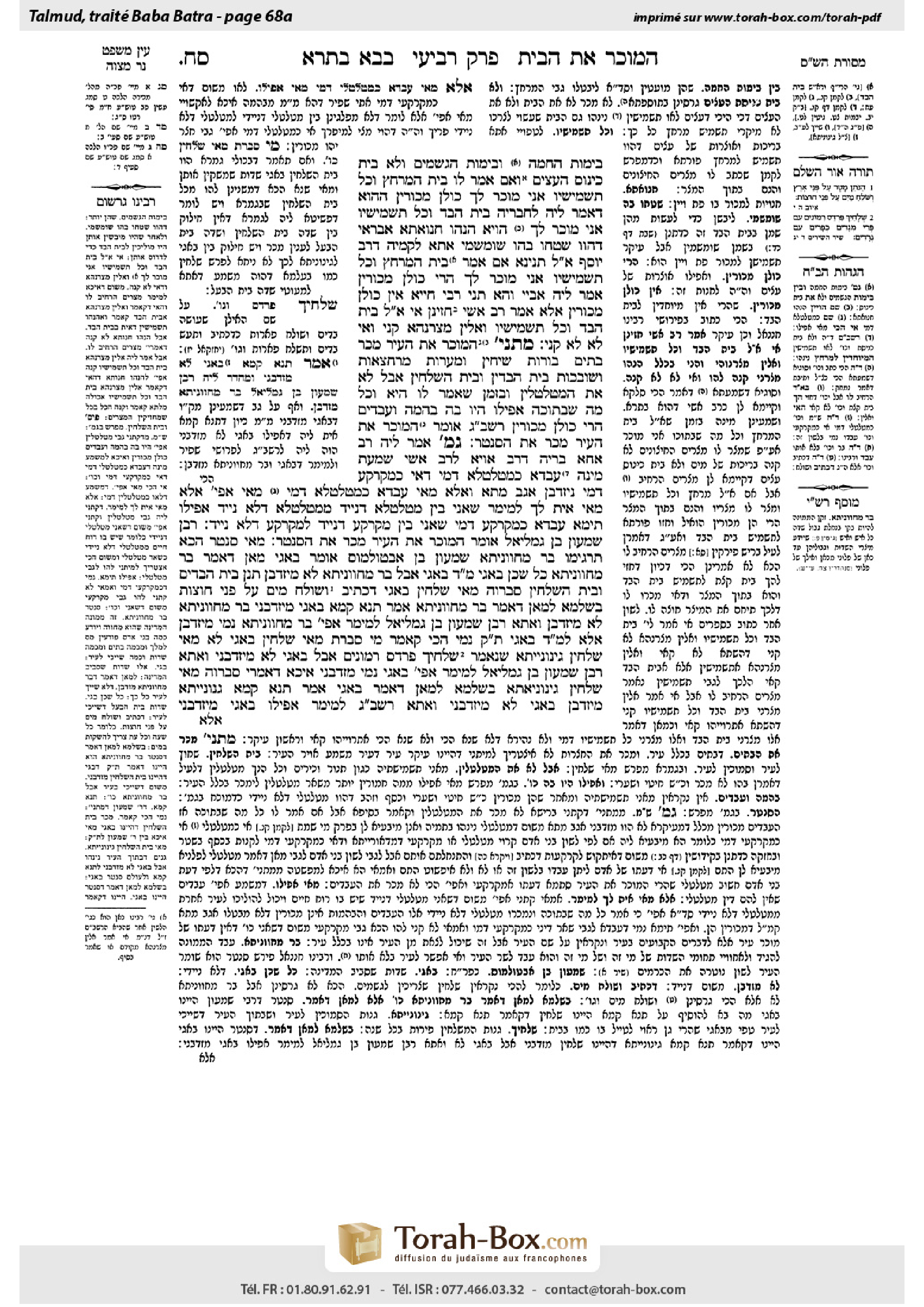
Bava Batra 68a: Talmud study for Daf Yomi
Study the Talmud for Daf Yomi with scanned pages, Hebrew text, English translations from Sefaria and AI-generated French translations.
Passage selection and English or AI-generated French translation are available where the scan has annotations. Daf Study is independent of Torah-Box and Sefaria.
Browse Bava Batra · בבא בתרא · All tractatesBava Batra 68a text and translations
This page of Bava Batra includes the Aramaic text, an English translation and an AI-generated French translation, alongside the scan above.
בבא בתרא ס״ח א · Aramaic and Hebrew text
בִּימוֹת הַחַמָּה וּבִימוֹת הַגְּשָׁמִים, וְלֹא בֵּית כִּינּוּס הָעֵצִים. וְאִם אָמַר לוֹ: ״בֵּית הַמֶּרְחָץ וְכׇל תַּשְׁמִישָׁיו אֲנִי מוֹכֵר לָךְ״ – כּוּלָּן מְכוּרִין.
הָהוּא דַּאֲמַר לֵיהּ לְחַבְרֵיהּ: ״בֵּית הַבַּד וְכׇל תַּשְׁמִישָׁיו אֲנִי מוֹכֵר לָךְ״. הֲוַיָא הָנְהוּ חַנְוָאתָא אַבָּרַאי, דַּהֲווֹ שָׁטְחוּ בְּהוּ שׁוּמְשְׁמֵי. אֲתָא לְקַמֵּיהּ דְּרַב יוֹסֵף,
אֲמַר לֵיהּ: תְּנֵינָא, אִם אָמַר: ״בֵּית הַמֶּרְחָץ וְכׇל תַּשְׁמִישָׁיו אֲנִי מוֹכֵר לָךְ״ – הֲרֵי כּוּלָּן מְכוּרִין. אֲמַר לֵיהּ אַבָּיֵי, וְהָא תָּנֵי רַבִּי חִיָּיא: אֵין כּוּלָּן מְכוּרִין! אֶלָּא אָמַר רַב אָשֵׁי: חָזֵינַן – אִי אֲמַר לֵיהּ: ״בֵּית הַבַּד וְכׇל תַּשְׁמִישָׁיו, וְאִלֵּין מִצְרָנַהָא״ – קָנֵי, וְאִי לָא – לָא קָנֵי.
מַתְנִי׳ הַמּוֹכֵר אֶת הָעִיר – מָכַר בָּתִּים; בּוֹרוֹת, שִׁיחִין וּמְעָרוֹת; מֶרְחֲצָאוֹת וְשׁוֹבָכוֹת; בֵּית הַבַּדִּין וּבֵית הַשְּׁלָחִין; אֲבָל לֹא אֶת הַמִּטַּלְטְלִין. וּבִזְמַן שֶׁאָמַר לוֹ: ״הִיא וְכׇל מַה שֶּׁבְּתוֹכָהּ״ – אֲפִילּוּ הָיוּ בָּהּ בְּהֵמָה וַעֲבָדִים, הֲרֵי כּוּלָּן מְכוּרִין. רַבָּן שִׁמְעוֹן בֶּן גַּמְלִיאֵל אוֹמֵר: הַמּוֹכֵר אֶת הָעִיר – מָכַר אֶת הַסַּנְטֵר.
גְּמָ׳ אֲמַר לֵיהּ רַב אַחָא בְּרֵיהּ דְּרַב אַוְיָא לְרַב אָשֵׁי: שָׁמְעַתְּ מִינַּהּ, עַבְדָּא כְּמִטַּלְטְלָא דָּמֵי; דְּאִי כִּמְקַרְקַע דָּמֵי, נִיזְדַּבַּן אַגַּב מָתָא! וְאֶלָּא מַאי, עַבְדָּא כְּמִטַּלְטְלָא דָּמֵי?! מַאי אֲפִילּוּ?
אֶלָּא מַאי אִית לָךְ לְמֵימַר – שָׁאנֵי בֵּין מִטַּלְטְלָא דְנָיֵיד מִמִּטַּלְטְלָא דְּלָא נָיֵיד; אֲפִילּוּ תֵּימָא עַבְדָּא כִּמְקַרְקַע דָּמֵי – שָׁאנֵי בֵּין מְקַרְקַע דְּנָיֵיד, לִמְקַרְקַע דְּלָא נָיֵיד.
רַבָּן שִׁמְעוֹן בֶּן גַּמְלִיאֵל אוֹמֵר: הַמּוֹכֵר אֶת הָעִיר – מָכַר אֶת הַסַּנְטֵר. מַאי ״סַנְטֵר״? הָכָא תַּרְגִּימוּ: בַּר מַחְווֹנִיתָא. שִׁמְעוֹן בֶּן אַבְטוּלְמוֹס אוֹמֵר: בָּאגֵי. מַאן דְּאָמַר בַּר מַחְווֹנִיתָא – כׇּל שֶׁכֵּן בָּאגֵי; מַאן דְּאָמַר בָּאגֵי – אֲבָל בַּר מַחְווֹנִיתָא לָא מִיזְדַּבַּן.
תְּנַן: בֵּית הַבַּדִּים וּבֵית הַשְּׁלָחִין. סַבְרוּהָ, מַאי ״שְׁלָחִין״ – בָּאגֵי, דִּכְתִיב: ״וְשֹׁלֵחַ מַיִם עַל פְּנֵי חוּצוֹת״; בִּשְׁלָמָא לְמַאן דְּאָמַר בַּר מַחְווֹנִיתָא – אֲמַר תַּנָּא קַמָּא: בָּאגֵי מִיזְדַּבְּנִי, בַּר מַחְווֹנִיתָא לָא מִיזְדַּבַּן; וַאֲתָא רַבָּן שִׁמְעוֹן בֶּן גַּמְלִיאֵל לְמֵימַר: אֲפִילּוּ בַּר מַחְווֹנִיתָא נָמֵי מִיזְדַּבַּן. אֶלָּא לְמַאן דְּאָמַר בָּאגֵי – תַּנָּא קַמָּא נָמֵי הָכִי קָאָמַר!
מִי סָבְרַתְּ מַאי ״שְׁלָחִין״ – בָּאגֵי?! לָא; מַאי ״שְׁלָחִין״ – גִּינוּנְיָיתָא, שֶׁנֶּאֱמַר: ״שְׁלָחַיִךְ פַּרְדֵּס רִמּוֹנִים״; אֲבָל בָּאגֵי – לָא מִיזְדַּבְּנִי. וַאֲתָא רַבָּן שִׁמְעוֹן בֶּן גַּמְלִיאֵל לְמֵימַר: אֲפִילּוּ בָּאגֵי נָמֵי מִזְדַּבְּנִי.
אִיכָּא דְּאָמְרִי: סַבְרוּהָ, מַאי ״שְׁלָחִין״ – גִּינוּנְיָאתָא; בִּשְׁלָמָא לְמַאן דְּאָמַר בָּאגֵי – אָמַר תַּנָּא קַמָּא: גְּנוּנָיְיָתָא מִיזְדַּבַּן, בָּאגֵי לָא מִיזְדַּבְּנִי; וַאֲתָא רַבָּן שִׁמְעוֹן בֶּן גַּמְלִיאֵל לְמֵימַר: אֲפִילּוּ בָּאגֵי מִיזְדַּבְּנִי.
Bava Batra 68a · English translation
in the summer season or in the rainy season, nor has he sold him the storeroom for the wood. But if the seller says to the buyer: I am selling you the bathhouse and all of its accompaniments, all these components are sold.
The Gemara relates: There was a certain person who said to another: I am selling you this olive press and all of its accompaniments. There were certain stores outside of the olive press, where, in addition to the ordinary services that these stores provided, sesame seeds would also be spread out to dry before they would be pressed for their oil. The seller and the buyer disagreed about whether these stores were included in the sale, and the buyer came before Rav Yosef, presenting him with his claim to ownership of the stores.
Rav Yosef said to him: We learned in the previously cited baraita that if the seller says to the buyer: I am selling you the bathhouse and all of its accompaniments, all these components are sold. Rav Yosef held that in this case too, the disputed stores were sold. Abaye said to Rav Yosef: But didn’t Rabbi Ḥiyya teach in a baraita: They are not all sold? Rather, the issue should be resolved as Rav Ashi said: We consider the seller’s statement, and if he said to the buyer: I am selling you the olive press and all of its accompaniments, and these are its boundaries, and he included the area of the stores within those boundaries, the buyer has acquired those stores, but if the seller does not say this, he has not acquired them, as they are not actually part of the olive press.
MISHNA: One who sells a city without specifying what is included in the sale has sold with it the houses, the pits, the ditches and caves, the bathhouses and the dovecotes, and the olive presses and beit hashelaḥin, as will be explained in the Gemara, but he has not sold the movable property in the city. But when the seller says to the buyer: I am selling you it and everything that is in it, even if there were cattle and Canaanite slaves in the city, all these entities are sold. Rabban Shimon ben Gamliel says: One who sells a city has sold with it the santar, the meaning of which will be explained in the Gemara.
GEMARA: Rav Aḥa, son of Rav Avya, said to Rav Ashi: Learn from the mishna that the legal status of a Canaanite slave is like that of movable property, as if it is like that of land, the slave should be sold along with the city. Rav Ashi responded: Rather, what do you claim, that the legal status of a Canaanite slave is like that of movable property? If that is the case, what is the meaning of the mishna’s statement that even if there were cattle and Canaanite slaves in the city, they are all sold? This is obvious, as the slaves should be treated no differently than the rest of the city’s movable property.
Rather, what have you to say? You must explain that there is a difference between movable property that moves about by itself, such as slaves, and movable property that does not move about by itself, i.e., inanimate objects. In exactly the same manner, one can claim that even if you say that the legal status of a Canaanite slave is like that of land, there is a difference between land that moves about by itself, i.e., slaves, and land that does not move about by itself.
§ The mishna teaches: Rabban Shimon ben Gamliel says: One who sells a city has sold with it the santar. The Gemara asks: What is the meaning of the term santar? Here in Babylonia they interpreted it to mean the land registrar [bar maḥavanita] in charge of keeping track of property boundaries. Shimon ben Avtolemos disagrees and says that it is referring to the fields that surround the city. The Gemara comments: The one who says that santar means the land registrar understands that according to Rabban Shimon ben Gamliel, when one sells a city, all the more so are the fields that surround the city included in the sale. But the one who says that it means the fields that surround the city holds that the land registrar is not sold with the city.
The Gemara attempts to adduce proof in support of one of the opinions: We learned in the mishna here that the olive presses and beit hashelaḥin are sold along with the city. The Sages initially maintained: What is meant by shelaḥin? This is referring to irrigated fields, fields that require additional irrigation to supplement the rain that they receive. As it is written: “Who gives rain upon the earth and sends [shole’aḥ] water upon the fields” (Job 5:10). Granted, according to the one who says that santar means the land registrar, the first tanna of the mishna said that the fields that surround the city are sold with the city, but the land registrar is not sold, and Rabban Shimon ben Gamliel comes to say that even the land registrar is sold. But according to the one who says that santar means fields, this is what the first tanna is saying as well. In what way, then, does Rabban Shimon ben Gamliel disagree with the first tanna?
The Gemara rejects this proof: Do you maintain that what is meant by shelaḥin is irrigated fields? This is not the case. Rather, what is meant by shelaḥin? This is referring to gardens found within the city, as it is stated: “Your shoots [shelaḥayikh] are an orchard of pomegranates” (Song of Songs 4:13). But the fields that surround the city are not sold. And Rabban Shimon ben Gamliel comes to say that even the fields are sold as well. This is one version of the discussion.
Some say that the discussion took place as follows: The Sages initially assumed that what is meant by shelaḥin? This is referring to gardens found within the city. Granted, according to the one who said that santar means the fields that surround the city, the first tanna of the mishna said that the gardens found within the city are sold along with the city, but the fields that surround the city are not sold, and Rabban Shimon ben Gamliel comes to say that even the fields that surround the city are sold.
Bava Batra 68a · Traduction française (IA)
En saison estivale ou en saison des pluies, ni n'a-t-il vendu la pièce de stockage pour le bois. Mais si le vendeur dit à l'acheteur : Je vends à toi la maison de bain et toutes ses annexes, tous ces éléments sont vendus.
La Guemara rapporte : Il y avait un certain homme qui disait à un autre : Je vends à toi cette presse d'olive et toutes ses annexes. Il y avait certaines boutiques en dehors de la presse d'olive, où, en plus des services ordinaires que ces boutiques fournissaient, on étalait aussi des graines de sésame pour les sécher avant de les presser pour en extraire l'huile. Le vendeur et l'acheteur étaient en désaccord sur le fait que ces boutiques fussent incluses dans la vente, et l'acheteur s'est présenté devant Rav Yosef, lui exposant sa revendication sur ces boutiques.
Rav Yosef dit à lui : Nous avons appris dans la baraïta citée précédemment que si le vendeur dit à l'acheteur : Je vends à toi la maison de bain et toutes ses annexes, tous ces éléments sont vendus. Rav Yosef considère que dans ce cas également, les boutiques en litige étaient vendues. Abaye dit à Rav Yosef : Mais n'a-t-il pas enseigné Rabbi Ḥiyya dans une baraïta : Ils ne sont pas tous vendus ? Plutôt, la question doit être résolue selon ce que Rav Ashi a dit : Nous considérons l'expression du vendeur, et si il dit à l'acheteur : Je vends à toi la presse d'olive et toutes ses annexes, et ces sont ses limites, et il inclut la zone des boutiques dans ces limites, l'acheteur acquiert ces boutiques, mais si le vendeur ne dit pas cela, il n'a pas acquis ces boutiques, car elles ne font pas réellement partie de la presse d'olive.
MICHNA : Celui qui vend une ville sans spécifier ce qui est inclus dans la vente a vendu avec elle les maisons, les puits, les fossés et les grottes, les maisons de bain et les colombiers, et les presses d'olive et le beit hashelaḥin, comme sera expliqué dans la Guemara, mais il n'a pas vendu les biens mobiliers de la ville. Mais lorsque le vendeur dit à l'acheteur : Je vends à toi cela et tout ce qui est dedans, même s'il y avait des bœufs et des esclaves cananéens dans la ville, tous ces éléments sont vendus. Rabban Shimon ben Gamliel dit : Celui qui vend une ville a vendu avec elle le santar, dont la signification sera expliquée dans la Guemara.
GUEMARA : Rav Aḥa, fils de Rav Avya, dit à Rav Ashi : Apprends de la mishna que le statut juridique de l'esclave cananéen est comme celui des biens mobiliers, car si c'est comme celui du terrain, l'esclave devrait être vendu avec la ville. Rav Ashi répondit : Plutôt, que veux-tu dire, que le statut juridique de l'esclave cananéen est comme celui des biens mobiliers ? Si c'est le cas, que signifie la déclaration de la mishna que même s'il y avait des bœufs et des esclaves cananéens dans la ville, ils sont tous vendus ? Cela est évident, car les esclaves devraient être traités de la même manière que le reste des biens mobiliers de la ville.
Plutôt, que veux-tu dire ? Tu dois expliquer qu'il y a une différence entre les biens mobiliers qui se déplacent tout seuls, comme les esclaves, et les biens mobiliers qui ne se déplacent pas tout seuls, c'est-à-dire les objets inanimés. De la même manière, on peut affirmer que même si tu dis que le statut juridique de l'esclave cananéen est comme celui du terrain, il y a une différence entre le terrain qui se déplace tout seul, c'est-à-dire les esclaves, et le terrain qui ne se déplace pas tout seul.
§ La Michna enseigne : Rabban Shimon ben Gamliel dit : Celui qui vend une ville a vendu avec elle le santar. La Guemara pose la question : Quelle est la signification du terme santar ? Ici en Babylone, on l'interprète comme désignant le bar maḥavanita, le responsable des registres fonciers chargé de suivre les limites des propriétés. Simon ben Avtolemos est d'avis contraire et dit qu'il s'agit des champs qui entourent la ville. La Guemara commente : Celui qui dit que santar signifie le bar maḥavanita comprend que selon Rabban Shimon ben Gamliel, lorsqu'on vend une ville, les champs qui entourent la ville sont inclus dans la vente. Celui qui dit qu'il s'agit des champs qui entourent la ville considère que le bar maḥavanita n'est pas vendu avec la ville.
La Guemara tente d'apporter une preuve en faveur d'une des opinions : Nous avons appris dans la Michna ici que les presses d'olive et le beit hashelaḥin sont vendus avec la ville. Les Sages ont initialement maintenu : De quoi s'agit-il par shelaḥin ? Cela désigne des champs irrigués, des champs nécessitant une irrigation supplémentaire pour compléter la pluie qu'ils reçoivent. Comme il est écrit : « Qui donne la pluie sur la terre et envoie [shole’aḥ] l'eau sur les champs » (Job 5:10). Admettons que selon celui qui dit que santar signifie le bar maḥavanita, le premier tanna de la Michna a dit que les champs qui entourent la ville sont vendus avec la ville, mais le bar maḥavanita n'est pas vendu, et Rabban Shimon ben Gamliel vient dire que même le bar maḥavanita est vendu. Mais selon celui qui dit que santar signifie les champs, c'est ce que le premier tanna dit également. De quelle manière, alors, Rabban Shimon ben Gamliel diffère-t-il du premier tanna ?
La Guemara rejette cette preuve : Veux-tu dire que shelaḥin désigne des champs irrigués ? Ce n'est pas le cas. Plutôt, de quoi s'agit-il par shelaḥin ? Cela désigne des jardins situés à l'intérieur de la ville, comme il est dit : « Tes pousses [shelaḥayikh] sont un verger de grenades » (Chant des Chants 4:13). Mais les champs qui entourent la ville ne sont pas vendus. Et Rabban Shimon ben Gamliel vient dire que même les champs sont vendus. C'est une version de la discussion.
Certains disent que la discussion s'est déroulée ainsi : Les Sages ont initialement supposé que shelaḥin désigne des jardins situés à l'intérieur de la ville. Admettons que selon celui qui a dit que santar signifie les champs qui entourent la ville, le premier tanna de la mishna a dit que les jardins situés à l'intérieur de la ville sont vendus avec la ville, mais les champs qui entourent la ville ne sont pas vendus, et Rabban Shimon ben Gamliel vient dire que même les champs qui entourent la ville sont vendus.
Traduction française générée par IA à partir de l’édition anglaise de Sefaria. Vérifie toujours un passage avec le texte source.
Text from Sefaria: William Davidson Edition - Vocalized Aramaic (CC BY NC); William Davidson Edition - English (CC BY NC).