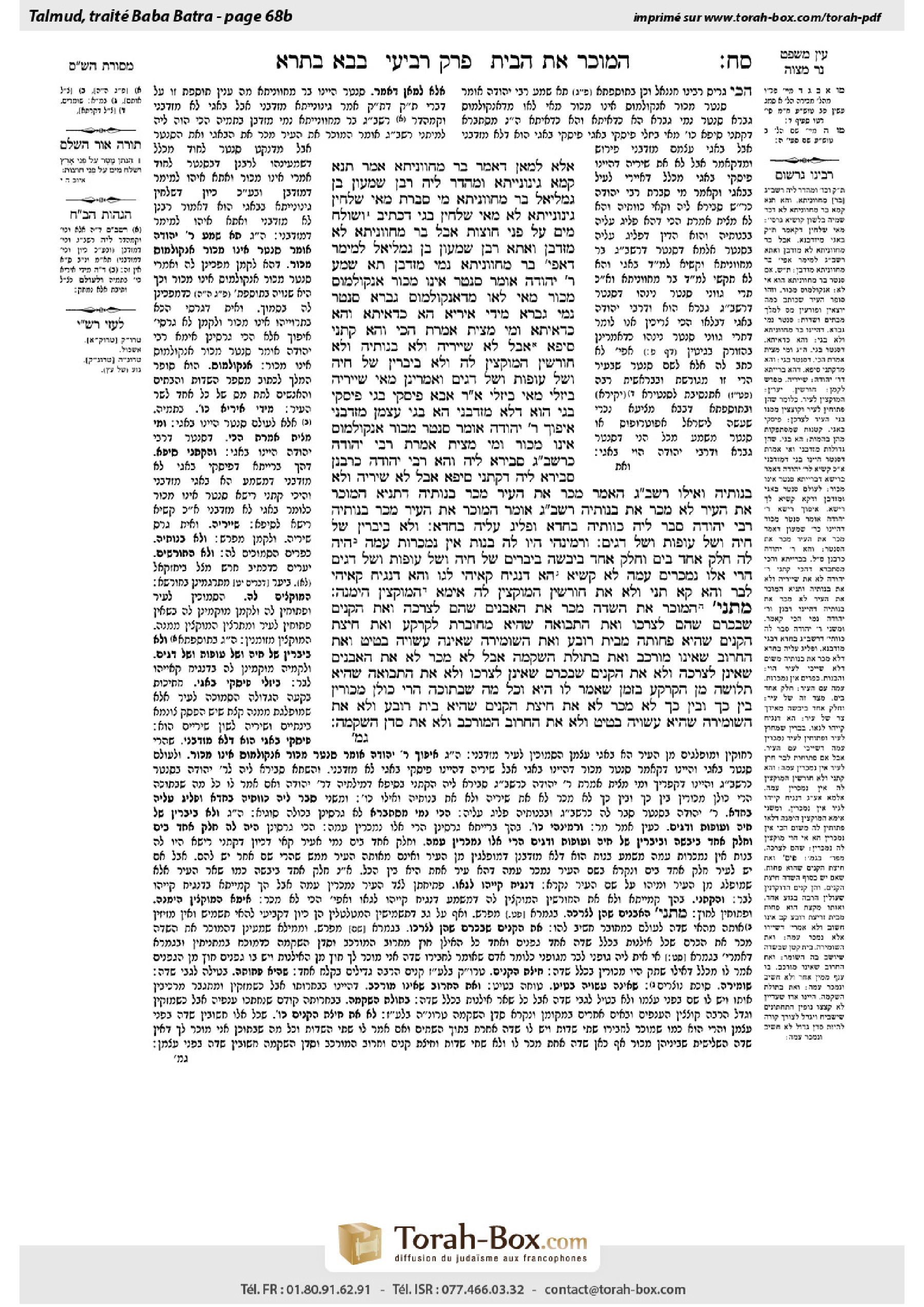
Bava Batra 68b: Talmud study for Daf Yomi
Study the Talmud for Daf Yomi with scanned pages, Hebrew text, English translations from Sefaria and AI-generated French translations.
Passage selection and English or AI-generated French translation are available where the scan has annotations. Daf Study is independent of Torah-Box and Sefaria.
Browse Bava Batra · בבא בתרא · All tractatesBava Batra 68b text and translations
This page of Bava Batra includes the Aramaic text, an English translation and an AI-generated French translation, alongside the scan above.
בבא בתרא ס״ח ב · Aramaic and Hebrew text
אֶלָּא לְמַאן דְּאָמַר בַּר מַחְווֹנִיתָא – אָמַר תַּנָּא קַמָּא: גִּינוּנְיָיתָא; וּמַהְדַּר לֵיהּ רַבָּן שִׁמְעוֹן בֶּן גַּמְלִיאֵל: בַּר מַחְווֹנִיתָא?! מִי סָבְרַתְּ מַאי ״שְׁלָחִין״ – גִּינוּנְיָיתָא?! לָא; מַאי ״שְׁלָחִין״ – בָּגֵי, דִּכְתִיב: ״וְשֹׁלֵחַ מַיִם עַל פְּנֵי חוּצוֹת״; אֲבָל בַּר מַחְווֹנִיתָא – לָא מִזְדַּבַּן. וַאֲתָא רַבָּן שִׁמְעוֹן בֶּן גַּמְלִיאֵל לְמֵימַר, דַּאֲפִילּוּ בַּר מַחְווֹנִיתָא נָמֵי מִזְדַּבַּן.
תָּא שְׁמַע, רַבִּי יְהוּדָה אוֹמֵר: סַנְטֵר אֵינוֹ מָכוּר, אַנְקוּלְמוּס מָכוּר. מַאי, לָאו מִדְּאַנְקוּלְמוּס גַּבְרָא, סַנְטֵר נָמֵי גַּבְרָא? מִידֵּי אִירְיָא?! הָא כִּדְאִיתָא וְהָא כִּדְאִיתָא.
וּמִי מָצֵית אָמְרַתְּ הָכִי? וְהָא קָתָנֵי סֵיפָא: אֲבָל לֹא שְׁיָירֶיהָ וְלֹא בְּנוֹתֶיהָ, וְלֹא חוֹרָשִׁין הַמּוּקְצִין לָהּ, וְלֹא בֵּיבָרִין שֶׁל חַיָּה וְשֶׁל עוֹפוֹת וְשֶׁל דָּגִים. וְאָמְרִינַן: מַאי ״שְׁיָירֶיהָ״? בִּיזְלֵי. מַאי בִּיזְלֵי? אָמַר רַבִּי אַבָּא: פִּיסְקֵי בָּגֵי. פִּיסְקֵי בָּגֵי הוּא דְּלָא מִזְדַּבְּנִי, הָא בָּגֵי עַצְמָן – מִזְדַּבְּנִי!
אֵיפוֹךְ – רַבִּי יְהוּדָה אוֹמֵר: סַנְטֵר – מָכוּר, אַנְקוּלְמוֹס – אֵינוֹ מָכוּר.
וּמִי מָצֵית אָמְרַתְּ רַבִּי יְהוּדָה – כְּרַבָּן שִׁמְעוֹן בֶּן גַּמְלִיאֵל סְבִירָא לֵיהּ? וְהָא רַבִּי יְהוּדָה כְּרַבָּנַן סְבִירָא לֵיהּ! דְּקָתָנֵי סֵיפָא: אֲבָל לֹא שְׁיָירֶיהָ וְלֹא בְּנוֹתֶיהָ. וְאִילּוּ רַבָּן שִׁמְעוֹן בֶּן גַּמְלִיאֵל, הָאָמַר: מָכַר אֶת הָעִיר – מָכַר בְּנוֹתֶיהָ! דְּתַנְיָא: הַמּוֹכֵר אֶת הָעִיר – לָא מָכַר אֶת בְּנוֹתֶיהָ. רַבָּן שִׁמְעוֹן בֶּן גַּמְלִיאֵל אוֹמֵר: הַמּוֹכֵר אֶת הָעִיר – מָכַר בְּנוֹתֶיהָ!
רַבִּי יְהוּדָה סָבַר לֵיהּ כְּווֹתֵיהּ בַּחֲדָא, וּפְלִיג עֲלֵיהּ בַּחֲדָא.
וְלֹא בֵּיבָרִין שֶׁל חַיָּה וְשֶׁל עוֹפוֹת וְשֶׁל דָּגִים. וּרְמִינְהִי: הָיוּ לָהּ בָּנוֹת – אֵין נִמְכָּרוֹת עִמָּהּ. הָיָה לָהּ חֵלֶק אֶחָד בַּיָּם וְחֵלֶק אֶחָד בַּיַּבָּשָׁה; בֵּיבָרִים שֶׁל חַיָּה וְשֶׁל עוֹפוֹת וְשֶׁל דָּגִים – הֲרֵי אֵלּוּ נִמְכָּרִים עִמָּהּ!
לָא קַשְׁיָא; הָא דִּנְגִיחַ קַאיְהִי לְגָו, וְהָא דִּנְגִיחַ קַאיְהִי לְבַר. וְהָא קָא תָנֵי: וְלֹא אֶת חוֹרָשִׁין הַמּוּקְצִין לָהּ! אֵימָא: הַמּוּקְצִין הֵימֶנָּה.
מַתְנִי׳ הַמּוֹכֵר אֶת הַשָּׂדֶה – מָכַר אֶת הָאֲבָנִים שֶׁהֵם לְצׇרְכָּהּ, וְאֶת הַקָּנִים שֶׁבַּכֶּרֶם שֶׁהֵם לְצׇרְכּוֹ, וְאֶת הַתְּבוּאָה שֶׁהִיא מְחוּבֶּרֶת לַקַּרְקַע, וְאֶת חִיצַת הַקָּנִים שֶׁהִיא פְּחוּתָה מִבֵּית רוֹבַע, וְאֶת הַשּׁוֹמֵירָה שֶׁאֵינָהּ עֲשׂוּיָה בְּטִיט, וְאֶת הֶחָרוּב שֶׁאֵינוֹ מוּרְכָּב, וְאֶת בְּתוּלַת הַשִּׁקְמָה.
אֲבָל לֹא מָכַר לֹא אֶת הָאֲבָנִים שֶׁאֵינָן לְצׇרְכָּהּ, וְלֹא אֶת הַקָּנִים שֶׁבַּכֶּרֶם שֶׁאֵינָן לְצׇרְכּוֹ, וְלֹא אֶת הַתְּבוּאָה שֶׁהִיא תְּלוּשָׁה מִן הַקַּרְקַע. בִּזְמַן שֶׁאָמַר לוֹ: ״הִיא וְכׇל מַה שֶּׁבְּתוֹכָהּ״ – הֲרֵי כּוּלָּן מְכוּרִין. בֵּין כָּךְ וּבֵין כָּךְ – לֹא מָכַר לֹא אֶת חִיצַת הַקָּנִים שֶׁהִיא בֵּית רוֹבַע, וְלֹא אֶת הַשּׁוֹמֵירָה שֶׁהִיא עֲשׂוּיָה בְּטִיט, וְלֹא אֶת הֶחָרוּב הַמּוּרְכָּב, וְלֹא אֶת סַדַּן הַשִּׁקְמָה.
Bava Batra 68b · English translation
But according to the one who says that santar means the land registrar, is it reasonable that the first tanna of the mishna said that the gardens within the city are included in the sale of the city, and Rabban Shimon ben Gamliel responded to him that the land registrar is included? How are the two connected? The Gemara answers: Do you maintain that what is meant by shelaḥin is gardens? This is not the case. Rather, what is meant by shelaḥin? This is referring to the fields that surround the city, as it is written: “Who gives rain upon the earth and sends [sholeaḥ] waters upon the fields” (Job 5:10). According to the first tanna, it is specifically the fields that are sold with the city, but the land registrar is not sold. And Rabban Shimon ben Gamliel comes to say that even the land registrar is also sold.
The Gemara suggests: Come and hear a proof from the following baraita: Rabbi Yehuda says: The santar is not sold with the city, but the city scribe [ankolemus] is sold with it. What, is it not clear from the fact that the city scribe is a man that the santar is also a man? The Gemara rejects this proof: Are the cases comparable? This case is as it is, and that case is as it is, and santar means fields, and not the land registrar.
The Gemara asks: How can you say that according to Rabbi Yehuda the fields surrounding the city are not sold along with it? But isn’t it taught in the latter clause of this baraita: But when one sells a city he has not sold its remnants, and not its daughters, i.e., the nearby rural villages, and not the woods that are set aside and designated for the city, and not the enclosures [beivarin] for animals, for birds, and for fish. And we said in explanation: What is meant by its remnants? Bizlei. The Gemara asks: What is the meaning of bizlei? Rabbi Abba said: The strips of the fields that are separated from the main fields by a stretch that cannot be cultivated. From here, it may be inferred that it is the strips of the fields that are not sold with the city, but the fields themselves are sold with it.
The Gemara suggests: Reverse the statement found in the baraita so that Rabbi Yehuda says that the santar, now understood to mean fields, is sold with the city, but the city scribe is not sold with it.
The Gemara asks: How can you say that Rabbi Yehuda holds in accordance with the opinion of Rabban Shimon ben Gamliel, to the point that you adduce proof from the words of Rabbi Yehuda with regard to the opinion of Rabban Shimon ben Gamliel? But doesn’t Rabbi Yehuda hold in accordance with the opinion of the Rabbis? As it is taught in the latter clause of that same baraita: But when one sells a city he does not sell its remnants, and he does not sell its daughters, i.e., the nearby rural villages. Whereas with regard to Rabban Shimon ben Gamliel, doesn’t he say that one who sold a city sold its daughters along with it, i.e., the nearby rural villages, as it is taught in a baraita: One who sells a city has not sold its daughters; Rabban Shimon ben Gamliel disagrees and says: One who sells a city has sold its daughters.
The Gemara answers: This does not prove that Rabbi Yehuda disagrees with Rabban Shimon ben Gamliel, as it may be suggested that Rabbi Yehuda holds in accordance with the opinion of Rabban Shimon ben Gamliel with regard to one issue, that the fields that surround the city are included in the sale, and disagrees with him with regard to another issue, as according to Rabbi Yehuda the nearby villages are not sold along with the city.
§ The baraita teaches: When one sells a city he has not sold, among other things, the enclosures for animals, for birds, and for fish. And the Gemara raises a contradiction from another baraita: If the city has daughters, i.e., nearby villages, they are not sold along with it. If it has one part on the sea and one part on dry land, or if it has enclosures for animals, for birds, or for fish, these are all sold along with the city.
The Gemara answers that this is not difficult, as a distinction can be made between different cases: Here, the one baraita addresses animal enclosures whose openings face inward, i.e., toward the city, and they are therefore considered a part of the city, whereas there, the other baraita addresses animal enclosures whose openings face outward, i.e., away from the city, and therefore they are not included in its sale. The Gemara raises a difficulty: But doesn’t the baraita teach: And he has not sold the woods that are set aside for the city, indicating that they face the city, and nevertheless they are not sold along with the city? The Gemara answers: Say that the baraita should be emended so that it reads instead: And he has not sold the woods that are set apart from the city, i.e., that are at a distance and do not face the city.
MISHNA: One who sells a field without specifying what is included in the sale has sold the stones in the field that are for its use, and the reeds in the vineyard that are for its use, and the produce that is still attached to the ground, and the cluster of reeds that occupy less than the area required for sowing a quarter-kav of seed [beit rova], and the watch station that is not plastered with clay, and the young carob tree that has not yet been grafted, and the untrimmed sycamore that is still young.
But he has not sold along with the field the stones that are not designated for use in the field, and not the reeds in the vineyard that are not designated for its use, and not the produce that is already detached from the ground. When the seller says to the buyer: I am selling you it and everything that is in it, all these components are sold along with the field. Both in this case, where he executes the sale without specification, and in that case, where he adds the phrase that he is selling everything that is in the field, he has not sold the cluster of reeds that occupy a beit rova or more, as they are considered a separate field, and he has not sold the watch station that is plastered with clay, and not the carob tree that has been grafted, and not the sycamore trunk. All of these entities are significant in their own right and have a status independent from that of the fields, and they are therefore not included in the sale of the field.
Bava Batra 68b · Traduction française (IA)
Mais selon celui qui affirme que santar signifie le registre de la terre, est-il raisonnable que le premier tanna de la mitsna ait dit que les jardins à l'intérieur de la ville sont inclus dans la vente de la ville, et que Rabban Shimon ben Gamliel ait répondu à ce propos que le registre de la terre est inclus ? Comment ces deux éléments sont-ils liés ? La Guemara répond : Maintenez-vous que shelaḥin signifie les jardins ? Ce n'est pas le cas. Plutôt, que signifie shelaḥin ? Cela fait référence aux champs qui entourent la ville, comme il est écrit : « Qui donne la pluie sur la terre et envoie [sholeaḥ] des eaux sur les champs » (Job 5:10). Selon le premier tanna, c'est spécifiquement les champs qui sont vendus avec la ville, mais le registre de la terre n'est pas vendu. Et Rabban Shimon ben Gamliel affirme que même le registre de la terre est également vendu.
La Guemara suggère : Viens écouter une preuve à partir de la suivante baraïta : Rabbi Yehuda dit : Le santar n'est pas vendu avec la ville, mais le scribe de la ville [ankolemus] est vendu avec elle. Qu'est-ce que cela ne serait pas clair du fait que le scribe de la ville est un homme, que le santar est aussi un homme ? La Guemara rejette cette preuve : Les cas sont-ils comparables ? Ce cas est tel qu'il est, et celui-ci est tel qu'il est, et santar signifie les champs, et non le registre de la terre.
La Guemara pose la question : Comment pouvez-vous dire que selon Rabbi Yehuda les champs qui entourent la ville ne sont pas vendus avec elle ? Mais n'est-il pas enseigné dans la dernière partie de cette baraïta : Mais quand on vend une ville, on n'a pas vendu ses restes, et non ses filles, c'est-à-dire les villages ruraux proches, et non les bois désignés et réservés à la ville, et non les enclos [beivarin] pour les animaux, les oiseaux et les poissons. Et nous avons dit dans l'explication : Que signifie ses restes ? Bizlei. La Guemara pose la question : Quel est le sens de bizlei ? Rabbi Abba dit : Les bandes des champs qui sont séparées des champs principaux par une distance qui ne peut être cultivée. D'où l'on peut déduire que ce sont les bandes des champs qui ne sont pas vendus avec la ville, mais les champs eux-mêmes sont vendus avec elle.
La Guemara suggère : Inversez l'affirmation trouvée dans la baraïta afin que Rabbi Yehuda dise que le santar, maintenant compris comme les champs, est vendu avec la ville, mais le scribe de la ville n'est pas vendu avec elle.
La Guemara pose la question : Comment pouvez-vous dire que selon Rabbi Yehuda il suit l'opinion de Rabban Shimon ben Gamliel, à tel point que vous citez une preuve à partir des paroles de Rabbi Yehuda concernant l'opinion de Rabban Shimon ben Gamliel ? Mais n'est-ce pas enseigné que Rabbi Yehuda suit l'opinion des Rabbins ? Comme il est enseigné dans la dernière partie de cette même baraïta : Mais quand on vend une ville, on n'a pas vendu ses filles, c'est-à-dire les villages ruraux proches. En ce qui concerne Rabban Shimon ben Gamliel, n'est-ce pas qu'il dit que celui qui vend une ville a vendu ses filles, c'est-à-dire les villages ruraux proches, comme il est enseigné dans une autre baraïta : Celui qui vend une ville n'a pas vendu ses filles ; Rabban Shimon ben Gamliel désaccorde et dit : Celui qui vend une ville a vendu ses filles.
La Guemara répond : Cela ne prouve pas que Rabbi Yehuda s'oppose à Rabban Shimon ben Gamliel, car il peut être suggéré que Rabbi Yehuda suit l'opinion de Rabban Shimon ben Gamliel concernant une question, à savoir que les champs qui entourent la ville sont inclus dans la vente, et s'oppose à lui concernant une autre question, à savoir que selon Rabbi Yehuda les villages proches ne sont pas vendus avec la ville.
§ La baraïta enseigne : Quand on vend une ville, on n'a pas vendu, entre autres choses, les enclos pour les animaux, les oiseaux et les poissons. Et la Guemara soulève une contradiction à partir d'une autre baraïta : Si la ville a des filles, c'est-à-dire des villages ruraux proches, elles ne sont pas vendues avec elle. Si elle a une partie sur la mer et une partie sur la terre ferme, ou si elle a des enclos pour les animaux, les oiseaux ou les poissons, ceux-ci sont tous vendus avec la ville.
La Guemara répond que cela n'est pas difficile, car une distinction peut être faite entre différents cas : Ici, la première baraïta traite des enclos d'animaux dont les ouvertures sont tournées vers l'intérieur, c'est-à-dire vers la ville, et qui sont donc considérés comme faisant partie de la ville, tandis que là, la seconde baraïta traite des enclos d'animaux dont les ouvertures sont tournées vers l'extérieur, c'est-à-dire loin de la ville, et qui ne sont donc pas inclus dans sa vente. La Guemara soulève une difficulté : Mais n'est-ce pas enseigné que la baraïta dit : Et il n'a pas vendu les bois réservés à la ville, indiquant qu'ils sont tournés vers la ville, et pourtant ils ne sont pas vendus avec la ville ? La Guemara répond : Dites que la baraïta devrait être corrigée afin de lire plutôt : Et il n'a pas vendu les bois séparés de la ville, c'est-à-dire qui sont à distance et ne sont pas tournés vers la ville.
MICHNA : Celui qui vend un champ sans spécifier ce qui est inclus dans la vente a vendu les pierres du champ qui sont destinées à son usage, et les roseaux du vignoble qui sont destinés à son usage, et les récoltes encore attachées au sol, et le groupe de roseaux qui occupent moins de la surface nécessaire pour semer un quart de kav [beit rova], et la tour de veille qui n'est pas enduite de terre, et l'arbre de carob jeune qui n'a pas encore été greffé, et le sycamore non taillé qui est encore jeune.
Mais il n'a pas vendu avec le champ les pierres qui ne sont pas destinées à l'usage du champ, ni les roseaux du vignoble qui ne sont pas destinés à son usage, ni les produits déjà détachés du sol. Lorsque le vendeur dit à l'acheteur : « Je te vends cela et tout ce qui est dedans », tous ces éléments sont vendus avec le champ. Cela est vrai dans ce cas où la vente est effectuée sans précision, et dans celui où l'on ajoute la formule « je te vends tout ce qui est dans le champ ». Il n'a pas vendu les roseaux regroupés en un beit rova ou plus, car ils sont considérés comme un champ distinct, ni la tour de veille recouverte de boue, ni l'arbre de calebasse greffé, ni le tronc de sycomore. Tous ces éléments ont une importance propre et un statut indépendant de celui des champs, et ils ne sont donc pas inclus dans la vente du champ.
Traduction française générée par IA à partir de l’édition anglaise de Sefaria. Vérifie toujours un passage avec le texte source.
Text from Sefaria: William Davidson Edition - Vocalized Aramaic (CC BY NC); William Davidson Edition - English (CC BY NC).