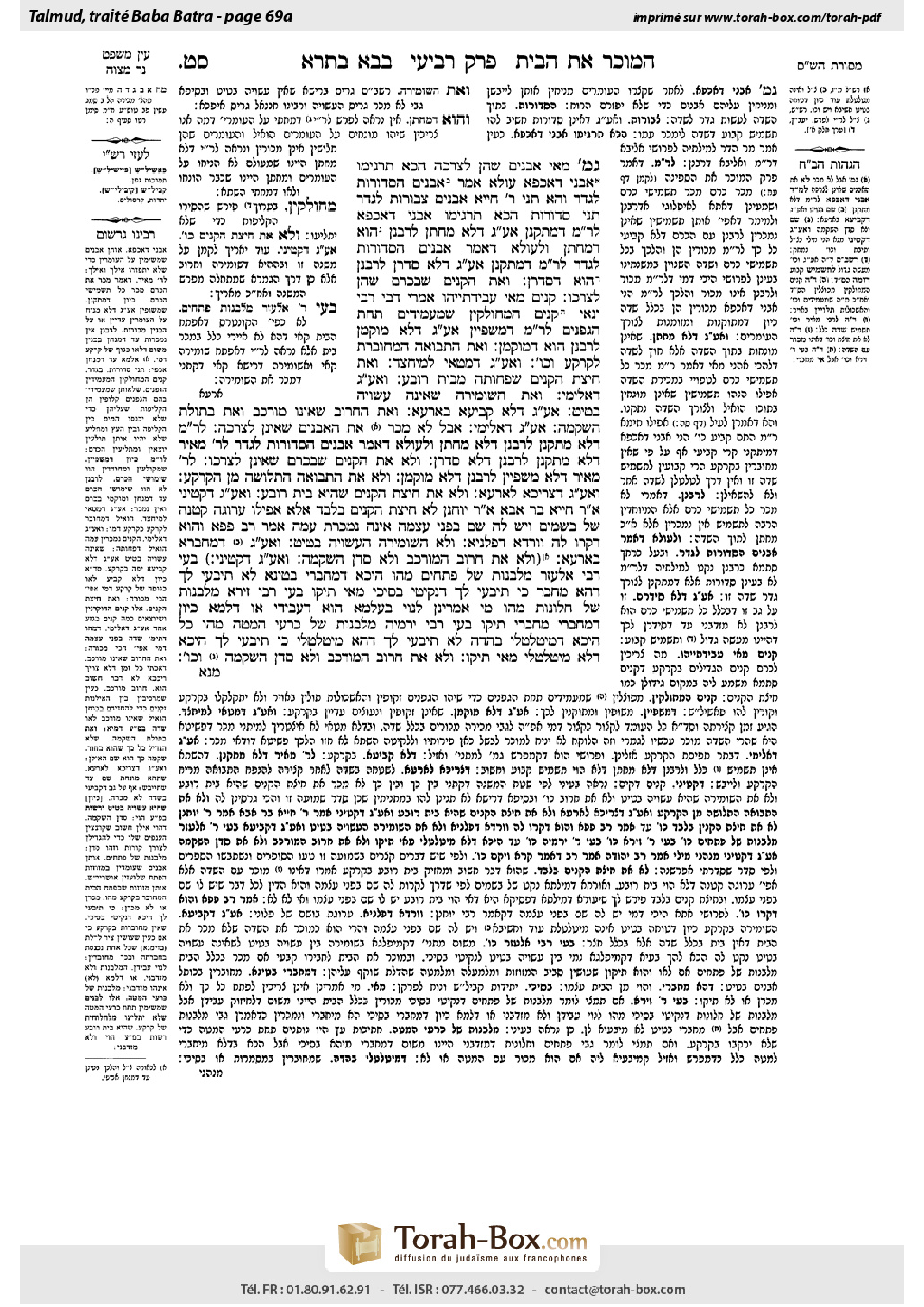
Bava Batra 69a: Talmud study for Daf Yomi
Study the Talmud for Daf Yomi with scanned pages, Hebrew text, English translations from Sefaria and AI-generated French translations.
Passage selection and English or AI-generated French translation are available where the scan has annotations. Daf Study is independent of Torah-Box and Sefaria.
Browse Bava Batra · בבא בתרא · All tractatesBava Batra 69a text and translations
This page of Bava Batra includes the Aramaic text, an English translation and an AI-generated French translation, alongside the scan above.
בבא בתרא ס״ט א · Aramaic and Hebrew text
גְּמָ׳ מַאי ״אֲבָנִים שֶׁהֵן לְצׇרְכָּהּ״? הָכָא תַּרְגִּימוּ: אַבְנֵי דְאַכְפָּא. עוּלָּא אָמַר: אֲבָנִים הַסְּדוּרוֹת לְגָדֵר. וְהָא תָּנֵי רַבִּי חִיָּיא: אֲבָנִים צְבוּרוֹת לְגָדֵר! תְּנִי: ״סְדוּרוֹת״.
הָכָא תַּרְגִּימוּ אַבְנֵי דְאַכְפָּא; לְרַבִּי מֵאִיר – דִּמְתַקְּנָן, אַף עַל גַּב דְּלָא מַחֲתָן; לְרַבָּנַן – הוּא דְּמַחֲתָן.
וּלְעוּלָּא, דְּאָמַר: אֲבָנִים הַסְּדוּרוֹת לְגָדֵר; לְרַבִּי מֵאִיר – דִּמְתַקְּנָן, אַף עַל גַּב דְּלָא סְדִרָן; לְרַבָּנַן – הוּא דִּסְדִרָן.
וְאֶת הַקָּנִים שֶׁבַּכֶּרֶם שֶׁהֵן לְצׇרְכּוֹ. קָנִים מַאי עֲבִידְתַּיְיהוּ? אָמְרִי דְּבֵי רַבִּי יַנַּאי: קָנִים הַמְחוּלָּקִין שֶׁמַּעֲמִידִים תַּחַת הַגְּפָנִים; לְרַבִּי מֵאִיר – דִּמְשַׁפְּיָין, אַף עַל גַּב דְּלָא מוֹקְמָן; לְרַבָּנַן – הוּא דְּמוֹקְמָן.
וְאֶת הַתְּבוּאָה הַמְחוּבֶּרֶת לַקַּרְקַע וְכוּ׳. וְאַף עַל גַּב דִּמְטַאי לְמִיחְצַד. וְאֶת חִיצַת הַקָּנִים שֶׁפְּחוּתָה מִבֵּית רוֹבַע. וְאַף עַל גַּב דְּאַלִּימִי.
וְאֶת הַשּׁוֹמֵירָה שֶׁאֵינָהּ עֲשׂוּיָה בְּטִיט. אַף עַל גַּב דְּלָא קְבִיעָא בְּאַרְעָא. וְאֶת הֶחָרוּב שֶׁאֵינוֹ מוּרְכָּב, וְאֶת בְּתוּלַת הַשִּׁקְמָה. אַף עַל גַּב דְּאַלִּימִי.
אֲבָל לֹא מָכַר אֶת הָאֲבָנִים שֶׁאֵינָן לְצׇרְכָּהּ. לְרַבִּי מֵאִיר – דְּלָא מְתַקְּנָן, לְרַבָּנַן – דְּלָא מַחֲתָן.
וּלְעוּלָּא, דְּאָמַר: אֲבָנִים הַסְּדוּרוֹת לְגָדֵר; לְרַבִּי מֵאִיר – דְּלָא מְתַקְּנָן, לְרַבָּנַן – דְּלָא סְדִרָן.
וְלֹא אֶת הַקָּנִים שֶׁבַּכֶּרֶם שֶׁאֵינָן לְצׇרְכּוֹ. לְרַבִּי מֵאִיר – דְּלָא מְשַׁפְּיָין, לְרַבָּנַן – דְּלָא מוֹקְמָן. וְלֹא אֶת הַתְּבוּאָה הַתְּלוּשָׁה מִן הַקַּרְקַע. וְאַף עַל גַּב דִּצְרִיכָא לְאַרְעָא.
וְלֹא אֶת חִיצַת הַקָּנִים שֶׁהִיא בֵּית רוֹבַע. וְאַף עַל גַּב דְּקַטִּינֵי. אָמַר רַבִּי חִיָּיא בַּר אַבָּא אָמַר רַבִּי יוֹחָנָן: לֹא חִיצַת הַקָּנִים בִּלְבַד; אֶלָּא אֲפִילּוּ עֲרוּגָה קְטַנָּה שֶׁל בְּשָׂמִים, וְיֵשׁ לָהּ שֵׁם בִּפְנֵי עַצְמָהּ – אֵינָהּ נִמְכֶּרֶת עִמָּהּ. אָמַר רַב פָּפָּא: וְהוּא דְּקָרוּ לָהּ: ״וַורְדָּא דִפְלָנְיָא״.
וְלֹא הַשּׁוֹמֵירָה הָעֲשׂוּיָה בְּטִיט. וְאַף עַל גַּב דִּמְחַבְּרָא בְּאַרְעָא. וְלֹא אֶת חָרוּב הַמּוּרְכָּב, וְלֹא סַדַּן הַשִּׁקְמָה. וְאַף עַל גַּב דְּקַטִּינֵי.
בָּעֵי רַבִּי אֶלְעָזָר: מַלְבְּנוֹת שֶׁל פְּתָחִים, מַהוּ? הֵיכָא דִּמְחַבְּרִי בְּטִינָא – לָא תִּיבְּעֵי לָךְ, דְּהָא מְחַבַּר; כִּי תִּיבְּעֵי לָךְ – דִּנְקִיטִי בְּסִיכֵּי; מַאי? תֵּיקוּ.
בָּעֵי רַבִּי זֵירָא: מַלְבְּנוֹת שֶׁל חַלּוֹנוֹת, מַהוּ? מִי אָמְרִינַן: לְנוֹי בְּעָלְמָא הוּא דַּעֲבִידִי; אוֹ דִלְמָא, כֵּיוָן דִּמְחַבְּרִי – מְחַבְּרִי? תֵּיקוּ.
בָּעֵי רַבִּי יִרְמְיָה: מַלְבְּנוֹת שֶׁל כַּרְעֵי הַמִּטָּה, מַהוּ? כֹּל הֵיכָא דְּמִטַּלְטְלֵי בַּהֲדַהּ – לָא תִּיבְּעֵי לָךְ, דְּהָא מִטַּלְטְלִי; כִּי תִּיבְּעֵי לָךְ – הֵיכָא דְּלָא מִטַּלְטְלִי; מַאי? תֵּיקוּ.
וְלֹא אֶת חָרוּב הַמּוּרְכָּב, וְלֹא סַדַּן הַשִּׁקְמָה וְכוּ׳.
Bava Batra 69a · English translation
GEMARA: The mishna teaches that one who sells a field has sold the stones in the field that are for its use. The Gemara clarifies: What is meant by stones that are for its use? Here in Babylonia they interpreted it as follows: Stones placed on the sheaves in the field to protect them from being scattered by the wind. Ulla says: The mishna is referring to stones that are arranged for the future building of a fence for the field. The Gemara asks: But didn’t Rabbi Ḥiyya teach in a baraita that they are stones that are piled up for the future building of a fence, and not necessarily arranged? The Gemara answers: Teach that Rabbi Ḥiyya said: They are stones that are arranged for the future building of a fence.
The Gemara elaborates on the two explanations: It was stated that here in Babylonia they interpreted the mishna as referring to stones that are placed on the sheaves. According to Rabbi Meir this should be understood as referring to stones that are ready to be used to protect the sheaves, even though they are not yet placed on them. This is in keeping with Rabbi Meir’s opinion that whenever a place is sold, all the accompaniments that are necessary for its proper utilization are included in the sale (see 78b). According to the Rabbis, the mishna is referring specifically to stones that are already placed on the sheaves.
And according to Ulla, who says that the mishna is referring to stones that are arranged for the future building of a fence for the field, according to Rabbi Meir, stones that are ready to be used for building a fence are also included in the sale, even though they are not yet arranged for that purpose. According to the Rabbis, the mishna is referring specifically to stones that are already arranged for building a fence.
The Gemara continues with its clarification of the mishna, which teaches that one who sells a field has also sold the reeds in the vineyard that are for its use. The Gemara asks: With regard to the reeds, what is their purpose in the vineyard? The Sages of the school of Rabbi Yannai said: These are reeds that are split on top and placed under the vines so that the boughs of the vines can rest on them. According to Rabbi Meir, this is referring to reeds that have been smoothed and made ready for this purpose, even though they are not yet set in their place. According to the Rabbis, the mishna refers specifically to reeds that are already set in their place.
The Gemara continues expounding the mishna, which includes among the components that are sold with a field the produce that is still attached to the ground. The Gemara comments: Even though the time has already come for the produce to be cut down, it is included in the sale since it is still attached to the ground. The mishna also includes among the things that are sold with a field the cluster of reeds that occupy less than a beit rova. The Gemara notes: Even though these reeds are thick, they are still classified as part of the field.
The mishna teaches that one who sells a field sells with it the watch station that is not plastered with clay. The Gemara comments: Even though it is not fixed in the ground and can still be moved, since it is not plastered, it is not significant enough to be considered an independent entity, and it is considered part of the field. The mishna also includes the following among the components that are sold with a field: And the carob tree that has not been grafted, and the untrimmed sycamore. The Gemara notes: Even though they are big and thick, since they have not yet reached the stage of grafting, in the case of the carob, or trimming, in the case of the sycamore, they are considered part of the field.
The Gemara proceeds to explain the second half of the mishna, which teaches: But he has not sold along with the field the stones that are not designated for use in the field. On the assumption that the mishna speaks of stones that are placed on the sheaves to prevent them from being scattered, according to Rabbi Meir, the mishna is referring to stones that are not ready to be used for this purpose, whereas according to the Rabbis, even if the stones are ready to be used to protect the sheaves, they are not included in the sale if they are not yet placed on them.
And according to Ulla, who says that the mishna is referring to stones that are arranged for the future building of a fence for the field, according to Rabbi Meir, this clause addresses a case where the stones were not ready to be used for this purpose, whereas according to the Rabbis, it addresses a case where the stones were not yet arranged for building a fence, even though they were ready to be used for that purpose.
The mishna teaches that one who sells a field has not sold the reeds in the vineyard that are not designated for its use. The Gemara explains: According to Rabbi Meir, this is referring to a case where the reeds are not smoothed, whereas according to the Rabbis, the reference is to reeds that are not yet set in their place, even if they are smoothed. The mishna further teaches: One who sells a field has also not sold the produce that is detached from the ground. The Gemara comments: The produce is not included in the sale even though it still requires the ground, that is, it needs to be left in the field in order to dry out completely.
The mishna teaches that one who sells a field has not sold the cluster of reeds that occupy a beit rova. The Gemara comments: And this is so even though they are thin, as since they occupy the area of a beit rova they are considered a separate entity and are not part of the field. Concerning this ruling, Rabbi Ḥiyya bar Abba says that Rabbi Yoḥanan says: It is not only a cluster of reeds that is considered a separate entity, and therefore not included in the sale; rather, even a small garden bed of spices that does not occupy the area of a beit rova but has a distinct name is not sold along with the field. Rav Pappa said: What this means is that people call it the roses [vardda] of so-and-so, thereby establishing for it a name of its own.
The mishna teaches that the sale does not include the watch station that is plastered with clay. The Gemara comments: And this is the halakha even though it is attached to the ground, as it is still considered a separate entity and not part of the field. The mishna teaches: He has also not sold the carob tree that has been grafted, and he has not sold the sycamore trunk. The Gemara notes: Even though they are small, they are considered their own entity.
Apropos the discussion of a watch station that is attached to the ground, the Gemara cites a discussion about the sale of a house: Rabbi Elazar raised the dilemma: With regard to wooden door frames, what is the halakha? Are they sold together with the house, or not? The Gemara explains the question: Do not raise the dilemma in a case where the frames are attached to the house with clay, as they are certainly attached to the house and sold along with it. When you can raise this dilemma is where they are connected only with small wooden pegs. What is the ruling in that case? No resolution was found for this question, and so the dilemma shall stand [teiku] unresolved.
Rabbi Zeira raises a similar dilemma about what is included in the sale of a house: With regard to window frames, what is the halakha? Are they sold together with the house, or not? Do we say that they serve merely as an ornament, and are not included in the sale, and the seller can remove them from the house and keep them for himself? Or perhaps, since they are attached to the window, they are attached. The dilemma shall stand unresolved.
And similarly, Rabbi Yirmeya raised a dilemma: With regard to stands for the legs of a bed that are placed under the legs to prevent them from being damaged by moisture, what is the halakha? The Gemara explains the question: Do not raise the dilemma wherever the stands move along with the bed, as they move along with it and are therefore not considered part of the house. Where you can raise this dilemma is where they do not move along with the bed. What is the ruling in that case? No resolution was found for this question either, and therefore the dilemma shall stand unresolved.
The mishna teaches: One who sells a field has not sold the carob tree that has been grafted, and he has not sold the sycamore trunk.
Bava Batra 69a · Traduction française (IA)
GUEMARA : La mitsva enseigne que celui qui vend un champ a vendu les pierres du champ qui sont utiles à son usage. La Guemara précise : De quoi ces pierres utiles à l'usage du champ ? Ici en Babylonie, ils l'ont interprété ainsi : des pierres placées sur les gerbes dans le champ pour les protéger contre l'éparpillement par le vent. Ulla dit : la mitsva fait référence à des pierres disposées pour la construction future d'une clôture pour le champ. La Guemara pose la question : Mais n'avait pas Rabbi Ḥiyya enseigné dans une baraïta qu'il s'agissait de pierres empilées pour la construction future d'une clôture, et non nécessairement disposées ? La Guemara répond : Apprends que Rabbi Ḥiyya a dit : ce sont des pierres disposées pour la construction future d'une clôture.
La Guemara développe les deux interprétations : Il a été dit que ici en Babylonie, ils interprétaient la mitsva comme faisant référence à des pierres placées sur les gerbes. Selon Rabbi Meir, cela devrait être compris comme faisant référence à des pierres prêtes à être utilisées pour protéger les gerbes, même si elles ne sont pas encore placées sur elles. Cela correspond à l'opinion de Rabbi Meir selon laquelle, lorsqu'un lieu est vendu, tous les accessoires nécessaires à son utilisation sont inclus dans la vente (voir 78b). Selon les Rabbins, la mitsva fait référence spécifiquement à des pierres déjà placées sur les gerbes.
Et selon Ulla, qui dit que la mitsva fait référence à des pierres disposées pour la construction future d'une clôture pour le champ, selon Rabbi Meir, des pierres prêtes à être utilisées pour la construction d'une clôture sont également incluses dans la vente, même si elles ne sont pas encore disposées à cet effet. Selon les Rabbins, la mitsva fait référence spécifiquement à des pierres déjà disposées pour la construction d'une clôture.
La Guemara continue avec la clarification de la mitsna, qui enseigne que celui qui vend un champ a également vendu les roseaux du verger qui sont utilisés pour son usage. La Guemara pose la question : concernant les roseaux, quel est leur usage dans le verger ? Les Sages de la maison de Rabbi Yannai dirent : ce sont des roseaux qui sont coupés en haut et placés sous les vignes afin que les branches des vignes puissent reposer dessus. Selon Rabbi Meir, cela fait référence à des roseaux lisses et prêts à cet usage, même s'ils ne sont pas encore placés à cet effet. Selon les Rabbins, la mitsna fait référence spécifiquement à des roseaux déjà placés à cet effet.
La Guemara continue d'explorer la mitsna, qui inclut parmi les composants vendus avec un champ les produits encore attachés au sol. La Guemara commente : Même si le moment est déjà venu de couper les produits, ils sont inclus dans la vente puisqu'ils sont encore attachés au sol. La mitsna inclut également parmi les choses vendues avec un champ un groupe de roseaux occupant moins d'un beit rova. La Guemara note : Même si ces roseaux sont épais, ils sont encore classés comme faisant partie du champ.
La mitsna enseigne que celui qui vend un champ vend avec lui la tour de veille qui n'est pas enduite de boue. La Guemara commente : Même si elle n'est pas fixée au sol et peut encore être déplacée, puisqu'elle n'est pas enduite, elle n'est pas suffisamment importante pour être considérée comme une entité indépendante, et elle est considérée comme faisant partie du champ. La mitsna inclut également parmi les composants vendus avec un champ : et l'arbre de carob non greffé, et l'arbre de sycamore non taillé. La Guemara note : Même s'ils sont grands et épais, puisqu'ils n'ont pas encore atteint la phase de greffe, dans le cas du carob, ou de taillage, dans le cas du sycamore, ils sont considérés comme faisant partie du champ.
La Guemara poursuit l'explication de la deuxième moitié de la mitsna, qui enseigne : mais il n'a pas vendu avec le champ les pierres qui ne sont pas désignées pour son usage. Sur l'hypothèse que la mitsna parle de pierres placées sur les gerbes pour les empêcher d'être éparpillées, selon Rabbi Meir, la mitsna fait référence à des pierres non prêtes à être utilisées à cet effet, tandis que selon les Rabbins, même si les pierres sont prêtes à être utilisées pour protéger les gerbes, elles ne sont pas incluses dans la vente si elles ne sont pas encore placées sur elles.
Et selon Ulla, qui dit que la mitsna fait référence à des pierres disposées pour la construction future d'une clôture pour le champ, selon Rabbi Meir, cette clause fait référence à un cas où les pierres n'étaient pas prêtes à être utilisées à cet effet, tandis que selon les Rabbins, elle fait référence à un cas où les pierres n'étaient pas encore disposées pour la construction d'une clôture, même s'ils étaient prêts à être utilisées à cet effet.
La mitsna enseigne que celui qui vend un champ n'a pas vendu les roseaux du verger qui ne sont pas désignés pour son usage. La Guemara explique : selon Rabbi Meir, cela fait référence à un cas où les roseaux ne sont pas lisses, tandis que selon les Rabbins, la référence est à des roseaux non encore placés à leur emplacement, même s'ils sont lisses. La mitsna enseigne également : celui qui vend un champ n'a pas vendu les produits détachés du sol. La Guemara commente : les produits ne sont pas inclus dans la vente même s'ils nécessitent encore le sol, c'est-à-dire qu'ils doivent rester dans le champ pour sècher complètement.
La mitsna enseigne que celui qui vend un champ n'a pas vendu le groupe de roseaux occupant un beit rova. La Guemara commente : et cela même s'ils sont fins, car puisqu'ils occupent la surface d'un beit rova, ils sont considérés comme une entité distincte et ne font pas partie du champ. Concernant cette décision, Rabbi Ḥiyya bar Abba dit que Rabbi Yoḥanan dit : ce n'est pas seulement un groupe de roseaux qui est considéré comme une entité distincte et donc non inclus dans la vente ; plutôt, même un petit lit de plantes aromatiques qui ne prend pas la surface d'un beit rova mais qui a un nom distinct n'est pas vendu avec le champ. Rav Pappa dit : ce que cela signifie, c'est que les gens l'appellent les roses [vardda] de tel ou tel, ce qui établit pour lui un nom propre.
La Michna enseigne que la vente ne comprend pas le point de veille qui est enduit de boue. La Guemara commente : Et ceci est la halakha même s'il est attaché au sol, car il est encore considéré comme une entité distincte et non faisant partie du champ. La Michna enseigne : Il n'a pas non plus vendu l'arbre de carob greffé, et il n'a pas vendu le tronc de sycomore. La Guemara note : Même s'ils sont petits, ils sont considérés comme des entités distinctes.
En ce qui concerne la discussion sur un point de veille attaché au sol, la Guemara cite une discussion sur la vente d'une maison : Rabbi Elazar soulève le dilemme : En ce qui concerne les cadres de porte en bois, quelle est la halakha ? Sont-ils vendus avec la maison, ou non ? La Guemara explique la question : Ne soulève pas ce dilemme dans un cas où les cadres sont attachés à la maison avec de la boue, car ils sont certainement attachés à la maison et vendus avec elle. Lorsque tu peux souléver ce dilemme, c'est lorsque leur connexion est uniquement par des petits clous en bois. Quel est le statut dans ce cas ? Aucune résolution n'a été trouvée pour cette question, et donc le dilemme restera sans réponse.
Rabbi Zeira soulève un dilemme similaire concernant ce qui est inclus dans la vente d'une maison : En ce qui concerne les cadres de fenêtre, quelle est la halakha ? Sont-ils vendus avec la maison, ou non ? Disons-nous qu'ils servent uniquement d'ornement et ne sont pas inclus dans la vente, et le vendeur peut les retirer de la maison et les garder pour lui-même ? Ou peut-être, puisqu'ils sont attachés à la fenêtre, ils sont considérés comme attachés. Le dilemme restera sans réponse.
Et de même, Rabbi Yirmeya soulève un dilemme : En ce qui concerne les supports sous les pieds d'un lit qui sont placés sous les pieds pour les protéger de l'humidité, quelle est la halakha ? La Guemara explique la question : Ne soulève pas ce dilemme là où les supports se déplacent avec le lit, car ils se déplacent avec lui et sont donc considérés comme faisant partie du lit. Lorsque tu peux soulver ce dilemme, c'est là où ils ne se déplacent pas avec le lit. Quel est le statut dans ce cas ? Aucune résolution n'a été trouvée pour cette question non plus, et donc le dilemme restera sans réponse.
La Michna enseigne : Celui qui vend un champ n'a pas vendu l'arbre de carob greffé, et n'a pas vendu le tronc de sycomore.
Traduction française générée par IA à partir de l’édition anglaise de Sefaria. Vérifie toujours un passage avec le texte source.
Text from Sefaria: William Davidson Edition - Vocalized Aramaic (CC BY NC); William Davidson Edition - English (CC BY NC).