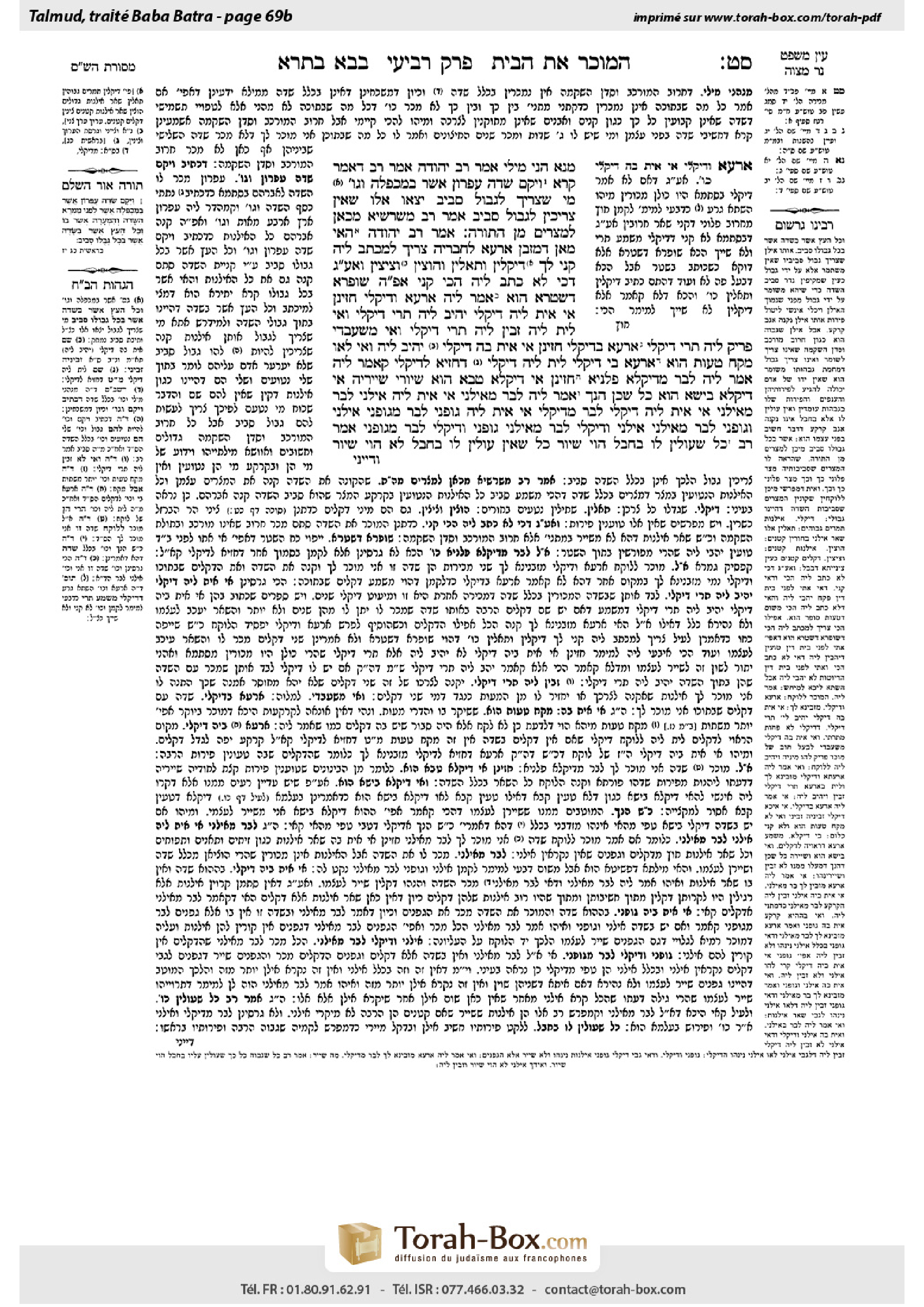
Bava Batra 69b: Talmud study for Daf Yomi
Study the Talmud for Daf Yomi with scanned pages, Hebrew text, English translations from Sefaria and AI-generated French translations.
Passage selection and English or AI-generated French translation are available where the scan has annotations. Daf Study is independent of Torah-Box and Sefaria.
Browse Bava Batra · בבא בתרא · All tractatesBava Batra 69b text and translations
This page of Bava Batra includes the Aramaic text, an English translation and an AI-generated French translation, alongside the scan above.
בבא בתרא ס״ט ב · Aramaic and Hebrew text
מְנָא הָנֵי מִילֵּי? אָמַר רַב יְהוּדָה אָמַר רַב, דְּאָמַר קְרָא: ״וַיָּקׇם שְׂדֵה עֶפְרוֹן אֲשֶׁר בַּמַּכְפֵּלָה וְגוֹ׳״ – מִי שֶׁצָּרִיךְ לִגְבוּל סָבִיב. יָצְאוּ אֵלּוּ, שֶׁאֵין צְרִיכִין לִגְבוּל סָבִיב. אָמַר רַב מְשַׁרְשְׁיָא: מִכָּאן לִמְצָרִים מִן הַתּוֹרָה.
אָמַר רַב יְהוּדָה: הַאי מַאן דִּמְזַבֵּן אַרְעָא לְחַבְרֵיהּ, צָרִיךְ לְמִכְתַּב לֵיהּ: ״קְנִי לָךְ דִּיקְלִין וְתָאלִין וְהוּצִין וְצִיצִין״. וְאַף עַל גַּב דְּכִי לָא כְּתַב לֵיהּ הָכִי – קְנֵי, אֲפִילּוּ הָכִי – שׁוּפְרָא דִשְׁטָרָא הוּא.
אֲמַר לֵיהּ: ״אַרְעָא וְדִיקְלֵי״ – חָזֵינַן; אִי אִית לֵיהּ דִּיקְלֵי – יָהֵיב לֵיהּ תְּרֵי דִיקְלֵי, וְאִי לֵית לֵיהּ – זָבֵין לֵיהּ תְּרֵי דִיקְלֵי, וְאִי מְשַׁעְבְּדִי – פָּרֵיק לֵיהּ תְּרֵי דִיקְלֵי.
״אַרְעָא בְּדִיקְלֵי״ – חָזֵינַן; אִי אִית בַּהּ דִּיקְלֵי – יָהֵיב לֵיהּ, וְאִי לָאו – מִקָּח טָעוּת הוּא. ״אַרְעָא בֵּי דִיקְלֵי״ – לֵית לֵיהּ דִּיקְלֵי, דְּחַזְיָא לְדִיקְלֵי קָאָמַר לֵיהּ. אֲמַר לֵיהּ לְבַר מִדִּיקְלָא פְּלָנְיָא – חָזֵינַן; אִי דִּיקְלָא טָבָא הוּא – שַׁיּוֹרֵי שַׁיְּירֵיהּ, אִי דִּיקְלָא בִּישָׁא הוּא – כׇּל שֶׁכֵּן הָנָךְ.
אֲמַר לֵיהּ לְבַר מֵאִילָנֵי – אִי אִית לֵיהּ אִילָנֵי, לְבַר מֵאִילָנֵי. אִי אִית לֵיהּ דִּיקְלֵי – לְבַר מִדִּיקְלֵי. אִי אִית לֵיהּ גּוּפְנֵי – לְבַר מִגּוּפְנֵי.
אִילָנֵי וְגוּפְנֵי – לְבַר מֵאִילָנֵי. אִילָנֵי וְדִיקְלֵי – לְבַר מֵאִילָנֵי. גּוּפְנֵי וְדִיקְלֵי – לְבַר מִגּוּפְנֵי.
אָמַר רַב: כֹּל שֶׁעוֹלִין לוֹ בְּחֶבֶל – הָוֵי שִׁיּוּר, כֹּל שֶׁאֵין עוֹלִין לוֹ בְּחֶבֶל – לָא הָוֵי שִׁיּוּר.
Bava Batra 69b · English translation
The Gemara asks: From where are these matters, i.e., that a grafted carob and a sycamore trunk are not included in the sale of a field, derived? Rav Yehuda said that Rav said: As the verse states: “So the field of Ephron, which was in Machpelah, which was before Mamre, the field, and the cave that was within it, and all the trees that were in the field, that were in all the boundaries around, were established for Abraham as a possession” (Genesis 23:17–18). This teaches that anything that requires a boundary around it, as it does not have natural demarcations, is included in the sale of a field. This excludes these trees, i.e., the grafted carob and the sycamore trunk, which do not require a boundary around them, as they stand out individually on their own. Rav Mesharshiyya says: From here there is a source that the acquisition of the actual boundaries in a sale is from the Torah.
§ Rabbi Yehuda said: One who sells land to another must write for him the following in the bill of sale: Acquire for yourself the palm trees and the dates and the branches and the seedlings. And even if he did not write this for him the buyer would still acquire all of these entities, as demonstrated by the mishna that it is only a grafted carob and a sycamore trunk that are excluded from the sale of a field. Even so, it is an enhancement of the bill of sale that he write all of the details of the transaction so that there be no possible room for disagreement.
If the seller said to the buyer: I am selling you the land and palm trees, we consider the situation. If he has palm trees, he must give him two palm trees as two is the minimum number of trees that would justify being called: Trees, in the plural. And if he has no palm trees, he must buy two palm trees for him somewhere else. And if he has palm trees, but they are mortgaged to another person, he must redeem two palm trees and give them to the buyer.
If the seller said to the buyer: I am selling you land with palm trees, we consider the situation. If there are palm trees on the land, he must give him the land, and if not, this is a mistaken transaction and the sale is void. If the seller said to the buyer: I am selling you land of palm trees, the buyer has no claim to receive palm trees. Therefore, if the land has no palm trees, this is not a mistaken transaction, as the seller meant to say to him that the land was fit for palm trees, and not that it already contained them. Furthermore, if the seller said to the buyer that he is selling the land except for such and such a palm tree, we consider the situation. If it is a good palm tree, we assume that he retained only that one for himself and did not include it in the sale, but if it is a bad palm tree, we assume that all the more so did he retain for himself the other ones that are of higher quality.
If the seller said to the buyer that he is selling him the entire field except for the trees, we consider the situation. If he has different types of trees in the field, for example, olive and fig trees, he has sold the entire field except for the trees. If he has only palm trees in the field, we assume that he meant to sell the entire field except for the palm trees, even though one does not ordinarily refer to palm trees by the more general term: Trees. Similarly, if he has only grapevines in the field, the buyer acquires everything except for the grapevines.
If the field has both trees and grapevines, he has sold everything except for the trees; therefore, the buyer does not acquire the trees, which the seller excluded from the sale, but he does acquire the grapevines. Similarly, if in the field there are both trees and palm trees, he has sold everything except for the trees. If there are no other trees in the field, but only grapevines and palm trees, everything, including the palm trees, is sold except for the grapevines, which we assume the seller reserved for himself.
Rav says: If the seller specified that he is selling a field but not the trees, any tree that is so tall that one must climb it by rope in order to harvest its fruit is retained and is not included in the sale, and any tree that one need not climb by rope is not retained and is sold along with the field.
Bava Batra 69b · Traduction française (IA)
La Guemara pose la question : D'où sont dérivées ces choses, c'est-à-dire que les caroubes greffés et les troncs de saule ne sont pas inclus dans la vente d'un champ ? Rav Yéhuda a dit que Rav a dit : Comme la Paracha dit : « Ainsi, le champ d'Ephron, qui était dans Machpelah, qui était avant Mamré, le champ, et la caverne qui était en lui, et toutes les arbres qui étaient dans le champ, qui étaient autour de toutes les limites, ont été établis pour Abraham comme possession » (Genèse 23 : 17-18). Cela enseigne que tout ce qui nécessite une limite autour de lui, car il n'a pas de délimitations naturelles, est inclus dans la vente d'un champ. Cela exclut ces arbres, c'est-à-dire les caroubes greffés et les troncs de saule, qui n'ont pas besoin d'une limite autour d'eux, car ils se distinguent individuellement par eux-mêmes. Rav Mesharshiyya dit : D'ici, il y a une source que l'acquisition des limites réelles dans une vente provient de la Torah.
§ Rabbi Yéhuda a dit : Celui qui vend un terrain à un autre doit écrire dans le contrat de vente : Acquière pour toi les palmiers et les figuiers et les branches et les jeunes pousses. Et même s'il n'a pas écrit cela pour lui, l'acheteur acquiert tout de même ces entités, comme le démontre la mitsva qui indique que seul le caroube greffé et le tronc de saule sont exclus de la vente d'un champ. Cependant, il s'agit d'une amélioration du contrat de vente qu'il écrive toutes les détails de la transaction afin qu'il n'y ait pas de place possible à l'interprétation différente.
Si le vendeur dit à l'acheteur : Je te vends le terrain et les palmiers, nous examinons la situation. S'il a des palmiers, il doit lui donner deux palmiers, car deux est le nombre minimum d'arbres qui justifie d'être appelés : Arbres, au pluriel. Et s'il n'a pas de palmiers, il doit acheter deux palmiers pour lui ailleurs. Et s'il a des palmiers, mais qu'ils sont hypothéqués à une autre personne, il doit racheter deux palmiers et les lui donner.
Si le vendeur dit à l'acheteur : Je te vends le terrain avec les palmiers, nous examinons la situation. S'il y a des palmiers sur le terrain, il doit lui donner le terrain, et si non, c'est une transaction erronée et la vente est nulle. Si le vendeur dit à l'acheteur : Je te vends le terrain de palmiers, l'acheteur n'a pas droit de recevoir des palmiers. Par conséquent, si le terrain n'a pas de palmiers, cela n'est pas une transaction erronée, car le vendeur voulait dire à l'acheteur que le terrain était adapté aux palmiers, et non qu'il contenait déjà des palmiers. De plus, si le vendeur dit à l'acheteur qu'il lui vend le terrain sauf tel et tel palmier, nous examinons la situation. Si c'est un bon palmier, nous supposons qu'il a gardé seulement celui-ci pour lui-même et ne l'a pas inclus dans la vente, mais si c'est un mauvais palmier, nous supposons qu'il a encore plus gardé pour lui-même les autres qui sont de meilleure qualité.
Si le vendeur dit à l'acheteur qu'il lui vend tout le champ sauf les arbres, nous examinons la situation. S'il a différents types d'arbres dans le champ, par exemple des oliviers et des figuiers, il a vendu tout le champ sauf les arbres. S'il a seulement des palmiers dans le champ, nous supposons qu'il voulait vendre tout le champ sauf les palmiers, même si on ne désigne généralement pas les palmiers par le terme général : Arbres. De même, si il a seulement des vignes dans le champ, l'acheteur acquiert tout sauf les vignes.
Si le champ comporte à la fois des arbres et des vignes, tout est vendu sauf les arbres ; par conséquent, l'acheteur ne possède pas les arbres que le vendeur a exclusivement exclu de la vente, mais il possède les vignes. De même, si dans le champ il y a à la fois des arbres et des palmiers, tout est vendu sauf les arbres. Si dans le champ il n'y a pas d'autres arbres, mais seulement des vignes et des palmiers, tout, y compris les palmiers, est vendu sauf les vignes, que nous supposons que le vendeur a réservé pour lui-même.
Rav dit : Si le vendeur spécifie qu'il vend un champ mais pas les arbres, tout arbre qui est si haut qu'on doit monter dessus avec une corde pour récolter ses fruits est conservé et n'est pas inclus dans la vente, et tout arbre dont on n'a pas besoin de monter dessus avec une corde n'est pas conservé et est vendu avec le champ.
Traduction française générée par IA à partir de l’édition anglaise de Sefaria. Vérifie toujours un passage avec le texte source.
Text from Sefaria: William Davidson Edition - Vocalized Aramaic (CC BY NC); William Davidson Edition - English (CC BY NC).