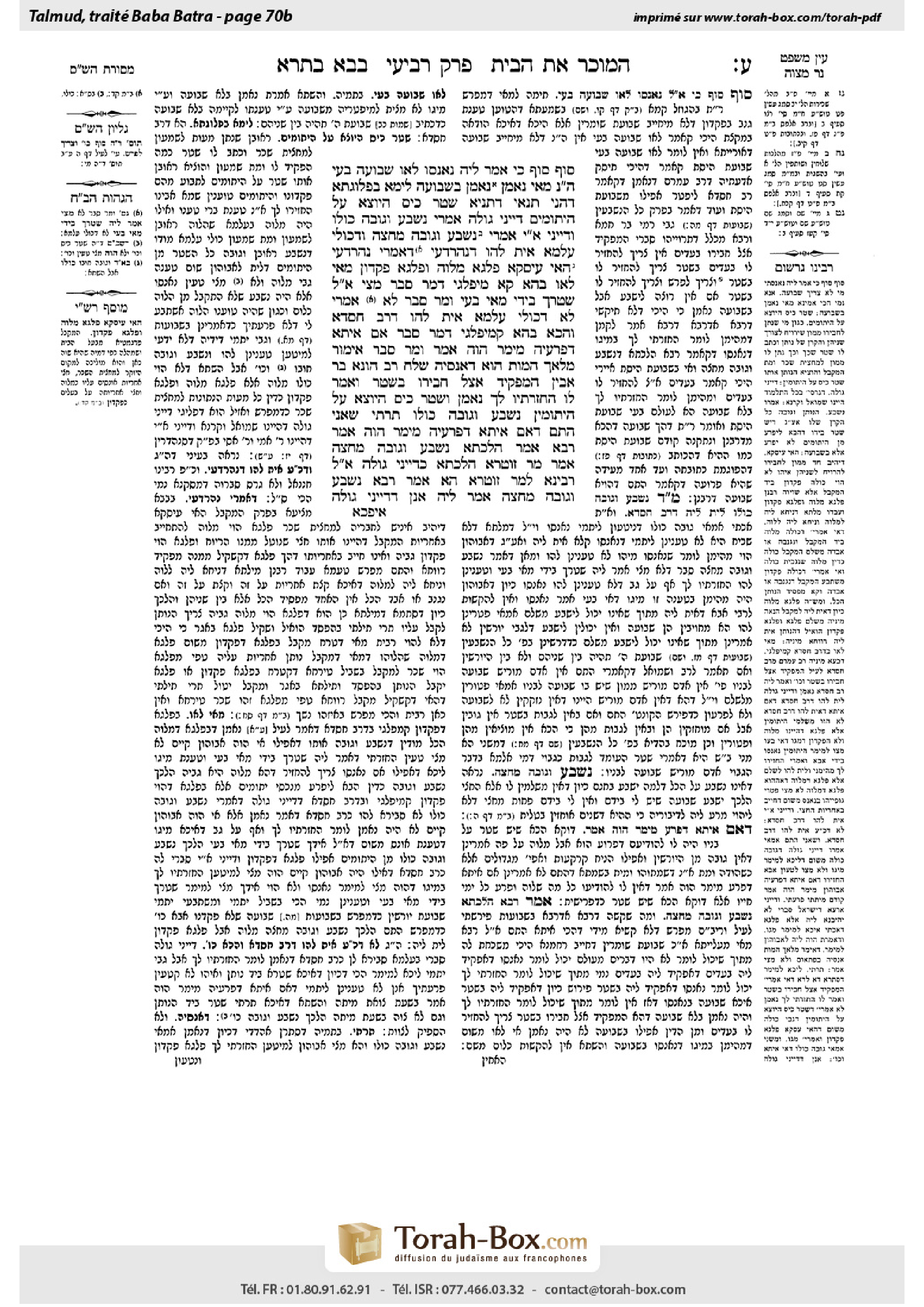
Bava Batra 70b: Talmud study for Daf Yomi
Study the Talmud for Daf Yomi with scanned pages, Hebrew text, English translations from Sefaria and AI-generated French translations.
Passage selection and English or AI-generated French translation are available where the scan has annotations. Daf Study is independent of Torah-Box and Sefaria.
Browse Bava Batra · בבא בתרא · All tractatesBava Batra 70b text and translations
This page of Bava Batra includes the Aramaic text, an English translation and an AI-generated French translation, alongside the scan above.
בבא בתרא ע׳ ב · Aramaic and Hebrew text
סוֹף סוֹף, כִּי אָמַר לֵיהּ ״נֶאֶנְסוּ״, לָאו שְׁבוּעָה בָּעֵי? הָכָא נָמֵי, מַאי ״נֶאֱמָן״ – נֶאֱמָן בִּשְׁבוּעָה.
לֵימָא בִּפְלוּגְתָּא דְּהָנֵי תַּנָּאֵי – דְּתַנְיָא: שְׁטַר כִּיס הַיּוֹצֵא עַל הַיְּתוֹמִים – דַּיָּינֵי גוֹלָה אָמְרִי: נִשְׁבָּע וְגוֹבֶה כּוּלּוֹ. וְדַיָּינֵי אֶרֶץ יִשְׂרָאֵל אָמְרִי: נִשְׁבָּע וְגוֹבֶה מֶחֱצָה.
וּדְכוּלֵּי עָלְמָא אִית לְהוּ דִּנְהַרְדָּעֵי – דְּאָמְרִי נְהַרְדָּעֵי: הַאי עִיסְקָא – פַּלְגָא מִלְוֶה, וּפַלְגָא פִּקָּדוֹן.
מַאי, לָאו בְּהָא קָא מִיפַּלְגִי – דְּמָר סָבַר, מָצֵי אֲמַר לֵיהּ: ״שְׁטָרָךְ בִּידִי מַאי בָּעֵי״; וּמָר סָבַר, לָא אָמְרִי?
לָא; דְּכוּלֵּי עָלְמָא אִית לְהוּ דְּרַב חִסְדָּא; וְהָכָא בְּהָא קָמִיפַּלְגִי – דְּמָר סָבַר: אִם אִיתָא דְּפַרְעֵיהּ, מֵימָר הֲוָה אָמַר. וּמָר סָבַר: אֵימוֹר מַלְאַךְ הַמָּוֶת הוּא דְּאַנְסֵיהּ.
שְׁלַח רַב הוּנָא בַּר אָבִין: הַמַּפְקִיד אֵצֶל חֲבֵירוֹ בִּשְׁטָר, וְאָמַר לוֹ: ״הֶחְזַרְתִּיו לָךְ״ – נֶאֱמָן. וּשְׁטַר כִּיס הַיּוֹצֵא עַל הַיְּתוֹמִין – נִשְׁבָּע וְגוֹבֶה כּוּלּוֹ.
תַּרְתֵּי?! שָׁאנֵי הָתָם, דְּאִם אִיתָא דְּפַרְעֵיהּ – מֵימָר הֲוָה אָמַר.
רָבָא אָמַר: הִלְכְתָא – נִשְׁבָּע וְגוֹבֶה מֶחֱצָה. אָמַר מָר זוּטְרָא: הִלְכְתָא כְּדַיָּינֵי גוֹלָה. אֲמַר לֵיהּ רָבִינָא לְמָר זוּטְרָא, הָא אָמַר רָבָא: נִשְׁבָּע וְגוֹבֶה מֶחֱצָה! אֲמַר לֵיהּ: אֲנַן, דְּדַיָּינֵי גוֹלָה
Bava Batra 70b · English translation
Ultimately, even when the bailee says to the depositor that the items were taken from him under circumstances beyond his control, is he not required to take an oath? How, then, can you assert that he is deemed credible to claim that he returned the items without taking an oath? Rav Ḥisda said to him: Here too, what did I mean when I said that he is deemed credible? It means that he is deemed credible when he takes an oath.
The Gemara suggests: Let us say that Rav Amram and Rav Ḥisda disagree with regard to the issue that is the subject of the dispute between these tanna’im, as a halakha is taught in a baraita with regard to a purse document, i.e., a document that records an arrangement whereby one gives another money as an investment in a joint venture on condition that the profits will be divided equally between the two parties. If the person who received the money died, and this document was presented by the lender against the orphans, the judges of the exile say that the lender takes an oath that the money had never been returned to him, and he collects the entire sum. And the judges of Eretz Yisrael say that he takes an oath and collects only half of the sum.
And it is understood that everyone agrees with the opinion of the Sages of Neharde’a, as the Sages of Neharde’a say: With regard to this joint venture, whereby one person gives money to another on condition that it will be used for business purposes and that the profits will be divided equally between the two parties, half of the invested money is considered a loan, for which the borrower is exclusively liable, and half is considered a deposit, so that if it is lost under circumstances beyond his control, the borrower is exempt from the liability to return it.
According to this assumption, everyone agrees that the claimant can recover from the orphans by means of an oath the half of the money that is considered a loan, just as he would have been able to demand that money from their father. Concerning the half that is considered a deposit, what, is it not with regard to this point that they disagree, as one Sage, the judges of the exile, holds like Rav Amram that the depositor can say to the bailee: What is your document doing in my possession? Therefore, neither the father nor his children are deemed credible to claim that they had returned the half that is considered a deposit, and the investor can collect that half as well. And one Sage, the judges of Eretz Yisrael, holds like Rav Ḥisda, that one cannot assert this claim, and therefore the investor can collect only the half that is considered a loan. But as for the half that is considered a deposit, the father would have been deemed credible in his claim that he had already returned it.
The Gemara rejects this opinion: No, everyone, i.e., both the judges of the exile and the judges of Eretz Yisrael, agrees with the opinion of Rav Ḥisda, that the father can claim that he returned the money. And here, they disagree about the following issue, as one Sage, the judges of the exile, holds that if it is so that he had in fact repaid the money, he would have told his children that he repaid it. Since he did not tell them, it may be assumed that he never repaid the money. And one Sage, the judges of Eretz Yisrael, holds that you can say that it was the Angel of Death that prevented him from doing so, meaning he died before he had the opportunity to give his children a detailed report concerning his financial affairs.
Apropos this discussion, it is related that Rav Huna bar Avin sent the following ruling: If one deposits an item with another and receives a document attesting to the deposit, and the bailee later says to him: I returned the item to you, the bailee is deemed credible even if the document is still in the hands of the depositor. And with regard to a purse document attesting to a joint venture that was presented by the lender to support his claim against the borrower’s orphans, the lender takes an oath that the money had never been returned to him and collects the entire sum from the orphans.
The Gemara asks: Don’t these two halakhot contradict each other? If the father is deemed credible when he claims that he repaid a loan, the court should present this claim on behalf of his orphans. The Gemara answers: It is different there, as if it is so that the father had, in fact, repaid the money, he would have told his children that he repaid it. Since he did not tell them anything about it, it may be assumed that he never repaid the money.
Rava said: With regard to the case of a purse document that was presented to support a claim against orphans, the halakha is that the claimant takes an oath that the money had never been returned to him and then collects half of the sum recorded in the document, in accordance with the judges of Eretz Yisrael. The Gemara relates that two generations later, Mar Zutra said: The halakha is in accordance with the opinion of the judges of the exile. Ravina said to Mar Zutra: Didn’t Rava say that the claimant takes an oath and collects half of the sum? Mar Zutra said to him: With regard to the opinion of the judges of the exile, we
Bava Batra 70b · Traduction française (IA)
Finalement, même lorsque le dépositaire dit au déposant que les objets ont été pris chez lui dans des circonstances hors de son contrôle, n'est-il pas tenu de jurer ? Comment alors pouvez-vous affirmer qu'il est considéré comme crédible pour prétendre avoir rendu les objets sans jurer ? Rav Ḥisda dit à lui : ici aussi, que voulais-je dire lorsque j'ai dit qu'il est considéré comme crédible ? Cela signifie qu'il est considéré comme crédible lorsqu'il jure.
La Guemara suggère : disons que Rav Amram et Rav Ḥisda diffèrent sur l'objet de la dispute entre ces tannaïm, car une halakha est enseignée dans une baraïta concernant un document de sac, c'est-à-dire un document qui enregistre un arrangement selon lequel l'un donne de l'argent à un autre comme investissement dans une entreprise commune, sous condition que les bénéfices soient divisés équitablement entre les deux parties. Si la personne qui a reçu l'argent est décédée et que ce document est présenté par le prêteur contre les orphelins, les juges de l'exil disent que le prêteur jure qu'il n'a jamais récupéré l'argent et récupère l'intégralité de la somme. Les juges d'Israël disent qu'il jure et récupère seulement la moitié de la somme.
Et on comprend que tout le monde s'accorde sur l'opinion des Sages de Neharde’a, car les Sages de Neharde’a disent : concernant ce partenariat, où l'un donne de l'argent à l'autre en condition qu'il sera utilisé pour des affaires et que les bénéfices seront divisés équitablement entre les deux parties, la moitié de l'argent investi est considérée comme un prêt, pour lequel le prêteur est seul responsable, et la moitié est considérée comme un dépôt, de sorte que si elle est perdue dans des circonstances hors de son contrôle, le prêteur est exempt de la responsabilité de la rendre.
Selon cette hypothèse, tout le monde s'accorde sur le fait que le demandeur peut récupérer auprès des orphelins par l'intermédiaire d'un serment la moitié de l'argent considérée comme un prêt, tout comme il aurait pu exiger cette somme auprès de leur père. Concernant la moitié considérée comme un dépôt, que n'est-ce pas justement sur ce point qu'ils diffèrent, car un Sage, les juges de l'exil, suit l'opinion de Rav Amram selon laquelle le déposant peut dire au dépositaire : Qu'est-ce que ce document fait chez moi ? Ainsi, ni le père ni ses enfants ne sont considérés comme crédibles pour affirmer avoir rendu la moitié considérée comme un dépôt, et l'investisseur peut récupérer cette moitié également. Un autre Sage, les juges d'Israël, suit l'opinion de Rav Ḥisda, selon lequel on ne peut pas affirmer cette revendication, et par conséquent l'investisseur peut récupérer seulement la moitié considérée comme un prêt. Mais concernant la moitié considérée comme un dépôt, le père aurait été considéré comme crédible pour affirmer avoir déjà rendu l'argent.
La Guemara rejette cette opinion : non, tout le monde, c'est-à-dire à la fois les juges de l'exil et les juges d'Israël, s'accordent sur l'opinion de Rav Ḥisda, selon laquelle le père peut affirmer avoir rendu l'argent. Et ici, ils diffèrent sur le point suivant, car un Sage, les juges de l'exil, affirme que si c'est vrai qu'il a effectivement remboursé l'argent, il aurait dit à ses enfants qu'il l'avait remboursé. Puisque il n'a pas dit cela, on peut supposer qu'il n'a jamais remboursé l'argent. Un autre Sage, les juges d'Israël, affirme que l'on peut dire que c'est l'Ange de la Mort qui a empêché cela, c'est-à-dire qu'il est mort avant d'avoir eu l'occasion de donner un compte rendu détaillé de ses affaires financières à ses enfants.
À propos de cette discussion, il est rapporté que Rav Huna bar Avin a envoyé le suivant : si l'on dépose un objet chez un autre et reçoit un document attestant du dépôt, et que le dépositaire dit plus tard : j'ai rendu l'objet à vous, le dépositaire est considéré comme crédible même si le document est encore entre les mains du déposant. Et concernant un document de sac attestant d'un partenariat qui a été présenté par le prêteur pour soutenir sa revendication contre les orphelins du débiteur, le prêteur jure qu'il n'a jamais récupéré l'argent et récupère l'intégralité de la somme auprès des orphelins.
La Guemara demande : ne sont-ce pas ces deux halakhot pas contradictoires ? Si le père est considéré comme crédible lorsqu'il affirme avoir remboursé un prêt, le tribunal devrait présenter cette revendication au nom de ses orphelins. La Guemara répond : c'est différent là, car si c'est vrai qu'il a effectivement remboursé l'argent, il aurait dit à ses enfants qu'il l'avait remboursé. Puisque il n'a rien dit à ce sujet, on peut supposer qu'il n'a jamais remboursé l'argent.
Rava dit : concernant le cas d'un document de sac présenté pour soutenir une revendication contre des orphelins, la halakha est que le demandeur jure qu'il n'a jamais récupéré l'argent et récupère ensuite la moitié de la somme indiquée dans le document, conformément à l'opinion des juges d'Israël. La Guemara rapporte que deux générations plus tard, Mar Zutra dit : la halakha suit l'opinion des juges de l'exil. Ravina dit à Mar Zutra : n'as-tu pas dit que le demandeur jure et récupère la moitié ? Mar Zutra dit à lui : concernant l'opinion des juges de l'exil, nous
Traduction française générée par IA à partir de l’édition anglaise de Sefaria. Vérifie toujours un passage avec le texte source.
Text from Sefaria: William Davidson Edition - Vocalized Aramaic (CC BY NC); William Davidson Edition - English (CC BY NC).