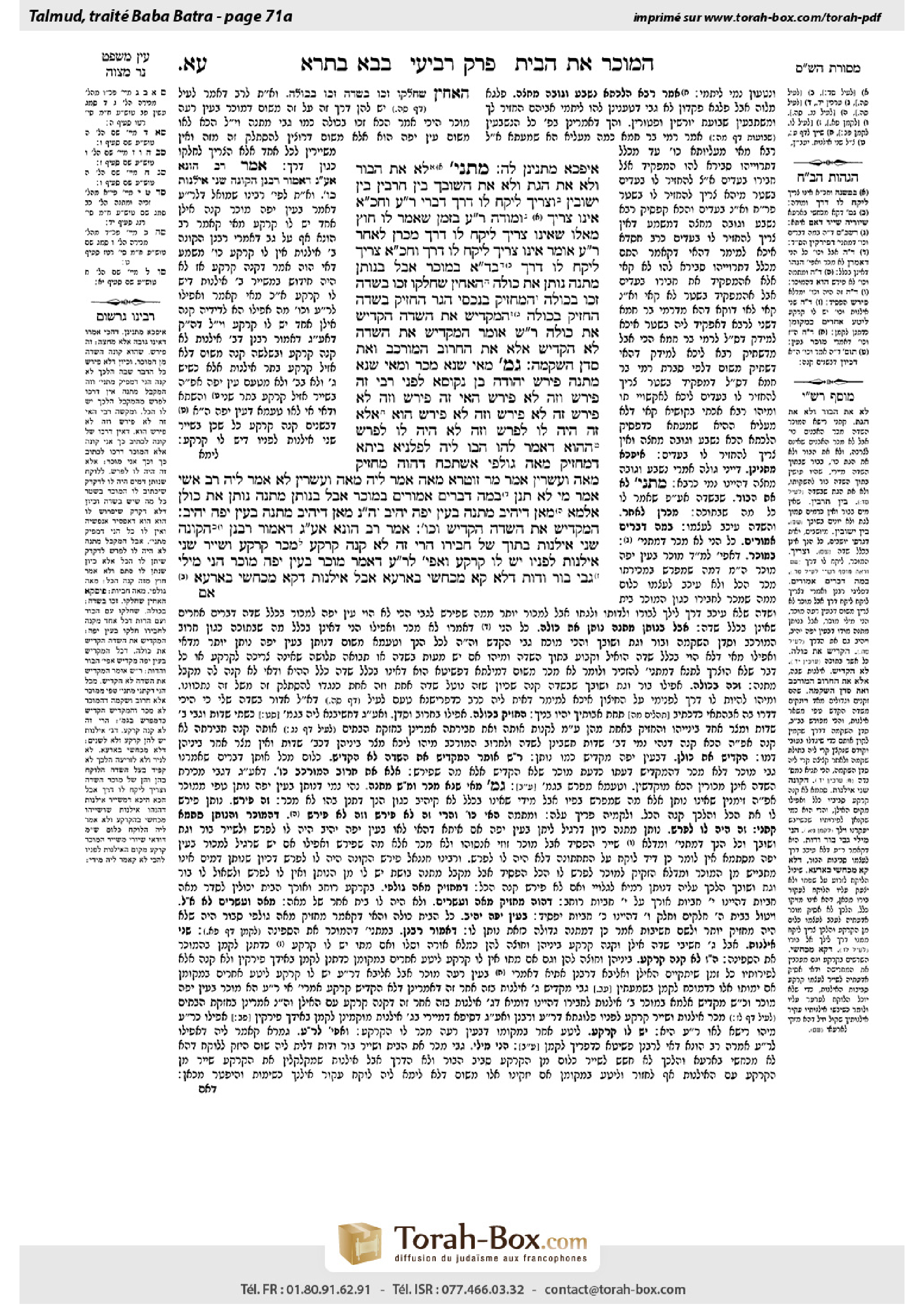
Bava Batra 71a: Talmud study for Daf Yomi
Study the Talmud for Daf Yomi with scanned pages, Hebrew text, English translations from Sefaria and AI-generated French translations.
Passage selection and English or AI-generated French translation are available where the scan has annotations. Daf Study is independent of Torah-Box and Sefaria.
Browse Bava Batra · בבא בתרא · All tractatesBava Batra 71a text and translations
This page of Bava Batra includes the Aramaic text, an English translation and an AI-generated French translation, alongside the scan above.
בבא בתרא ע״א א · Aramaic and Hebrew text
אִיפְּכָא מַתְנִינַן לַהּ.
מַתְנִי׳ לֹא אֶת הַבּוֹר וְלֹא אֶת הַגַּת וְלֹא אֶת הַשּׁוֹבָךְ – בֵּין חֲרֵבִין, בֵּין יְשׁוּבִין. וְצָרִיךְ לִיקַּח לוֹ דֶּרֶךְ, דִּבְרֵי רַבִּי עֲקִיבָא. וַחֲכָמִים אוֹמְרִים: אֵינוֹ צָרִיךְ.
וּמוֹדֶה רַבִּי עֲקִיבָא בִּזְמַן שֶׁאָמַר לוֹ: ״חוּץ מֵאֵלּוּ״, שֶׁאֵינוֹ צָרִיךְ לִיקַּח לוֹ דֶּרֶךְ. מְכָרָן לְאַחֵר – רַבִּי עֲקִיבָא אוֹמֵר: אֵינוֹ צָרִיךְ לִיקַּח לוֹ דֶּרֶךְ, וַחֲכָמִים אוֹמְרִים: צָרִיךְ לִיקַּח לוֹ דֶּרֶךְ.
בַּמֶּה דְּבָרִים אֲמוּרִים – בְּמוֹכֵר, אֲבָל בְּנוֹתֵן מַתָּנָה – נוֹתֵן אֶת כּוּלָּהּ. הָאַחִין שֶׁחָלְקוּ, זָכוּ בַּשָּׂדֶה – זָכוּ בְּכוּלָּהּ. הַמַּחֲזִיק בְּנִכְסֵי הַגֵּר, הֶחְזִיק בַּשָּׂדֶה – הֶחְזִיק בְּכוּלָּהּ.
הַמַּקְדִּישׁ אֶת הַשָּׂדֶה – הִקְדִּישׁ אֶת כּוּלָּהּ. רַבִּי שִׁמְעוֹן אוֹמֵר: הַמַּקְדִּישׁ אֶת הַשָּׂדֶה – לֹא הִקְדִּישׁ אֶלָּא אֶת הֶחָרוּב הַמּוּרְכָּב, וְאֶת סַדַּן הַשִּׁקְמָה.
גְּמָ׳ מַאי שְׁנָא מֶכֶר וּמַאי שְׁנָא מַתָּנָה? פֵּירֵשׁ יְהוּדָה בֶּן נְקוֹסָא לִפְנֵי רַבִּי: זֶה פֵּירֵשׁ וְזֶה לֹא פֵּירֵשׁ.
הַאי ״זֶה פֵּירֵשׁ וְזֶה לֹא פֵּירֵשׁ״?! זֶה לֹא פֵּירֵשׁ וְזֶה לֹא פֵּירֵשׁ הוּא! אֶלָּא זֶה הָיָה לוֹ לְפָרֵשׁ, וְזֶה לֹא הָיָה לוֹ לְפָרֵשׁ.
הַהוּא דַּאֲמַר לְהוּ: ״הַבוּ לֵיהּ לִפְלָנְיָא בֵּיתָא, דְּמַחְזִיק מְאָה גּוּלְפֵי״. אִשְׁתְּכַח דַּהֲוָה מַחְזִיק מְאָה וְעֶשְׂרִין, אָמַר מָר זוּטְרָא: מְאָה אֲמַר לֵיהּ, מְאָה וְעֶשְׂרִין לָא אֲמַר לֵיהּ.
רַב אָשֵׁי אָמַר, מִי לָא תְּנַן: בַּמֶּה דְּבָרִים אֲמוּרִים – בְּמוֹכֵר, אֲבָל בְּנוֹתֵן מַתָּנָה – נוֹתֵן אֶת כּוּלָּן? אַלְמָא מַאן דְּיָהֵיב מַתָּנָה – בְּעַיִן יָפָה יָהֵיב; הָכָא נָמֵי, מַאן דְּיָהֵיב מַתָּנָה – בְּעַיִן יָפָה יָהֵיב.
הַמַּקְדִּישׁ אֶת הַשָּׂדֶה – הִקְדִּישׁ וְכוּ׳. אָמַר רַב הוּנָא, אַף עַל גַּב דַּאֲמוּר רַבָּנַן: הַקּוֹנֶה שְׁנֵי אִילָנוֹת בְּתוֹךְ שֶׁל חֲבֵירוֹ – הֲרֵי זֶה לֹא קָנָה קַרְקַע, מָכַר קַרְקַע וְשִׁיֵּיר שְׁנֵי אִילָנוֹת לְפָנָיו – יֵשׁ לוֹ קַרְקַע. וַאֲפִילּוּ לְרַבִּי עֲקִיבָא, דְּאָמַר: מוֹכֵר בְּעַיִן יָפָה מוֹכֵר – הָנֵי מִילֵּי גַּבֵּי בּוֹר וָדוּת, דְּלָא קָא מַכְחֲשִׁי בְּאַרְעָא; אֲבָל אִילָנוֹת, דְּקָא מַכְחֲשִׁי בְּאַרְעָא –
Bava Batra 71a · English translation
learned the reverse, that is to say, according to our version of the baraita, it is the judges of the exile who maintain that the claimant collects only half the sum, which corresponds to the halakha taught by Rava.
MISHNA: In continuation of the previous mishna (68b) discussing one who sells a field, the mishna teaches that even if he says that he is selling it and everything that is in it, has sold neither the cistern, nor the winepress, nor the dovecote, whether it is abandoned or utilized, as these items are not part of the field itself. And the seller must purchase for himself a path through the buyer’s domain to reach whatever remains his. This is the statement of Rabbi Akiva, who holds that one who sells, sells generously; therefore, whatever is not explicitly excluded from the sale is assumed to be sold, and it is presumed that the seller did not retain for himself the right to the path that he requires to access his property. And the Rabbis say: The seller need not purchase a path through the buyer’s domain, as it is assumed that since the seller withholds these items for himself, he also reserves a path to reach them.
And Rabbi Akiva concedes that when the seller says to the buyer in the bill of sale that he is selling the field apart from these things, i.e., the cistern and the winepress, he need not purchase for himself a path through the buyer’s domain. Since these items would have been excluded from the sale even if he had said nothing, it is assumed that he also meant to reserve for himself the right to access them. But if the seller kept the field but sold the cistern and winepress to another person, Rabbi Akiva says: The buyer need not purchase for himself a path through the seller’s domain to reach what he has bought, since a seller sells generously. But the Rabbis say: He must purchase for himself a path through the seller’s domain.
In what case is this statement, that these items are excluded, said? It is said with regard to one who sells a field, but with regard to one who gives it away as a gift, it is assumed that he gives all of it, including everything found in the field. Similarly, with regard to brothers who divide their father’s estate among themselves, when they each acquire a field as part of their inheritance, they acquire all of it, including the items that would be excluded from a sale. So too, with regard to one who takes possession of the property of a convert, when he takes possession of a field, he takes possession of all of it.
One who consecrates a field has consecrated all of it. Rabbi Shimon says: One who consecrates a field has not consecrated any of the items that are ordinarily excluded from a sale except for the grafted carob tree and the sycamore trunk.
GEMARA: The Gemara asks: In what way is a sale different from a gift, and in what way is a gift different from a sale? Why does the mishna distinguish between the two with regard to what is retained by the prior owner? Yehuda ben Nekosa explained before Rabbi Yehuda HaNasi: The difference between the cases is that this one, the seller, specified that certain items were not included in the sale, and that one, the donor, did not specify.
The Gemara asks: How can it be suggested that this one specified and that one did not specify, when in fact this one did not specify, and that one did not specify, as in neither case did the prior owner specify what items he was reserving for himself? Rather, the difference is that this one, the buyer, should have specified that those items that are not integral parts of the field are nevertheless included in the sale, and since he neglected to do so, he suffers the loss. But in the case of a gift, that one, the recipient, should not have specified what was included in the gift, as it would have been inappropriate for him to act in this manner.
It is related that there was a certain person who said to others: Give to so-and-so my house containing 100 barrels [gulfei] as a gift. It was found that there was a house in his possession that contained 120 barrels. Mar Zutra said: The owner said to him that he was giving him a house containing 100 barrels, and he did not say to him that he was giving him a house containing 120 barrels. Therefore, the recipient receives only the portion of the house that holds 100 barrels, and not the rest of the house.
Rav Ashi said: Didn’t we learn in the mishna here: In what case is this statement said? It is said with regard to one who sells a field, but with regard to one who gives it away as a gift, it is assumed that he gives all of it. Apparently, one who gives a gift gives generously. Here too, then, say that one who gives a gift gives generously, even if he is not always precise in his wording. Therefore, it should be assumed that the donor intended to give the recipient the entire house, which contains more than 100 barrels.
§ The mishna teaches: One who consecrates a field, has consecrated all of it. Rav Huna said: Even though the Rabbis said: If one buys two trees in the field of another, he does not acquire any of the land but acquires only the trees, and if he sells land to another, and he retains two trees for himself, he also retains the land around those trees, that does not always apply. Rav Huna elaborates: And even according to Rabbi Akiva, who says that one who sells, sells generously and does not retain anything for himself, this does not always apply, as this statement applies only with regard to a pit and a cistern, which do not weaken the land, and therefore the seller feels no need to protect himself from the potential claims of the buyer. But with regard to trees, which do weaken the land, as they draw water and nutrients from the soil,
Bava Batra 71a · Traduction française (IA)
on a appris l'inverse, c'est-à-dire, selon notre version de la baraïta, ce sont les juges de l'exil qui affirment que le demandeur récupère seulement la moitié de la somme, ce qui correspond à la halakha enseignée par Rava.
MICHNA : En continuation de la précédente mishna (68b) discutant celui qui vend un champ, la mishna enseigne que même s'il dit qu'il vend le champ et tout ce qui est en lui, il n'a pas vendu le puits, la vigne, ni le colombier, qu'importe s'ils sont abandonnés ou utilisés, car ces objets ne font pas partie du champ lui-même. Et le vendeur doit acheter pour lui-même un chemin à travers le domaine de l'acheteur pour accéder à ce qui lui reste. C'est la déclaration de Rabbi Akiva, qui considère que celui qui vend vend généreusement ; donc, tout ce qui n'est pas explicitement exclu de la vente est supposé être vendu, et on suppose que le vendeur n'a pas réservé pour lui-même le droit d'accès au chemin nécessaire pour atteindre sa propriété. Et les Rabbins disent : Le vendeur n'a pas besoin d'acheter un chemin à travers le domaine de l'acheteur, car on suppose que puisque le vendeur conserve ces objets pour lui-même, il réserve aussi un chemin pour y accéder.
Et Rabbi Akiva reconnaît que lorsque le vendeur dit à l'acheteur dans le contrat de vente qu'il vend le champ à l'exception de ces objets, c'est-à-dire le puits et la vigne, il n'a pas besoin d'acheter pour lui-même un chemin à travers le domaine de l'acheteur. Puisque ces objets auraient été exclus de la vente même s'il n'avait dit rien, on suppose qu'il a aussi voulu réservé pour lui-même le droit d'accéder à ces objets. Mais si le vendeur conserve le champ mais vend le puits et la vigne à une autre personne, Rabbi Akiva dit : L'acheteur n'a pas besoin d'acheter pour lui-même un chemin à travers le domaine du vendeur pour accéder à ce qu'il a acheté, puisque le vendeur vend généreusement. Mais les Rabbins disent : Il doit acheter pour lui-même un chemin à travers le domaine du vendeur.
Dans quel cas cette déclaration, que ces objets sont exclus, est-elle dite ? Elle est dite concernant celui qui vend un champ, mais concernant celui qui le donne en cadeau, on suppose qu'il donne tout, y compris tout ce qui est dans le champ. De même, concernant des frères qui divisent la propriété de leur père entre eux, lorsqu'ils acquièrent chacun un champ comme héritage, ils acquièrent tout, y compris les objets qui seraient exclus d'une vente. De même, concernant celui qui prend possession de la propriété d'un converti, lorsqu'il prend possession d'un champ, il prend possession de tout.
Celui qui consacre un champ a consacré tout. Rabbi Shimon dit : Celui qui consacre un champ n'a pas consacré aucun des objets qui sont habituellement exclus d'une vente, sauf le carobier greffé et le tronc de sycomore.
GUEMARA : La Guemara pose la question : De quelle manière la vente diffère-t-elle du don, et de quelle manière le don diffère-t-il de la vente ? Pourquoi la mishna distingue-t-elle entre les deux concernant ce qui est conservé par l'ancien propriétaire ? Yehuda ben Nekosa a expliqué devant Rabbi Yehuda HaNasi : La différence entre les cas réside dans le fait que celui-ci, le vendeur, a spécifié que certains objets n'étaient pas inclus dans la vente, et que celui-là, le donateur, n'a pas spécifié.
La Guemara pose la question : Comment peut-on suggérer que celui-ci a spécifié et que celui-là n'a pas spécifié, alors que, en réalité, celui-ci n'a pas spécifié et celui-là n'a pas spécifié, car dans aucun cas l'ancien propriétaire n'a spécifié ce qu'il conservait pour lui-même ? Plutôt, la différence réside dans le fait que celui-ci, l'acheteur, aurait dû spécifier que ces objets, qui ne font pas partie intégrante du champ, sont toutefois inclus dans la vente, et puisque l'acheteur n'a pas fait cela, il subit la perte. Mais dans le cas d'un don, celui-là, le receveur, ne devrait pas avoir spécifié ce qui était inclus dans le don, car cela aurait été inapproprié de sa part d'agir ainsi.
Il est rapporté que certains disaient à un autre : Donnez à tel que-ci ma maison contenant 100 barils [gulfei] en cadeau. On découvrit qu'il y avait une maison en son possession contenant 120 barils. Mar Zutra dit : Le propriétaire dit à lui qu'il lui donnait une maison contenant 100 barils, et il n'a pas dit qu'il lui donnait une maison contenant 120 barils. Donc, le receveur reçoit seulement la partie de la maison contenant 100 barils, et non la reste de la maison.
Rav Ashi dit : N'avons-nous pas appris dans la mishna ici : Dans quel cas cette déclaration est-elle dite ? Elle est dite concernant celui qui vend un champ, mais concernant celui qui le donne en cadeau, on suppose qu'il donne tout. Apparemment, celui qui donne un cadeau donne généreusement. Ici aussi, donc, disons que celui qui donne un cadeau donne généreusement, même s'il n'est pas toujours précis dans ses paroles. Donc, il devrait être supposé que le donateur avait l'intention de donner à l'acheteur toute la maison, qui contient plus de 100 barils.
§ La Michna enseigne : Celui qui consacre un champ a consacré tout. Rav Huna dit : Même si les Rabbins dirent : Si l'on achète deux arbres dans le champ d'un autre, on n'acquiert aucun de la terre mais seulement les arbres, et si l'on vend la terre à un autre et qu'on conserve deux arbres pour soi, on conserve aussi la terre autour de ces arbres, cela ne s'applique pas toujours. Rav Huna développe : Et même selon Rabbi Akiva, qui dit que celui qui vend vend généreusement et ne conserve rien pour lui-même, cela ne s'applique pas toujours, car cette déclaration s'applique seulement concernant un puits et un cisternes, qui ne affaiblissent pas la terre, et donc le vendeur ne se sent pas la nécessité de se protéger contre les éventuelles revendications du acheteur. Mais concernant les arbres, qui affaiblissent la terre, car ils tirent l'eau et les nutriments du sol,
Traduction française générée par IA à partir de l’édition anglaise de Sefaria. Vérifie toujours un passage avec le texte source.
Text from Sefaria: William Davidson Edition - Vocalized Aramaic (CC BY NC); William Davidson Edition - English (CC BY NC).