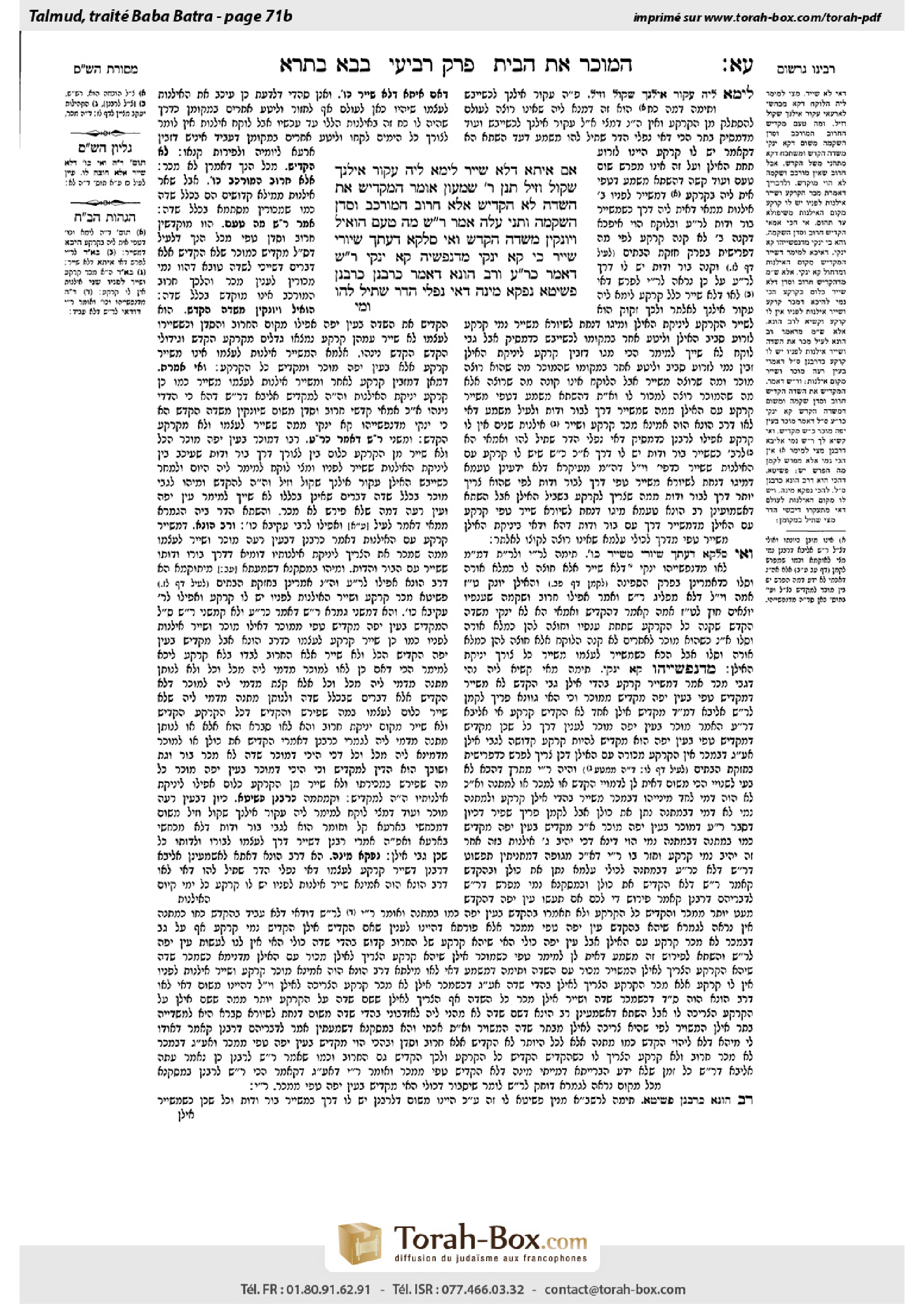
Bava Batra 71b: Talmud study for Daf Yomi
Study the Talmud for Daf Yomi with scanned pages, Hebrew text, English translations from Sefaria and AI-generated French translations.
Passage selection and English or AI-generated French translation are available where the scan has annotations. Daf Study is independent of Torah-Box and Sefaria.
Browse Bava Batra · בבא בתרא · All tractatesBava Batra 71b text and translations
This page of Bava Batra includes the Aramaic text, an English translation and an AI-generated French translation, alongside the scan above.
בבא בתרא ע״א ב · Aramaic and Hebrew text
אִם אִיתָא דְּלָא שַׁיַּיר, לֵימָא לֵיהּ: ״עֲקוֹר אִילָנָךְ, שְׁקוֹל וְזִיל״.
תְּנַן, רַבִּי שִׁמְעוֹן אוֹמֵר: הַמַּקְדִּישׁ אֶת הַשָּׂדֶה – לֹא הִקְדִּישׁ אֶלָּא חָרוּב הַמּוּרְכָּב, וְסַדַּן הַשִּׁקְמָה. וְתָנֵי עֲלַהּ: ״אָמַר רַבִּי שִׁמְעוֹן: מָה טַעַם? הוֹאִיל וְיוֹנְקִין מִשְּׂדֵה הֶקְדֵּשׁ״.
וְאִי סָלְקָא דַּעְתָּךְ שַׁיּוֹרֵי שַׁיַּיר, כִּי קָא יָנְקִי – מִדְּנַפְשֵׁיהּ קָא יָנְקִי!
רַבִּי שִׁמְעוֹן דְּאָמַר – כְּרַבִּי עֲקִיבָא. וְרַב הוּנָא דְּאָמַר – כְּרַבָּנַן.
כְּרַבָּנַן?! פְּשִׁיטָא! נָפְקָא מִינַּהּ – דְּאִי נָפְלִי, הָדַר שָׁתֵיל לְהוּ.
Bava Batra 71b · English translation
if it is so that the prior owner did not retain some of the land for himself, let the buyer say to him: Uproot your trees, take them, and go, as the trees draw water and nutrients from the soil, causing damage to the buyer’s land. Therefore, the seller must have retained for himself the land needed for these trees.
The Gemara raises an objection: We learned in the mishna here that Rabbi Shimon says: One who consecrates a field has not consecrated any of the items that are ordinarily excluded from a sale except for the grafted carob tree and the sycamore trunk. And it is taught with regard to this in a baraita: Rabbi Shimon said: What is the reason that it is specifically the carob tree and the sycamore trunk that are consecrated? Since they draw their nutrients from a consecrated field, the owner must have had in mind to consecrate them as well, as otherwise his trees would be nurtured from consecrated property.
And if it enters your mind, as Rav Huna claims, that when the seller retains certain trees for himself, he also retains the land around them so that they will be nurtured from soil that belongs to him, what is the reason for Rabbi Shimon’s ruling? When these trees draw their nutrients, they draw their nutrients from the ground that the consecrator had retained for himself that still belongs to him, not from consecrated property.
The Gemara answers: The assumption that Rav Huna’s statement is true according to everyone must be reconsidered. Rather, Rabbi Shimon, who says that one who consecrates his field does not retain for himself the land around the trees, holds in accordance with the opinion of his teacher, Rabbi Akiva. According to Rabbi Akiva, one who sells, sells generously, and there is no presumption that he retained some item or right for himself unless this was stated explicitly. Therefore, Rabbi Shimon rules that one who consecrates his field has also consecrated the carob trees, as otherwise they would draw nutrients from consecrated land. And Rav Huna, who says that when a seller retains trees for himself he also retains the land around them, holds in accordance with the opinion of the Rabbis, who say that one who sells, sells sparingly.
The Gemara asks: If Rav Huna’s statement is only in accordance with the opinion of the Rabbis, then isn’t his statement obvious? What novel idea is he adding? The Gemara answers: The practical difference is that while one might have thought that the prior owner retains a right to the land only for the sake of trees that were there, this is not the case. Rather, he retains absolute ownership of the land, and therefore, if the trees fall or die he can plant them again.
Bava Batra 71b · Traduction française (IA)
Si c'est ainsi que l'ancien propriétaire n'a pas réservé une partie du terrain pour lui-même, que l'acheteur dise à lui : Démontez vos arbres, emportez-les et partez, car les arbres puisent de l'eau et des nutriments du sol, causant un préjudice au terrain de l'acheteur. Ainsi, le vendeur doit avoir réservé pour lui-même le terrain nécessaire à ces arbres.
La Guemara soulève une objection : Nous avons appris dans la Michna ici que Rabbi Shimon dit : Celui qui consacre un champ n'a pas consacré aucun des objets habituellement exclus d'une vente, sauf le carob greffé et le tronc de saule. Et cela est enseigné dans une baraïta : Rabbi Shimon dit : Pourquoi est-ce précisément le carob et le tronc de saule qui sont consacrés ? Parce qu'ils puisent leurs nutriments d'un champ consacré, l'owner aurait dû avoir l'intention de les consacrer également, sinon ses arbres seraient nourris à partir d'une propriété consacrée.
Et si cela entre dans votre pensée, comme Rav Huna affirme, que lorsque le vendeur conserve certains arbres pour lui-même, il conserve aussi le terrain autour d'eux afin qu'ils soient nourris par un sol qui lui appartient, quelle est la raison du jugement de Rabbi Shimon ? Lorsque ces arbres puisent leurs nutriments, ils le font à partir du sol que le consacrant avait réservé pour lui-même, qui lui appartient encore, et non à partir d'une propriété consacrée.
La Guemara répond : L'hypothèse selon laquelle l'affirmation de Rav Huna est vraie selon tout le monde doit être réexaminée. Plutôt, Rabbi Shimon, qui dit que celui qui consacre son champ ne réserve pas pour lui-même le terrain autour des arbres, suit l'opinion de son maître, Rabbi Akiva. Selon Rabbi Akiva, celui qui vend vend généreusement, et il n'y a pas de présomption qu'il ait réservé quelque chose ou un droit pour lui-même à moins que cela ne soit explicitement mentionné. Ainsi, Rabbi Shimon déclare que celui qui consacre son champ a aussi consacré les carobs, autrement ils tireraient leurs nutriments d'un terrain consacré. Et Rav Huna, qui dit que lorsque le vendeur conserve des arbres pour lui-même il conserve aussi le terrain autour d'eux, suit l'opinion des Sages, qui disent que celui qui vend vend parcimonieusement.
La Guemara pose la question : Si l'affirmation de Rav Huna est uniquement selon l'opinion des Sages, n'est-ce pas évident ? Quelle idée nouvelle ajoute-t-il ? La Guemara répond : La différence pratique est que bien qu'on puisse penser que l'ancien propriétaire conserve un droit sur le terrain uniquement pour les arbres qui y étaient, ce n'est pas le cas. Plutôt, il conserve une propriété absolue sur le terrain, et donc, si les arbres tombent ou meurent, il peut les replanter à nouveau.
Traduction française générée par IA à partir de l’édition anglaise de Sefaria. Vérifie toujours un passage avec le texte source.
Text from Sefaria: William Davidson Edition - Vocalized Aramaic (CC BY NC); William Davidson Edition - English (CC BY NC).