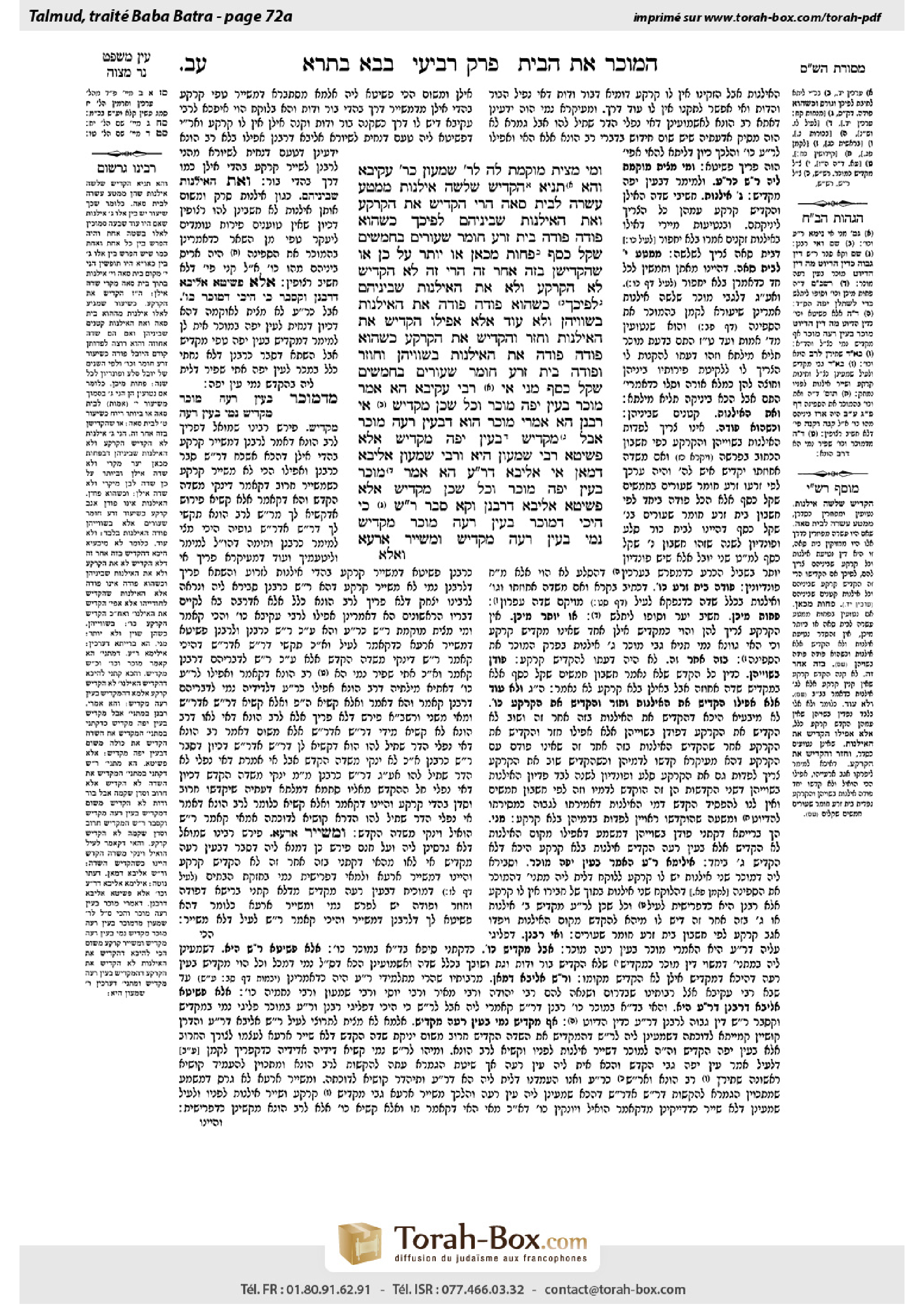
Bava Batra 72a: Talmud study for Daf Yomi
Study the Talmud for Daf Yomi with scanned pages, Hebrew text, English translations from Sefaria and AI-generated French translations.
Passage selection and English or AI-generated French translation are available where the scan has annotations. Daf Study is independent of Torah-Box and Sefaria.
Browse Bava Batra · בבא בתרא · All tractatesBava Batra 72a text and translations
This page of Bava Batra includes the Aramaic text, an English translation and an AI-generated French translation, alongside the scan above.
בבא בתרא ע״ב א · Aramaic and Hebrew text
וּמִי מָצֵית מוֹקְמַתְּ לַהּ לְרַבִּי שִׁמְעוֹן כְּרַבִּי עֲקִיבָא? וְהָא תַּנְיָא: הִקְדִּישׁ שְׁלֹשָׁה אִילָנוֹת מִמַּטַּע עֲשָׂרָה לְבֵית סְאָה – הֲרֵי הִקְדִּישׁ אֶת הַקַּרְקַע וְאֶת הָאִילָנוֹת שֶׁבֵּינֵיהֶם; לְפִיכָךְ כְּשֶׁהוּא פּוֹדֶה – פּוֹדֶה בֵּית זֶרַע חוֹמֶר שְׂעוֹרִים, בַּחֲמִשִּׁים שֶׁקֶל כָּסֶף.
פָּחוֹת מִכָּאן אוֹ יוֹתֵר עַל כֵּן, אוֹ שֶׁהִקְדִּישָׁן בָּזֶה אַחַר זֶה – הֲרֵי זֶה לֹא הִקְדִּישׁ לֹא הַקַּרְקַע, וְלֹא אֶת הָאִילָנוֹת שֶׁבֵּינֵיהֶם. לְפִיכָךְ, כְּשֶׁהוּא פּוֹדֶה – פּוֹדֶה אֶת הָאִילָנוֹת בְּשׇׁוְויֵהֶן. וְלֹא עוֹד, אֶלָּא אֲפִילּוּ הִקְדִּישׁ אֶת הָאִילָנוֹת, וְחָזַר וְהִקְדִּישׁ אֶת הַקַּרְקַע; כְּשֶׁהוּא פּוֹדֶה – פּוֹדֶה אֶת הָאִילָנוֹת בְּשׇׁוְויֵהֶן, וְחוֹזֵר וּפוֹדֶה בֵּית זֶרַע חוֹמֶר שְׂעוֹרִים בַּחֲמִשִּׁים שֶׁקֶל כָּסֶף.
מַנִּי? אִי רַבִּי עֲקִיבָא, הָא אָמַר: מוֹכֵר בְּעַיִן יָפָה מוֹכֵר; וְכׇל שֶׁכֵּן מַקְדִּישׁ! אִי רַבָּנַן, הָא אָמְרִי: מוֹכֵר הוּא דִּבְעַיִן רָעָה מוֹכֵר, אֲבָל מַקְדִּישׁ – בְּעַיִן יָפָה מַקְדִּישׁ! אֶלָּא פְּשִׁיטָא רַבִּי שִׁמְעוֹן הִיא,
וְרַבִּי שִׁמְעוֹן – אַלִּיבָּא דְמַאן? אִי אַלִּיבָּא דְרַבִּי עֲקִיבָא, הָא אָמַר: מוֹכֵר בְּעַיִן יָפָה מוֹכֵר; וְכׇל שֶׁכֵּן מַקְדִּישׁ! אֶלָּא פְּשִׁיטָא אַלִּיבָּא דְרַבָּנַן, וְקָא סָבַר רַבִּי שִׁמְעוֹן: כִּי הֵיכִי דְּמוֹכֵר בְּעַיִן רָעָה מוֹכֵר, מַקְדִּישׁ נָמֵי בְּעַיִן רָעָה מַקְדִּישׁ – וּמְשַׁיַּיר אַרְעָא.
Bava Batra 72a · English translation
The Gemara asks: But can you establish that the opinion of Rabbi Shimon is in accordance with the opinion of Rabbi Akiva, that one who sells or consecrates property does so generously? But isn’t it taught in a baraita: If one consecrates three trees in a field where ten trees are planted in an area required for sowing one se’a of seed [beit se’a], he has consecrated not only those trees, but also the land and the young trees between them? Therefore, if this is an ancestral field of his, when he redeems them, he redeems the land and everything contained within it according to the standard rate established by the Torah, whereby an area fit for the sowing of a ḥomer, i.e., a kor, of barley seed is redeemed for fifty silver shekels.
The baraita continues: If the ratio of land to trees was less than this, and the trees were planted more densely, or if the ratio of land to trees was more than this, and the trees were planted less densely, or if he consecrated each of the trees separately, one after the other, this person has consecrated neither the land nor the young trees between them. Therefore, when he redeems them, he redeems the trees in accordance with their worth. And moreover, even if one consecrates the trees where they are planted more densely, less densely, or one after the other, and then afterward he consecrates the land, so that everything belongs to the Temple treasury, when he redeems them, he redeems the trees separately in accordance with their worth, and then he redeems the land according to the standard rate, where an area fit for the sowing of a ḥomer of barley seed is redeemed for fifty silver shekels.
The Gemara clarifies: Whose opinion is expressed in the baraita? If it is the opinion of Rabbi Akiva, doesn’t he say that one who sells, sells generously, and all the more so one who consecrates does so generously? This being the case, even if the trees were consecrated one after the other, some of the land should be consecrated along with them. And if the baraita reflects the opinion of the Rabbis, don’t they say in the mishna that it is specifically the seller who sells sparingly, but one who consecrates, consecrates generously, and therefore the pit and the winepress are consecrated along with the field? Therefore, the halakha stated here is not in accordance with their opinion either. Rather, it is obvious that the baraita is in accordance with the opinion of Rabbi Shimon in the mishna here, that even one who consecrates a field does not consecrate the cistern and the winepress along with it.
And the opinion of Rabbi Shimon is in accordance with the opinion of whom? If it is in accordance with the opinion of Rabbi Akiva, doesn’t he say that one who sells, sells generously, and all the more so one who consecrates does so generously? Rather, it is obvious that his opinion is in accordance with the opinion of the Rabbis, who disagree with Rabbi Akiva and say that one who sells, sells sparingly. And Rabbi Shimon disagrees with the Rabbis insofar as he himself holds that just as one who sells, sells sparingly, one who consecrates also consecrates sparingly and retains the land around the trees for himself.
Bava Batra 72a · Traduction française (IA)
Le Guemara pose la question : Mais peut-on établir que l'opinion de Rabbi Shimon est en accord avec celle de Rabbi Akiva, selon laquelle celui qui vend ou consacre une propriété le fait généreusement ? Mais n'est-il pas enseigné dans une baraïta : Si l'on consacre trois arbres dans un champ où dix arbres sont plantés dans une surface nécessaire pour semer un se'a de grain [beit se'a], il a consacré non seulement ces arbres, mais aussi la terre et les jeunes arbres entre eux ? Ainsi, si c'est un champ ancestral de sa part, lorsqu'il le rachète, il rachète la terre et tout ce qui est contenu dedans selon le taux standard établi par la Torah, selon lequel une surface adaptée à la semence d'un ḥomer, c'est-à-dire d'un kor, de grain de blé est rachetée pour cinquante sicles d'argent.
La baraïta continue : Si le rapport entre la terre et les arbres était inférieur à cela, et que les arbres étaient plantés plus denses, ou si le rapport entre la terre et les arbres était supérieur à cela, et que les arbres étaient plantés moins denses, ou si l'on consacrait chaque arbre séparément, l'un après l'autre, cette personne n'a consacré ni la terre ni les jeunes arbres entre eux. Ainsi, lorsqu'il les rachète, il rachète les arbres selon leur valeur. Et de plus, même si l'on consacre les arbres où ils sont plantés plus denses, moins denses, ou l'un après l'autre, et ensuite l'on consacre la terre, de sorte que tout appartienne au trésor du Temple, lorsqu'il les rachète, il rachète les arbres séparément selon leur valeur, et ensuite il rachète la terre selon le taux standard, où une surface adaptée à la semence d'un ḥomer de grain de blé est rachetée pour cinquante sicles d'argent.
Le Guemara clarifie : De quelle opinion s'agit-il dans la baraïta ? Si c'est l'opinion de Rabbi Akiva, n'a-t-il pas dit que celui qui vend, vend généreusement, et encore plus celui qui consacre le fait généreusement ? Dans ce cas, même si les arbres étaient consacrés l'un après l'autre, une partie de la terre devrait être consacrée avec eux. Et si la baraïta reflète l'opinion des Rabbins, n'ont-ils pas dit dans la mitsna que c'est spécifiquement celui qui vend qui vend parcimonieusement, mais celui qui consacre, consacre généreusement, et par conséquent le puits et la vigne sont consacrés avec le champ ? Ainsi, la halakha évoquée ici ne correspond pas à leur opinion non plus. Il est évident que la baraïta correspond à l'opinion de Rabbi Shimon dans la mitsna ici, selon laquelle même celui qui consacre un champ ne consacre pas le puits et la vigne avec lui.
Et l'opinion de Rabbi Shimon correspond-elle à celle de qui ? Si elle correspond à celle de Rabbi Akiva, n'a-t-il pas dit que celui qui vend, vend généreusement, et encore plus celui qui consacre le fait généreusement ? Il est évident que son opinion correspond à celle des Rabbins, qui s'opposent à Rabbi Akiva et disent que celui qui vend, vend parcimonieusement. Et Rabbi Shimon s'oppose aux Rabbins en ce sens qu'il considère que celui qui vend, vend parcimonieusement, et celui qui consacre aussi consacre parcimonieusement et conserve la terre autour des arbres pour lui-même.
Traduction française générée par IA à partir de l’édition anglaise de Sefaria. Vérifie toujours un passage avec le texte source.
Text from Sefaria: William Davidson Edition - Vocalized Aramaic (CC BY NC); William Davidson Edition - English (CC BY NC).