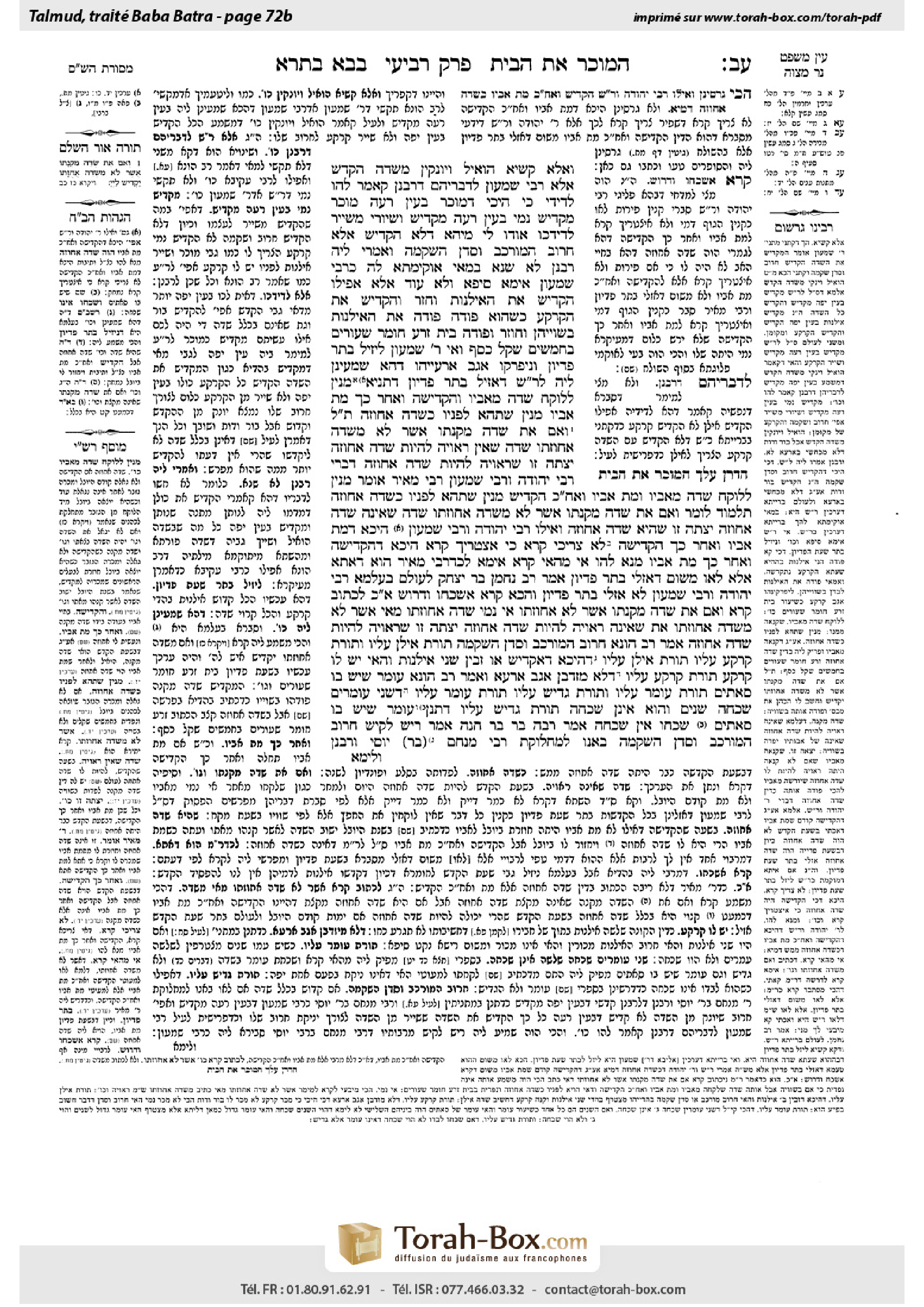
Bava Batra 72b: Talmud study for Daf Yomi
Study the Talmud for Daf Yomi with scanned pages, Hebrew text, English translations from Sefaria and AI-generated French translations.
Passage selection and English or AI-generated French translation are available where the scan has annotations. Daf Study is independent of Torah-Box and Sefaria.
Browse Bava Batra · בבא בתרא · All tractatesBava Batra 72b text and translations
This page of Bava Batra includes the Aramaic text, an English translation and an AI-generated French translation, alongside the scan above.
בבא בתרא ע״ב ב · Aramaic and Hebrew text
וְאֶלָּא קַשְׁיָא ״הוֹאִיל וְיוֹנְקִין מִשְּׂדֵה הֶקְדֵּשׁ״!
אֶלָּא רַבִּי שִׁמְעוֹן – לְדִבְרֵיהֶם דְּרַבָּנַן קָאָמַר לְהוּ: לְדִידִי, כִּי הֵיכִי דְּמוֹכֵר בְּעַיִן רָעָה מוֹכֵר, מַקְדִּישׁ נָמֵי בְּעַיִן רָעָה מַקְדִּישׁ – וְשַׁיּוֹרֵי מְשַׁיַּיר; לְדִידְכוּ, אוֹדוּ לִי מִיהָא דְּלֹא הִקְדִּישׁ אֶלָּא חָרוּב הַמּוּרְכָּב וְסַדַּן הַשִּׁקְמָה! וְאָמְרִי לֵיהּ רַבָּנַן: לָא שְׁנָא.
בְּמַאי אוֹקֵימְתָּא לַהּ – כְּרַבִּי שִׁמְעוֹן? אֵימָא סֵיפָא: וְלֹא עוֹד, אֶלָּא אֲפִילּוּ הִקְדִּישׁ אֶת הָאִילָנוֹת וְחָזַר וְהִקְדִּישׁ אֶת הַקַּרְקַע, כְּשֶׁהוּא פּוֹדֶה – פּוֹדֶה אֶת הָאִילָנוֹת בְּשׇׁוְיֵיהֶן, וְחוֹזֵר וּפוֹדֶה בֵּית זֶרַע חוֹמֶר שְׂעוֹרִים בַּחֲמִשִּׁים שֶׁקֶל כָּסֶף.
וְאִי רַבִּי שִׁמְעוֹן – לֵיזִיל בָּתַר פִּדְיוֹן, וְנִיפַּרְקוּ אַגַּב אַרְעַיְיהוּ – דְּהָא שָׁמְעִינַן לֵיהּ לְרַבִּי שִׁמְעוֹן דְּאָזֵיל בָּתַר פִּדְיוֹן!
דְּתַנְיָא: מִנַּיִן לַלּוֹקֵחַ שָׂדֶה מֵאָבִיו וְהִקְדִּישָׁהּ, וְאַחַר כָּךְ מֵת אָבִיו – מִנַּיִן שֶׁתְּהֵא לְפָנָיו כִּשְׂדֵה אֲחוּזָּה? תַּלְמוּד לוֹמַר: ״וְאִם אֶת שְׂדֵה מִקְנָתוֹ אֲשֶׁר לֹא מִשְּׂדֵה אֲחֻזָּתוֹ״ – שָׂדֶה שֶׁאֵין רְאוּיָה לִהְיוֹת שְׂדֵה אֲחוּזָּה, יָצְתָה זוֹ – שֶׁרְאוּיָה לִהְיוֹת שְׂדֵה אֲחוּזָּה; דִּבְרֵי רַבִּי יְהוּדָה וְרַבִּי שִׁמְעוֹן.
רַבִּי מֵאִיר אוֹמֵר: מִנַּיִן לַלּוֹקֵחַ שָׂדֶה מֵאָבִיו, וּמֵת אָבִיו וְאַחַר כָּךְ הִקְדִּישׁ, מִנַּיִן שֶׁתְּהֵא לְפָנָיו כִּשְׂדֵה אֲחוּזָּה? תַּלְמוּד לוֹמַר: ״וְאִם אֶת שְׂדֵה מִקְנָתוֹ אֲשֶׁר לֹא מִשְּׂדֵה אֲחֻזָּתוֹ״ – שָׂדֶה שֶׁאֵינָהּ שְׂדֵה אֲחוּזָּה, יָצְתָה זוֹ – שֶׁהִיא שְׂדֵה אֲחוּזָּה.
וְאִילּוּ רַבִּי יְהוּדָה וְרַבִּי שִׁמְעוֹן, הֵיכָא דְּמֵת אָבִיו וְאַחַר כָּךְ הִקְדִּישָׁהּ – לָא צְרִיכִי קְרָא; כִּי אִצְטְרִיךְ קְרָא – הֵיכָא דְּהִקְדִּישָׁהּ וְאַחַר כָּךְ מֵת אָבִיו.
מְנָא לְהוּ? אִי מֵהַאי קְרָא, אֵימָא לְכִדְרַבִּי מֵאִיר הוּא דַּאֲתָא! אֶלָּא לָאו מִשּׁוּם דְּאָזְלִי בָּתַר פִּדְיוֹן?
אָמַר רַב נַחְמָן בַּר יִצְחָק: לְעוֹלָם בְּעָלְמָא – רַבִּי יְהוּדָה וְרַבִּי שִׁמְעוֹן לָא אָזְלִי בָּתַר פִּדְיוֹן; וְהָכָא, קְרָא אַשְׁכַּחוּ וּדְרוּשׁ – אִם כֵּן, לִכְתּוֹב קְרָא: ״וְאִם אֶת שְׂדֵה מִקְנָתוֹ אֲשֶׁר לֹא אֲחוּזָּתוֹ״, אִי נָמֵי ״שְׂדֵה אֲחוּזָּתוֹ״, מַאי ״אֲשֶׁר לֹא מִשְּׂדֵה אֲחֻזָּתוֹ״? אֶת שֶׁאֵינָהּ רְאוּיָה לִהְיוֹת שְׂדֵה אֲחוּזָּה, יָצְתָה זוֹ – שֶׁרְאוּיָה לִהְיוֹת שְׂדֵה אֲחוּזָּה.
אָמַר רַב הוּנָא: חָרוּב הַמּוּרְכָּב וְסַדַּן הַשִּׁקְמָה – תּוֹרַת אִילָן עָלָיו, וְתוֹרַת קַרְקַע עָלָיו. תּוֹרַת אִילָן עָלָיו, דְּהֵיכָא דְּאַקְדֵּישׁ אוֹ זַבֵּין שְׁנֵי אִילָנוֹת וְהַאי – יֵשׁ לוֹ קַרְקַע. תּוֹרַת קַרְקַע עָלָיו, דְּלָא מִזְדַּבַּן אַגַּב אַרְעָא.
וְאָמַר רַב הוּנָא: עוֹמֶר שֶׁיֵּשׁ בּוֹ סָאתַיִם – תּוֹרַת עוֹמֶר עָלָיו וְתוֹרַת גָּדִישׁ עָלָיו. תּוֹרַת עוֹמֶר עָלָיו, דִּשְׁנֵי עוֹמָרִים – שִׁכְחָה, שְׁנַיִם וָהוּא – אֵינָן שִׁכְחָה.
תּוֹרַת גָּדִישׁ עָלָיו, דִּתְנַן: עוֹמֶר שֶׁיֵּשׁ בּוֹ סָאתַיִם, שְׁכָחוֹ – אֵין שִׁכְחָה.
אָמַר רַבָּה בַּר בַּר חָנָה אָמַר רֵישׁ לָקִישׁ: חָרוּב הַמּוּרְכָּב וְסַדַּן הַשִּׁקְמָה – בָּאנוּ לְמַחְלוֹקֶת רַבִּי מְנַחֵם בַּר יוֹסֵי וְרַבָּנַן.
Bava Batra 72b · English translation
The Gemara concludes stating the difficulty: But this is difficult, as Rabbi Shimon himself said that the grafted carob tree and the sycamore trunk are consecrated along with the field since they draw their nutrients from a consecrated field, indicating that one who consecrates acts generously and does not retain the land around the trees for himself.
The Gemara explains: Rather, it must be understood that when Rabbi Shimon stated his ruling in the mishna, he was not expressing his own opinion. Rather, he was speaking to the Rabbis in accordance with their statement, and he meant to say: According to my opinion, just as one who sells, sells sparingly, so too, one who consecrates, consecrates sparingly and retains for himself land to nurture the trees. Therefore, when one consecrates a field, even the sycamore and carob tree are not consecrated along with it. But according to your opinion, that one who consecrates does so generously, agree with me at least that one who consecrates a field has consecrated only the grafted carob and the sycamore trunk, because they draw nutrients from consecrated ground, but he has not consecrated the other items that are not integral parts of the field. And the Rabbis said to him: There is no difference between the two in this regard. Since one who consecrates an item does so generously, everything found in the field is consecrated.
The Gemara returns to the baraita that it had concluded was taught according to the opinion of Rabbi Shimon, and asks: In accordance with which opinion did you interpret the baraita discussing consecrated property? It was interpreted in accordance with the opinion of Rabbi Shimon. But say the last clause: And moreover, even if one consecrates the trees and then afterward he consecrates the land, when he redeems them, he redeems the trees separately in accordance with their worth, and then he redeems the land according to the standard rate, where an area fit for the sowing of a ḥomer of barley seed is redeemed for fifty silver shekels.
And if the baraita is in accordance with the opinion of Rabbi Shimon, let him follow the character of the field at the time of its redemption, and so the trees should be redeemed along with their land, as at the time of the redemption both the trees and the land are consecrated. As we have already heard that Rabbi Shimon follows the time of the redemption, i.e., he determines the price at which a field is redeemed based on the time it is being redeemed.
As it is taught in a baraita: From where is it derived that with regard to one who purchases a field from his father and consecrates it, and afterward his father dies, so the field would now be considered his as an inheritance, from where is it derived that with regard to its redemption it should be considered before him as an ancestral field and not a field that he purchased? The verse states about a field that was purchased: “And if he sanctifies to the Lord a field that he has bought, which is not of his ancestral fields” (Leviticus 27:22). The verse speaks specifically of a field that is not fit at the time of its consecration to be an ancestral field, meaning that he never could have inherited it in the future. This specification excludes this field that was fit to be an ancestral field from this halakha, since eventually it would have become his through inheritance, even had he not purchased it. This is the statement of Rabbi Yehuda and Rabbi Shimon.
The baraita continues: Rabbi Meir learns a different halakha from this verse, and he says: From where is it derived that in the case of one who purchases a field from his father, and his father dies, and afterward he consecrates the field, from where is it derived that it should be considered before him like an ancestral field? The verse states: “And if he sanctifies to the Lord a field that he has bought, which is not of his ancestral fields.” The verse refers specifically to a field that is not now an ancestral field at the time of its consecration. This specification excludes this field, as after the death of the father, it is an ancestral field.
But according to Rabbi Yehuda and Rabbi Shimon, a verse is not required to teach that, in a case where his father dies and afterward he consecrates the field, it is considered to be an ancestral field, as this is obvious. A verse is required only to teach the halakha in a case where he consecrates the field after having bought it, and afterward his father dies.
The Gemara asks: From where do Rabbi Yehuda and Rabbi Shimon arrive at this conclusion? If they derive it only from this verse, you can say that the verse came to be interpreted in accordance with the opinion of Rabbi Meir, as opposed to the opinions of Rabbi Yehuda and Rabbi Shimon, as there is no clear proof from the verse to support either opinion. Rather, is it not due to the fact that they follow the time of the redemption, and at the time of the redemption the father is dead, and the field is the son’s ancestral field that is currently in the possession of the Temple treasury?
Rav Naḥman bar Yitzḥak says: Actually, I can say to you that generally speaking, Rabbi Yehuda and Rabbi Shimon do not follow the time of the redemption, and therefore their ruling here is not based on this premise. But here they found a verse and interpreted it, as, if the verse is to be understood as it was explained by Rabbi Meir, then let the verse write: And if he sanctifies to the Lord a field that he has bought, which is not his ancestral estate, or let it write: Which is not his ancestral field. What is meant by the expression: “Which is not of his ancestral fields” (Leviticus 27:22)? It means that a field that is not fit to ever be an ancestral field is considered a purchased field. That excludes this field, as it is fit to be an ancestral field. Based on this explanation, the baraita that addresses one who consecrates trees can, in fact, be understood to be in accordance with the opinion of Rabbi Shimon.
§ Rav Huna says: A grafted carob and a sycamore trunk have both the status of a tree and the status of land. Each of these has the status of a tree, so if one consecrates or buys two trees and this carob or sycamore, he has also consecrated or bought the land between them, as the sycamore or carob joins with the other two trees to form a unit of three trees that take their land with them. And each has the status of land, as it is not sold along with land, as explained in the mishna, that one who sells a field has not sold a grafted carob or a sycamore trunk that is in the field.
And Rav Huna says in a similar fashion: A large sheaf of grain that contains two se’a has both the status of a sheaf and the status of a heap with regard to the halakhot of forgotten sheaves that must be left for the poor. It has the status of a sheaf, as the principle is that two sheaves that were inadvertently left in the field are considered forgotten sheaves that must be left for the poor, whereas three sheaves need not be left for the poor, but rather the owner of the field may go back and take them for himself. In this regard a two-se’a sheaf is considered one sheaf, so if one forgot two sheaves and also this sheave that contains two se’a, the three together are three sheaves and are not considered forgotten sheaves that must be left for the poor.
And it has the status of a heap, as we learned in a mishna (Pe’a 6:6): In the case of a sheaf that contains two se’a, if one forgets it in a field, it is not considered a forgotten sheaf that must be left for the poor, as its size and importance grant it the status of a heap, rather than a sheaf.
§ Rabba bar bar Ḥana says that Reish Lakish says: With regard to whether a grafted carob and a sycamore trunk are consecrated along with a field that one has consecrated, we have arrived at the dispute between Rabbi Menaḥem bar Yosei and the Rabbis, as Rabbi Menaḥem bar Yosei rules that they are not consecrated, whereas the Rabbis rule that they are.
Bava Batra 72b · Traduction française (IA)
La Guemara conclut en disant que c'est difficile : Mais cela est difficile, car Rabbi Shimon lui-même a dit que l'arbre de carob greffé et le tronc de saule sont consacrés avec le champ, puisqu'ils tirent leur nutriments d'un champ consacré, indiquant que celui qui consacre agit généreusement et ne conserve pas la terre autour des arbres pour lui-même.
La Guemara explique : Plutôt, il faut comprendre que lorsque Rabbi Shimon a exprimé son jugement dans la Michna, il ne s'exprimait pas selon son propre avis. Plutôt, il parlait aux Rabbins selon leur déclaration, et il voulait dire : Selon mon avis, tout comme celui qui vend vend parcimonieusement, ainsi celui qui consacre consacre parcimonieusement et conserve pour lui-même une terre pour nourrir les arbres. Ainsi, lorsque l'on consacre un champ, même l'arbre de carob greffé et le tronc de saule ne sont pas consacrés avec lui. Mais selon votre avis, que celui qui consacre agit généreusement, acceptez au moins que celui qui consacre un champ a consacré seulement l'arbre de carob greffé et le tronc de saule, puisqu'ils tirent leur nutriments d'une terre consacrée, mais il n'a pas consacré les autres objets qui ne sont pas des parties intégrantes du champ. Et les Rabbins lui dirent : Il n'y a pas de différence entre les deux en ce sens. Puisqu'il agit généreusement lorsqu'il consacre un objet, tout ce qui est trouvé dans le champ est consacré.
La Guemara revient au baraïta qu'elle avait conclu être enseigné selon l'avis de Rabbi Shimon, et pose la question : Selon quel avis avez-vous interprété ce baraïta concernant la propriété consacrée ? Il a été interprété selon l'avis de Rabbi Shimon. Mais dites la dernière phrase : Et de plus, même si l'on consacre les arbres et ensuite l'on consacre la terre, lorsqu'on les rachète, on rachète les arbres séparément selon leur valeur, et ensuite on rachète la terre selon le taux standard, où une surface adaptée à la semence d'un ḥomer de blé est rachetée pour cinquante sicloirs d'argent.
Et si le baraïta est selon l'avis de Rabbi Shimon, qu'il suive le caractère du champ au moment de son rachat, et ainsi les arbres devraient être rachetés avec leur terre, car au moment du rachat, à la fois les arbres et la terre sont consacrés. Comme nous avons déjà entendu que Rabbi Shimon suit le moment du rachat, c'est-à-dire qu'il détermine le prix auquel un champ est racheté selon le moment où il est racheté.
Comme il est enseigné dans un baraïta : D'où est tiré le fait que, concernant celui qui achète un champ de son père et le consacre, et ensuite son père meurt, de sorte que le champ est désormais considéré comme son héritage, d'où est tiré le fait que, concernant son rachat, il devrait être considéré avant lui comme un champ ancestral et non un champ qu'il a acheté ? La Sainte Écriture dit à propos d'un champ acheté : « Et s'il consacre à l'Éternel un champ qu'il a acheté, qui n'est pas de ses champs ancestraux » (Lv. 27:22). La Sainte Écriture parle spécifiquement d'un champ qui n'est pas adapté au moment de sa consécration à être un champ ancestral, c'est-à-dire qu'il ne pourrait jamais être hérité à l'avenir. Cette spécification exclut ce champ qui est adapté à être un champ ancestral de cette halakha, car finalement il deviendrait sien par héritage, même s'il ne l'avait pas acheté. C'est l'opinion de Rabbi Yéhuda et de Rabbi Shimon.
Le baraïta continue : Rabbi Méir tire une autre halakha de cette Sainte Écriture, et il dit : D'où est tiré le fait que, dans le cas où l'on achète un champ de son père, et que son père meurt, et ensuite l'on consacre le champ, d'où est tiré le fait qu'il devrait être considéré avant lui comme un champ ancestral ? La Sainte Écriture dit : « Et s'il consacre à l'Éternel un champ qu'il a acheté, qui n'est pas de ses champs ancestraux. » La Sainte Écriture fait référence spécifiquement à un champ qui n'est pas actuellement un champ ancestral au moment de sa consécration. Cette spécification exclut ce champ, car après la mort du père, il est un champ ancestral.
Mais selon Rabbi Yéhuda et Rabbi Shimon, une Sainte Écriture n'est pas nécessaire pour enseigner cela, dans le cas où son père meurt et ensuite il consacre le champ, car cela est évident. Une Sainte Écriture est nécessaire uniquement pour enseigner la halakha dans le cas où il consacre le champ après avoir l'acheté, et ensuite son père meurt.
La Guemara pose la question : D'où Rabbi Yéhuda et Rabbi Shimon arrivent-ils à cette conclusion ? Si ils tirent cela uniquement de cette Sainte Écriture, vous pouvez dire que la Sainte Écriture a été interprétée selon l'avis de Rabbi Méir, contrairement aux avis de Rabbi Yéhuda et Rabbi Shimon, car il n'y a pas de preuve claire dans la Sainte Écriture pour soutenir l'un ou l'autre avis. Plutôt, n'est-ce pas à cause du fait qu'ils suivent le moment du rachat, et au moment du rachat le père est mort, et le champ est le champ ancestral du fils qui est actuellement en possession du trésor du Temple ?
Rav Naḥman bar Yitzḥak dit : En réalité, je peux vous dire que, dans l'ensemble, Rabbi Yéhuda et Rabbi Shimon ne suivent pas le moment du rachat, et donc leur décision ici ne s'appuie pas sur ce principe. Mais ici ils ont trouvé une Sainte Écriture et l'ont interprétée, car, si la Sainte Écriture est à comprendre comme l'explique Rabbi Méir, alors la Sainte Écriture devrait écrire : « Et s'il consacre à l'Éternel un champ qu'il a acheté, qui n'est pas son domaine ancestral », ou bien : « Qui n'est pas son champ ancestral ». Qu'entend-on par l'expression : « Qui n'est pas de ses champs ancestraux » (Lv. 27:22) ? Cela signifie qu'un champ qui n'est pas adapté à devenir un champ ancestral est considéré comme un champ acheté. Cela exclut ce champ, car il est adapté à devenir un champ ancestral. Selon cette explication, le baraïta concernant la consécration des arbres peut, en effet, être compris selon l'avis de Rabbi Shimon.
§ Rav Huna dit : Un carob greffé et un tronc de saule ont à la fois le statut d'un arbre et celui d'une terre. Chacun d'eux a le statut d'un arbre, donc si l'on consacre ou achète deux arbres et ce carob ou ce tronc de saule, on a aussi consacré ou acheté la terre entre eux, car le saule ou le carob s'unissent aux deux autres arbres pour former un groupe de trois arbres qui emportent leur terre avec eux. Et chacun a le statut de terre, car il n'est pas vendu avec la terre, comme expliqué dans la mitsna, qui dit qu'une personne qui vend un champ n'a pas vendu un carob greffé ou un tronc de saule qui est dans le champ.
Et Rav Huna dit de la même manière : Un faisceau de blé qui contient deux se'ot a à la fois le statut d'un faisceau et celui d'une pile en ce qui concerne les halakhot des faisceaux oubliés qui doivent être laissés aux pauvres. Il a le statut d'un faisceau, car la règle est que deux faisceaux laissés accidentellement dans le champ sont considérés comme des faisceaux oubliés qui doivent être laissés aux pauvres, tandis que trois faisceaux n'ont pas besoin d'être laissés aux pauvres, mais plutôt l'propriétaire du champ peut retourner les prendre. En ce sens, un faisceau de deux se'ot est considéré comme un seul faisceau, donc si l'on oublie deux faisceaux et aussi ce faisceau qui contient deux se'ot, les trois ensemble sont trois faisceaux et ne sont pas considérés comme des faisceaux oubliés qui doivent être laissés aux pauvres.
Et il a le statut d'une pile, car nous avons appris dans une mitsna (Pe'a 6:6) : Dans le cas d'un faisceau qui contient deux se'ot, si l'on oublie ce faisceau dans un champ, il n'est pas considéré comme un faisceau oublié qui doit être laissé aux pauvres, car sa taille et son importance lui confèrent le statut d'une pile, plutôt que d'un faisceau.
§ Rabba bar bar Ḥana dit que Reish Lakish dit : En ce qui concerne la consécration d'un carob greffé et d'un tronc de saule avec un champ que l'on a consacré, nous avons atteint le débat entre Rabbi Menaḥem bar Yosei et les Rabbins, car Rabbi Menaḥem bar Yosei considère qu'ils ne sont pas consacrés, tandis que les Rabbins considèrent qu'ils le sont.
Traduction française générée par IA à partir de l’édition anglaise de Sefaria. Vérifie toujours un passage avec le texte source.
Text from Sefaria: William Davidson Edition - Vocalized Aramaic (CC BY NC); William Davidson Edition - English (CC BY NC).