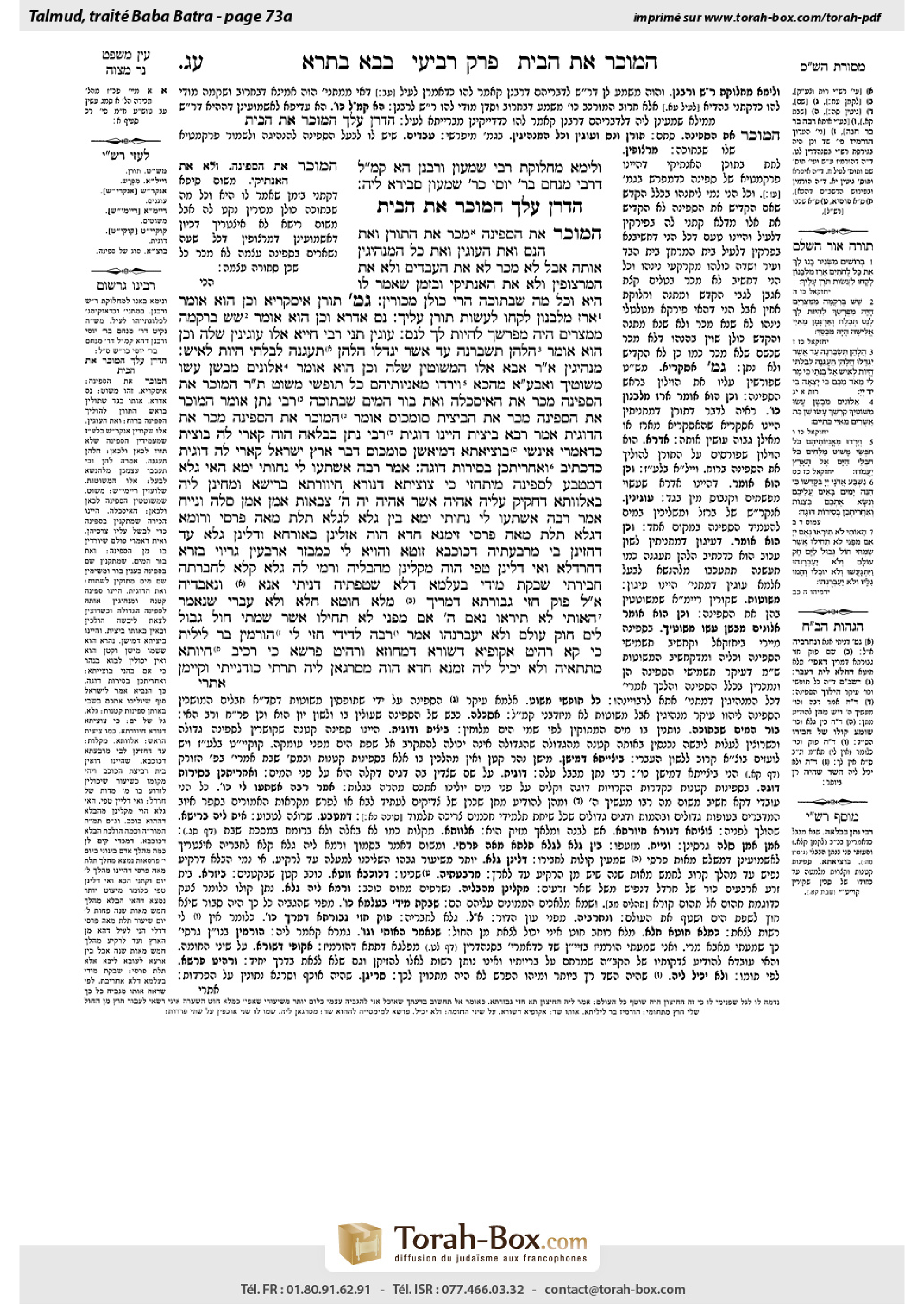
Bava Batra 73a: Talmud study for Daf Yomi
Study the Talmud for Daf Yomi with scanned pages, Hebrew text, English translations from Sefaria and AI-generated French translations.
Passage selection and English or AI-generated French translation are available where the scan has annotations. Daf Study is independent of Torah-Box and Sefaria.
Browse Bava Batra · בבא בתרא · All tractatesBava Batra 73a text and translations
This page of Bava Batra includes the Aramaic text, an English translation and an AI-generated French translation, alongside the scan above.
בבא בתרא ע״ג א · Aramaic and Hebrew text
וְלֵימָא מַחְלוֹקֶת רַבִּי שִׁמְעוֹן וְרַבָּנַן! הָא קָא מַשְׁמַע לַן – דְּרַבִּי מְנַחֵם בְּרַבִּי יוֹסֵי כְּרַבִּי שִׁמְעוֹן סְבִירָא לֵיהּ.
הַדְרָן עֲלָךְ הַמּוֹכֵר אֶת הַבַּיִת
הַמּוֹכֵר אֶת הַסְּפִינָה – מָכַר אֶת הַתּוֹרֶן וְאֶת הַנֵּס וְאֶת הָעוֹגִין, וְאֶת כָּל הַמַּנְהִיגִין אוֹתָהּ. אֲבָל לֹא מָכַר לֹא אֶת הָעֲבָדִים, וְלֹא אֶת הַמַּרְצוּפִין, וְלֹא אֶת הָאַנְתִיקֵי. וּבִזְמַן שֶׁאָמַר לוֹ: ״הִיא וְכׇל מַה שֶּׁבְּתוֹכָהּ״ – הֲרֵי כּוּלָּן מְכוּרִין.
גְּמָ׳ ״תּוֹרֶן״ – אִיסְקַרְיָא. וְכֵן הוּא אוֹמֵר: ״אֶרֶז מִלְּבָנוֹן לָקָחוּ לַעֲשׂוֹת תֹּרֶן עָלָיִךְ״. ״נֵס״ – אַדְרָא. וְכֵן הוּא אוֹמֵר: ״שֵׁשׁ בְּרִקְמָה מִמִּצְרַיִם הָיָה מִפְרָשֵׂךְ לִהְיוֹת לָךְ לְנֵס״. ״עוֹגִין״ – תָּנֵי רַבִּי חִיָּיא: אֵלּוּ עוֹגִינִין שֶׁלָּהּ. וְכֵן הוּא אוֹמֵר: ״הֲלָהֵן תְּשַׂבֵּרְנָה עַד אֲשֶׁר יִגְדָּלוּ, הֲלָהֵן תֵּעָגֵנָה לְבִלְתִּי הֱיוֹת לְאִישׁ.
״מַנְהִיגִין״ – אָמַר רַבִּי אַבָּא: אֵלּוּ הַמְּשׁוֹטִין שֶׁלָּהּ. וְכֵן הוּא אוֹמֵר: ״אַלּוֹנִים מִבָּשָׁן עָשׂוּ מִשּׁוֹטָיִךְ״. וְאִי בָּעֵית אֵימָא, מֵהָכָא: ״וְיָרְדוּ מֵאֳנִיּוֹתֵיהֶם כֹּל תֹּפְשֵׂי מָשׁוֹט״.
תָּנוּ רַבָּנַן: הַמּוֹכֵר אֶת הַסְּפִינָה – מָכַר אֶת הָאִיסְכָּלָה, וְאֶת בּוֹר הַמַּיִם שֶׁבְּתוֹכָהּ. רַבִּי נָתָן אוֹמֵר: הַמּוֹכֵר אֶת הַסְּפִינָה – מָכַר אֶת הַבִּיצִּית. סוֹמְכוֹס אוֹמֵר: הַמּוֹכֵר אֶת הַסְּפִינָה – מָכַר אֶת הַדּוּגִית.
אָמַר רָבָא: בִּיצִּית הַיְינוּ דּוּגִית. רַבִּי נָתָן – בַּבְלָאָה הֲוָה, קָארֵי לַהּ: ״בּוּצִּית״ – כִּדְאָמְרִי אִינָשֵׁי: בּוּצִּיָאתָא דְמֵיאשָׁן. סוֹמְכוֹס – דְּבַר אֶרֶץ יִשְׂרָאֵל, קָארֵי לַהּ: ״דּוּגִית״, כְּדִכְתִיב: ״וְאַחֲרִיתְכֶן בְּסִירוֹת דּוּגָה״.
אָמַר רַבָּה, אִשְׁתַּעוּ לִי נָחוֹתֵי יַמָּא: הַאי גַּלָּא דִּמְטַבַּע לִסְפִינָה – מִיתְחֲזֵי כִּי צוּצִיתָא דְנוּרָא חִיוּוֹרְתָּא בְּרֵישָׁא, וּמָחֵינַן לֵיהּ בְּאַלְווֹתָא דַּחֲקִיק עֲלֵיהּ – ״אֶהְיֶה אֲשֶׁר אֶהְיֶה יָהּ ה׳ צְבָאוֹת אָמֵן אָמֵן סֶלָה״, וְנָיַיח.
אָמַר רַבָּה, אִשְׁתַּעוּ לִי נָחוֹתֵי יַמָּא: בֵּין גַּלָּא לְגַלָּא תְּלָת מְאָה פַּרְסֵי, וְרוּמָא דְגַלָּא תְּלָת מְאָה פַּרְסֵי. זִימְנָא חֲדָא הֲוָה אָזְלִינַן בְּאוֹרְחָא, וְדַלִּינַן גַּלָּא עַד דַּחֲזֵינַן בֵּי מַרְבַּעְתֵּיהּ דְּכוֹכְבָא זוּטָא, וְהַוְיָא לִי כְּמִבְזַר אַרְבְּעִין גְּרִיוֵי בִּזְרָא דְחַרְדְּלָא. וְאִי דַּלִּינַן טְפֵי – הֲוָה מִקְּלֵינַן מֵהַבְלֵיהּ.
וְרָמֵי לַהּ גַּלָּא קָלָא לַחֲבֶרְתַּהּ: ״חֲבֶירְתִּי, שְׁבַקְתְּ מִידֵּי בְּעָלְמָא דְּלָא שְׁטַפְתֵּיהּ, דְּנֵיתֵי אֲנָא וּנְאַבְּדֵיה?ּ״ אָמַר לֵיהּ: ״פּוֹק חֲזִי גְּבוּרְתָּא דְּמָרִיךְ, מְלָא חוּטָא חָלָא – וְלָא עֲבַרִי, שֶׁנֶּאֱמַר: ׳הַאוֹתִי לֹא תִירָאוּ נְאֻם ה׳, אִם מִפָּנַי לֹא תָחִילוּ אֲשֶׁר שַׂמְתִּי חוֹל גְּבוּל לַיָּם, חׇק עוֹלָם וְלֹא יַעַבְרֶנְהוּ׳״.
אָמַר רַבָּה: לְדִידִי חֲזֵי לִי הוּרְמִין בַּר לִילִית, כִּי קָא רָהֵיט אַקּוּפְיָא דְּשׁוּרָא דְמָחוֹזָא, וְרָהֵיט פָּרָשָׁא כִּי רְכִיב חֵיוְתָא מִתַּתָּאֵיהּ, וְלָא יָכֵיל לֵיהּ. זִמְנָא חֲדָא הֲוָה מְסָרְגָאן לֵיהּ תַּרְתֵּי כּוּדַנְיָיתֵי, וְקָיְימָן
Bava Batra 73a · English translation
The Gemara asks: But let us say that this is the dispute between Rabbi Shimon and the Rabbis, as it was concluded previously that according to Rabbi Shimon himself, even the carob and sycamore trees are not consecrated. The Gemara answers: Reish Lakish teaches us this, that Rabbi Menaḥem, son of Rabbi Yosei, holds in accordance with the opinion of Rabbi Shimon, and therefore Rabbi Shimon is not the only Sage who holds this opinion.
MISHNA: One who sells a ship has sold along with it the toren, and the nes, and the ogin, and all of the equipment that is used for directing it. But he has not sold the slaves who serve as oarsmen, nor the packing bags that are used for transporting goods, nor the antikei on the ship. And when one said to the buyer: You are purchasing it, the ship, and all that it contains, all of these latter elements are also sold.
GEMARA: The toren is the mast [iskarya]. And in this regard it states: “They have taken cedars from Lebanon to make masts [toren] for you” (Ezekiel 27:5). The nes is the sail, and in this regard it states: “Of fine linen with richly woven work from Egypt was your sail, that it might be to you for an ensign [nes]” (Ezekiel 27:7). With regard to the meaning of ogin, Rabbi Ḥiyya teaches: These are the ship’s anchors, and so it states: “Would you tarry for them until they were grown? Would you shut yourselves off for them [te’agena] and have no husbands?” (Ruth 1:13). This demonstrates that the root ayin, gimmel, nun, means being shut up and held firmly in one place.
The mishna teaches that the buyer acquires all the equipment used for directing the ship. Rabbi Abba says: These are the ship’s oars. And this is as it states: “Of the oaks of Bashan they have made your oars” (Ezekiel 27:6). Since a verse discussing ships focuses on its oars, evidently the oars are an integral part of the ship. And if you wish, say instead that it is demonstrated from here: “And all that handle the oar, the mariners, and all the pilots of the sea, shall come down from their ships” (Ezekiel 27:29).
The Sages taught: One who sells a ship has also sold the gangway [iskala] used for boarding the ship, and the water tank it contains. Rabbi Natan says: One who sells a ship has sold the ship’s boat [bitzit], which is used as a lifeboat or for fishing in shallow waters. Sumakhos says: One who sells a ship has sold the dugit, as explained below.
Rava said: The bitzit is the same as the dugit. Rabbi Natan was a Babylonian, and therefore he called small boats butzit, as people say: The botziata, small boats, of Miashan. Sumakhos, who was from Eretz Yisrael, called these boats dugit, as it is written: “You shall be taken away with hooks, and your residue in fishing boats [duga]” (Amos 4:2).
§ The Gemara cites several incidents that involve ships and the conversation of seafarers. Rabba said: Seafarers related to me that when this wave that sinks a ship appears with a ray of white fire at its head, we strike it with clubs that are inscribed with the names of God: I am that I am, Yah, the Lord of Hosts, amen amen, Selah. And the wave then abates.
Rabba said: Seafarers related to me that in a certain place between one wave and the next wave there are three hundred parasangs, and the height of a wave is three hundred parasangs. Once, seafarers recounted, we were traveling along the route and a wave lifted us up until we saw the resting place of a small star, and it appeared to me the size of the area needed for scattering forty se’a of mustard seeds. And if it had lifted us higher, we would have been scorched by the heat of the star.
And the wave raised its voice and shouted to another wave: My friend, did you leave anything in the world that you did not wash away, that I may come and destroy it? The second wave said to it: Go out and see the greatness of your Master, God, as even when there is as much as a string of sand on the land I cannot pass, as it is stated: “Will you not fear Me, said the Lord; will you not tremble at My presence? Who has placed the sand for the bound of the sea, an everlasting ordinance, which it cannot pass?” (Jeremiah 5:22).
§ Rabba said: I have seen the one called Hurmin, son of Lilith, when he was running on the pinnacles of the wall of the city of Meḥoza, and a horseman was riding an animal below him but was unable to catch up to him. Once, they saddled for him two mules and they stood
Bava Batra 73a · Traduction française (IA)
Le Guemara pose la question : Mais disons que cela est la dispute entre Rabbi Shimon et les Rabbins, comme il a été conclu précédemment que selon Rabbi Shimon lui-même, même les arbres de carob et de sycomore ne sont pas consacrés. Le Guemara répond : Reish Lakish nous enseigne cela, que Rabbi Menaḥem, fils de Rabbi Yosei, suit l'opinion de Rabbi Shimon, et donc Rabbi Shimon n'est pas le seul Sage qui adopte cette opinion.
MICHNA : Celui qui vend un navire a vendu avec lui le toren, le nes et l'ogin, ainsi que tous les équipements utilisés pour le diriger. Mais il n'a pas vendu les esclaves qui servent d'avlons, ni les sacs utilisés pour transporter les marchandises, ni les antikei sur le navire. Et lorsqu'on disait au acheteur : Tu achètes le navire et tout ce qu'il contient, tous ces éléments ultérieurs sont également vendus.
GUEMARA : Le toren est le mât [iskarya]. Et dans ce contexte, il est dit : « Ils ont pris des cèdres du Liban pour faire des mâts [toren] pour vous » (Ezéchiel 27:5). Le nes est la voile, et dans ce contexte, il est dit : « De lin fin avec des ouvrages richement tissés d'Égypte était votre voile, afin qu'elle soit pour vous un drapeau [nes] » (Ezéchiel 27:7). En ce qui concerne la signification d'ogin, Rabbi Ḥiyya enseigne : Ce sont les ancres du navire, et ainsi il est dit : « Voulez-vous attendre qu'ils grandissent ? Voulez-vous vous enfermer pour eux [te’agena] et n'avoir aucun mari ? » (Ruth 1:13). Cela démontre que la racine ayin, gimmel, nun, signifie être enfermé et maintenu fermement en un lieu.
La mishna enseigne que l'acheteur acquiert tous les équipements utilisés pour diriger le navire. Rabbi Abba dit : Ce sont les avirons du navire. Et cela est comme il est dit : « De l'érable de Bashan ils ont fait vos avirons » (Ezéchiel 27:6). Puisque un verset concernant les navires se concentre sur ses avirons, il est évident que les avirons font partie intégrante du navire. Et si vous le souhaitez, dites plutôt que cela est démontré ici : « Et tous ceux qui manient l'aviron, les marins et tous les pilotes de la mer, descendront de leurs navires » (Ezéchiel 27:29).
Les Sages enseignent : Celui qui vend un navire a également vendu le gangway [iskala] utilisé pour monter à bord du navire, ainsi que le réservoir d'eau qu'il contient. Rabbi Natan dit : Celui qui vend un navire a vendu la petite embarcation [bitzit] du navire, utilisée comme bateau de sauvetage ou pour pêcher dans les eaux peu profondes. Sumakhos dit : Celui qui vend un navire a vendu le dugit, comme expliqué ci-dessous.
Rava dit : La bitzit est la même que le dugit. Rabbi Natan était un Babuvin, et donc il appelait les petits bateaux butzit, comme on dit : Les botziata, petits bateaux, de Miashan. Sumakhos, qui était d'Eretz Yisrael, appelait ces bateaux dugit, comme il est écrit : « Tu seras emporté avec des hameçons, et ton reste dans les bateaux de pêche [duga] » (Amos 4:2).
§ Le Guemara cite plusieurs incidents impliquant des navires et les conversations des marins. Rabba dit : Les marins m'ont raconté que lorsqu'une vague qui coule un navire apparaît avec un rayon de feu blanc à sa tête, nous la frappons avec des bâtons inscrits avec les noms de Dieu : « Je suis celui qui suis », Yah, l'Éternel des armées, amen, amen, Selah. Et la vague s'apaise alors.
Rabba dit : Les marins m'ont raconté que dans un certain endroit entre une vague et la suivante, il y a trois cents parasangs, et la hauteur d'une vague est trois cents parasangs. Un jour, les marins racontèrent que nous étions en route et une vague nous a soulevés jusqu'à ce que nous ayons vu le lieu de repos d'une petite étoile, et il semblait avoir la taille de la surface nécessaire pour disperser quarante se'a de grain de moutarde. Et si elle nous avait soulevés davantage, nous aurions été brûlés par la chaleur de l'étoile.
Et la vague a levé sa voix et a crié à une autre vague : Mon ami, as-tu laissé quelque chose dans le monde que tu n'as pas lavé, afin que je vienne le détruire ? La deuxième vague a répondu à celle-ci : Sortez et voyez la grandeur de votre Maître, Dieu, car même lorsqu'il y a autant qu'une chaîne de sable sur la terre, je ne peux pas passer, comme il est dit : « Ne crains-tu pas Moi, dit l'Éternel ? Ne tremble-t-on pas devant Ma présence ? Qui a mis le sable pour la limite de la mer, un ordonnance éternelle, qu'elle ne peut pas traverser ? » (Jérémie 5:22).
§ Rabba dit : J'ai vu celui appelé Hurmin, fils de Lilith, lorsqu'il courait sur les pinnacles du mur de la ville de Meḥoza, et un cavalier montait un animal en dessous de lui mais ne pouvait pas le rattraper. Un jour, on lui a mis deux mules sur le dos et ils se tenaient
Traduction française générée par IA à partir de l’édition anglaise de Sefaria. Vérifie toujours un passage avec le texte source.
Text from Sefaria: William Davidson Edition - Vocalized Aramaic (CC BY NC); William Davidson Edition - English (CC BY NC).