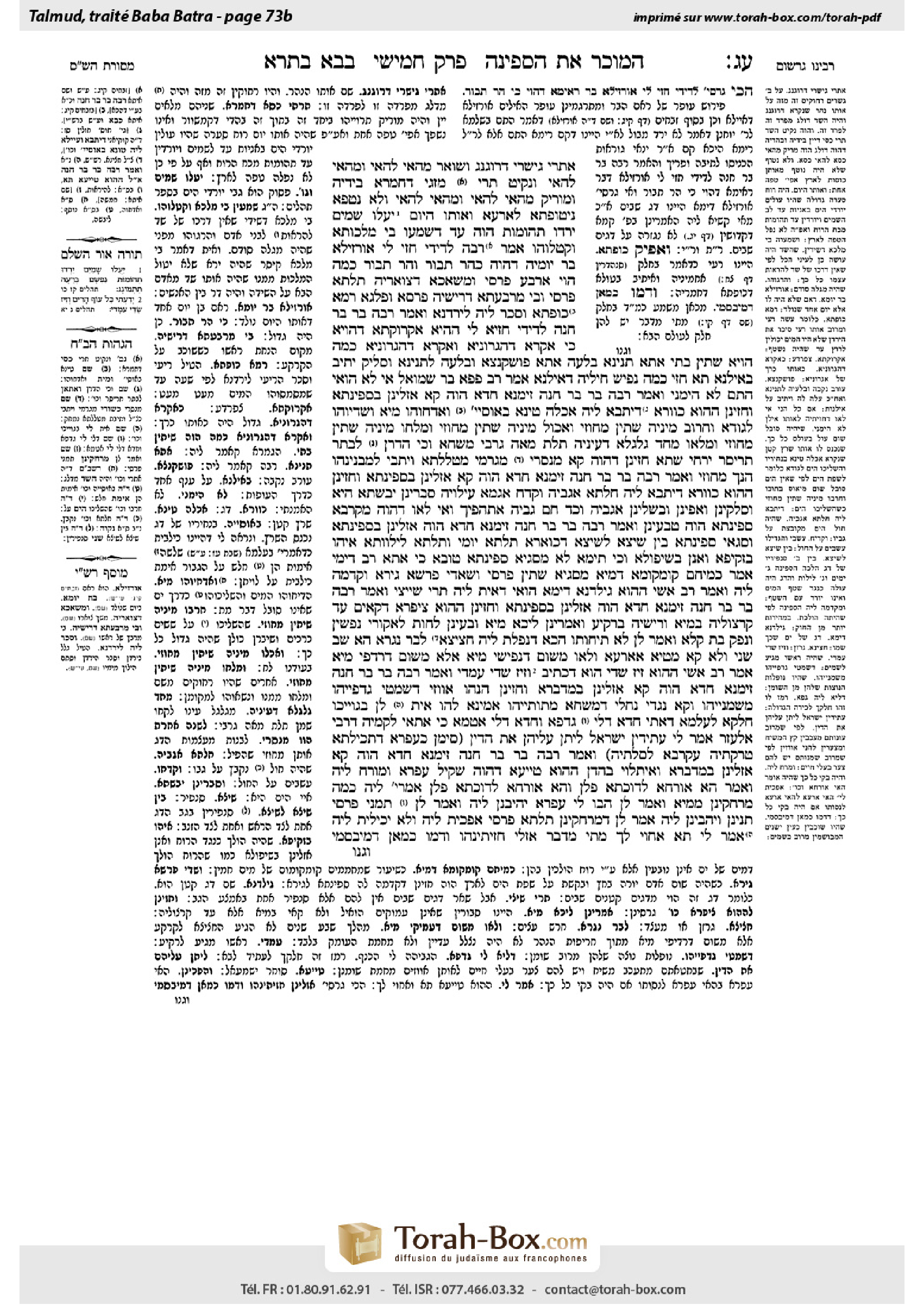
Bava Batra 73b: Talmud study for Daf Yomi
Study the Talmud for Daf Yomi with scanned pages, Hebrew text, English translations from Sefaria and AI-generated French translations.
Passage selection and English or AI-generated French translation are available where the scan has annotations. Daf Study is independent of Torah-Box and Sefaria.
Browse Bava Batra · בבא בתרא · All tractatesBava Batra 73b text and translations
This page of Bava Batra includes the Aramaic text, an English translation and an AI-generated French translation, alongside the scan above.
בבא בתרא ע״ג ב · Aramaic and Hebrew text
אַתְּרֵי גִישְׁרֵי דְרוֹגְנַג; וְשָׁוַאר מֵהַאי לְהַאי וּמֵהַאי לְהַאי, וְנָקֵיט תְּרֵי מִזְגֵי דְחַמְרָא בִּידֵיהּ, וּמוֹרִיק מֵהַאי לְהַאי וּמֵהַאי לְהַאי, וְלָא נָטְפָא נִיטּוּפְתָּא לְאַרְעָא; וְאוֹתוֹ הַיּוֹם ״יַעֲלוּ שָׁמַיִם יֵרְדוּ תְהוֹמוֹת״ הֲוָה. עַד דִּשְׁמַעוּ בֵּי מַלְכוּתָא, וְקַטְלוּהוּ.
אָמַר רַבָּה: לְדִידִי חֲזֵי לִי אוּרְזִילָא בַּר יוֹמֵיהּ, דַּהֲוָה כְּהַר תָּבוֹר. וְהַר תָּבוֹר כַּמָּה הָוֵי? אַרְבַּע פַּרְסֵי. וּמְשָׁאכָא דְצַוְּארֵיהּ תְּלָתָא פַּרְסֵי, וּבֵי מַרְבַּעְתָּא דְרֵישֵׁיהּ פַּרְסָא וּפַלְגָא. רְמָא כּוּפְתָּא, וּסְכַר לֵיהּ לְיַרְדְּנָא.
וְאָמַר רַבָּה בַּר בַּר חָנָה: לְדִידִי חַזְיָא לִי הָהִיא אַקְרוּקְתָּא, דְּהַוְיָא כִּי אַקְרָא דְהַגְרוּנְיָא. וְאַקְרָא דְהַגְרוּנְיָא כַּמָּה הָוְיָא? שִׁתִּין בָּתֵּי. אֲתָא תַּנִּינָא בַּלְעַהּ. אֲתָא פּוּשְׁקַנְצָא וּבַלְעַהּ לְתַנִּינָא, וּסְלֵיק יְתֵיב בְּאִילָנָא. תָּא חֲזִי כַּמָּה נְפִישׁ חֵילֵיהּ דְּאִילָנָא. אָמַר רַב פָּפָּא בַּר שְׁמוּאֵל: אִי לָא הֲוַאי הָתָם, לָא הֵימַנִי.
וְאָמַר רַבָּה בַּר בַּר חָנָה: זִימְנָא חֲדָא הֲוָה קָא אָזְלִינַן בִּסְפִינְתָּא, וַחֲזֵינַן הָהוּא כַּוְורָא דְּיָתְבָא לֵיהּ אָכְלָה טִינָא בְּאוּסְיֵיהּ, וְאַדְחוּהוּ מַיָּא וְשַׁדְיוּהוּ לְגוּדָּא, וַחֲרוּב מִינֵּיהּ שִׁתִּין מָחוֹזֵי. וַאֲכוּל מִינֵּיהּ שִׁתִּין מָחוֹזֵי, וּמְלַחוּ מִינֵּיהּ שִׁתִּין מָחוֹזֵי, וּמַלִּאוּ מֵחַד גִּלְגְּלָא דְעֵינֵיהּ תְּלָת מְאָה גַּרְבֵי מִשְׁחָא. וְכִי הֲדַרַן לְבָתַר תְּרֵיסַר יַרְחֵי שַׁתָּא, חֲזֵינַן דַּהֲוָה קָא מְנַסְּרִי מִגַּרְמֵיהּ מְטַלְּלָתָא, וְיָתְבִי לְמִבְנִינְהוּ הָנָךְ מָחוֹזֵי.
וְאָמַר רַבָּה בַּר בַּר חָנָה: זִימְנָא חֲדָא הֲוָה קָא אָזְלִינַן בִּסְפִינְתָּא, וַחֲזֵינַן הָהוּא כְּווֹרָא דְּיָתְבָא לֵיהּ חָלְתָּא אַגַּבֵּיהּ וְקָדַח אַגְמָא עִילָּוֵיהּ. סָבְרִינַן יַבֶּשְׁתָּא הִיא, וּסְלֵקִינַן וַאֲפֵינַן וּבַשְּׁלִינַן אַגַּבֵּיהּ. וְכַד חַם גַּבֵּיהּ אִתְהֲפִיךְ, וְאִי לָאו דַּהֲוָה מְקָרְבָא סְפִינְתָּא, הֲוָה טָבְעִינַן.
וְאָמַר רַבָּה בַּר בַּר חָנָה: זִימְנָא חֲדָא הֲוָה אָזְלִינַן בִּסְפִינְתָּא, וּסְגַאי סְפִינְתָּא בֵּין שִׁיצָא לְשִׁיצָא דִּכְוָארָא תְּלָתָא יוֹמֵי וּתְלָתָא לֵילָווֹתָא, אִיהוּ בִּזְקִיפָא וַאֲנַן בְּשִׁיפּוּלָא. וְכִי תֵּימָא: לָא מְסַגְּיָא סְפִינְתָּא טוּבָא, כִּי אֲתָא רַב דִּימִי אָמַר: כְּמֵיחַם קוּמְקוּמָא דְמַיָּא מְסַגְּיָא שִׁתִּין פַּרְסֵי, וְשָׁאדֵי פָּרָשָׁא גִּירָא – וְקָדְמָה לֵיהּ. וְאָמַר רַב אָשֵׁי: הָהוּא גִּילְדָּנָא דְיַמָּא הוּא, דְּאִית לֵיהּ תְּרֵי שִׁייצֵי.
וְאָמַר רַבָּה בַּר בַּר חָנָה: זִימְנָא חֲדָא הֲוָה אָזְלִינַן בִּסְפִינְתָּא, וַחֲזֵינַן הָהוּא צִיפְּרָא דְּקָאֵים עַד קַרְצוּלֵיהּ בְּמַיָּא, וְרֵישֵׁיהּ בִּרְקִיעַ. וְאָמְרִינַן לֵיכָּא מַיָּא, וּבָעֵינַן לֵחוּת לְאִקּוֹרֵי נַפְשִׁין; וּנְפַק בַּת קָלָא וְאָמַר לַן: ״לָא תֵּיחוּתוּ הָכָא, דִּנְפַלַת לֵיהּ חֲצִיצָא לְבַר נַגָּרָא הָא שַׁב שְׁנֵי, וְלָא קָא מָטְיָא אַאַרְעָא״. וְלָאו מִשּׁוּם דִּנְפִישִׁי מַיָּא, אֶלָּא מִשּׁוּם דִּרְדִפִי מַיָּא. אָמַר רַב אָשֵׁי: וְהָהוּא זִיז שָׂדַי הוּא, דִּכְתִיב: ״וְזִיז שָׂדַי עִמָּדִי״.
וְאָמַר רַבָּה בַּר בַּר חָנָה: זִימְנָא חֲדָא הֲוָה קָא אָזְלִינַן בְּמַדְבְּרָא, וַחֲזֵינַן הָנְהוּ אֲווֹזֵי דְּשָׁמְטִי גַּדְפַיְיהוּ מִשֻּׁמְנַיְיהוּ, וְקָא נָגְדִי נַחֲלֵי דְמִשְׁחָא מִתּוּתַיְיהוּ. אָמֵינָא לְהוּ: אִית לַן בְּגַוַּיְיכוּ חֻלָקָא לְעָלְמָא דְאָתֵי? חֲדָא דְּלִי גַּדְפָּא, וַחֲדָא דְּלִי אַטְמָא. כִּי אֲתַאי לְקַמֵּיהּ דְּרַבִּי אֶלְעָזָר, אָמַר לִי: עֲתִידִין יִשְׂרָאֵל לִיתֵּן עֲלֵיהֶן אֶת הַדִּין.
(סִימָן: כְּעַפְרָא דִתְכֵילְתָּא טְרַקְתֵּיהּ עַקְרַבָּא לְסִלְתֵּיהּ)
וְאָמַר רַבָּה בַּר בַּר חָנָה: זִימְנָא חֲדָא הֲוָה קָא אָזְלִינַן בְּמַדְבְּרָא, וְאִיתְלַוִּי בַּהֲדַן הַהוּא טַיָּיעָא דַּהֲוָה שָׁקֵיל עַפְרָא וּמוֹרַח לֵיהּ, וְאָמַר: הָא אוֹרְחָא לְדוּכְתָּא פְּלָן, וְהָא אוֹרְחָא לְדוּכְתָּא פְּלָן. אָמְרִינַן לֵיהּ: כַּמָּה מְרַחֲקִינַן מִמַּיָּא? וְאָמַר לַן: הַבוּ לִי עַפְרָא. יָהֲבִינַן לֵיהּ, וְאָמַר לַן: תַּמְנֵי פַּרְסֵי. תָּנֵינַן וְיָהֲבִינַן לֵיהּ, אָמַר לַן דִּמְרַחֲקִינַן תְּלָתָא פַּרְסֵי. אֲפַכִית לֵיהּ, וְלָא יְכֵילִית לֵיהּ.
אָמַר לִי: תָּא אַחֲוֵי לָךְ מֵתֵי מִדְבָּר. אֲזַלִי, חֲזִיתִינְהוּ וְדָמוּ כְּמַאן דְּמִיבַּסְּמִי,
Bava Batra 73b · English translation
on the two bridges of the river Rognag, and he jumped from this one to that one, and from that one to this one. And he was holding two cups of wine in his hands and was pouring from this one to that one, and from that one to this one, and not one drop fell to the ground. And that day was stormy, similar to the description in a verse dealing with seafarers: “They mounted up to the heavens, they went down to the deeps; their soul melted away because of trouble” (Psalms 107:26). He continued in this manner until word of his behavior was heard in the house of the king, and they killed him.
Rabba said: I have seen a day-old antelope [urzila] that was as large as Mount Tabor. And how large is Mount Tabor? It is four parasangs. And the length of its neck was three parasangs, and the place where his head rests was a parasang and a half. It cast feces [kufta] and thereby dammed up the Jordan.
And Rabba bar bar Ḥana said: I have seen a certain frog [akrokta] that was as large as the fort [akra] of Hagronya. And how large is the fort of Hagronya? It is as large as sixty houses. A snake came and swallowed the frog. A raven came and swallowed the snake, and flew up and sat in a tree. Come and see how great is the strength of the tree, which could bear the weight of that raven. Rav Pappa bar Shmuel said: If I had not been there and seen this, I would not believe it.
§ And Rabba bar bar Ḥana said: Once we were traveling in a ship and we saw a certain fish in whose nostril [be’usyeih] a mud eater [akhla tina], i.e., a type of insect, had sat and killed him. And the waters thrust the fish and threw it upon the shore. And sixty districts were destroyed by the fish, and sixty districts ate from it, and another sixty districts salted its meat to preserve it. And they filled from one of its eyeballs three hundred flasks of oil. And when we returned there after the twelve months of the year had passed, we saw that they were cutting beams from its bones, and they had set out to build those districts that had been destroyed.
And Rabba bar bar Ḥana said: Once we were traveling on a ship and we saw a certain fish upon which sand had settled, and grass grew on it. We assumed that it was dry land and went up and baked and cooked on the back of the fish, but when its back grew hot it turned over. And were it not for the fact that the ship was close by, we would have drowned.
And Rabba bar bar Ḥana said: Once we were traveling in a ship and the ship traveled between one fin [shitza] and the other fin of a fish for three days and three nights. The fish was swimming in the opposite direction of the ship, so that it was swimming upward against the wind and the waves, and we were sailing downward. And if you would say that the ship did not travel very fast, when Rav Dimi came from Eretz Yisrael to Babylonia he said: In the short amount of time required to heat a kettle of water, that ship can travel sixty parasangs. And another demonstration of its speed is that a horseman shot an arrow, and yet the ship was traveling so swiftly that it outraced it. And Rav Ashi said: That fish was a sea gildana, which has two sets of fins.
And Rabba bar bar Ḥana said: Once we were traveling in a ship and we saw a certain bird that was standing with water up to its ankles [kartzuleih] and its head was in the sky. And we said to ourselves that there is no deep water here, and we wanted to go down to cool ourselves off. And a Divine Voice emerged and said to us: Do not go down here, as the ax of a carpenter fell into it seven years ago and it has still not reached the bottom. And this is not because the water is so large and deep. Rather, it is because the water is turbulent. Rav Ashi said: And that bird is called ziz sadai, wild beast, as it is written: “I know all the fowls of the mountains; and the ziz sadai is Mine” (Psalms 50:11).
And Rabba bar bar Ḥana said: Once we were traveling in the desert and we saw these geese whose wings were sloping because they were so fat, and streams of oil flowed beneath them. I said to them: Shall we have a portion of you in the World-to-Come? One raised a wing, and one raised a leg, signaling an affirmative response. When I came before Rabbi Elazar, he said to me: The Jewish people will eventually be held accountable for the suffering of the geese. Since the Jews do not repent, the geese are forced to continue to grow fat as they wait to be given to the Jewish people as a reward.
§ The Gemara provides a mnemonic for the items shown by an Arab man to Rabba bar bar Ḥana in the following stories: Like the dust of the sky-blue; the scorpion stung the basket.
And Rabba bar bar Ḥana said: Once we were traveling in the desert and we were accompanied by a certain Arab who would take dust and smell it and say: This is the road to such and such a place, and that is the road to such and such a place. We said to him: How far are we from water? And he said to us: Bring me dust. We brought it to him, and he said: Eight parasangs. Later, we said this a second time, and gave him dust, and he said to us that we are at a distance of three parasangs. I switched the type of dust to test him, but I could not confuse him, as he was an expert in this matter.
That Arab said to me: Come, I will show you the dead of the wilderness, i.e., the Jewish people who left Egypt and died in the wilderness. I went and saw them; and they had the appearance of one who is intoxicated,
Bava Batra 73b · Traduction française (IA)
sur les deux ponts du fleuve Rognag, et il sautait de l'un à l'autre, et de l'autre à l'un. Et il tenait deux coupes de vin à la main et versait du celle-ci à celle-là, et de celle-là à celle-ci, sans qu'une goutte ne tombe au sol. Et ce jour-là, il faisait très mauvais, semblable à la description d'un verset concernant les marins : « Ils montèrent jusqu'aux cieux, ils descendirent aux profondeurs ; leur âme fondit en raison de l'ennui » (Psaumes 107:26). Il continua ainsi jusqu'à ce que la nouvelle de son comportement soit entendue dans la maison du roi, et ils le tuèrent.
Rabba dit : J'ai vu un cerf de un jour [urzila] qui était aussi grand que la montagne de Tabor. Et combien mesure la montagne de Tabor ? Elle mesure quatre parasangs. Et la longueur de son cou était trois parasangs, et la place où sa tête reposait était un parasang et demi. Il excreta [kufta] et ainsi boucha le Jourdain.
Et Rabba bar bar Ḥana dit : J'ai vu un certain crapaud [akrokta] qui était aussi grand que le fort [akra] d'Hagronya. Et combien mesure le fort d'Hagronya ? Il mesure aussi grand que soixante maisons. Un serpent vint et engloutit le crapaud. Un corbeau vint et engloutit le serpent, et s'éleva et s'assit dans un arbre. Voyez donc combien la force de l'arbre est grande, qui pouvait porter le poids de ce corbeau. Rav Pappa bar Shmuel dit : Si je n'avais pas été là et n'avais pas vu cela, je n'y croirais pas.
§ Et Rabba bar bar Ḥana dit : Une fois, nous étions en voyage sur un bateau et nous vîmes un certain poisson dont le nez [be’usyeih] était occupé par un insecte mangeur de boue [akhla tina], c'est-à-dire un type d'insecte, qui l'avait tué. Et les eaux poussèrent le poisson et le jetèrent sur la rive. Et soixante districts furent détruits par le poisson, et soixante districts mangèrent de lui, et un autre soixante districts salèrent sa viande pour le conserver. Et ils remplirent trois cents flacons d'huile d'un de ses yeux. Et lors que nous revînmes après que les douze mois de l'année eurent passé, nous vîmes qu'ils coupaient des poutres de ses os, et qu'ils étaient partis pour construire ces districts qui avaient été détruits.
Et Rabba bar bar Ḥana dit : Une fois, nous étions en voyage sur un bateau et nous vîmes un certain poisson sur lequel s'était déposé du sable, et de l'herbe poussait sur lui. Nous pensions que c'était une terre ferme et montâmes et cuivâmes et cuisinâmes sur le dos du poisson, mais lorsque son dos s'échauffa, il se retourna. Et si ce n'était pas pour le fait que le bateau était proche, nous aurions été noyés.
Et Rabba bar bar Ḥana dit : Une fois, nous étions en voyage sur un bateau et le bateau voyageait entre un filet [shitza] et l'autre filet d'un poisson pendant trois jours et trois nuits. Le poisson nageait dans la direction opposée au bateau, de sorte qu'il nageait contre le vent et les vagues, et nous naviguions en sens inverse. Et si vous dites que le bateau ne voyageait pas très vite, lorsque Rav Dimi vint d'Eretz Yisrael vers Babylone, il dit : En la courte durée nécessaire pour chauffer une marmite d'eau, ce bateau peut parcourir soixante parasangs. Et une autre démonstration de sa vitesse est que un cavalier lança une flèche, et pourtant le bateau voyageait si rapidement qu'il surpassait celle-ci. Et Rav Ashi dit : Ce poisson était un gildana de mer, qui a deux ensembles de filets.
Et Rabba bar bar Ḥana dit : Une fois, nous étions en voyage sur un bateau et nous vîmes un certain oiseau qui était debout avec de l'eau jusqu'aux chevilles [kartzuleih] et sa tête était dans le ciel. Et nous disions entre nous qu'il n'y avait pas d'eau profonde ici, et nous voulions descendre pour nous rafraîchir. Et une Voix Divine émergea et dit à nous : Ne descendez pas ici, car la hache d'un charpentier est tombée dedans il y a sept ans et n'a pas encore atteint le fond. Et cela n'est pas parce que l'eau est si grande et profonde. Plutôt, c'est parce que l'eau est turbulente. Rav Ashi dit : Et cet oiseau s'appelle ziz sadai, bête sauvage, comme il est écrit : « Je connais toutes les oiseaux des montagnes ; et le ziz sadai est à moi » (Psaumes 50:11).
Et Rabba bar bar Ḥana dit : Une fois, nous étions en voyage dans le désert et nous vîmes ces oies dont les ailes étaient inclinées parce qu'elles étaient si grasses, et des ruisseaux d'huile coulaient sous elles. Je dis à elles : Devons-nous avoir une part de vous dans le Monde à Venir ? L'une leva un aile, et l'autre leva une patte, signifiant une réponse affirmative. Lorsque je me présentai devant Rabbi Elazar, il me dit : Le peuple juif sera un jour tenu responsable de la souffrance des oies. Puisque les Juifs ne se repentent pas, les oies sont contraintes de continuer à grossir en attendant d'être données au peuple juif comme récompense.
§ La Guemara fournit un mnémonique pour les objets montrés par un homme arabe à Rabba bar bar Ḥana dans les histoires suivantes : Comme la poussière du ciel bleu ; le scorpion a piqué le panier.
Et Rabba bar bar Ḥana dit : Une fois, nous étions en voyage dans le désert et nous étions accompagnés par un certain Arabe qui prenait de la poussière et la sentait et disait : Celle-ci est le chemin vers telle et telle place, et celle-là est le chemin vers telle et telle place. Nous disions à lui : À quelle distance sommes-nous de l'eau ? Et il nous dit : Apportez-moi de la poussière. Nous lui apportâmes, et il dit : Huit parasangs. Plus tard, nous disions cela une seconde fois, et lui apportâmes de la poussière, et il nous dit que nous étions à une distance de trois parasangs. J'ai changé le type de poussière pour tester lui, mais je ne pus pas le confondre, car il était expert dans cette matière.
Cet Arabe me dit : Viens, je te montrerai les morts du désert, c'est-à-dire le peuple juif qui est parti d'Égypte et est mort dans le désert. Je suis allé et les ai vus ; et ils avaient l'aspect d'une personne ivre,
Traduction française générée par IA à partir de l’édition anglaise de Sefaria. Vérifie toujours un passage avec le texte source.
Text from Sefaria: William Davidson Edition - Vocalized Aramaic (CC BY NC); William Davidson Edition - English (CC BY NC).