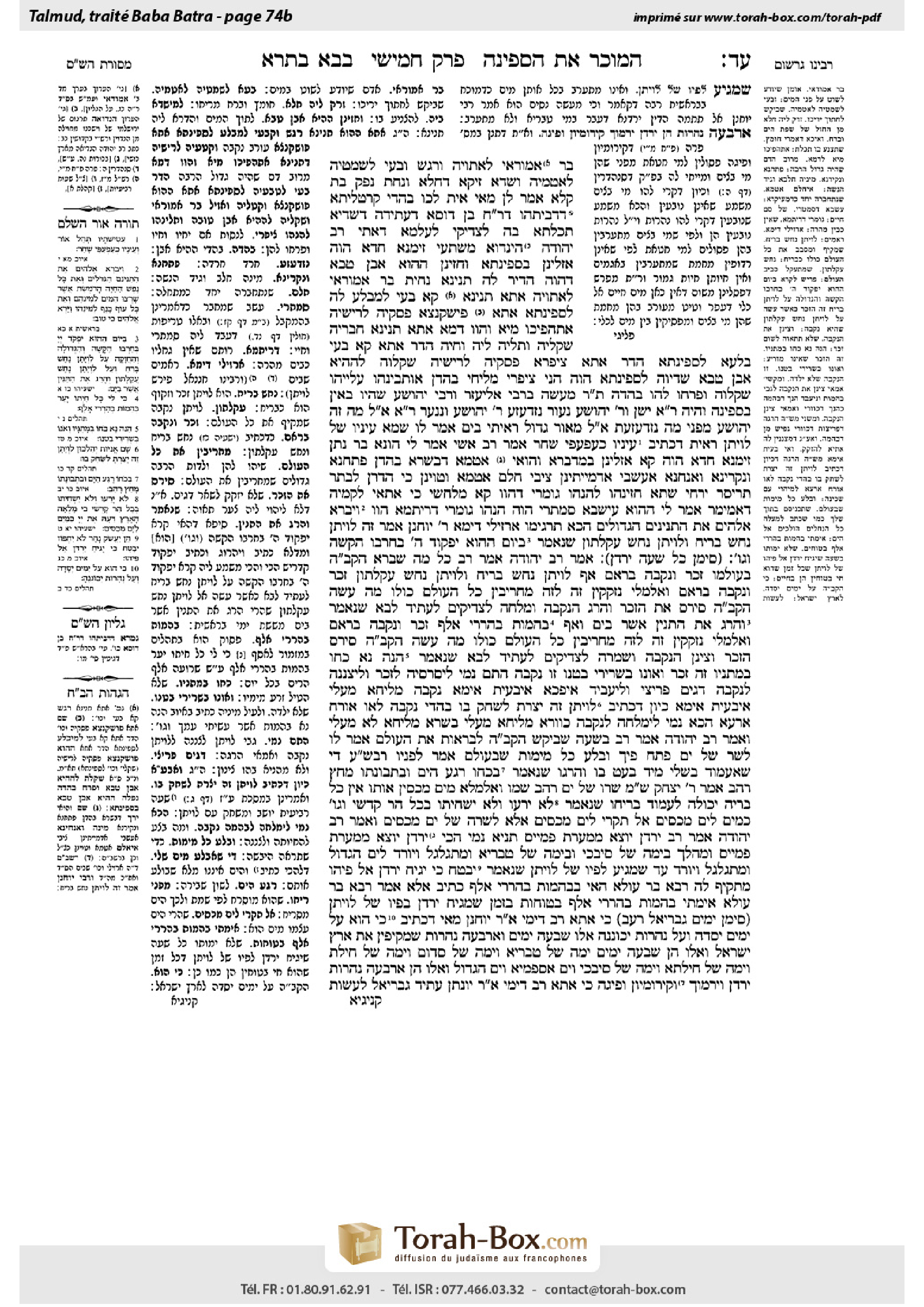
Bava Batra 74b: Talmud study for Daf Yomi
Study the Talmud for Daf Yomi with scanned pages, Hebrew text, English translations from Sefaria and AI-generated French translations.
Passage selection and English or AI-generated French translation are available where the scan has annotations. Daf Study is independent of Torah-Box and Sefaria.
Browse Bava Batra · בבא בתרא · All tractatesBava Batra 74b text and translations
This page of Bava Batra includes the Aramaic text, an English translation and an AI-generated French translation, alongside the scan above.
בבא בתרא ע״ד ב · Aramaic and Hebrew text
בַּר אָמוֹרַאי לְאֵתוּיַהּ, וּרְגַשׁ וּבָעֵי לִשְׁמְטֵיהּ לְאַטְמֵיהּ, וּשְׁדָא זִיקָא דְחַלָּא וּנְחֵת. נְפַק בַּת קָלָא אֲמַר לַן: ״מַאי אִית לְכוּ בַּהֲדֵי קַרְטְלִיתָא דִּדְבֵיתְהוּ דְּרַבִּי חֲנִינָא בֶּן דּוֹסָא, דַּעֲתִידָה דְּשָׁדְיָא תְּכֵלְתָּא בָּהּ לְצַדִּיקֵי לְעָלְמָא דְאָתֵי!״
רַב יְהוּדָה הִינְדְּוָא מִשְׁתַּעֵי: זִימְנָא חֲדָא הֲוָה אָזְלִינַן בִּסְפִינְתָּא, וַחֲזֵינַן הָהוּא אֶבֶן טָבָא דַּהֲוָה הָדַיר לַהּ תַּנִּינָא. נָחֵית בַּר אָמוֹרָאֵי לְאֵתוּיַהּ, אֲתָא תַּנִּינָא קָא בָּעֵי לְמִבְלַע לַהּ לִסְפִינְתָּא. אֲתָא פִּישְׁקַנְצָא פַּסְקֵיהּ לְרֵישֵׁיהּ, אִתְהֲפִיכוּ מַיָּא וַהֲווֹ דְּמָא. אֲתָא תַּנִּינָא חַבְרֵיהּ, שַׁקְלַהּ וְתַלְיַהּ לֵיהּ וַחֲיָה. הֲדַר אֲתָא קָא בָּעֵי בָּלְעָא לִסְפִינְתָּא, הֲדַר אֲתָא צִיפְּרָא פַּסְקֵיהּ לְרֵישֵׁיהּ. שַׁקְלוּהָ לְהַהִיא אֶבֶן טָבָא שַׁדְיוּהָ לִסְפִינְתָּא; הֲוָה הָנֵי צִיפְּרֵי מְלִיחִי בַּהֲדַן, אוֹתְבִינְהוּ עֲלַיְיהוּ; שַׁקְלוּהָ וּפְרַחוּ לְהוּ בַּהֲדַהּ.
תָּנוּ רַבָּנַן: מַעֲשֶׂה בְּרַבִּי אֱלִיעֶזֶר וְרַבִּי יְהוֹשֻׁעַ שֶׁהָיוּ בָּאִין בִּסְפִינָה, וְהָיָה רַבִּי אֱלִיעֶזֶר יָשֵׁן וְרַבִּי יְהוֹשֻׁעַ נֵעוֹר. נִזְדַּעְזַע רַבִּי יְהוֹשֻׁעַ, וְנִנְעַר רַבִּי אֱלִיעֶזֶר. אָמַר לוֹ: מָה זֶה יְהוֹשֻׁעַ, מִפְּנֵי מָה נִזְדַּעְזַעְתָּ? אָמַר לוֹ: מָאוֹר גָּדוֹל רָאִיתִי בַּיָּם. אָמַר לוֹ: שֶׁמָּא עֵינָיו שֶׁל לִוְיָתָן רָאִיתָ – דִּכְתִיב: ״עֵינָיו כְּעַפְעַפֵּי שָׁחַר״.
אָמַר רַב אָשֵׁי, אָמַר לִי הוּנָא בַּר נָתָן: זִימְנָא חֲדָא הֲוָה קָא אָזְלִינַן בְּמַדְבְּרָא, וַהֲוַאי אַטְמָא דְּבִשְׂרָא בַּהֲדַן. פְּתַחְנָא, וְנַקַּירְנָא, וְאַנַּחְנָא אַעִשְׂבֵי. אַדְּמַיְיתִינַן צִיבֵי, חֲלַם אַטְמָא, וּטְוֵינַן. כִּי הֲדַרַן לְבָתַר תְּרֵיסַר יַרְחֵי שַׁתָּא, חֲזֵינְהוּ לְהָנְהוּ גּוּמְרֵי דַּהֲווֹ קָא מְלַחֲשִׁי. כִּי אֲתַאי לְקַמֵּיהּ דְּאַמֵּימָר, אֲמַר לִי: הַהוּא עִישְׂבָּא סַמְתָּרִי הֲוָה; הָנְהוּ גּוּמְרֵי דְּרִיתְמָא הֲווֹ.
״וַיִּבְרָא אֱלֹהִים אֶת הַתַּנִּינִם הַגְּדוֹלִים״ – הָכָא תַּרְגִּימוּ: אֻרְזִילֵי דְיַמָּא. רַבִּי יוֹחָנָן אָמַר: זֶה לִוְיָתָן נָחָשׁ בָּרִיחַ וְלִוְיָתָן נָחָשׁ עֲקַלָּתוֹן, שֶׁנֶּאֱמַר: ״בַּיּוֹם הַהוּא יִפְקֹד ה׳ בְּחַרְבּוֹ הַקָּשָׁה וְגוֹ׳״.
(סִימָן: כׇּל, שָׁעָה, יַרְדֵּן) אָמַר רַב: יְהוּדָה אָמַר רַב: כֹּל מַה שֶּׁבָּרָא הַקָּדוֹשׁ בָּרוּךְ הוּא בְּעוֹלָמוֹ – זָכָר וּנְקֵבָה בְּרָאָם. אַף לִוְיָתָן נָחָשׁ בָּרִיחַ וְלִוְיָתָן נָחָשׁ עֲקַלָּתוֹן – זָכָר וּנְקֵבָה בְּרָאָם, וְאִלְמָלֵי נִזְקָקִין זֶה לָזֶה – מַחְרִיבִין כָּל הָעוֹלָם כּוּלּוֹ. מָה עָשָׂה הַקָּדוֹשׁ בָּרוּךְ הוּא? סֵירַס אֶת הַזָּכָר, וְהָרַג הַנְּקֵבָה וּמְלָחָהּ לַצַּדִּיקִים לֶעָתִיד לָבֹא, שֶׁנֶּאֱמַר: ״וְהָרַג אֶת הַתַּנִּין אֲשֶׁר בַּיָּם״.
וְאַף בְּהֵמוֹת בְּהַרְרֵי אֶלֶף – זָכָר וּנְקֵבָה בְּרָאָם, וְאִלְמָלֵי נִזְקָקִין זֶה לָזֶה מַחֲרִיבִין כָּל הָעוֹלָם כּוּלּוֹ. מָה עָשָׂה הַקָּדוֹשׁ בָּרוּךְ הוּא? סֵירַס הַזָּכָר, וְצִינֵּן הַנְּקֵבָה וּשְׁמָרָהּ לַצַּדִּיקִים לֶעָתִיד לָבֹא, שֶׁנֶּאֱמַר: ״הִנֵּה נָא כֹחוֹ בְמׇתְנָיו״ – זֶה זָכָר, ״וְאוֹנוֹ בִּשְׁרִירֵי בִטְנוֹ״ – זוֹ נְקֵבָה.
הָתָם נָמֵי, לִיסָרְסֵיהּ לְזָכָר וְלִיצַנְּנַּהּ לִנְקֵבָה! דָּגִים פְּרִיצִי. וְלֶיעְבֵּיד אִיפְּכָא! אִיבָּעֵית אֵימָא: נְקֵבָה מְלִיחָא מְעַלֵּי; אִיבָּעֵית אֵימָא, כֵּיוָן דִּכְתִיב: ״לִוְיָתָן זֶה יָצַרְתָּ לְשַׂחֶק בּוֹ״, בַּהֲדֵי נְקֵבָה לָאו אוֹרַח אַרְעָא. הָכָא נָמֵי, לִימְלְחַהּ לִנְקֵבָה! כְּווֹרָא מְלִיחָא מְעַלֵּי, בִּשְׂרָא מְלִיחָא לָא מְעַלֵּי.
וְאָמַר רַב יְהוּדָה אָמַר רַב: בְּשָׁעָה שֶׁבִּיקֵּשׁ הַקָּדוֹשׁ בָּרוּךְ הוּא לִבְראוֹת אֶת הָעוֹלָם, אָמַר לוֹ לְשַׂר שֶׁל יָם: פְּתַח פִּיךָ וּבְלַע כׇּל מֵימוֹת שֶׁבָּעוֹלָם. אָמַר לְפָנָיו: רִבּוֹנוֹ שֶׁל עוֹלָם, דַּי שֶׁאֶעְמוֹד בְּשֶׁלִּי. מִיָּד בָּעַט בּוֹ וַהֲרָגוֹ, שֶׁנֶּאֱמַר: ״בְּכֹחוֹ רָגַע הַיָּם וּבִתְבוּנָתוֹ מָחַץ רָהַב״.
אָמַר רַבִּי יִצְחָק: שְׁמַע מִינַּהּ, שָׂרוֹ שֶׁל יָם ״רַהַב״ שְׁמוֹ; וְאִלְמָלֵא מַיִם מְכַסִּין אוֹתוֹ – אֵין כׇּל בְּרִיָּה יְכוֹלָה לַעֲמוֹד בְּרֵיחוֹ, שֶׁנֶּאֱמַר: ״לֹא יָרֵעוּ וְלֹא יַשְׁחִיתוּ בְּכׇל הַר קׇדְשִׁי וְגוֹ׳, כַּמַּיִם לַיָּם מְכַסִּים״ – אַל תִּקְרֵי ״לַיָּם מְכַסִּים״, אֶלָּא ״לְשָׂרָהּ שֶׁל יָם מְכַסִּים״.
וְאָמַר רַב יְהוּדָה אָמַר רַב: יַרְדֵּן – יוֹצֵא מִמְּעָרַת פַּמְיָיס. תַּנְיָא נָמֵי הָכִי: יַרְדֵּן יוֹצֵא מִמְּעָרַת פַּמְיָיס, וּמְהַלֵּךְ בְּיַמָּהּ שֶׁל סִיבְכִי וּבְיַמָּהּ שֶׁל טְבֶרְיָא, וּמִתְגַּלְגֵּל וְיוֹרֵד לַיָּם הַגָּדוֹל; וּמִתְגַּלְגֵּל וְיוֹרֵד עַד שֶׁמַּגִּיעַ לְפִיו שֶׁל לִוְיָתָן, שֶׁנֶּאֱמַר: ״יִבְטַח כִּי יָגִיחַ יַרְדֵּן אֶל פִּיהוּ״. מַתְקֵיף לַהּ רָבָא בַּר עוּלָּא: הַאי בִּבְהֵמוֹת בְּהַרְרֵי אֶלֶף כְּתִיב! אֶלָּא אָמַר רָבָא בַּר עוּלָּא: אֵימָתַי בְּהֵמוֹת בְּהַרְרֵי אֶלֶף בְּטוּחוֹת? בִּזְמַן שֶׁמֵּגִיחַ יַרְדֵּן בְּפִיו שֶׁל לִוְיָתָן.
(סִימָן: יָמִים, גַּבְרִיאֵל, רָעָב) כִּי אֲתָא רַב דִּימִי אָמַר רַבִּי יוֹחָנָן, מַאי דִּכְתִיב: ״כִּי הוּא עַל יַמִּים יְסָדָהּ וְעַל נְהָרוֹת יְכוֹנְנֶהָ״? אֵלּוּ שִׁבְעָה יָמִים וְאַרְבָּעָה נְהָרוֹת שֶׁמַּקִּיפִין אֶת אֶרֶץ יִשְׂרָאֵל. וְאֵלּוּ הֵן שִׁבְעָה יָמִים: יַמָּהּ שֶׁל טְבֶרְיָא, וְיַמָּהּ שֶׁל סְדוֹם, וְיַמָּהּ שֶׁל חֵילָת, וְיַמָּהּ שֶׁל חֵילָתָא, וְיַמָּהּ שֶׁל סִיבְכִי, וְיַם אַסְפַּמְיָא, וְיָם הַגָּדוֹל. וְאֵלּוּ הֵן אַרְבָּעָה נְהָרוֹת: יַרְדֵּן, וְיַרְמוּךְ, וְקֵירוּמְיוֹן, וּפֵיגָה.
כִּי אֲתָא רַב דִּימִי אָמַר רַבִּי יוֹנָתָן: עָתִיד גַּבְרִיאֵל לַעֲשׂוֹת
Bava Batra 74b · English translation
i.e., a diver [bar amoraei] went into the water to bring up this chest, and the fish became angry and sought to sever his thigh, but the diver threw upon it a flask of vinegar and they descended and swam away. A Divine Voice emerged and said to us: What right do you have to touch the crate of the wife of Rabbi Ḥanina ben Dosa, as she is destined to insert sky-blue wool in it to be used in the ritual fringes of the righteous in the World-to-Come?
Rav Yehuda from India relates: Once we were traveling in a ship and we saw a certain precious stone that was encircled by a snake. A diver descended to bring it up, and the snake came and sought to swallow the ship. A raven came and cut off its head, and the water turned into blood due to the enormousness of the snake. Another snake came, took the precious stone, and hung it on the dead snake, and it recovered. It returned and again sought to swallow the ship, and yet again a bird came and cut off its head, took that precious stone, and threw it onto the ship. We had with us these salted birds; we placed the stone on them, and they took the stone and flew away with it.
§ Apropos the stories of large sea creatures, the Gemara discusses the large sea creatures mentioned in the Bible. The Sages taught: There was an incident involving Rabbi Eliezer and Rabbi Yehoshua, who were traveling on a ship, and Rabbi Eliezer was sleeping and Rabbi Yehoshua was awake. Rabbi Yehoshua trembled, and Rabbi Eliezer awoke. Rabbi Eliezer said to him: What is this, Yehoshua; for what reason did you tremble? Rabbi Yehoshua said to him: I saw a great light in the sea. Rabbi Eliezer said to him: Perhaps you saw the eyes of the leviathan, as it is written: “And his eyes are like the eyelids of the morning” (Job 41:10).
Rav Ashi said: Huna bar Natan said to me: Once we were traveling in the desert, and we had a thigh of meat with us. We cut open the thigh and tore off the sciatic nerve and the forbidden fat and put it on the grass. By the time that we brought wood, the thigh had repaired itself, and we roasted it. When we returned to that place after twelve months of the year had passed, we saw that those coals were still glowing. When I came before Ameimar, he said to me: That grass was a drug of life [samterei], while those coals were of broom.
The verse states: “And God created the great sea monsters” (Genesis 1:21). Here, in Babylonia, they interpreted this as a reference to the sea oryx. Rabbi Yoḥanan says: This is leviathan the slant serpent, and leviathan the tortuous serpent, as it is stated: “In that day the Lord with His sore and great and strong sword will punish leviathan the slant serpent, and leviathan the tortuous serpent” (Isaiah 27:1).
§ The Gemara provides a mnemonic for the following statements of Rav Yehuda citing Rav: Everything; time; Jordan. Rav Yehuda says that Rav says: Everything that the Holy One, Blessed be He, created in His world, He created male and female. Even leviathan the slant serpent and leviathan the tortuous serpent He created male and female. And if they would have coupled and produced offspring, they would have destroyed the entire world. What did the Holy One, Blessed be He, do? He castrated the male and killed the female, and salted the female to preserve it for the banquet for the righteous in the future. As it is stated: “And He will slay the serpent that is in the sea” (Isaiah 27:1).
And He created even the beasts on the thousand hills (see Psalms 50:10) male and female. And they were so enormous that if they would have coupled and produced offspring, they would have destroyed the entire world. What did the Holy One, Blessed be He, do? He castrated the male and cooled the sexual desire of the female and preserved it for the righteous in the future. As it is stated about the beasts: “Lo now, his strength is in his loins” (Job 40:16); this is referring to the male. The continuation of the verse: “And his force is in the stays of his body”; this is the female, alluding to the idea that they did not use their genitals for the purpose of procreation.
The Gemara asks: There too, with regard to the leviathan, let Him castrate the male and cool the female; why was it necessary to kill the female? The Gemara answers: Fish are unrestrained, and therefore even if the female was cooled, the female would still procreate. The Gemara suggests: And let Him do the opposite, and kill and preserve the male leviathan. The Gemara responds: If you wish, say that the salted female is better; if you wish, say instead that since it is written: “There is leviathan, whom You have formed to sport with” (Psalms 104:26), the male must be left alive for sport, because it is not proper conduct to sport with a female. The Gemara asks: Here too, with regard to the beasts, let Him preserve the female in salt, instead of cooling it. The Gemara answers: Salted fish is good, but salted meat is not good.
And Rav Yehuda says that Rav says: At the time when the Holy One, Blessed be He, sought to create the world, He said to the minister of the sea: Open your mouth and swallow all the waters of the world, so that there will be room for land. The minister of the sea said before Him: Master of the Universe, it is enough that I will stay within my own waters. God immediately struck him and killed him; as it is stated: “He stirs up the sea with His power, and by His understanding He smites through Rahab” (Job 26:12).
Rabbi Yitzḥak said: Conclude from here that the name of the minister of the sea is Rahab, and were it not for waters of the sea that cover him, no creature could withstand his smell, as his corpse emits a terrible stench. As it is stated: “They shall not hurt nor destroy in all My holy mountain; for the earth shall be full of the knowledge of the Lord, as the waters cover the sea” (Isaiah 11:9). Do not read this phrase as “cover the sea”; rather read it as: Cover the minister of the sea, i.e., the term sea is referring to the minister of the sea, not to the sea itself.
And Rav Yehuda says that Rav says: The Jordan issues forth from the cave of Pamyas. That is also taught in a baraita: The Jordan issues forth from the cave of Pamyas, and travels in the Sea of Sivkhi, i.e., the Hula Lake, and in the Sea of Tiberias, the Sea of Galilee, and rolls down to the Great Sea, and rolls down until it reaches the mouth of the leviathan. As it is stated: “He is confident, though the Jordan rush forth to his mouth” (Job 40:23). Rava bar Ulla strongly objects to this explanation of the verse, stating: But this verse is written about the beasts on the thousand hills. Rather, Rava bar Ulla said that this is the meaning of the verse: When are the beasts on the thousand hills confident? When the Jordan rushes forth into the mouth of the leviathan.
§ The Gemara provides a mnemonic for the upcoming statements of Rav Dimi: Seas; Gabriel; hungry. When Rav Dimi came from Eretz Yisrael to Babylonia, he said that Rabbi Yoḥanan said: What is the meaning of that which is written: “For He has founded it upon the seas, and established it upon the floods” (Psalms 24:2)? These are the seven seas and four rivers that surround Eretz Yisrael. And these are the seven seas: The Sea of Tiberias, the Sea of Sodom, i.e., the Dead Sea, the Sea of Ḥeilat, the Sea of Ḥeilata, the Sea of Sivkhi, the Sea of Aspamya, and the Great Sea, i.e., the Mediterranean. And these are the four rivers: The Jordan, the Jarmuth, and the Keiromyon, and the Piga, which are the rivers of Damascus.
When Rav Dimi came from Eretz Yisrael to Babylonia he said that Rabbi Yonatan says: In the future, Gabriel will perform
Bava Batra 74b · Traduction française (IA)
c'est-à-dire, un plongeur [bar amoraei] est descendu dans l'eau pour ramener cette boîte, et les poissons se sont mis en colère et ont cherché à couper sa cuisse, mais le plongeur a jeté sur eux une bouteille de vinaigre et ils sont descendus et sont partis nager. Une Voix Divine est sortie et a dit à nous : Quel droit avez-vous de toucher la boîte de la femme de Rabbi Ḥanina ben Dosa, car elle est destinée à y insérer du laine bleue pour être utilisée dans les franges des justes dans le Monde à Venir ?
Rav Yehuda d'Inde rapporte : Un jour, nous étions en voyage sur un bateau et nous avons vu une pierre précieuse entourée par un serpent. Un plongeur est descendu pour la ramener, et le serpent est venu et a cherché à avaler le bateau. Un corbeau est venu et a coupé sa tête, et l'eau est devenue du sang à cause de la grandeur du serpent. Un autre serpent est venu, a pris la pierre précieuse et l'a accrochée à la tête du serpent mort, et il s'est rétabli. Il est revenu et a à nouveau cherché à avaler le bateau, et à nouveau un oiseau est venu et a coupé sa tête, a pris la pierre précieuse et l'a jeté sur le bateau. Nous avions avec nous ces oiseaux salés ; nous avons mis la pierre sur eux, et ils ont pris la pierre et sont partis voler avec elle.
§ En ce qui concerne les histoires de créatures marines gigantesques, la Guemara discute des grandes créatures marines mentionnées dans la Bible. Les Sages ont enseigné : Il y avait un incident impliquant Rabbi Eliezer et Rabbi Yehoshua, qui voyageaient sur un bateau, et Rabbi Eliezer dormait et Rabbi Yehoshua était éveillé. Rabbi Yehoshua tremblait, et Rabbi Eliezer s'est réveillé. Rabbi Eliezer a dit à lui : Qu'est-ce que c'est, Yehoshua ; pour quelle raison as-tu tremblé ? Rabbi Yehoshua a dit à lui : J'ai vu une grande lumière dans la mer. Rabbi Eliezer a dit à lui : Peut-être as-tu vu les yeux du léviathan, car il est écrit : « Et ses yeux sont comme les paupières de l'aube » (Job 41:10).
Rav Ashi a dit : Huna bar Natan m'a dit : Un jour, nous étions en voyage dans le désert, et nous avions un morceau de cuisse de viande avec nous. Nous avons ouvert la cuisse et déchiré le nerf sciatique et la graisse interdite et les avons mis sur l'herbe. Lorsque nous avons apporté du bois, la cuisse s'était réparée, et nous l'avons grillée. Lorsque nous sommes revenus à cet endroit après un an et douze mois, nous avons vu que ces braises étaient encore brûlantes. Lorsque je suis venu devant Ameimar, il m'a dit : Cette herbe était un remède de vie [samterei], tandis que ces braises étaient des buissons.
La Bible dit : « Et Dieu créa les grands monstres marins » (Genèse 1:21). Ici, en Babylonie, ils ont interprété cela comme faisant référence à l'oryx marin. Rabbi Yoḥanan dit : C'est le léviathan le serpent oblique, et le léviathan le serpent tordu, comme il est dit : « En ce jour, le Seigneur avec Sa plaie et Sa grande et forte épée punira le léviathan le serpent oblique, et le léviathan le serpent tordu » (Isaïe 27:1).
§ La Guemara fournit un mnémonique pour les déclarations suivantes de Rav Yehuda citant Rav : Tout ; temps ; Jourdain. Rav Yehuda dit que Rav dit : Tout ce que le Saint, le Très Haut, a créé dans Son monde, Il l'a créé mâle et femelle. Même le léviathan le serpent oblique et le léviathan le serpent tordu, Il les a créés mâle et femelle. Et s'ils avaient couplé et produit des descendants, ils auraient détruit l'ensemble du monde. Qu'ont fait le Saint, le Très Haut ? Il a castré le mâle et tué la femelle, et a salé la femelle pour la conserver pour le banquet des justes dans l'avenir. Comme il est dit : « Et Il tuera le serpent qui est dans la mer » (Isaïe 27:1).
Et Il a créé même les bêtes sur les mille collines (voir Psaumes 50:10) mâle et femelle. Et elles étaient si gigantesques que si elles avaient couplé et produit des descendants, elles auraient détruit l'ensemble du monde. Qu'ont fait le Saint, le Très Haut ? Il a castré le mâle et a refroidi le désir sexuel de la femelle et l'a conservé pour les justes dans l'avenir. Comme il est dit à propos des bêtes : « Maintenant, sa force est dans ses hanches » (Job 40:16) ; cela fait référence au mâle. La continuation du verset : « Et sa force est dans les attaches de son corps » ; cela fait référence à la femelle, allusion au fait qu'ils n'ont pas utilisé leurs organes génitaux à l'effet de la procréation.
La Guemara pose la question : Là aussi, concernant le léviathan, qu'il le castrasse le mâle et refroidisse la femelle ; pourquoi avait-il été nécessaire de tuer la femelle ? La Guemara répond : Les poissons sont indomptés, et donc même si la femelle avait été refroidie, la femelle aurait encore procréé. La Guemara suggère : Et qu'il fasse l'inverse, et tue et conserve le léviathan mâle. La Guemara répond : Si tu veux, dis que la femelle salée est meilleure ; si tu veux, dis plutôt que puisque cela est écrit : « Il y a le léviathan, que Tu as formé pour t'amuser » (Psaumes 104:26), le mâle doit être laissé vivant pour t'amuser, car il n'est pas convenable de s'amuser avec une femelle. La Guemara pose la question : Là aussi, concernant les bêtes, qu'il conserve la femelle salée, au lieu de la refroidir. La Guemara répond : La viande salée est bonne, mais la viande salée n'est pas bonne.
Et Rav Yehuda dit que Rav dit : À l'époque où le Saint, le Très Haut, voulait créer le monde, Il a dit au ministre de la mer : Ouvre ta bouche et avale toutes les eaux du monde, afin qu'il y ait de la place pour la terre. Le ministre de la mer a dit devant Lui : Maître du Monde, il suffit que je reste dans mes eaux. Dieu a immédiatement frappé lui et l'a tué ; comme il est dit : « Il agite la mer avec Sa puissance, et par Sa compréhension Il frappe Rahab » (Job 26:12).
Rabbi Yitzḥak a dit : Concluez-en ici que le nom du ministre de la mer est Rahab, et si ce n'était pas pour les eaux de la mer qui le recouvrent, aucun être ne pourrait résister à son odeur, car son corps émet une odeur terrible. Comme il est dit : « Ils ne nuiront ni ne détruiront en tout mon mont sacré ; car la terre sera pleine de la connaissance du Seigneur, comme les eaux recouvrent la mer » (Isaïe 11:9). Ne lisez pas cette phrase comme « recouvrir la mer » ; lisez-la plutôt comme : Recouvrir le ministre de la mer, c'est-à-dire que le terme « mer » fait référence au ministre de la mer, pas à la mer elle-même.
Et Rav Yéhouda dit que Rav dit : Le Jourdain sort d'une grotte appelée Pamyas. Cela est également enseigné dans une baraïta : Le Jourdain sort d'une grotte appelée Pamyas, traverse la mer de Sivkhi, c'est-à-dire le lac Hula, et la mer de Tibériade, la mer de Galilée, et descend jusqu'à la grande mer, jusqu'à ce qu'il atteigne la bouche du léviathan. Comme il est dit : « Il est confiant, bien que le Jourdain s'écoule jusqu'à sa bouche » (Job 40:23). Rava bar Ulla s'oppose fortement à cette interprétation de la parole, disant : Mais cette parole est écrite à propos des bêtes des mille collines. Plutôt, Rava bar Ulla dit que c'est la signification de la parole : Quand les bêtes des mille collines sont-elles confiantes ? Quand le Jourdain s'écoule jusqu'à la bouche du léviathan.
§ Le Guemara fournit un acrostiche pour les prochaines déclarations de Rav Dimi : Mers ; Gabriel ; affamé. Lorsque Rav Dimi est venu d'Eretz Yisraël vers Babylone, il a dit que Rabbi Yoḥanan a dit : Quelle est la signification de ce qui est écrit : « Car Il l'a fondée sur les mers, et l'a établie sur les fleuves » (Psaumes 24:2) ? Ce sont les sept mers et quatre rivières qui entourent Eretz Yisraël. Et ces sept mers sont : La mer de Tibériade, la mer de Sodome, c'est-à-dire la mer Morte, la mer de Ḥeilat, la mer de Ḥeilata, la mer de Sivkhi, la mer d'Aspamya, et la grande mer, c'est-à-dire la Méditerranée. Et ces quatre rivières sont : Le Jourdain, le Jarmuth, et le Keiromyon, et le Piga, qui sont les rivières de Damas.
Lorsque Rav Dimi est venu d'Eretz Yisraël vers Babylone, il a dit que Rabbi Yonatan dit : À l'avenir, Gabriel accomplira
Traduction française générée par IA à partir de l’édition anglaise de Sefaria. Vérifie toujours un passage avec le texte source.
Text from Sefaria: William Davidson Edition - Vocalized Aramaic (CC BY NC); William Davidson Edition - English (CC BY NC).