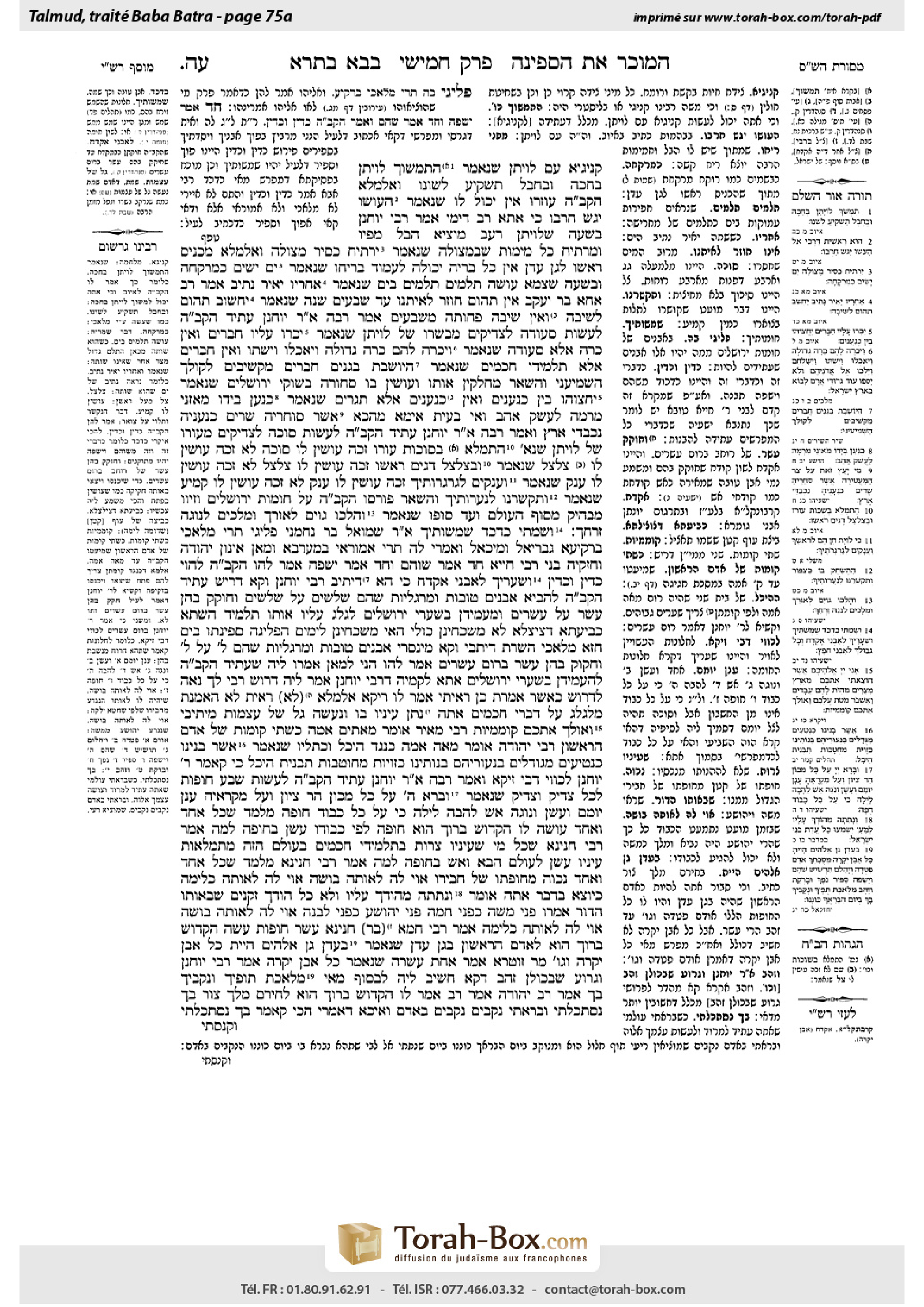
Bava Batra 75a: Talmud study for Daf Yomi
Study the Talmud for Daf Yomi with scanned pages, Hebrew text, English translations from Sefaria and AI-generated French translations.
Passage selection and English or AI-generated French translation are available where the scan has annotations. Daf Study is independent of Torah-Box and Sefaria.
Browse Bava Batra · בבא בתרא · All tractatesBava Batra 75a text and translations
This page of Bava Batra includes the Aramaic text, an English translation and an AI-generated French translation, alongside the scan above.
בבא בתרא ע״ה א · Aramaic and Hebrew text
קְנִיגְיָא עִם לִוְיָתָן, שֶׁנֶּאֱמַר: ״הַתִּמְשֹׁךְ לִוְיָתָן בְּחַכָּה וּבְחֶבֶל תַּשְׁקִיעַ לְשֹׁנוֹ״, וְאִלְמָלֵא הַקָּדוֹשׁ בָּרוּךְ הוּא עוֹזְרוֹ – אֵין יָכוֹל לוֹ; שֶׁנֶּאֱמַר: ״הָעֹשׂוֹ יַגֵּשׁ חַרְבּוֹ״.
כִּי אֲתָא רַב דִּימִי אָמַר רַבִּי יוֹחָנָן: בְּשָׁעָה שֶׁלִּוְיָתָן רָעֵב, מוֹצִיא הֶבֶל מִפִּיו וּמַרְתִּיחַ כׇּל מֵימוֹת שֶׁבַּמְּצוּלָה – שֶׁנֶּאֱמַר: ״יַרְתִּיחַ כַּסִּיר מְצוּלָה״. וְאִלְמָלֵא מַכְנִיס רֹאשׁוֹ לְגַן עֵדֶן – אֵין כׇּל בְּרִיָּה יְכוֹלָה לַעֲמוֹד בְּרֵיחוֹ, שֶׁנֶּאֱמַר: ״יָם יָשִׂים כְּמֶרְקָחָה״.
וּבְשָׁעָה שֶׁצָּמֵא – עוֹשֶׂה תְּלָמִים תְּלָמִים בַּיָּם, שֶׁנֶּאֱמַר: ״אַחֲרָיו יָאִיר נָתִיב״. אָמַר רַב אַחָא בַּר יַעֲקֹב: אֵין תְּהוֹם חוֹזֵר לְאֵיתָנוֹ עַד שִׁבְעִים שָׁנָה, שֶׁנֶּאֱמַר: ״יַחְשֹׁב תְּהוֹם לְשֵׂיבָה״ – וְאֵין ״שֵׂיבָה״ פְּחוּתָה מִשִּׁבְעִים.
אָמַר רַבָּה אָמַר רַבִּי יוֹחָנָן: עָתִיד הַקָּדוֹשׁ בָּרוּךְ הוּא לַעֲשׂוֹת סְעוּדָה לַצַּדִּיקִים מִבְּשָׂרוֹ שֶׁל לִוְיָתָן, שֶׁנֶּאֱמַר: ״יִכְרוּ עָלָיו חַבָּרִים״; וְאֵין ״כֵּרָה״ אֶלָּא סְעוּדָה – שֶׁנֶּאֱמַר: ״וַיִּכְרֶה לָהֶם כֵּרָה גְדוֹלָה וַיֹּאכְלוּ וַיִּשְׁתּוּ״; וְאֵין ״חֲבֵרִים״ אֶלָּא תַּלְמִידֵי חֲכָמִים – שֶׁנֶּאֱמַר: ״הַיּוֹשֶׁבֶת בַּגַּנִּים, חֲבֵרִים מַקְשִׁיבִים לְקוֹלֵךְ, הַשְׁמִיעִנִי״.
וְהַשְּׁאָר – מְחַלְּקִין אוֹתוֹ, וְעוֹשִׂין בּוֹ סְחוֹרָה בְּשׁוּקֵי יְרוּשָׁלַיִם – שֶׁנֶּאֱמַר: ״יֶחֱצוּהוּ בֵּין כְּנַעֲנִים״; וְאֵין ״כְּנַעֲנִים״ אֶלָּא תַּגָּרִים – שֶׁנֶּאֱמַר: ״כְּנַעַן בְּיָדוֹ מֹאזְנֵי מִרְמָה לַעֲשֹׁק אָהֵב״. וְאִי בָּעֵית אֵימָא, מֵהָכָא: ״אֲשֶׁר סֹחֲרֶיהָ שָׂרִים, כִּנְעָנֶיהָ נִכְבַּדֵּי אָרֶץ״.
וְאָמַר רַבָּה אָמַר רַבִּי יוֹחָנָן: עָתִיד הַקָּדוֹשׁ בָּרוּךְ הוּא לַעֲשׂוֹת סוּכָּה לַצַּדִּיקִים מֵעוֹרוֹ שֶׁל לִוְיָתָן, שֶׁנֶּאֱמַר: ״הַתְמַלֵּא בְשֻׂכּוֹת עוֹרוֹ״. זָכָה – עוֹשִׂין לוֹ סוּכָּה, לֹא זָכָה – עוֹשִׂין לוֹ צִלְצָל; שֶׁנֶּאֱמַר: ״וּבְצִלְצַל דָּגִים רֹאשׁוֹ״.
זָכָה – עוֹשִׂין לוֹ צִלְצָל, לֹא זָכָה – עוֹשִׂין לוֹ עֲנָק; שֶׁנֶּאֱמַר: ״וַעֲנָקִים לְגַרְגְּרֹתֶיךָ״. זָכָה – עוֹשִׂין לוֹ עֲנָק, לֹא זָכָה – עוֹשִׂין לוֹ קָמֵיעַ; שֶׁנֶּאֱמַר: ״וְתִקְשְׁרֶנּוּ לְנַעֲרוֹתֶיךָ״.
וְהַשְּׁאָר – פּוֹרְסוֹ הַקָּדוֹשׁ בָּרוּךְ הוּא עַל חוֹמוֹת יְרוּשָׁלַיִם, וְזִיווֹ מַבְהִיק מִסּוֹף הָעוֹלָם וְעַד סוֹפוֹ, שֶׁנֶּאֱמַר: ״וְהָלְכוּ גוֹיִם לְאוֹרֵךְ, וּמְלָכִים לְנֹגַהּ זַרְחֵךְ״.
״וְשַׂמְתִּי כַּדְכֹד שִׁמְשֹׁתַיִךְ״ – אָמַר רַבִּי שְׁמוּאֵל בַּר נַחְמָנִי: פְּלִיגִי תְּרֵי מַלְאֲכֵי בִּרְקִיעָא – גַּבְרִיאֵל וּמִיכָאֵל; וְאָמְרִי לַהּ תְּרֵי אָמוֹרָאֵי בְּמַעְרְבָא, וּמַאן אִינּוּן – יְהוּדָה וְחִזְקִיָּה בְּנֵי רַבִּי חִיָּיא; חַד אָמַר: שׁוֹהַם, וְחַד אָמַר: יָשְׁפֵה. אָמַר לְהוּ הַקָּדוֹשׁ בָּרוּךְ הוּא: לֶהֱוֵי כְּדֵין וּכְדֵין.
״וּשְׁעָרַיִךְ לְאַבְנֵי אֶקְדָּח״ – כִּי הָא דְּיָתֵיב רַבִּי יוֹחָנָן וְקָא דָרֵישׁ: עָתִיד הַקָּדוֹשׁ בָּרוּךְ הוּא לְהָבִיא אֲבָנִים טוֹבוֹת וּמַרְגָּלִיּוֹת שֶׁהֵם שְׁלֹשִׁים עַל שְׁלֹשִׁים, וְחוֹקֵק בָּהֶן עֶשֶׂר עַל עֶשְׂרִים, וּמַעֲמִידָן בְּשַׁעֲרֵי יְרוּשָׁלַיִם. לִגְלֵג עָלָיו אוֹתוֹ תַּלְמִיד: הַשְׁתָּא כְּבֵיעֲתָא דְצִיצְלָא לָא מַשְׁכְּחִינַן, כּוּלֵּי הַאי מַשְׁכְּחִינַן?!
לְיָמִים הִפְלִיגָה סְפִינָתוֹ בַּיָּם, חֲזָא מַלְאֲכֵי הַשָּׁרֵת דְּיָתְבִי וְקָא מְינַסְּרִי אֲבָנִים טוֹבוֹת וּמַרְגָּלִיּוֹת שֶׁהֵם שְׁלֹשִׁים עַל שְׁלֹשִׁים, וְחָקוּק בָּהֶן עֶשֶׂר בְּרוּם עֶשְׂרִים. אֲמַר לְהוּ: הָנֵי לְמַאן? אֲמַרוּ לֵיהּ: שֶׁעָתִיד הַקָּדוֹשׁ בָּרוּךְ הוּא לְהַעֲמִידָן בְּשַׁעֲרֵי יְרוּשָׁלַיִם. אֲתָא לְקַמֵּיהּ דְּרַבִּי יוֹחָנָן, אֲמַר לֵיהּ: דְּרוֹשׁ רַבִּי, לְךָ נָאֶה לִדְרוֹשׁ, כַּאֲשֶׁר אָמַרְתָּ כֵּן רָאִיתִי. אָמַר לוֹ: רֵיקָא! אִלְמָלֵא לֹא רָאִיתָ – לֹא הֶאֱמַנְתָּ; מְלַגְלֵג עַל דִּבְרֵי חֲכָמִים אַתָּה! נָתַן עֵינָיו בּוֹ, וְנַעֲשָׂה גַּל שֶׁל עֲצָמוֹת.
מֵיתִיבִי: ״וָאוֹלֵךְ אֶתְכֶם קוֹמְמִיּוּת״ – רַבִּי מֵאִיר אוֹמֵר: מָאתַיִם אַמָּה, כִּשְׁתֵּי קוֹמוֹת שֶׁל אָדָם הָרִאשׁוֹן.
רַבִּי יְהוּדָה אוֹמֵר: מֵאָה אַמָּה, כְּנֶגֶד הֵיכָל וּכְתָלָיו – שֶׁנֶּאֱמַר: ״אֲשֶׁר בָּנֵינוּ כִּנְטִעִים מְגֻדָּלִים בִּנְעוּרֵיהֶם, בְּנוֹתֵינוּ כְזָוִיֹּת מְחֻטָּבוֹת תַּבְנִית הֵיכָל״! כִּי קָאָמַר רַבִּי יוֹחָנָן – לְכַוֵּוי דְּבֵי זִיקָא.
וְאָמַר רַבָּה אָמַר רַבִּי יוֹחָנָן: עָתִיד הַקָּדוֹשׁ בָּרוּךְ הוּא לַעֲשׂוֹת שֶׁבַע חוּפּוֹת לְכׇל צַדִּיק וְצַדִּיק, שֶׁנֶּאֱמַר: ״וּבָרָא ה׳ עַל כׇּל מְכוֹן הַר צִיּוֹן וְעַל מִקְרָאֶהָ עָנָן יוֹמָם, וְעָשָׁן וְנֹגַהּ אֵשׁ לֶהָבָה לָיְלָה, כִּי עַל כׇּל כָּבוֹד חֻפָּה״ – מְלַמֵּד שֶׁכׇּל אֶחָד וְאֶחָד עוֹשֶׂה לוֹ הַקָּדוֹשׁ בָּרוּךְ הוּא חוּפָּה לְפִי כְּבוֹדוֹ.
עָשָׁן בַּחוּפָּה לָמָּה? אָמַר רַבִּי חֲנִינָא: שֶׁכׇּל מִי שֶׁעֵינָיו צָרוֹת בְּתַלְמִידֵי חֲכָמִים בָּעוֹלָם הַזֶּה, מִתְמַלְּאוֹת עֵינָיו עָשָׁן לָעוֹלָם הַבָּא. וְאֵשׁ בַּחוּפָּה לָמָּה? אָמַר רַבִּי חֲנִינָא: מְלַמֵּד שֶׁכׇּל אֶחָד וְאֶחָד נִכְוֶה מֵחוּפָּתוֹ שֶׁל חֲבֵירוֹ. אוֹי לָהּ לְאוֹתָהּ בּוּשָׁה, אוֹי לָהּ לְאוֹתָהּ כְּלִימָה.
כַּיּוֹצֵא בַּדָּבָר אַתָּה אוֹמֵר: ״וְנָתַתָּה מֵהוֹדְךָ עָלָיו״ – וְלֹא כׇּל הוֹדְךָ; זְקֵנִים שֶׁבְּאוֹתוֹ הַדּוֹר אָמְרוּ: פְּנֵי מֹשֶׁה כִּפְנֵי חַמָּה, פְּנֵי יְהוֹשֻׁעַ כִּפְנֵי לְבָנָה; אוֹי לָהּ לְאוֹתָהּ בּוּשָׁה, אוֹי לָהּ לְאוֹתָהּ כְּלִימָּה.
אָמַר רַבִּי חָמָא בַּר חֲנִינָא: עֶשֶׂר חוּפּוֹת עָשָׂה הַקָּדוֹשׁ בָּרוּךְ הוּא לְאָדָם הָרִאשׁוֹן בְּגַן עֵדֶן – שֶׁנֶּאֱמַר: ״בְּעֵדֶן גַּן אֱלֹהִים הָיִיתָ, כׇּל אֶבֶן יְקָרָה וְגוֹ׳״. מָר זוּטְרָא אָמַר: אַחַת עֶשְׂרֵה, שֶׁנֶּאֱמַר: ״כׇּל אֶבֶן יְקָרָה״. אָמַר רַבִּי יוֹחָנָן: וְגָרוּעַ שֶׁבְּכוּלָּן – זָהָב, דְּקָא חָשֵׁיב לֵיהּ לְבַסּוֹף.
מַאי ״מְלֶאכֶת תֻּפֶּיךָ וּנְקָבֶיךָ בָּךְ״? אָמַר רַב יְהוּדָה אָמַר רַב: אָמַר לוֹ הַקָּדוֹשׁ בָּרוּךְ הוּא לְחִירָם מֶלֶךְ צוֹר: ״בְּךָ נִסְתַּכַּלְתִּי, וּבָרָאתִי נְקָבִים נְקָבִים בָּאָדָם״. וְאִיכָּא דְאָמְרִי, הָכִי קָאָמַר: בְּךָ נִסְתַּכַּלְתִּי,
Bava Batra 75a · English translation
a hunt of the leviathan, as it is stated: “Can you draw out leviathan with a fish hook? Or press down his tongue with a cord?” (Job 40:25). And were the Holy One, Blessed be He, not assisting Gabriel, he would not be able to hunt it, as it is stated: “Only He Who made him can use His sword to approach him” (Job 40:19).
When Rav Dimi came from Eretz Yisrael to Babylonia, he said that Rabbi Yoḥanan said: When the leviathan is hungry, he produces breath from his mouth and thereby boils all of the waters in the depths of the sea. As it is stated: “He makes the deep boil like a pot” (Job 41:23). And if the leviathan did not place its head in the Garden of Eden, no creature could withstand his foul smell, as it is stated: “He makes the sea like a seething mixture [merkaḥa]” (Job 41:23), and the term merkaḥa is also used to describe something with a smell (see Exodus 30:25).
And when he is thirsty, he makes many furrows in the sea, as it is stated: “He makes a path to shine after him” (Job 41:24). Rav Aḥa bar Yaakov says: After the leviathan drinks from the sea, the depth of the sea does not return to its normal condition until seventy years have passed, as it is stated: “One would think the deep to be hoary” (Job 41:24), and hoary indicates a person who is no less than seventy years old.
Rabba says that Rabbi Yoḥanan says: In the future, the Holy One, Blessed be He, will make a feast for the righteous from the flesh of the leviathan, as it is stated: “The ḥabbarim will make a feast [yikhru] of him” (Job 40:30). And kera means nothing other than a feast, as it is stated: “And he prepared [va’yikhreh] for them a great feast [kera]; and they ate and drank” (II Kings 6:23). And ḥabbarim means nothing other than Torah scholars, as it is stated: “You that dwell in the gardens, the companions [ḥaverim] hearken for your voice: Cause me to hear it” (Song of Songs 8:13). This verse is interpreted as referring to Torah scholars, who listen to God’s voice.
And with regard to the remainder of the leviathan, they will divide it and use it for commerce in the markets of Jerusalem, as it is stated: “They will part him among the kena’anim” (Job 40:30). And kena’anim means nothing other than merchants, as it is stated: “As for the merchant [kena’an], the balances of deceit are in his hand. He loves to oppress” (Hosea 12:8). And if you wish, say that the proof is from here: “Whose merchants are princes, whose traffickers [kinaneha] are the honorable of the earth” (Isaiah 23:8).
And Rabba says that Rabbi Yoḥanan says: In the future, the Holy One, Blessed be He, will prepare a sukka for the righteous from the skin of the leviathan, as it is stated: “Can you fill his skin with barbed irons [besukkot]” (Job 40:31). If one is deserving of being called righteous, an entire sukka is prepared for him from the skin of the leviathan; if one is not deserving of this honor, a covering is prepared for his head, as it is stated: “Or his head with fish-spears” (Job 40:31).
If one is deserving at least of this reward, a covering is prepared for him, and if one is not deserving, a necklace is prepared for him, as it is stated: “And necklaces about your neck” (Proverbs 1:9). If one is somewhat deserving, a necklace is prepared for him, and if one is not deserving even of this, only an amulet is prepared for him from the skin of the leviathan, as it is stated: “Or will you bind him for your maidens” (Job 40:29), i.e., a small amulet is prepared for him, like the amulets tied on children’s necks.
And with regard to the remaining part of the skin of the leviathan, the Holy One, Blessed be He, spreads it on the walls of Jerusalem, and its glory radiates from one end of the world until the other end. As it is stated: “And nations shall walk in your light, and kings at the brightness of your rising” (Isaiah 60:3).
§ With regard to the future glory of Jerusalem, the Gemara interprets the verse: “And I will make your pinnacles of kadkhod” (Isaiah 54:12). Rabbi Shmuel bar Naḥmani said: Two angels in heaven, Gabriel and Michael, disagree with regard to the material that will be used to form the walls of Jerusalem. And some say that this dispute is between two amora’im in the West, i.e., Eretz Yisrael. And who are they? They are Yehuda and Ḥizkiyya, the sons of Rabbi Ḥiyya. One said they will be made of onyx, and one said of jasper. The Holy One, Blessed be He, said to them: Let it be like this [kedein] and like that [ukhedein], i.e., let them be formed from both together. This compromise is indicated by the word kadkhod, a combination of this [kedein] and that [ukhedein].
The Gemara analyzes the rest of that verse: “And your gates of precious stones” (Isaiah 54:12). This should be understood in light of that incident where Rabbi Yoḥanan sat and taught: In the future, the Holy One, Blessed be He, will bring precious stones and pearls that are thirty by thirty cubits, and He will hollow out in them a hole of ten by twenty cubits and set them in the gates of Jerusalem. A certain unnamed student sneered at him, saying: Now we do not find precious stones even of the size of an egg of a dove, and yet all of this we will find?
After a period of time that student’s ship went to sea, where he saw ministering angels sitting and sawing precious stones and pearls that were thirty by thirty cubits, and hollowed out in them were holes of ten by twenty cubits. He said to the angels: For whom are these? They said to him that in the future, the Holy One, Blessed be He, will place them in the gates of Jerusalem. Later, the student came before Rabbi Yoḥanan and said to him: Continue to interpret, my teacher, it is fitting for you to interpret, as I saw just as you said. Rabbi Yoḥanan said to him: Worthless man, if you had not seen, you would not have believed; clearly, you are mocking the statement of the Sages. Rabbi Yoḥanan set his eyes upon him, and the student was instantly killed and turned into a pile of bones.
The Gemara raises an objection against Rabbi Yoḥanan’s statement, based on a baraita. The verse states: “And I will make you go upright [komemiyyut]” (Leviticus 26:13). Rabbi Meir says: In the future, the Jewish people will have the stature of two hundred cubits, equivalent to two times the height [komot] of Adam the first man, whose height was one hundred cubits. Rabbi Meir interprets the word komemiyyut as two komot.
Rabbi Yehuda says: They will have the stature of one hundred cubits, corresponding to the Sanctuary and its walls, as it is stated: “We whose sons are as plants grown up in their youth; whose daughters are as corner-pillars carved after the fashion of the Sanctuary” (Psalms 144:12). But if they are each one hundred cubits tall, how could the Jews enter the gates of Jerusalem, whose entrance gate will be ten by twenty cubits, as claimed by Rabbi Yoḥanan? The Gemara answers: When Rabbi Yoḥanan stated that idea, he was not referring to the gates themselves but to the windows that allow wind to enter.
§ And Rabba says that Rabbi Yoḥanan says: In the future, the Holy One, Blessed be He, will fashion seven canopies for each and every righteous individual, as it is stated: “And the Lord will create over the whole habitation of Mount Zion, and over those who are invited to it, a cloud and smoke by day, and the shining of a flaming fire by night; for over all the glory shall be a canopy” (Isaiah 4:5). This teaches that for each and every righteous individual, the Holy One, Blessed be He, fashions for him a canopy seven times over, in accordance with his honor, i.e., greater individuals receive grander and larger canopies.
The Gemara asks a question with regard to the above verse: Why should there be smoke in a canopy? Rabbi Ḥanina said: It is because anyone whose eyes are narrow, i.e., is stingy, toward Torah scholars in this world, his eyes fill with smoke in the World-to-Come. And why should there be fire in a canopy? Rabbi Ḥanina said: This teaches that each and every one is burned from embarrassment at the size of the canopy of the other, and says: Woe for this embarrassment, woe for this disgrace, that I did not merit a canopy as large as his.
In a similar manner, you can say that God said to Moses about Joshua: “And you shall put of your honor upon him” (Numbers 27:20), which indicates that you should put some of your honor, but not all of your honor. The elders of that generation said: The face of Moses was as bright as the face of the sun; the face of Joshua was like the face of the moon. Woe for this embarrassment, woe for this disgrace, that we did not merit another leader of the stature of Moses.
Rabbi Ḥama bar Ḥanina says: The Holy One, Blessed be He, fashioned ten canopies for Adam the first man, in the Garden of Eden; as it is stated to Hiram, king of Tyre: “You were in Eden the garden of God; every precious stone was your covering, the carnelian, the topaz, and the emerald, the beryl, the onyx, and the jasper, the sapphire, the carbuncle, and the smaragd, and gold; the workmanship of your drums and of your holes was in you; they were prepared on the day that you were created” (Ezekiel 28:13). This verse mentions ten items, from carnelian to gold. Mar Zutra said: There were eleven canopies, as it states: “Every precious stone,” which is also part of the tally. Rabbi Yoḥanan said: And the worst of all of them was gold, as it is counted last, which indicates that the other items are more valuable.
The Gemara asks: What is the meaning of the phrase: “The workmanship of your drums and of your holes [nekavekha]” (Ezekiel 28:13)? Rav Yehuda says that Rav says: The Holy One, Blessed be He, said to Hiram, king of Tyre: Were you in the Garden of Eden when I created all of this for you? I looked at you, saw that you would one day claim divinity for yourself, and created many orifices [nekavim] in man, i.e., the excretory system, so that you would know that you are human and not a god. And there are those who say that this is what God said to Hiram: I looked at you
Bava Batra 75a · Traduction française (IA)
une chasse au léviathan, comme il est dit : « Peux-tu attirer le léviathan avec une ligne à pêche ? Ou le faire taire avec une corde ? » (Job 40:25). Et s'il n'était pas aidé par le Saint, le Béni soit-Il, Gabriel, il ne pourrait pas le chasser, comme il est dit : « Seul celui qui l'a créé peut utiliser son épée pour s'approcher de lui » (Job 40:19).
Quand Rav Dimi est venu de la Terre d'Israël en Babylone, il a dit que Rabbi Yoḥanan a dit : Quand le léviathan a faim, il exhale de l'air de sa bouche et fait bouillir toutes les eaux des profondeurs de la mer. Comme il est dit : « Il fait bouillir les profondeurs comme une marmite » (Job 41:23). Et si le léviathan n'avait pas mis sa tête dans le Jardin d'Éden, aucun être ne pourrait résister à son odeur nauséabonde, comme il est dit : « Il fait la mer comme une mélange bouillonnant [merkaḥa] » (Job 41:23), et le terme merkaḥa désigne aussi quelque chose qui a une odeur (voir Exode 30:25).
Et quand il a soif, il fait de nombreuses entailles dans la mer, comme il est dit : « Il fait un chemin pour briller après lui » (Job 41:24). Rav Aḥa bar Yaakov dit : Après que le léviathan a bu de la mer, la profondeur de la mer ne retrouve pas son état normal avant que soient passés soixante-dix ans, comme il est dit : « On croirait que la mer est blanchie » (Job 41:24), et blanchie désigne une personne dont l'âge est au moins de soixante-dix ans.
Rabba dit que Rabbi Yoḥanan dit : À l'avenir, le Saint, le Béni soit-Il, fera un festin pour les justes à partir de la chair du léviathan, comme il est dit : « Les ḥabbarim feront un festin [yikhru] de lui » (Job 40:30). Et kera ne signifie rien d'autre qu'un festin, comme il est dit : « Et il prépara [va’yikhreh] pour eux un grand festin [kera] ; et ils mangèrent et burent » (II Rois 6:23). Et ḥabbarim ne signifie rien d'autre que des savants de la Torah, comme il est dit : « Vous qui habitiez dans les jardins, les compagnons [ḥaverim] écoutent votre voix : Faites-moi entendre cela » (Songe des Songes 8:13). Cette verset est interprété comme désignant les savants de la Torah, qui écoutent la voix de Dieu.
Et concernant la partie restante du léviathan, ils le partageront et l'utiliseront pour le commerce dans les marchés de Jérusalem, comme il est dit : « Ils le partageront parmi les kena’anim » (Job 40:30). Et kena’anim ne signifie rien d'autre que des marchands, comme il est dit : « Quant au marchand [kena’an], les balances de tromperie sont en sa main. Il aime opprimer » (Osée 12:8). Et si vous le souhaitez, dites que la preuve vient d'ici : « Whose merchants are princes, whose traffickers [kinaneha] are the honorable of the earth » (Isaïe 23:8).
Et Rabba dit que Rabbi Yoḥanan dit : À l'avenir, le Saint, le Béni soit-Il, préparera une hutte pour les justes à partir de la peau du léviathan, comme il est dit : « Peux-tu remplir sa peau avec des barbes d'irons [besukkot] » (Job 40:31). Si l'on est digne d'être appelé juste, une hutte entière est préparée pour lui à partir de la peau du léviathan ; si l'on n'est pas digne de ce honneur, un couvre-chef est préparé pour sa tête, comme il est dit : « Ou sa tête avec des piques de poisson » (Job 40:31).
Si l'on est digne au moins de cette récompense, un couvre-chef est préparé pour lui, et si l'on n'est pas digne, un collier est préparé pour lui, comme il est dit : « Et des colliers autour de votre cou » (Proverbes 1:9). Si l'on est quelque peu digne, un collier est préparé pour lui, et si l'on n'est pas digne même de cela, seul un talisman est préparé pour lui à partir de la peau du léviathan, comme il est dit : « Ou pouras-tu le lier pour tes servantes » (Job 40:29), c'est-à-dire un petit talisman est préparé pour lui, comme les talismans attachés au cou des enfants.
Et concernant la partie restante de la peau du léviathan, le Saint, le Béni soit-Il, l'étend sur les murs de Jérusalem, et sa splendeur rayonne de l'un bout du monde à l'autre. Comme il est dit : « Et les nations marcheront dans votre lumière, et les rois à la splendeur de votre lever » (Isaïe 60:3).
§ Concernant la gloire future de Jérusalem, la Guemara interprète la versette : « Et je ferai vos pinnacles de kadkhod » (Isaïe 54:12). Rabbi Shmuel bar Naḥmani a dit : Deux anges au ciel, Gabriel et Michel, s'entretiennent sur le matériau qui sera utilisé pour former les murs de Jérusalem. Et certains disent que ce désaccord est entre deux tanna’im en Occident, c'est-à-dire en Terre d'Israël. Et qui sont-ils ? Ce sont Yehuda et Ḥizkiyya, les fils de Rabbi Ḥiyya. L'un a dit qu'ils seront faits d'onyx, l'autre de jaspe. Le Saint, le Béni soit-Il, a dit à eux : Fassez-le ainsi [kedein] et ainsi [ukhedein], c'est-à-dire qu'ils soient formés des deux ensemble. Ce compromis est indiqué par le mot kadkhod, une combinaison de ce [kedein] et de cela [ukhedein].
Le Guemara analyse le reste de cette versette : « Et vos portes de pierres précieuses » (Isaïe 54:12). Cela doit être compris à la lumière de cet incident où Rabbi Yoḥanan s'est assis et a enseigné : À l'avenir, le Saint, le Béni soit-Il, apportera des pierres et des perles précieuses de trente par trente de coudées, et il creusera dans elles un trou de dix par vingt de coudées et les placera dans les portes de Jérusalem. Un certain étudiant inconnu a moqué ce propos, disant : Maintenant, nous ne trouvons même pas de pierres précieuses de la taille d'un œuf de moineau, et pourtant nous trouverons tout cela ?
Après un certain temps, le bateau de cet étudiant est parti en mer, où il a vu des anges ministériels assis et taillant des pierres et des perles précieuses de trente par trente de coudées, et dans lesquelles étaient creusés des trous de dix par vingt de coudées. Il a dit aux anges : Pour qui sont-ils ? Ils lui ont répondu que dans l'avenir, le Saint, le Béni soit-Il, les placera dans les portes de Jérusalem. Plus tard, l'étudiant est venu devant Rabbi Yoḥanan et lui a dit : Continuez à interpréter, mon maître, il est convenable que vous interprétez, car je viens de voir exactement ce que vous avez dit. Rabbi Yoḥanan a dit à lui : Homme inutile, si tu n'avais pas vu, tu ne croirais pas ; clairement, tu moques la parole des Sages. Rabbi Yoḥanan a fixé ses yeux sur lui, et l'étudiant est instantanément mort et est devenu une pile de os.
La Guemara soulève une objection contre l'affirmation du Rabbi Yoḥanan, fondée sur une baraïta. La Bible dit : « Et je ferai que vous marchiez droit [komemiyyut] » (Lévitique 26:13). Le Rabbi Meir dit : Dans l'avenir, le peuple juif aura la stature de deux cents coudées, équivalant à deux fois la hauteur [komot] d'Adam, le premier homme, dont la hauteur était de cent coudées. Le Rabbi Meir interprète le mot komemiyyut comme deux komot.
Le Rabbi Yehuda dit : Ils auront la stature de cent coudées, correspondant au Sanctuaire et à ses murs, comme il est dit : « Nous dont les fils sont comme des plantes mûres à l'âge de la jeunesse ; dont les filles sont comme des piliers de coin sculptés selon la forme du Sanctuaire » (Ps 144:12). Mais si chacun mesure cent coudées de haut, comment les Juifs pourraient-ils entrer dans les portes de Jérusalem, dont la porte d'entrée mesure dix par vingt coudées, selon l'affirmation du Rabbi Yoḥanan ? La Guemara répond : Lorsque le Rabbi Yoḥanan a dit cela, il ne faisait pas référence aux portes elles-mêmes, mais aux fenêtres qui permettent l'entrée de l'air.
§ Rabba dit que le Rabbi Yoḥanan dit : Dans l'avenir, le Saint, le Très Haut, formera sept tentes pour chaque individu juste, comme il est dit : « Et le Seigneur créera sur toute la demeure de la montagne de Sion, et sur ceux qui y sont invités, un nuage et une fumée par jour, et la lumière d'un feu flamboyant par nuit ; car sur toute la gloire sera une tente » (Is 4:5). Cela enseigne que pour chaque individu juste, le Saint, le Très Haut, forme pour lui une tente sept fois, conformément à son honneur, c'est-à-dire que les personnes plus grandes recevront des tentes plus grandes et plus majestueuses.
La Guemara pose une question concernant le verset ci-dessus : Pourquoi y a-t-il de la fumée dans une tente ? Le Rabbi Ḥanina dit : C'est parce que celui dont les yeux sont étroits, c'est-à-dire qui est avare envers les savants de la Torah dans ce monde, ses yeux seront remplis de fumée dans l'au-delà. Et pourquoi y a-t-il du feu dans une tente ? Le Rabbi Ḥanina dit : Cela enseigne que chacun est brûlé par l'embarras de la taille de la tente de l'autre, et dit : Malheur pour cet embarras, malheur pour cette honte, que je n'ai pas mérité une tente aussi grande que la sienne.
De la même manière, on peut dire que Dieu a dit à Moïse à propos de Josué : « Et tu mettras de ton honneur sur lui » (Nm 27:20), ce qui indique que tu devrais mettre une partie de ton honneur, mais pas tout ton honneur. Les anciens de cette génération dirent : Le visage de Moïse était aussi brillant que celui du soleil ; le visage de Josué était comme celui de la lune. Malheur pour cet embarras, malheur pour cette honte, que nous n'avons pas mérité un autre chef de la stature de Moïse.
Le Rabbi Ḥama bar Ḥanina dit : Le Saint, le Très Haut, a façonné dix tentes pour Adam, le premier homme, dans le Jardin d'Éden ; comme il est dit à Hiram, roi de Tyr : « Tu étais dans le jardin d'Éden, le jardin de Dieu ; toutes les pierres précieuses étaient ton couverture, le carnelian, le topaze, et l'émeraude, le béryl, l'onyx, et le jaspe, le saphir, le carbuncle, et le smaragd, et l'or ; l'ouvrage de tes tambours et de tes orifices était en toi ; ils étaient préparés le jour où tu as été créé » (Ez 28:13). Ce verset mentionne dix éléments, du carnelian à l'or. Mar Zutra dit : Il y avait onze tentes, comme il est dit : « Toutes les pierres précieuses », ce qui est aussi compté. Le Rabbi Yoḥanan dit : Et le pire de tous était l'or, comme il est mentionné en dernier, ce qui indique que les autres éléments sont plus précieux.
La Guemara pose la question : Quelle est la signification de la phrase : « L'ouvrage de tes tambours et de tes orifices [nekavekha] » (Ez 28:13) ? Rav Yehuda dit que Rav dit : Le Saint, le Très Haut, a dit à Hiram, roi de Tyr : Étais-tu dans le Jardin d'Éden lorsque j'ai créé tout cela pour toi ? J'ai regardé, j'ai vu que tu allais un jour prétendre à la divinité, et j'ai créé beaucoup d'orifices [nekavim] chez l'homme, c'est-à-dire le système excretoire, afin que tu saches que tu es humain et non un dieu. Et ceux qui disent que c'est ce que Dieu a dit à Hiram : J'ai regardé, j'ai vu que tu allais un jour prétendre à la divinité
Traduction française générée par IA à partir de l’édition anglaise de Sefaria. Vérifie toujours un passage avec le texte source.
Text from Sefaria: William Davidson Edition - Vocalized Aramaic (CC BY NC); William Davidson Edition - English (CC BY NC).