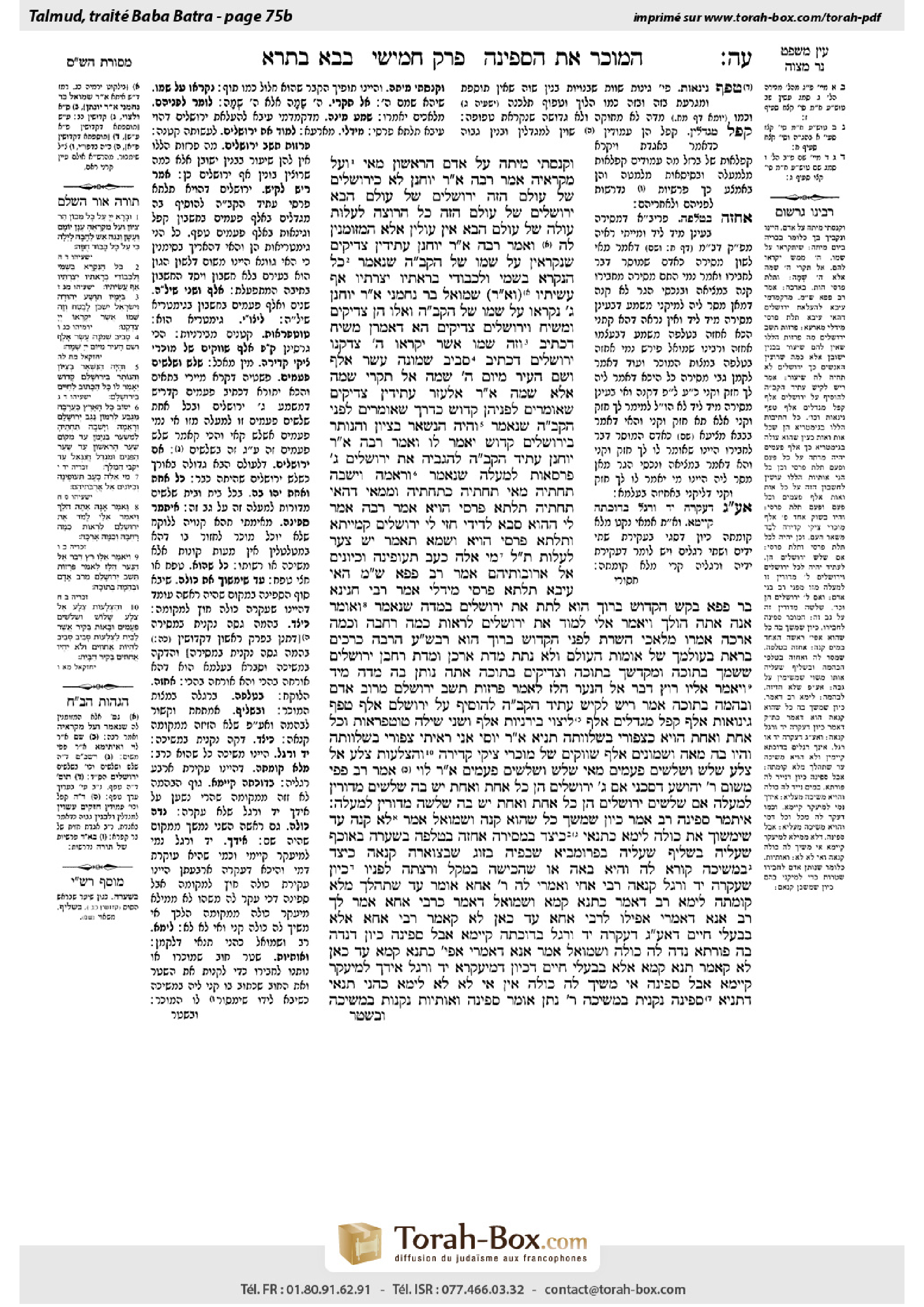
Bava Batra 75b: Talmud study for Daf Yomi
Study the Talmud for Daf Yomi with scanned pages, Hebrew text, English translations from Sefaria and AI-generated French translations.
Passage selection and English or AI-generated French translation are available where the scan has annotations. Daf Study is independent of Torah-Box and Sefaria.
Browse Bava Batra · בבא בתרא · All tractatesBava Batra 75b text and translations
This page of Bava Batra includes the Aramaic text, an English translation and an AI-generated French translation, alongside the scan above.
בבא בתרא ע״ה ב · Aramaic and Hebrew text
וְקָנַסְתִּי מִיתָה עַל אָדָם הָרִאשׁוֹן.
מַאי ״וְעַל מִקְרָאֶהָ״? אָמַר רַבָּה אָמַר רַבִּי יוֹחָנָן: לֹא כִּירוּשָׁלַיִם שֶׁל עוֹלָם הַזֶּה יְרוּשָׁלַיִם שֶׁל עוֹלָם הַבָּא; יְרוּשָׁלַיִם שֶׁל עוֹלָם הַזֶּה – כָּל הָרוֹצֶה לַעֲלוֹת עוֹלֶה, שֶׁל עוֹלָם הַבָּא – אֵין עוֹלִין אֶלָּא הַמְזוּמָּנִין לָהּ.
וְאָמַר רַבָּה אָמַר רַבִּי יוֹחָנָן: עֲתִידִין צַדִּיקִים שֶׁנִּקְרָאִין עַל שְׁמוֹ שֶׁל הַקָּדוֹשׁ בָּרוּךְ הוּא, שֶׁנֶּאֱמַר: ״כֹּל הַנִּקְרָא בִשְׁמִי וְלִכְבוֹדִי בְּרָאתִיו, יְצַרְתִּיו אַף עֲשִׂיתִיו״. וְאָמַר רַבִּי שְׁמוּאֵל בַּר נַחְמָנִי אָמַר רַבִּי יוֹחָנָן: שְׁלֹשָׁה נִקְרְאוּ עַל שְׁמוֹ שֶׁל הַקָּדוֹשׁ בָּרוּךְ הוּא, וְאֵלּוּ הֵן: צַדִּיקִים, וּמָשִׁיחַ, וִירוּשָׁלִַים.
צַדִּיקִים – הָא דַּאֲמַרַן. מָשִׁיחַ – דִּכְתִיב: ״וְזֶה שְּׁמוֹ אֲשֶׁר יִקְרְאוֹ ה׳ צִדְקֵנוּ״. יְרוּשָׁלַיִם – דִּכְתִיב: ״סָבִיב שְׁמֹנָה עָשָׂר אָלֶף, וְשֵׁם הָעִיר מִיּוֹם ה׳ שָׁמָּה״, אַל תִּקְרֵי ״שָׁמָּה״ אֶלָּא ״שְׁמָהּ״. אָמַר רַבִּי אֶלְעָזָר: עֲתִידִין צַדִּיקִים שֶׁאוֹמְרִים לִפְנֵיהֶן ״קָדוֹשׁ״ – כְּדֶרֶךְ שֶׁאוֹמְרִים לִפְנֵי הַקָּדוֹשׁ בָּרוּךְ הוּא, שֶׁנֶּאֱמַר: ״וְהָיָה הַנִּשְׁאָר בְּצִיּוֹן וְהַנּוֹתָר בִּירוּשָׁלִַם, קָדוֹשׁ יֵאָמֶר לוֹ״.
וְאָמַר רַבָּה אָמַר רַבִּי יוֹחָנָן: עָתִיד הַקָּדוֹשׁ בָּרוּךְ הוּא לְהַגְבִּיהַּ אֶת יְרוּשָׁלַיִם שָׁלֹשׁ פַּרְסָאוֹת לְמַעְלָה, שֶׁנֶּאֱמַר: ״וְרָאֲמָה וְיָשְׁבָה תַחְתֶּיהָ״; מַאי ״תַּחְתֶּיהָ״ – כְּתַחְתֶּיהָ. וּמִמַּאי דְּהַאי ״תַּחְתֶּיהָ״ תְּלָתָא פַּרְסֵי הָוְיָא? אָמַר רַבָּה, אֲמַר לִי הָהוּא סָבָא: לְדִידִי חֲזֵי לִי יְרוּשָׁלַיִם קַמַּיְיתָא, וּתְלָתָא פַּרְסֵי הָוְיָא.
וְשֶׁמָּא תֹּאמַר: יֵשׁ צַעַר לַעֲלוֹת? תַּלְמוּד לוֹמַר: ״מִי אֵלֶּה כָּעָב תְּעוּפֶינָה, וְכַיּוֹנִים אֶל אֲרֻבֹּתֵיהֶם״. אָמַר רַב פָּפָּא: שְׁמַע מִינַּהּ, הַאי עֵיבָא – תְּלָתָא פַּרְסֵי מִידְּלֵי.
אָמַר רַבִּי חֲנִינָא בַּר פָּפָּא: בִּקֵּשׁ הַקָּדוֹשׁ בָּרוּךְ הוּא לָתֵת אֶת יְרוּשָׁלַיִם בְּמִדָּה, שֶׁנֶּאֱמַר: ״וָאֹמַר אָנָה אַתָּה הֹלֵךְ, וַיֹּאמֶר אֵלַי: לָמֹד אֶת יְרוּשָׁלִַם, לִרְאוֹת כַּמָּה רׇחְבָּהּ וְכַמָּה אׇרְכָּהּ״ –
אָמְרוּ מַלְאֲכֵי הַשָּׁרֵת לִפְנֵי הַקָּדוֹשׁ בָּרוּךְ הוּא: רִבּוֹנוֹ שֶׁל עוֹלָם, הַרְבֵּה כְּרַכִּים בָּרָאתָ בְּעוֹלָמְךָ שֶׁל אוּמּוֹת הָעוֹלָם – וְלֹא נָתַתָּ מִדַּת אׇרְכָּן וּמִדַּת רׇחְבָּן; יְרוּשָׁלַיִם – שֶׁשִּׁמְךָ בְּתוֹכָהּ, וּמִקְדָּשְׁךָ בְּתוֹכָהּ, וְצַדִּיקִים בְּתוֹכָהּ – אַתָּה נוֹתֵן בָּהּ מִדָּה?! מִיָּד – ״וַיֹּאמֶר אֵלָו, רֻץ דַּבֵּר אֶל הַנַּעַר הַלָּז לֵאמֹר: פְּרָזוֹת תֵּשֵׁב יְרוּשָׁלִַם, מֵרֹב אָדָם וּבְהֵמָה בְּתוֹכָהּ״.
אָמַר רֵישׁ לָקִישׁ: עָתִיד הַקָּדוֹשׁ בָּרוּךְ הוּא לְהוֹסִיף עַל יְרוּשְׁלֶם אֶלֶף טֶפֶף גִּינּוֹאוֹת, אֶלֶף קֶפֶל מִגְדָּלִים, אֶלֶף לִיצוֹי בִּירָנִיּוֹת, אֶלֶף וּשְׁנֵי שִׁילֹה טוֹטַפְרָאוֹת; וְכׇל אַחַת וְאַחַת הָוְיָא כְּצִפּוֹרִי בְּשַׁלְווֹתָהּ.
תַּנְיָא, אָמַר רַבִּי יוֹסֵי: אֲנִי רָאִיתִי צִפּוֹרִי בְּשַׁלְווֹתָהּ, וְהָיוּ בָּהּ מֵאָה וּשְׁמוֹנִים אֶלֶף שְׁוָוקִים שֶׁל מוֹכְרֵי צִיקֵי קְדֵירָה.
״וְהַצְּלָעוֹת צֵלָע אֶל צֵלָע, שָׁלוֹשׁ וּשְׁלֹשִׁים פְּעָמִים״ – מַאי ״שָׁלוֹשׁ וּשְׁלֹשִׁים פְּעָמִים״? אָמַר רַבִּי לֵוִי, אָמַר רַב פַּפֵּי מִשּׁוּם רַבִּי יְהוֹשֻׁעַ דְּסִכְנִי: אִם שָׁלֹשׁ יְרוּשָׁלַיִם הֵן, כׇּל אַחַת וְאַחַת יֵשׁ בָּהּ שְׁלֹשִׁים מְדוֹרִין לְמַעְלָה; אִם שְׁלֹשִׁים יְרוּשָׁלַיִם הֵן, כׇּל אַחַת וְאַחַת יֵשׁ בָּהּ שְׁלֹשָׁה מְדוֹרִין לְמַעְלָה.
אִיתְּמַר: סְפִינָה – רַב אָמַר: כֵּיוָן שֶׁמָּשַׁךְ כׇּל שֶׁהוּא – קָנָה. וּשְׁמוּאֵל אָמַר: לֹא קָנָה עַד שֶׁיִּמְשׁוֹךְ אֶת כּוּלָּהּ.
לֵימָא כְּתַנָּאֵי – כֵּיצַד בִּמְסִירָה? אֲחָזָהּ בְּטַלְפָּהּ, בִּשְׂעָרָהּ, בְּאוּכָּף שֶׁעָלֶיהָ, בִּשְׁלִיף שֶׁעָלֶיהָ, בִּפְרוּמְבְּיָא שֶׁבְּפִיהָ, בְּזוֹג שֶׁבְּצַוָּארָהּ – קְנָאָהּ. כֵּיצַד בִּמְשִׁיכָה? קוֹרֵא לָהּ וְהִיא בָּאָה, אוֹ שֶׁהִכִּישָׁהּ בְּמַקֵּל וְרָצְתָה לְפָנָיו – כֵּיוָן שֶׁעָקְרָה יָד וָרֶגֶל, קְנָאָהּ. רַבִּי אַחַי וְאָמְרִי לַהּ רַבִּי אַחָא אוֹמֵר: עַד שֶׁתְּהַלֵּךְ מְלֹא קוֹמָתָהּ.
לֵימָא רַב דְּאָמַר כְּתַנָּא קַמָּא וּשְׁמוּאֵל דְּאָמַר כְּרַבִּי אַחָא? אָמַר לְךָ רַב: אֲנָא דַּאֲמַרִי אֲפִילּוּ לְרַבִּי אַחָא – עַד כָּאן לָא קָאָמַר רַבִּי אַחָא אֶלָּא בְּבַעֲלֵי חַיִּים; דְּאַף עַל גַּב דְּעָקְרָה יָד וָרֶגֶל – בְּדוּכְתַּהּ קָיְימָא; אֲבָל סְפִינָה, כֵּיוָן דְּנָדָה בַּהּ פּוּרְתָּא – נָדָה לַהּ כּוּלָּהּ.
וּשְׁמוּאֵל אָמַר: אֲנָא דַּאֲמַרִי אֲפִילּוּ כְּתַנָּא קַמָּא – עַד כָּאן לָא קָאָמַר תַּנָּא קַמָּא אֶלָּא בְּבַעֲלֵי חַיִּים, דְּכֵיוָן דְּמִיעַקְרָא יָד וָרֶגֶל – אִידַּךְ לְמִיעְקַר קָיְימָא; אֲבָל סְפִינָה, אִי מָשֵׁיךְ לַהּ כּוּלַּהּ – אִין, אִי לָא – לָא.
לֵימָא כְּהָנֵי תַּנָּאֵי – דְּתַנְיָא: סְפִינָה נִקְנֵית בִּמְשִׁיכָה. רַבִּי נָתָן אוֹמֵר: סְפִינָה וְאוֹתִיּוֹת נִקְנוֹת בִּמְשִׁיכָה
Bava Batra 75b · English translation
and I decreed death on Adam the first man, to demonstrate that he was human and not a god.
§ The Gemara returns to the aforementioned verse: “And the Lord will create over the whole habitation of Mount Zion, and over those who are invited to it, a cloud and smoke by day” (Isaiah 4:5). What is the meaning of the phrase: “And over those who are invited to it”? Rabba says that Rabbi Yoḥanan says: Jerusalem of the World-to-Come is not like Jerusalem of this world. With regard to Jerusalem of this world, anyone who wants to ascend there can ascend. With regard to Jerusalem of the World-to-Come, only those who are invited to it can ascend.
And Rabba says that Rabbi Yoḥanan says: In the future, the righteous will be called by the name of the Holy One, Blessed be He; as it is stated: “Every one that is called by My name, and whom I have created for My glory, I have formed him, yea, I have made him” (Isaiah 43:7). This indicates that one who was created by God and causes Him glory is called by His name. And Rabbi Shmuel bar Naḥmani says that Rabbi Yoḥanan says: Three were called by the name of the Holy One, Blessed be He, and they are: The righteous, and the Messiah, and Jerusalem.
With regard to the righteous, this is as we have just said. With regard to the Messiah, this is as it is written: “And this is his name whereby he shall be called, the Lord is our righteousness” (Jeremiah 23:6). With regard to Jerusalem, this is as it is written: “It shall be eighteen thousand reeds round about. And the name of the city from that day shall be, the Lord is there [shamma]” (Ezekiel 48:35). Do not read the word as “there” [shamma]; rather, read it as: The Lord is its name [shemah]. Rabbi Elazar says: In the future, the righteous will have the name: Holy, recited before them, as one recites before the Holy One, Blessed be He; as it is stated: “And it shall come to pass, that he who is left in Zion, and he who remains in Jerusalem, shall be called holy” (Isaiah 4:3).
And Rabba says that Rabbi Yoḥanan says: In the future, the Holy One, Blessed be He, will raise Jerusalem three parasangs upward; as it is stated: “And it shall be lifted up and inhabited in its place” (Zechariah 14:10). What is the meaning of the phrase “in its place”? It means equivalent to its place, i.e., Jerusalem will be raised to a height whose measure in parasangs corresponds to the measure of its area in square parasangs. The Gemara asks: And from where is it derived that the place of Jerusalem was an area of three square parasangs? Rabba said that a certain elder said to me: I saw the initial Jerusalem, when it was still extant, and its area was three square parasangs.
The Gemara continues to discuss the statement of Rabbi Yoḥanan: And lest you say that there is discomfort in ascending to a place so high, the verse states in a prophecy depicting the return of the Jewish people to Jerusalem: “Who are these that fly as a cloud, and as the doves to their cotes” (Isaiah 60:8). This indicates that they can easily ascend to Jerusalem, as though they were clouds or doves. Rav Pappa said: Incidentally, one can learn from that statement that this cloud mentioned in the verse is three parasangs high, as it reaches Jerusalem, which will be raised three parasangs.
Rabbi Ḥanina bar Pappa says: The Holy One, Blessed be He, wished to give a set measure for Jerusalem, as it is stated in a prophecy of Zechariah: “And I lifted up my eyes and saw, and behold a man with a measuring line in his hand. Then I said: Where are you going? And he said to me: To measure Jerusalem, to see what is its breadth, and what is its length” (Zechariah 2:5–6).
The ministering angels said before the Holy One, Blessed be He: Master of the Universe, You have created many cities in Your world for the nations of the world, and You did not give the measure of their length or the measure of their width, i.e., they are not limited by any set measure, but expand as they develop. With regard to Jerusalem, which has Your name in it, and Your Temple in it, and righteous people in it, will You give it a measure? Immediately: “And, behold, the angel that spoke with me went forth, and another angel went out to meet him, and said to him: Run, speak to this young man, saying: Jerusalem shall be inhabited without walls for the multitude of men and cattle within it” (Zechariah 2:7–8).
Reish Lakish says: In the future, the Holy One, Blessed be He, will add to Jerusalem one thousand times the numerical value of tefaf of gardens; one thousand times the numerical value of kefel of towers; one thousand times the value of litzoy of fortifications; and one thousand and two times the value of shilo of small houses [totpera’ot]. And each and every one of these additions will be like the great city of Tzippori in its prosperity.
The Gemara clarifies the size of the city of Tzippori. It is taught in a baraita that Rabbi Yosei said: I saw Tzippori in its prosperity, and there were one hundred and eighty thousand markets of sellers of meat sauces in it. On this basis, one can estimate the future size of Jerusalem.
In a similar manner, the Gemara interprets the verse: “And the side-chambers were one over another, three and thirty times” (Ezekiel 41:6). What is the meaning of: “Three and thirty times”? Rabbi Levi says that Rav Pappi says in the name of Rabbi Yehoshua of Sikhnei: If in the future Jerusalem will triple in size, so that it occupies three times its former area, then each and every dwelling will contain thirty stories upward. If the area of Jerusalem will be multiplied by thirty, each and every dwelling will contain three stories above every house.
§ The Gemara returns to discuss the mishna, which discusses the acquisition of a ship. It was stated that there was a dispute among amora’im with regard to the manner in which a ship is acquired. Rav says: Once the buyer has pulled the ship and moved it by any amount, he has acquired it. And Shmuel says: He does not acquire it until he pulls the entire ship to the extent that the end of the ship has at least reached the place previously occupied by its front.
The Gemara suggests: Let us say that this dispute is parallel to a dispute between tanna’im, as it is taught in a baraita: How is an animal acquired through passing? If the buyer grasped it by its hoof, or by its hair, or by the saddle that is on it, or by the load that is on it, or by the bit [perumbiyya] in its mouth, or by the bell on its neck, he has acquired it. How is an animal acquired through pulling? If he calls it and it comes, or if he hits it with a stick and it runs before him, once it lifts a foreleg and a hind leg from where it was standing, he has acquired it. Rabbi Aḥai, and some say Rabbi Aḥa, says: It is not enough if the animal lifts its hooves. Rather, one does not acquire it until it walks its full length, i.e., it moves both of its forelegs and both of its hindlegs.
Shall we say that Rav, who holds that a buyer can acquire the ship even by moving it only a minimal distance, states his ruling in accordance with the opinion of the first tanna that it is enough for the animal to lift two legs; and Shmuel, who holds that the entire ship must be moved, states his ruling in accordance with the opinion of Rabbi Aḥa that the animal must move its full length? The Gemara rejects this suggestion: Rav could have said to you: I state my ruling even in accordance with the opinion of Rabbi Aḥa, since Rabbi Aḥa states his opinion only with regard to animals, as although it lifted a foreleg and a hind leg, it stands in its place. But in the case of a ship, once a bit of it moves, all of it moves, and therefore the buyer acquires it.
And Shmuel could say: I stated my ruling even in accordance with the opinion of the first tanna. The first tanna states his opinion only with regard to animals, as once an animal has lifted a foreleg and a hind leg, the other legs stand ready to be lifted. But with regard to a ship, if he pulls the entire ship, yes, he acquires it, but if he does not pull the whole ship, he does not acquire it.
The Gemara offers another suggestion: Let us say that the dispute of Rav and Shmuel is parallel to the dispute between these tanna’im, as it is taught in a baraita: A ship is acquired by pulling. Rabbi Natan says: A ship and letters, i.e., the content of a promissory note, are acquired by pulling the document
Bava Batra 75b · Traduction française (IA)
et je prononçai la sentence de mort contre Adam, le premier homme, afin de montrer qu'il était humain et non un dieu.
§ La Guemara reprend le verset mentionné précédemment : « Et l'Éternel formera sur toute la demeure de la montagne de Sion, et sur ceux qui y sont invités, un nuage et une fumée par jour » (Isaïe 4:5). Quelle est la signification de la phrase : « Et sur ceux qui y sont invités » ? Rabba dit que Rabbi Yoḥanan dit : Jérusalem du Monde à Venir n'est pas comme Jérusalem de ce monde. En ce qui concerne Jérusalem de ce monde, quiconque veut monter y montera. En ce qui concerne Jérusalem du Monde à Venir, seul celui qui est invité y montera.
Et Rabba dit que Rabbi Yoḥanan dit : À l'avenir, les justes seront appelés par le nom de l'Éternel, béni soit-Il ; comme il est dit : « Chacun qui est appelé par mon nom, et que j'ai créé à mon honneur, je l'ai formé, oui, je l'ai fait » (Isaïe 43:7). Cela indique que celui qui a été créé par Dieu et qui lui cause de la gloire est appelé par son nom. Et Rabbi Shmuel bar Naḥmani dit que Rabbi Yoḥanan dit : Trois furent appelés par le nom de l'Éternel, béni soit-Il, et ce sont : les justes, le Messie, et Jérusalem.
En ce qui concerne les justes, c'est comme nous l'avons dit précédemment. En ce qui concerne le Messie, c'est comme il est écrit : « Et ce sera son nom par lequel il sera appelé, l'Éternel est notre justice » (Lévitique 23:6). En ce qui concerne Jérusalem, c'est comme il est écrit : « Il sera dix-huit mille coudées autour. Et le nom de la ville à ce jour sera, l'Éternel est là [shamma] » (Ezéchiel 48:35). Ne lisez pas le mot comme « là » [shamma], mais lisez-le comme : l'Éternel est son nom [shemah]. Rabbi Elazar dit : À l'avenir, les justes auront le nom : Saint, prononcé devant eux, comme on prononce devant l'Éternel, béni soit-Il ; comme il est dit : « Et il arrivera que celui qui restera à Sion et celui qui restera à Jérusalem sera appelé saint » (Isaïe 4:3).
Et Rabba dit que Rabbi Yoḥanan dit : À l'avenir, l'Éternel, béni soit-Il, élèvera Jérusalem trois parasangs vers le haut ; comme il est dit : « Et il sera élevé et habité à son lieu » (Zacharie 14:10). Quelle est la signification de la phrase « à son lieu » ? Cela signifie équivalent à son lieu, c'est-à-dire Jérusalem sera élevée à une hauteur dont la mesure en parasangs correspond à la mesure de sa surface en parasangs carrés. La Guemara demande : D'où est-il tiré que le lieu de Jérusalem était une surface de trois parasangs carrés ? Rabba dit qu'un certain vieillard me dit : J'ai vu Jérusalem au début, quand elle était encore en existence, et sa surface était de trois parasangs carrés.
La Guemara continue à discuter l'affirmation de Rabbi Yoḥanan : Et afin que vous ne disiez pas qu'il y a un inconfort à monter vers un lieu si haut, le verset dit dans une prophétie décrivant le retour du peuple juif à Jérusalem : « Qui sont ces qui volent comme un nuage, et comme les moineaux à leurs nids » (Isaïe 60:8). Cela indique qu'ils peuvent facilement monter à Jérusalem, comme s'ils étaient des nuages ou des moineaux. Rav Pappa dit : Par ailleurs, on peut apprendre de cette affirmation que ce nuage mentionné dans le verset est trois parasangs de haut, car il atteint Jérusalem, qui sera élevée trois parasangs.
Rabbi Ḥanina bar Pappa dit : L'Éternel, béni soit-Il, voulait donner une mesure fixe à Jérusalem, comme il est dit dans une prophétie de Zacharie : « Et j'élève mes yeux et je vois, et voici un homme avec une règle de mesure à la main. Puis je dis : Où vas-tu ? Et il dit à moi : Pour mesurer Jérusalem, pour voir quelle est sa largeur et quelle est sa longueur » (Zacharie 2:5–6).
Les anges ministraux dirent devant l'Éternel, béni soit-Il : Maître du Monde, Vous avez créé beaucoup de villes dans Votre monde pour les nations du monde, et Vous n'avez pas donné la mesure de leur longueur ou la mesure de leur largeur, c'est-à-dire qu'elles ne sont pas limitées par une mesure fixe, mais s'étendent selon leur développement. En ce qui concerne Jérusalem, qui porte Votre nom en elle, et Votre Temple en elle, et des justes en elle, donnerez-vous une mesure à Jérusalem ? Immédiatement : « Et voici, l'ange qui parlait avec moi sortit, et un autre ange sortit pour le rencontrer, et dit à lui : Fuis, parle à ce jeune homme, disant : Jérusalem sera habitée sans murailles pour la multitude des hommes et des bêtes à l'intérieur d'elle » (Zacharie 2:7–8).
Reish Lakish dit : À l'avenir, l'Éternel, béni soit-Il, ajoutera à Jérusalem mille fois la valeur numérique de tefaf des jardins ; mille fois la valeur numérique de kefel des tours ; mille fois la valeur de litzoy des fortifications ; et mille et deux fois la valeur de shilo des petites maisons [totpera’ot]. Et chaque ajout sera comme la grande ville de Tzippori dans sa prospérité.
La Guemara clarifie la taille de la ville de Tzippori. Il est enseigné dans une baraïta que Rabbi Yosei dit : J'ai vu Tzippori dans sa prospérité, et il y avait cent quatre-vingt mille marchés de vendeurs de sauces de viande en elle. Sur cette base, on peut estimer la taille future de Jérusalem.
De manière similaire, la Guemara interprète le verset : « Et les chambres latérales étaient l'une sur l'autre, trente et trois fois » (Lévitique 41:6). Quelle est la signification de : « Trente et trois fois » ? Rabbi Levi dit que Rav Pappi dit en nom de Rabbi Yéhoshua de Sikhnei : Si, à l'avenir, Jérusalem triplerait en taille, de sorte qu'elle occuperait trois fois sa surface antérieure, alors chaque demeure contiendrait trente étages vers le haut. Si la surface de Jérusalem serait multipliée par trente, chaque demeure contiendrait trois étages au-dessus de chaque maison.
§ La Guemara reprend la discussion sur la mitsva, qui parle de l'acquisition d'un navire. Il a été dit qu'il y avait un désaccord entre les amoraïm concernant la manière dont un navire est acquis. Rav dit : Dès que l'acheteur a tiré le navire et l'a déplacé d'une certaine distance, il l'a acquis. Et Shmuel dit : Il ne l'acquiert pas jusqu'à ce qu'il ait tiré l'ensemble du navire jusqu'à ce que la fin du navire ait au moins atteint la place précédemment occupée par sa prémisse.
La Guemara suggère : Disons que ce désaccord est parallèle à un désaccord entre les tannaïm, comme il est enseigné dans une baraïta : Comment un animal est-il acquis par passage ? Si l'acheteur le saisit par son sabot, ou par ses cheveux, ou par la selle qui est sur lui, ou par la charge qui est sur lui, ou par le bit [perumbiyya] dans sa bouche, ou par la cloche sur son cou, il l'a acquis. Comment un animal est-il acquis par tirage ? Si l'on appelle l'animal et il vient, ou si l'on frappe l'animal avec un bâton et il court devant soi, dès qu'il soulève un avant-pied et un arrière-pied de l'endroit où il était, il l'a acquis. Rabbi Aḥai, et certains disent Rabbi Aḥa, dit : Il n'est pas suffisant que l'animal soulève ses sabots. Plutôt, on ne l'acquiert pas jusqu'à ce qu'il marche sur toute sa longueur, c'est-à-dire qu'il déplace les deux avant-pieds et les deux arrière-pieds.
Devons-nous dire que Rav, qui considère que l'acheteur peut acquérir le navire même en le déplaçant d'une distance minimale, formule son opinion conformément à l'opinion du premier tanna qui considère que suffit que l'animal soulève deux pattes ; et Shmuel, qui considère que tout le navire doit être déplacé, formule son opinion conformément à l'opinion de Rabbi Aḥa qui considère que l'animal doit marcher sur toute sa longueur ? La Guemara rejette cette suggestion : Rav pourrait avoir dit : Je formule mon opinion même conformément à l'opinion de Rabbi Aḥa, car Rabbi Aḥa formule son opinion uniquement concernant les animaux, car bien qu'il ait soulevé un avant-pied et un arrière-pied, il reste debout à sa place. Mais concernant un navire, dès qu'une partie du navire se déplace, tout le navire se déplace, et donc l'acheteur l'acquiert.
Et Shmuel pourrait dire : J'ai formulé mon opinion même conformément à l'opinion du premier tanna. Le premier tanna formule son opinion uniquement concernant les animaux, car dès qu'un animal a soulevé un avant-pied et un arrière-pied, les autres pattes sont prêtes à être soulevées. Mais concernant un navire, si l'on tire l'ensemble du navire, oui, il l'acquiert, mais si l'on ne tire pas l'ensemble du navire, on ne l'acquiert pas.
La Guemara propose une autre suggestion : Disons que le désaccord entre Rav et Shmuel est parallèle au désaccord entre ces tannaïm, comme il est enseigné dans une baraïta : Un navire est acquis par tirage. Rabbi Natan dit : Un navire et les lettres, c'est-à-dire le contenu d'une promesse, sont acquis en tirant le document.
Traduction française générée par IA à partir de l’édition anglaise de Sefaria. Vérifie toujours un passage avec le texte source.
Text from Sefaria: William Davidson Edition - Vocalized Aramaic (CC BY NC); William Davidson Edition - English (CC BY NC).