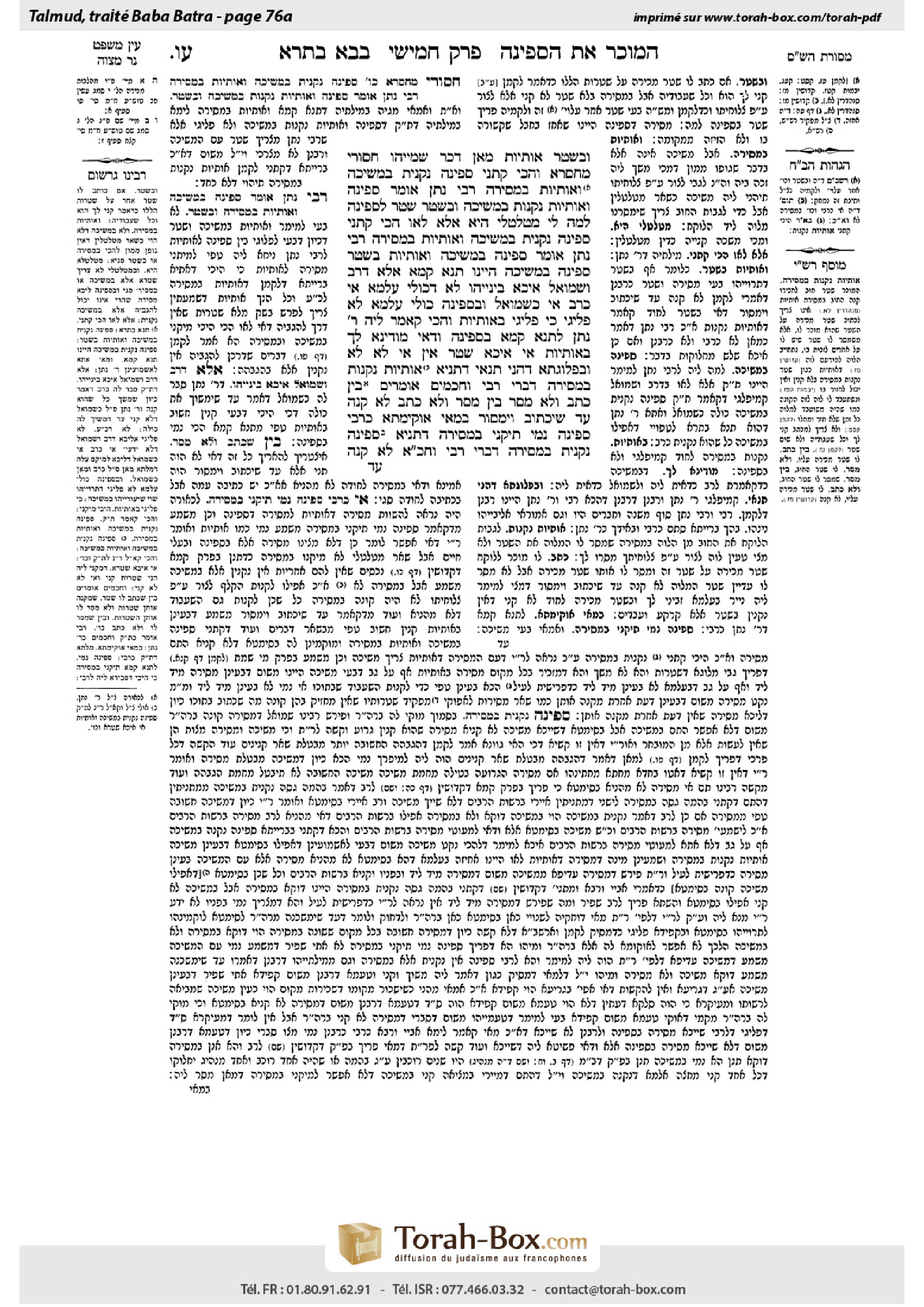
Bava Batra 76a: Talmud study for Daf Yomi
Study the Talmud for Daf Yomi with scanned pages, Hebrew text, English translations from Sefaria and AI-generated French translations.
Passage selection and English or AI-generated French translation are available where the scan has annotations. Daf Study is independent of Torah-Box and Sefaria.
Browse Bava Batra · בבא בתרא · All tractatesBava Batra 76a text and translations
This page of Bava Batra includes the Aramaic text, an English translation and an AI-generated French translation, alongside the scan above.
בבא בתרא ע״ו א · Aramaic and Hebrew text
וּבִשְׁטָר.
אוֹתִיּוֹת מַאן דְּכַר שְׁמַיְיהוּ? חַסּוֹרֵי מְחַסְּרָא, וְהָכִי קָתָנֵי: סְפִינָה נִקְנֵית בִּמְשִׁיכָה, וְאוֹתִיּוֹת בִּמְסִירָה. רַבִּי נָתָן אוֹמֵר: סְפִינָה וְאוֹתִיּוֹת נִקְנוֹת בִּמְשִׁיכָה וּבִשְׁטָר.
שְׁטָר לִסְפִינָה לְמָה לִי? מִטַּלְטְלֵי הִיא! אֶלָּא לָאו הָכִי קָתָנֵי: סְפִינָה נִקְנֵית בִּמְשִׁיכָה, וְאוֹתִיּוֹת בִּמְסִירָה. רַבִּי נָתָן אוֹמֵר: סְפִינָה בִּמְשִׁיכָה, וְאוֹתִיּוֹת בִּשְׁטָר?
סְפִינָה בִּמְשִׁיכָה – הַיְינוּ תַּנָּא קַמָּא! אֶלָּא דְּרַב וּשְׁמוּאֵל אִיכָּא בֵּינַיְיהוּ? לָא; דְּכוּלֵּי עָלְמָא – אִי כְּרַב, אִי כִּשְׁמוּאֵל, וּבִסְפִינָה כּוּלֵּי עָלְמָא לָא פְּלִיגִי;
כִּי פְּלִיגִי – בְּאוֹתִיּוֹת, וְהָכִי קָאָמַר לֵיהּ רַבִּי נָתָן לְתַנָּא קַמָּא: בִּסְפִינָה – וַדַּאי מוֹדֵינָא לָךְ; בְּאוֹתִיּוֹת – אִי אִיכָּא שְׁטָר, אִין; אִי לָא, לָא.
וּבִפְלוּגְתָּא דְּהָנֵי תַּנָּאֵי – דְּתַנְיָא: אוֹתִיּוֹת נִקְנוֹת בִּמְסִירָה, דִּבְרֵי רַבִּי. וַחֲכָמִים אוֹמְרִים: בֵּין כָּתַב וְלֹא מָסַר, בֵּין מָסַר וְלָא כָּתַב – לֹא קָנָה, עַד שֶׁיִּכְתּוֹב וְיִמְסוֹר.
בְּמַאי אוֹקֵימְתָּא – כְּרַבִּי? סְפִינָה נָמֵי תִּיקְּנֵי בִּמְסִירָה! דְּתַנְיָא: סְפִינָה נִקְנֵית בִּמְסִירָה, דִּבְרֵי רַבִּי. וַחֲכָמִים אוֹמְרִים: לֹא קָנָה
Bava Batra 76a · English translation
and by means of a bill of sale.
The Gemara clarifies the baraita: Letters in promissory notes, who mentioned anything about them? Why would Rabbi Natan speak about promissory notes, which are not discussed by the first tanna? The Gemara answers: The baraita is incomplete, and this is what it is teaching: A ship is acquired by pulling, and letters, i.e., the content of a promissory note, are acquired by merely transferring the document, not through pulling. Rabbi Natan says: A ship and letters are acquired by pulling and also by means of a bill of sale.
The Gemara asks: Why do I need a bill of sale for a ship? A ship is movable property, which is acquired not by means of giving a bill of sale, but through other acts of acquisition. Rather, is it not correct to say that this is what the baraita is teaching: A ship is acquired by pulling, and letters of credit by passing. Rabbi Natan says: A ship is acquired by pulling, and letters, i.e. the contents of a promissory note, are acquired either through pulling or by means of a bill of sale.
The Gemara asks: If Rabbi Natan holds that a ship is acquired by pulling, his opinion is apparently identical to the opinion of the first tanna. Rather, the practical difference between the two opinions is the dispute of Rav and Shmuel. According to the opinion of one tanna the buyer must move the entire ship out of its current location, while the other tanna maintains that one must move the ship only a minimal amount. The Gemara rejects this suggestion: No, everyone, Rabbi Natan and the first tanna, holds either in accordance with the opinion of Rav, or in accordance with the opinion of Shmuel. And with regard to a ship, everyone agrees that it is acquired through pulling.
When they disagree, it is with regard to acquiring letters, i.e. the contents of a promissory note. And this is what Rabbi Natan is saying to the first tanna: With regard to a ship, I certainly concede to you that it is acquired by pulling. But with regard to letters, whereas you maintain that passing suffices to acquire them, I hold that if in addition there is a bill of sale, yes, the acquisition is valid, but if not, the act of passing is not effective.
And according to this interpretation, the first tanna and Rabbi Natan disagree with regard to the dispute between these tanna’im. As it is taught in a baraita: Letters, i.e., the contents of a promissory note, are acquired by merely transferring the document; this is the statement of Rabbi Yehuda HaNasi. And the Rabbis say: Whether one wrote a bill of sale but did not transfer the promissory note to the buyer, or whether he transferred the promissory note but did not write a bill of sale, the buyer does not acquire the documents until the seller both writes a bill of sale and transfers the promissory note.
The Gemara asks: In accordance with which opinion did you interpret the opinion of the first tanna of the aforementioned baraita? If it is in accordance with the opinion of Rabbi Yehuda HaNasi, then let a ship be acquired also by passing, not only through pulling, as stated in the following baraita. As it is taught in a baraita: A ship is acquired by passing; this is the statement of Rabbi Yehuda HaNasi. And the Rabbis say: The buyer does not acquire it
Bava Batra 76a · Traduction française (IA)
et par l'intermédiaire d'un contrat de vente.
La Guemara clarifie la baraïta : Les lettres des billets de commande, qui ont mentionné quelque chose à leur sujet ? Pourquoi Rabbi Natan parle-t-il des billets de commande, qui ne sont pas discutés par le premier tanna ? La Guemara répond : la baraïta est incomplète, et voici ce qu'elle enseigne : un navire est acquis par le fait de le tirer, et les lettres, c'est-à-dire le contenu d'un billet de commande, sont acquis simplement en transférant le document, pas par le fait de le tirer. Rabbi Natan dit : un navire et les lettres sont acquis par le fait de les tirer et aussi par l'intermédiaire d'un contrat de vente.
La Guemara pose la question : pourquoi a-t-on besoin d'un contrat de vente pour un navire ? Un navire est un bien mobile, acquis non par l'intermédiaire d'un contrat de vente, mais par d'autres actes d'acquisition. Plutôt, n'est-ce pas correct de dire que c'est ce que la baraïta enseigne : un navire est acquis par le fait de le tirer, et les lettres de crédit par le transfert. Rabbi Natan dit : un navire est acquis par le fait de le tirer, et les lettres, c'est-à-dire le contenu d'un billet de commande, sont acquis soit par le fait de les tirer, soit par l'intermédiaire d'un contrat de vente.
La Guemara pose la question : si Rabbi Natan considère qu'un navire est acquis par le fait de le tirer, son opinion semble être identique à celle du premier tanna. En réalité, la différence pratique entre les deux opinions est le débat entre Rav et Shmuel. Selon l'opinion d'un tanna, l'acheteur doit déplacer l'ensemble du navire hors de son emplacement actuel, tandis que l'autre tanna maintient que l'on doit déplacer le navire seulement d'une quantité minimale. La Guemara rejette cette suggestion : non, tout le monde, Rabbi Natan et le premier tanna, adopte soit l'opinion de Rav, soit celle de Shmuel. Et concernant un navire, tout le monde convient qu'il est acquis par le fait de le tirer.
Lorsqu'ils divergent, c'est concernant l'acquisition des lettres, c'est-à-dire le contenu d'un billet de commande. Et c'est ce que Rabbi Natan dit au premier tanna : concernant un navire, je reconnais certainement que c'est acquis par le fait de le tirer. Mais concernant les lettres, alors que vous maintenez que le transfert suffit à les acquérir, je considère que si, en plus, il y a un contrat de vente, oui, l'acquisition est valide, mais si non, l'acte de transfert n'est pas efficace.
Et selon cette interprétation, le premier tanna et Rabbi Natan divergent concernant le débat entre ces tanna’im. Comme il est enseigné dans une baraïta : les lettres, c'est-à-dire le contenu d'un billet de commande, sont acquises simplement en transférant le document ; c'est l'opinion de Rabbi Yéhuda HaNasi. Et les Rabbins disent : que l'on ait écrit un contrat de vente mais n'ait pas transféré le billet de commande à l'acheteur, ou que l'on ait transféré le billet de commande mais n'ait pas écrit un contrat de vente, l'acheteur ne possède pas les documents jusqu'à ce que le vendeur ait à la fois écrit un contrat de vente et transféré le billet de commande.
La Guemara pose la question : selon quelle opinion avez-vous interprété l'opinion du premier tanna de la baraïta mentionnée précédemment ? Si c'est selon l'opinion de Rabbi Yéhuda HaNasi, alors un navire doit être acquis aussi par le passage, pas seulement par le fait de le tirer, comme il est dit dans la baraïta suivante. Comme il est enseigné dans une baraïta : un navire est acquis par le passage ; c'est l'opinion de Rabbi Yéhuda HaNasi. Et les Rabbins disent : l'acheteur ne l'acquiert pas
Traduction française générée par IA à partir de l’édition anglaise de Sefaria. Vérifie toujours un passage avec le texte source.
Text from Sefaria: William Davidson Edition - Vocalized Aramaic (CC BY NC); William Davidson Edition - English (CC BY NC).