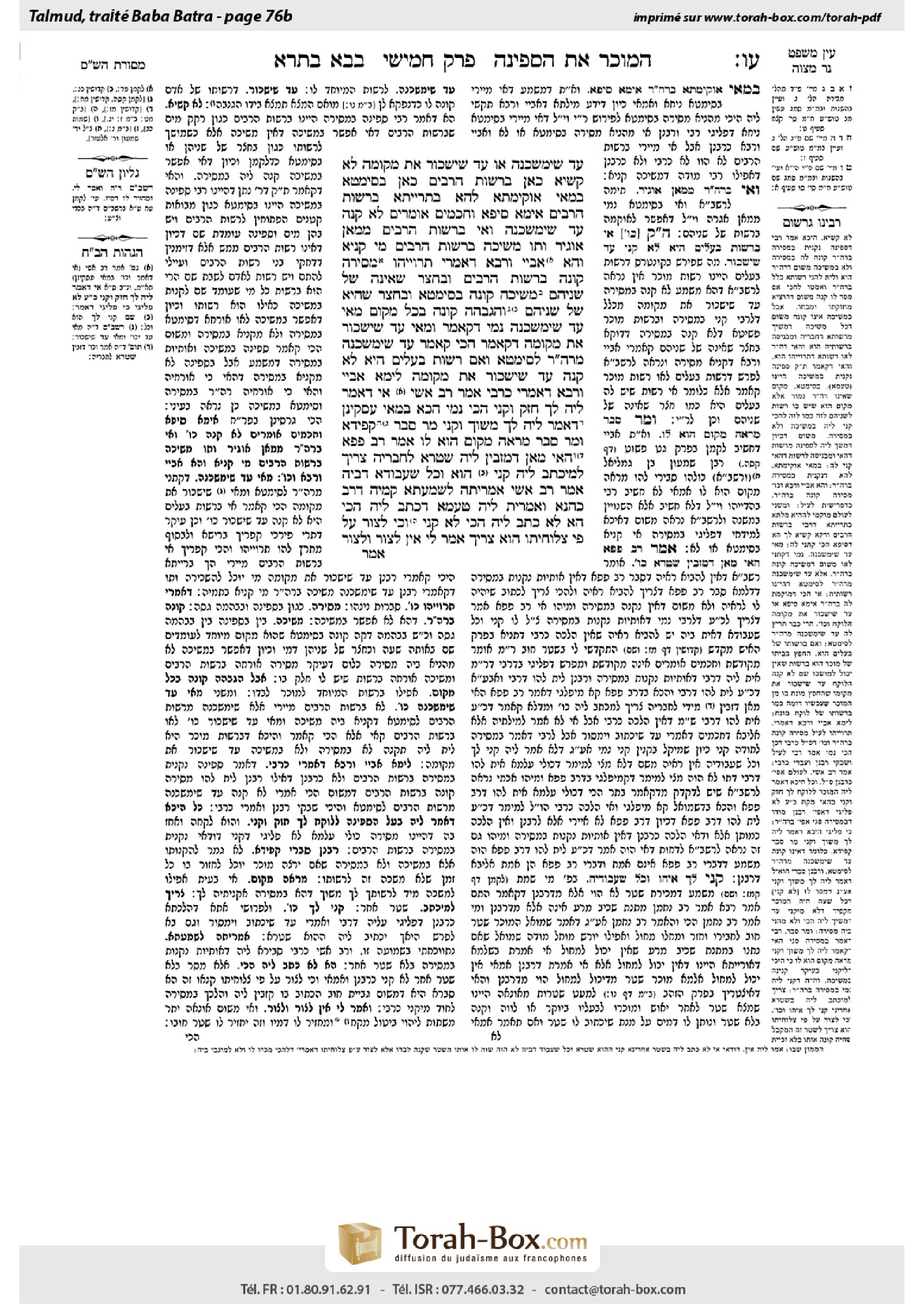
Bava Batra 76b: Talmud study for Daf Yomi
Study the Talmud for Daf Yomi with scanned pages, Hebrew text, English translations from Sefaria and AI-generated French translations.
Passage selection and English or AI-generated French translation are available where the scan has annotations. Daf Study is independent of Torah-Box and Sefaria.
Browse Bava Batra · בבא בתרא · All tractatesBava Batra 76b text and translations
This page of Bava Batra includes the Aramaic text, an English translation and an AI-generated French translation, alongside the scan above.
בבא בתרא ע״ו ב · Aramaic and Hebrew text
עַד שֶׁיִּמְשְׁכֶנָּה אוֹ עַד שֶׁיִּשְׂכּוֹר אֶת מְקוֹמָהּ!
לָא קַשְׁיָא; כָּאן בִּרְשׁוּת הָרַבִּים, כָּאן בְּסִימְטָא.
בְּמַאי אוֹקֵימְתָּא לְהָא בָּתְרָיְיתָא – בִּרְשׁוּת הָרַבִּים? אֵימָא סֵיפָא – וַחֲכָמִים אוֹמְרִים: לֹא קָנָה עַד שֶׁיִּמְשְׁכֶנָּה. וְאִי בִּרְשׁוּת הָרַבִּים, מִמַּאן אָגַר? וְתוּ, מְשִׁיכָה בִּרְשׁוּת הָרַבִּים מִי קָנְיָא?! וְהָא אַבָּיֵי וְרָבָא דְּאָמְרִי תַּרְוַיְיהוּ: מְסִירָה קוֹנָה בִּרְשׁוּת הָרַבִּים, וּבְחָצֵר שֶׁאֵינָהּ שֶׁל שְׁנֵיהֶם; מְשִׁיכָה קוֹנָה בְּסִימְטָא, וּבְחָצֵר שֶׁהִיא שֶׁל שְׁנֵיהֶם; וְהַגְבָּהָה קוֹנָה בְּכׇל מָקוֹם!
מַאי ״עַד שֶׁיִּמְשְׁכֶנָּה״ נָמֵי דְּקָאָמַר; וּמַאי ״עַד שֶׁיִּשְׂכּוֹר אֶת מְקוֹמָהּ״ דְּקָאָמַר – הָכִי קָאָמַר: עַד שֶׁיִּמְשְׁכֶנָּה מֵרְשׁוּת הָרַבִּים לְסִימְטָא; וְאִם רְשׁוּת בְּעָלִים הִיא – לָא קָנָה עַד שֶׁיִּשְׂכּוֹר אֶת מְקוֹמָהּ.
לֵימָא אַבָּיֵי וְרָבָא – דְּאָמְרִי כְּרַבִּי?
אָמַר רַב אָשֵׁי: אִי דְּאָמַר לֵיהּ ״לֵךְ חֲזֵק וּקְנִי״ – הָכִי נָמֵי; הָכָא בְּמַאי עָסְקִינַן – דְּאָמַר לֵיהּ: ״לֵךְ מְשׁוֹךְ וּקְנֵי״;
מָר סָבַר: קְפִידָא, וּמָר סָבַר: מַרְאֶה מָקוֹם הוּא לוֹ.
אָמַר רַב פָּפָּא: הַאי מַאן דִּמְזַבֵּין לֵיהּ שְׁטָרָא לְחַבְרֵיהּ, צָרִיךְ לְמִיכְתַּב לֵיהּ: ״קְנִי הוּא – וְכׇל שִׁעְבּוּדָא דְּבֵיהּ״. אָמַר רַב אָשֵׁי: אַמְרִיתַהּ לִשְׁמַעְתָּא קַמֵּיהּ דְּרַב כָּהֲנָא, וַאֲמַרִית לֵיהּ: טַעְמָא דִּכְתַב לֵיהּ הָכִי, הָא לָא כְּתַב לֵיהּ הָכִי – לָא קָנֵי?
וְכִי לָצוֹר עַל פִּי צְלוֹחִיתוֹ הוּא צָרִיךְ?! אָמַר לִי: אִין; לָצוֹר וְלָצוֹר.
Bava Batra 76b · English translation
until he pulls it, or until he rents its place. How, then, can the opinion of the first tanna of the baraita be ascribed to Rabbi Yehuda HaNasi?
The Gemara answers: This is not difficult; here, where Rabbi Yehuda HaNasi states that a ship is acquired through passing, he is referring to a ship situated in the public domain. Since a ship in the public domain cannot be acquired through pulling, which must be performed in a domain that is in one’s possession, it is acquired through passing. By contrast, there, in the first baraita, the ship is situated in an alleyway [simta], which is not the public domain, as both parties have the right to keep their possessions there. A ship in this location must be acquired through pulling.
The Gemara asks: To what case did you interpret that last baraita to be referring? It was interpreted as referring to the public domain. If so, say the latter clause of the baraita: And the Rabbis say that the buyer does not acquire it until he pulls it or until he rents its place. The Gemara asks: But if the ship is situated in the public domain, from whom can he rent the place? And furthermore, does pulling in the public domain effect acquisition? But don’t Abaye and Rava both say with regard to the different methods of acquisition: Passing effects acquisition in the public domain or in a courtyard that does not belong to either of the parties; pulling effects acquisition in an alleyway or in a courtyard that belongs to both of the parties; and lifting effects acquisition in every place, even in the seller’s domain.
The Gemara answers: What does the baraita mean when it says: Until he pulls it, and what does it mean when it says: Until he rents its place? This is what it is saying: The buyer does not acquire the ship until he pulls it from the public domain into an alleyway. And if the ship is located in the domain of some other owner, the buyer does not acquire it until he rents its place from the owner.
The Gemara asks: Shall we say that Abaye and Rava state their opinion in accordance with the opinion of Rabbi Yehuda HaNasi, not that of the Rabbis? The baraita indicates that only Rabbi Yehuda HaNasi maintains that one can acquire ownership by means of passing in the public domain.
Rav Ashi said: The Rabbis agree that it is possible to effect acquisition in the public domain through the act of passing. Therefore, if it is a case where the seller says to him: Go take possession and thereby effect acquisition, so too he can effect acquisition through the act of passing, and does not need to pull it. Here the Rabbis disagree with Rabbi Yehuda HaNasi, as we are dealing with a case where the seller says to him: Go pull and thereby effect acquisition of it.
Rav Ashi elaborates: One Sage, the Rabbis, holds that the seller is particular about the method by which the item is acquired, and therefore it can be acquired only through pulling. And one Sage, Rabbi Yehuda HaNasi, holds that the seller is merely indicating the manner to him, i.e., he advises him to use this act of acquisition but he does not mind if the buyer prefers to perform a different act of acquisition.
§ The Gemara returns to the issues of acquiring promissory notes. Rav Pappa says: One who sells a promissory note to another must write to him: Acquire it and all liens on property that are contained within it. Rav Ashi said: I stated this halakha before Rav Kahana, and I said to him the following analysis: The reason the buyer acquires it is that the seller wrote this for him. This indicates that if he did not write this for him, the buyer does not acquire the monetary rights recorded in the promissory note.
Rav Ashi asks: Why, then, did he purchase the promissory note? But does he require it to tie around the mouth of his flask as a stopper? Clearly, he purchased the document for the purpose of collecting the debt recorded in it. Rav Pappa said to me: Yes, it is possible that he purchased the promissory note in order to tie it around his flask. Since the owner did not transfer ownership of the obligation recorded in the promissory note, the buyer acquires only the paper itself.
Bava Batra 76b · Traduction française (IA)
jusqu'à ce qu'il le tire ou jusqu'à ce qu'il loue sa place. Comment alors peut-on attribuer l'opinion du premier tanna de la baraïta à Rabbi Yehuda HaNasi ?
La Guemara répond : Ce n'est pas difficile ; ici, où Rabbi Yehuda HaNasi affirme que le bateau est acquis par le passage, il s'agit d'un bateau situé dans le domaine public. Puisque un bateau dans le domaine public ne peut être acquis par le tirage, qui doit être effectué dans un domaine qui est en possession de l'acheteur, il est acquis par le passage. À l'inverse, là, dans la première baraïta, le bateau est situé dans une allée [simta], qui n'est pas le domaine public, car les deux parties ont le droit de conserver leurs possessions là. Un bateau dans cette localisation doit être acquis par le tirage.
La Guemara pose la question : À quel cas avez-vous interprété que cette dernière baraïta faisait référence ? Elle faisait référence au domaine public. Si c'est le cas, dites la dernière partie de la baraïta : Et les Rabbins disent que l'acheteur ne l'acquiert pas jusqu'à ce qu'il le tire ou jusqu'à ce qu'il loue sa place. La Guemara pose la question : Mais si le bateau est situé dans le domaine public, auprès de qui peut-il louer la place ? Et de plus, l'acte de tirage dans le domaine public produit-il l'acquisition ? Mais n'ont pas dit Abaye et Rava, concernant les différentes méthodes d'acquisition : le passage produit l'acquisition dans le domaine public ou dans une cour qui n'appartient à aucun des deux parties ; le tirage produit l'acquisition dans une allée ou dans une cour qui appartient aux deux parties ; et le levage produit l'acquisition partout, même dans le domaine du vendeur.
La Guemara répond : Que signifie la baraïta lorsqu'elle dit : Jusqu'à ce qu'il le tire, et que signifie-t-elle lorsqu'elle dit : Jusqu'à ce qu'il loue sa place ? C'est ce qu'elle dit : L'acheteur ne possède pas le bateau jusqu'à ce qu'il le tire du domaine public dans une allée. Et si le bateau est situé dans le domaine d'un autre propriétaire, l'acheteur ne l'acquiert pas jusqu'à ce qu'il loue sa place auprès du propriétaire.
La Guemara pose la question : Devons-nous dire que Abaye et Rava expriment leur opinion conformément à celle de Rabbi Yehuda HaNasi, et non celle des Rabbins ? La baraïta indique que seul Rabbi Yehuda HaNasi maintient que l'on peut acquérir la propriété par le passage dans le domaine public.
Rav Ashi dit : Les Rabbins sont d'accord sur le fait que l'acquisition peut être effectuée dans le domaine public par le passage. Par conséquent, si c'est un cas où le vendeur dit à l'acheteur : Va prendre possession et ainsi effectuer l'acquisition, il peut aussi l'effectuer par le passage, et n'a pas besoin de le tirer. Ici, les Rabbins s'opposent à Rabbi Yehuda HaNasi, car nous sommes dans un cas où le vendeur dit à l'acheteur : Va tirer et ainsi effectuer l'acquisition de cela.
Rav Ashi développe : Un Sage, les Rabbins, affirme que le vendeur est exigeant quant à la méthode par laquelle l'objet est acquis, et par conséquent, il peut être acquis uniquement par le tirage. Et un autre Sage, Rabbi Yehuda HaNasi, affirme que le vendeur indique simplement la méthode à l'acheteur, c'est-à-dire qu'il lui conseille d'utiliser cet acte d'acquisition, mais il n'a pas d'objection s'il préfère effectuer un autre acte d'acquisition.
§ La Guemara revient aux questions d'acquisition des notes de promesse. Rav Pappa dit : Celui qui vend une note de promesse à un autre doit écrire à lui : Acquiers-la et toutes les garanties sur les biens contenues dedans. Rav Ashi dit : J'ai dit cette halakha à Rav Kahana, et j'ai dit à lui l'analyse suivante : La raison pour laquelle l'acheteur l'acquiert est que le vendeur a écrit cela pour lui. Cela indique que si le vendeur n'a pas écrit cela pour lui, l'acheteur ne possède pas les droits monétaires inscrits dans la note de promesse.
Rav Ashi pose la question : Pourquoi alors a-t-il acheté la note de promesse ? Mais est-ce qu'il a besoin qu'elle soit attachée autour du cou de son flacon comme un bouchon ? Évidemment, il a acheté le document à l'intention de récupérer la dette inscrite dedans. Rav Pappa m'a dit : Oui, il est possible qu'il ait acheté la note de promesse afin d'attacher autour de son flacon. Puisque l'propriétaire n'a pas transféré la propriété de l'obligation inscrite dans la note de promesse, l'acheteur acquiert uniquement le papier lui-même.
Traduction française générée par IA à partir de l’édition anglaise de Sefaria. Vérifie toujours un passage avec le texte source.
Text from Sefaria: William Davidson Edition - Vocalized Aramaic (CC BY NC); William Davidson Edition - English (CC BY NC).