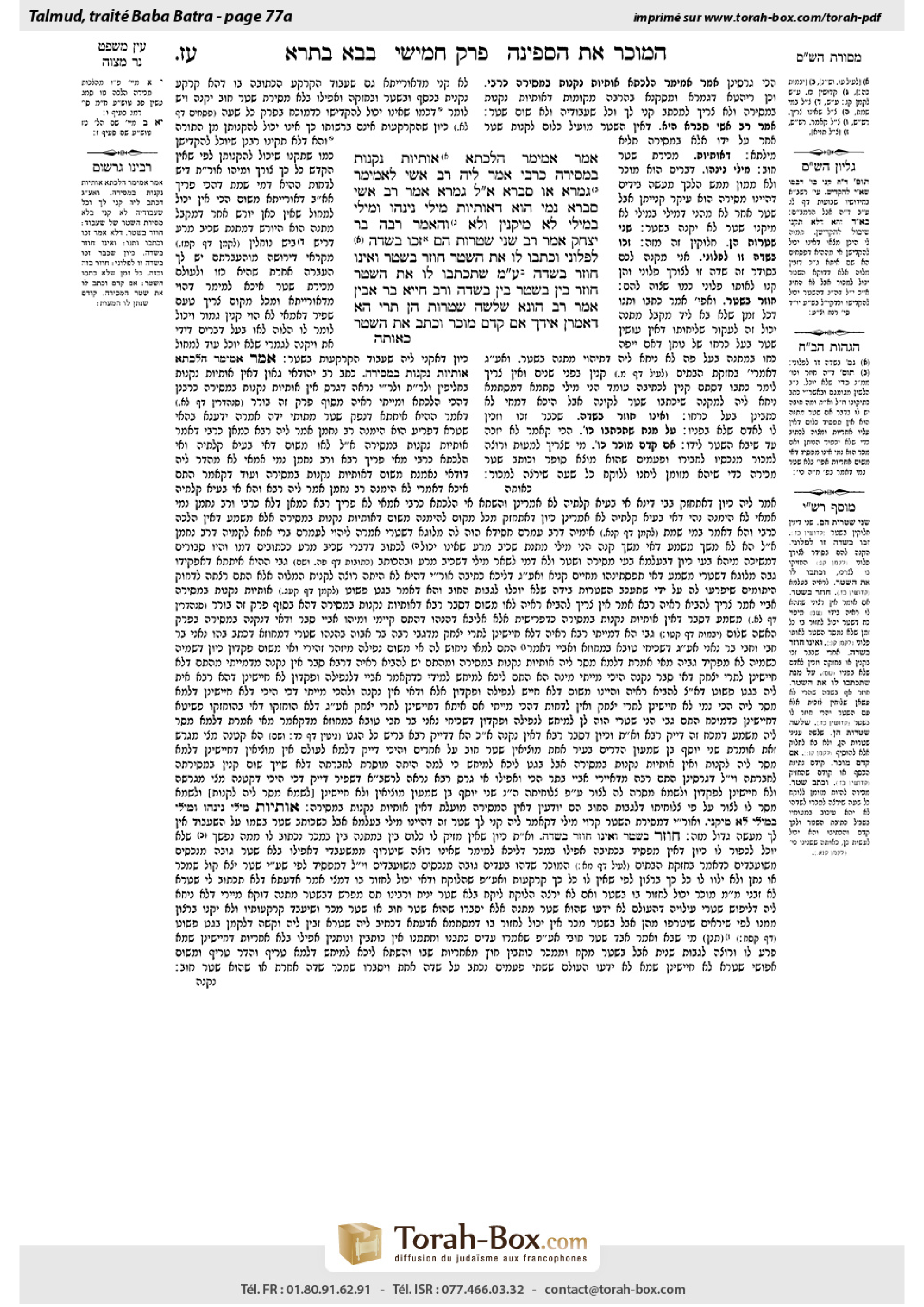
Bava Batra 77a: Talmud study for Daf Yomi
Study the Talmud for Daf Yomi with scanned pages, Hebrew text, English translations from Sefaria and AI-generated French translations.
Passage selection and English or AI-generated French translation are available where the scan has annotations. Daf Study is independent of Torah-Box and Sefaria.
Browse Bava Batra · בבא בתרא · All tractatesBava Batra 77a text and translations
This page of Bava Batra includes the Aramaic text, an English translation and an AI-generated French translation, alongside the scan above.
בבא בתרא ע״ז א · Aramaic and Hebrew text
אָמַר אַמֵּימָר, הִלְכְתָא: אוֹתִיּוֹת נִקְנוֹת בִּמְסִירָה, כְּרַבִּי. אָמַר לֵיהּ רַב אָשֵׁי לְאַמֵּימָר: גְּמָרָא, אוֹ סְבָרָא? אָמַר לֵיהּ: גְּמָרָא. אָמַר רַב אָשֵׁי: סְבָרָא נָמֵי הוּא – דְּאוֹתִיּוֹת מִילֵּי נִינְהוּ, וּמִילֵּי בְּמִילֵּי לָא מִיקַּנְיָן.
וְלָא?! וְהָאָמַר רַבָּה בַּר יִצְחָק אָמַר רַב: שְׁנֵי שְׁטָרוֹת הֵם – ״זְכוּ בְּשָׂדֶה לִפְלוֹנִי וְכִתְבוּ לוֹ אֶת הַשְּׁטָר״ – חוֹזֵר בַּשְּׁטָר, וְאֵינוֹ חוֹזֵר בַּשָּׂדֶה.
״עַל מְנָת שֶׁתִּכְתְּבוּ לוֹ אֶת הַשְּׁטָר״ – חוֹזֵר בֵּין בַּשְּׁטָר בֵּין בַּשָּׂדֶה.
וְרַב חִיָּיא בַּר אָבִין אָמַר רַב הוּנָא: שְׁלֹשָׁה שְׁטָרוֹת הֵן; תְּרֵי – הָא דַּאֲמַרַן, אִידַּךְ – אִם קָדַם מוֹכֵר וְכָתַב אֶת הַשְּׁטָר.
Bava Batra 77a · English translation
Ameimar says: The halakha is that letters are acquired by merely transferring the document to the buyer, in accordance with the opinion of Rabbi Yehuda HaNasi. Rav Ashi said to Ameimar: Is your ruling based on a tradition or on your own logical reasoning? Ameimar said to him: It is based on a tradition. Rav Ashi said: It also stands to reason that the contents of a promissory note are acquired through transferring, as letters, i.e., the contents of a promissory note, are words, i.e., the buyer is acquiring the right to a monetary obligation, not a physical item, and words cannot be acquired through other words.
The Gemara asks: And is it true that documents cannot be acquired through words? But doesn’t Rabba bar Yitzḥak say that Rav says: There are two types of documents. The first type is where one says to others: Take possession of this field for so-and-so and write the document for him as proof of the sale of the field. In this case, he may renege with regard to the document, i.e., he may change his mind and tell them not to write it. But he may not renege with regard to the field, as the buyer has already acquired it.
The second type of document is where he said: Take possession of this field for so-and-so on the condition that you write him a document. If the document has not yet been delivered he can retract his instruction both with regard to the document and with regard to the field, as the transfer of the field is dependent on the writing of the document.
And Rav Ḥiyya bar Avin says that Rav Huna says: There are actually three types of documents. Two are those that we stated above, and the other is if the seller wrote the document in advance.
Bava Batra 77a · Traduction française (IA)
Ameimar dit : La halakha est que les lettres sont acquises par la simple transmission du document à l'acheteur, conformément à l'opinion du Rabbi Yehuda HaNasi. Rav Ashi dit à Ameimar : Votre décision s'appuie-t-elle sur une tradition ou sur votre propre raisonnement logique ? Ameimar dit à lui : Elle s'appuie sur une tradition. Rav Ashi dit : Il est également logique que le contenu d'une note de promesse soit acquis par la transmission, comme des lettres, c'est-à-dire que le contenu d'une note de promesse, étant des mots, c'est-à-dire que l'acheteur acquiert le droit à une obligation monétaire, pas un objet physique, et les mots ne peuvent être acquis par d'autres mots.
Le Guemara demande : Et est-ce vrai que les documents ne peuvent être acquis par des mots ? Mais ne dit pas Rabba bar Yitzḥak que Rav dit : Il y a deux types de documents. Le premier type est celui où l'on dit aux autres : Prenez possession de ce champ pour tel et tel et écrivez le document pour lui comme preuve de la vente du champ. Dans ce cas, il peut récuser concernant le document, c'est-à-dire qu'il peut changer d'avis et dire qu'on ne doive pas l'écrire. Mais il ne peut pas récuser concernant le champ, car l'acheteur l'a déjà acquis.
Le deuxième type de document est celui où l'on dit : Prenez possession de ce champ pour tel et tel à la condition que vous écriviez un document pour lui. Si le document n'a pas encore été remis, il peut récuser son instruction à la fois concernant le document et concernant le champ, car la transmission du champ dépend de l'écriture du document.
Et Rav Ḥiyya bar Avin dit que Rav Huna dit : Il y a en réalité trois types de documents. Deux sont ceux que nous avons évoqués ci-dessus, et le troisième est s'il écrit le document à l'avance.
Traduction française générée par IA à partir de l’édition anglaise de Sefaria. Vérifie toujours un passage avec le texte source.
Text from Sefaria: William Davidson Edition - Vocalized Aramaic (CC BY NC); William Davidson Edition - English (CC BY NC).