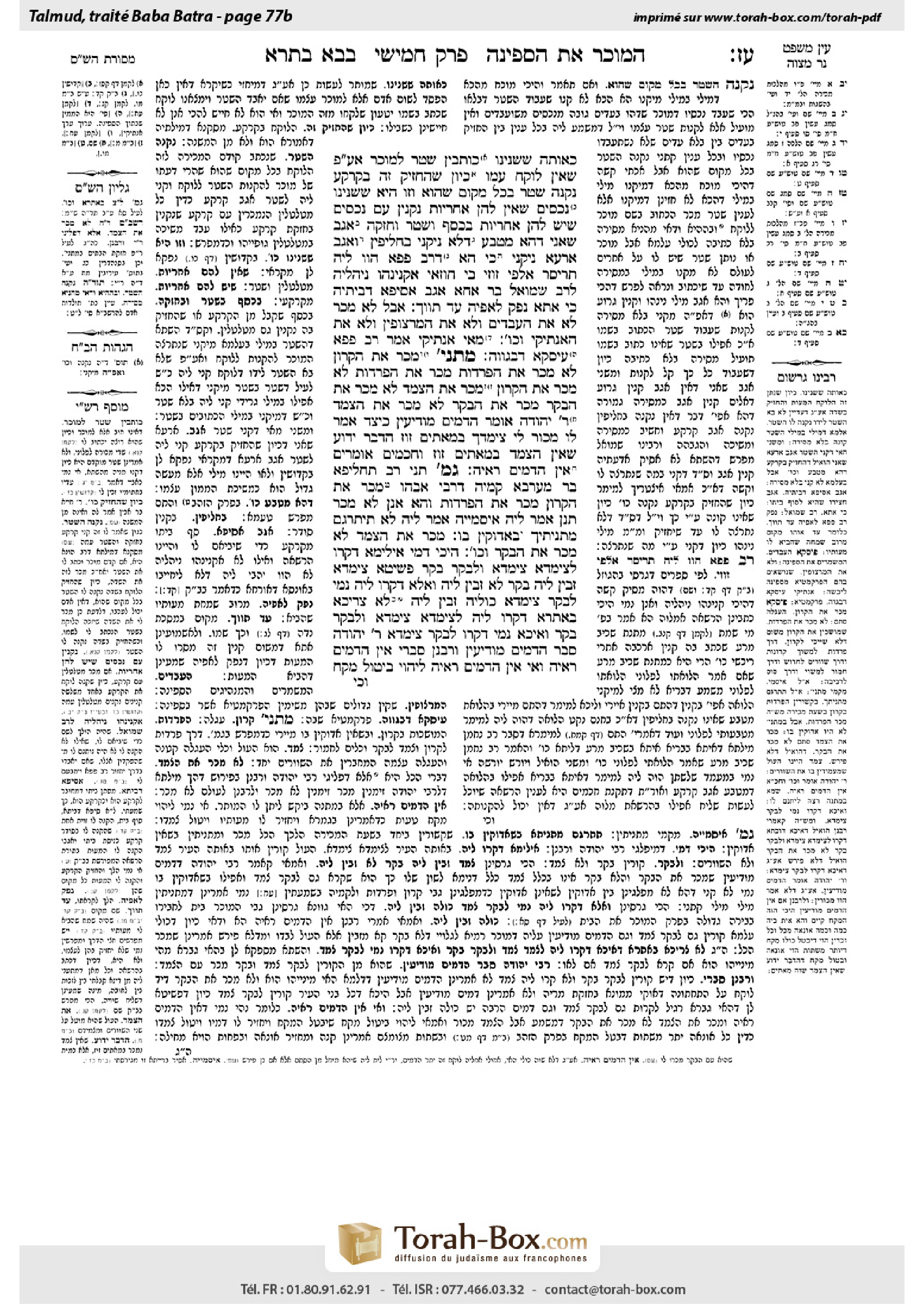
Bava Batra 77b: Talmud study for Daf Yomi
Study the Talmud for Daf Yomi with scanned pages, Hebrew text, English translations from Sefaria and AI-generated French translations.
Passage selection and English or AI-generated French translation are available where the scan has annotations. Daf Study is independent of Torah-Box and Sefaria.
Browse Bava Batra · בבא בתרא · All tractatesBava Batra 77b text and translations
This page of Bava Batra includes the Aramaic text, an English translation and an AI-generated French translation, alongside the scan above.
בבא בתרא ע״ז ב · Aramaic and Hebrew text
כְּאוֹתָהּ שֶׁשָּׁנִינוּ: כּוֹתְבִין שְׁטָר לַמּוֹכֵר אַף עַל פִּי שֶׁאֵין לוֹקֵחַ עִמּוֹ. כֵּיוָן שֶׁהֶחְזִיק זֶה בַּקַּרְקַע – נִקְנָה שְׁטָר בְּכׇל מָקוֹם שֶׁהוּא; וְזוֹ הִיא שֶׁשָּׁנִינוּ: נְכָסִים שֶׁאֵין לָהֶן אַחְרָיוּת נִקְנִין עִם נְכָסִים שֶׁיֵּשׁ לָהֶן אַחְרָיוּת, בְּכֶסֶף וּשְׁטָר וַחֲזָקָה!
אַגַּב שָׁאנֵי; דְּהָא מַטְבֵּעַ – דְּלָא נִיקְנֵי בַּחֲלִיפִין, וְאַגַּב אַרְעָא נִיקְנֵי.
כִּי הָא דְּרַב פָּפָּא הֲווֹ לֵיהּ תְּרֵיסַר אַלְפֵי זוּזֵי בֵּי חוֹזָאֵי, אַקְנִינְהוּ נִיהֲלֵיהּ לְרַב שְׁמוּאֵל בַּר אַחָא אַגַּב אַסִּיפָּא דְבֵיתֵיהּ. כִּי אֲתָא, נְפַק לְאַפֵּיהּ עַד תְּווֹךְ.
אֲבָל לֹא מָכַר לֹא אֶת הָעֲבָדִים וְלֹא אֶת הַמַּרְצוּפִין וְלֹא אֶת הָאַנְתִיקֵי וְכוּ׳. מַאי ״אַנְתִיקֵי״? אָמַר רַב פָּפָּא: עִיסְקָא דִּבְגַוַּוהּ.
מַתְנִי׳ מָכַר אֶת הַקָּרוֹן – לֹא מָכַר אֶת הַפְּרָדוֹת, מָכַר אֶת הַפְּרָדוֹת – לֹא מָכַר אֶת הַקָּרוֹן. מָכַר אֶת הַצֶּמֶד – לֹא מָכַר אֶת הַבָּקָר, מָכַר אֶת הַבָּקָר – לֹא מָכַר אֶת הַצֶּמֶד. רַבִּי יְהוּדָה אוֹמֵר: הַדָּמִים מוֹדִיעִין. כֵּיצַד? אָמַר לוֹ: ״מְכוֹר לִי צִימְדָּךְ בְּמָאתַיִם זוּז״ – הַדָּבָר יָדוּעַ שֶׁאֵין הַצֶּמֶד בְּמָאתַיִם זוּז. וַחֲכָמִים אוֹמְרִים: אֵין הַדָּמִים רְאָיָה.
גְּמָ׳ תָּנֵי רַב תַּחְלִיפָא בַּר מַעְרְבָא קַמֵּיהּ דְּרַבִּי אֲבָהוּ: מָכַר אֶת הַקָּרוֹן – מָכַר אֶת הַפְּרָדוֹת. וְהָא אֲנַן ״לֹא מָכַר״ תְּנַן! אֲמַר לֵיהּ: אִיסְמְיַיהּ? אֲמַר לֵיהּ: לָא, תִּיתַּרְגֵּם מַתְנִיתָיךְ בַּאֲדוּקִין בּוֹ.
מָכַר אֶת הַצֶּמֶד – לֹא מָכַר אֶת הַבָּקָר וְכוּ׳. הֵיכִי דָמֵי? אִילֵּימָא דְּקָרוּ לְצִימְדָּא ״צִימְדָּא״ וּלְבָקָר ״בָּקָר״ – פְּשִׁיטָא; צִימְדָּא זַבֵּין לֵיהּ, בָּקָר לָא זַבֵּין לֵיהּ! וְאֶלָּא דְּקָרוּ לֵיהּ נָמֵי לְבָקָר ״צִימְדָּא״? כּוּלֵּיהּ זַבֵּין לֵיהּ!
לָא צְרִיכָא, בְּאַתְרָא דְּקָרוּ לֵיהּ לְצִימְדָּא ״צִימְדָּא״ וּלְבָקָר ״בָּקָר״, וְאִיכָּא נָמֵי דְּקָרוּ לְבָקָר ״צִימְדָּא״; רַבִּי יְהוּדָה סָבַר: הַדָּמִים מוֹדִיעִין, וְרַבָּנַן סָבְרִי: אֵין הַדָּמִים רְאָיָה. וְאִי אֵין הַדָּמִים רְאָיָה, לֶיהֱוֵי בִּיטּוּל מִקָּח!
Bava Batra 77b · English translation
This is like that which we learned in a mishna (167b): A scribe may write a bill of sale for the seller even if the buyer is not with him when the seller presents his request. In a case of this kind, once this buyer takes possession of the land the deed is acquired wherever it is. And this is that which we learned in another mishna (Kiddushin 26a): Property that does not serve as a guarantee, i.e., movable property, can be acquired together with property that serves as a guarantee, i.e., land, when the land is acquired by means of giving money, or by means of giving a document, or by means of taking possession. This shows that a bill of sale can be transferred without any act of acquisition performed for the document, and certainly through words, which presents a difficulty to Rav Ashi’s opinion.
The Gemara answers: Acquiring a bill of sale by means of acquisition of land is different, as it is similar to acquisition through an item, not by means of words. The reason is that money, which cannot be acquired through symbolic exchange, a pro forma act of acquisition effecting the transfer of ownership of an item, nevertheless can be acquired by means of land.
This is like that incident where Rav Pappa had deposited twelve thousand dinars with bailees in Bei Ḥozai. He transferred ownership of the money in Bei Ḥozai to his agent Rav Shmuel bar Aḥa by means of the threshold of his house. The Gemara adds: When Rav Shmuel bar Aḥa came from Bei Ḥozai with the money, Rav Pappa was so happy that he was bringing him his money that he went out all the way until Tavakh to greet him.
§ The mishna teaches that when one sells a ship he has sold various other items; but he has not sold the slaves, nor the packing bags, nor the antikei. But when one said to the buyer: You are purchasing the ship and all that it contains, all of these are sold as well. The Gemara asks: What is the meaning of antikei? Rav Pappa said: It means the merchandise that is on the ship. This merchandise is not sold together with the ship.
MISHNA: One who sold a wagon [hakkaron] has not sold the mules that pull the wagon. Similarly, if one sold the mules, he has not sold the wagon. One who sold a yoke [hatzemed] has not sold the oxen, and one who sold the oxen has not sold the yoke. Rabbi Yehuda says: The sum of money indicates what one has sold. How so? If the buyer said to the seller: Sell me your yoke for two hundred dinars, since it is a known matter that a yoke is not sold for two hundred dinars he clearly intended to purchase the oxen as well. And the Rabbis say: The sum of money is not proof.
GEMARA: Rav Taḥlifa, from the West, i.e., Eretz Yisrael, taught a baraita before Rabbi Abbahu. If one sold a wagon, he has sold the mules together with it. Rabbi Abbahu asked: But didn’t we learn in the mishna that he has not sold the mules? Rav Taḥlifa said to him: Should I erase this baraita, as it is incorrect? Rabbi Abbahu said to him: No, do not erase it; you should explain that your baraita is referring to a case where the mules are fastened to the wagon. In that situation, one who purchases the wagon receives the mules as well.
The mishna teaches: One who sold a yoke has not sold the oxen; and the Rabbis and Rabbi Yehuda disagree over whether the sum of money proves exactly what was sold. The Gemara analyzes their disagreement: What are the circumstances? If we say that the mishna is referring to a place where they call a yoke: Tzimda, and they call oxen: Bakar, it is obvious that he sold him a yoke and did not sell him the oxen. But if the mishna is referring to a place where they also call oxen: Tzimda, then the seller sold him everything.
The Gemara explains: No, their dispute is necessary in a place where they call a yoke: Tzimda, and call oxen: Bakar, but there are also those who call oxen: Tzimda. Since it is unclear what is meant by the term: Tzimda, Rabbi Yehuda holds that the sum of money indicates whether he purchased a yoke or oxen, and the Rabbis hold that the amount of money does not serve as proof. The Gemara asks: But if the amount of money does not serve as proof, then in a case where the buyer paid two hundred dinars and received only a yoke, let the transaction be nullified.
Bava Batra 77b · Traduction française (IA)
C'est comme celui que nous avons appris dans une mitsva (167b) : Un scribe peut écrire un acte de vente pour le vendeur même si l'acheteur n'est pas présent lorsque le vendeur présente sa demande. Dans un cas tel que celui-ci, une fois que l'acheteur prend possession du terrain, l'acte est acquis là où il se trouve. Et c'est celui que nous avons appris dans une autre mitsva (Kiddushin 26a) : Une propriété qui ne sert pas de garantie, c'est-à-dire une propriété mobile, peut être acquise ensemble avec une propriété qui sert de garantie, c'est-à-dire un terrain, lorsque le terrain est acquis par l'offre d'argent, ou par l'offre d'un document, ou par la possession. Cela montre qu'un acte de vente peut être transféré sans aucun acte d'acquisition effectué pour le document, et certainement par des paroles, ce qui pose un problème pour l'opinion de Rav Ashi.
Le Guemara répond : L'acquisition d'un acte de vente par l'acquisition d'un terrain est différente, car elle est similaire à l'acquisition par un objet, pas par des paroles. La raison est que l'argent, qui ne peut pas être acquis par un échange symbolique, un acte formel d'acquisition effectuant la transmission de la propriété d'un objet, peut néanmoins être acquis par le terrain.
C'est comme l'incident où Rav Pappa avait déposé douze mille dinars avec des dépositaires à Bei Ḥozai. Il a transféré la propriété de l'argent à Bei Ḥozai à son agent Rav Shmuel bar Aḥa par le seuil de sa maison. Le Guemara ajoute : Lorsque Rav Shmuel bar Aḥa est revenu de Bei Ḥozai avec l'argent, Rav Pappa était si heureux qu'il lui apportait son argent qu'il est sorti jusqu'à Tavakh pour le saluer.
§ La mitsva enseigne que lorsqu'on vend un bateau, on a vendu divers autres objets ; mais on n'a pas vendu les esclaves, ni les ballots, ni les antikei. Mais lorsqu'on dit à l'acheteur : Tu achètes le bateau et tout ce qu'il contient, tous ces objets sont également vendus. Le Guemara demande : Quelle est la signification des antikei ? Rav Pappa dit : Cela signifie les marchandises qui sont sur le bateau. Ces marchandises ne sont pas vendues ensemble avec le bateau.
MICHNA : Celui qui a vendu un chariot [hakkaron] n’a pas vendu les mules qui tirent le chariot. De même, si l’on a vendu les mules, on n’a pas vendu le chariot. Celui qui a vendu un joug [hatzemed] n’a pas vendu les bœufs, et celui qui a vendu les bœufs n’a pas vendu le joug. Rabbi Yehuda dit : La somme d’argent indique ce qui a été vendu. Comment cela ? Si l’acheteur dit au vendeur : Vends-moi ton joug pour deux cents dinars, puisque c’est une chose connue que un joug ne se vend pas pour deux cents dinars, il a clairement l’intention d’acheter les bœufs également. Et les Rabbins disent : La somme d’argent n’est pas une preuve.
GUEMARA : Rav Taḥlifa, du West, c’est-à-dire d’Eretz Yisrael, a enseigné une baraïta devant Rabbi Abbahu. Si l’on vend un chariot, on a vendu les mules ensemble avec lui. Rabbi Abbahu a demandé : Mais n’avons-nous pas appris dans la mitsva que l’on n’a pas vendu les mules ? Rav Taḥlifa a dit à lui : Dois-je effacer cette baraïta, car elle est incorrecte ? Rabbi Abbahu a dit à lui : Non, ne l’efface pas ; tu devrais expliquer que ta baraïta fait référence à un cas où les mules sont attachées au chariot. Dans ce cas, celui qui achète le chariot reçoit les mules également.
La mitsva enseigne : Celui qui a vendu un joug n'a pas vendu les bœufs ; et les Rabbins et Rabbi Yehuda divergent sur le fait que la somme d'argent prouve exactement ce qui a été vendu. Le Guemara analyse leur désaccord : Quelles sont les circonstances ? Si nous disons que la mitsva fait référence à un lieu où ils appellent un joug : Tzimda, et ils appellent les bœufs : Bakar, il est évident qu'il a vendu un joug et n'a pas vendu les bœufs. Mais si la mitsva fait référence à un lieu où ils appellent aussi les bœufs : Tzimda, alors le vendeur a vendu tout.
Le Guemara explique : Non, leur désaccord est nécessaire dans un lieu où ils appellent un joug : Tzimda, et appellent les bœufs : Bakar, mais il y a aussi ceux qui appellent les bœufs : Tzimda. Puisque c'est indéterminé ce que signifie le terme : Tzimda, Rabbi Yehuda considère que la somme d'argent indique si l'on a acheté un joug ou des bœufs, et les Rabbins considèrent que la somme d'argent ne sert pas de preuve. Le Guemara demande : Mais si la somme d'argent ne sert pas de preuve, alors dans un cas où l'acheteur a payé deux cents dinars et a reçu seulement un joug, la transaction doit être annulée.
Traduction française générée par IA à partir de l’édition anglaise de Sefaria. Vérifie toujours un passage avec le texte source.
Text from Sefaria: William Davidson Edition - Vocalized Aramaic (CC BY NC); William Davidson Edition - English (CC BY NC).