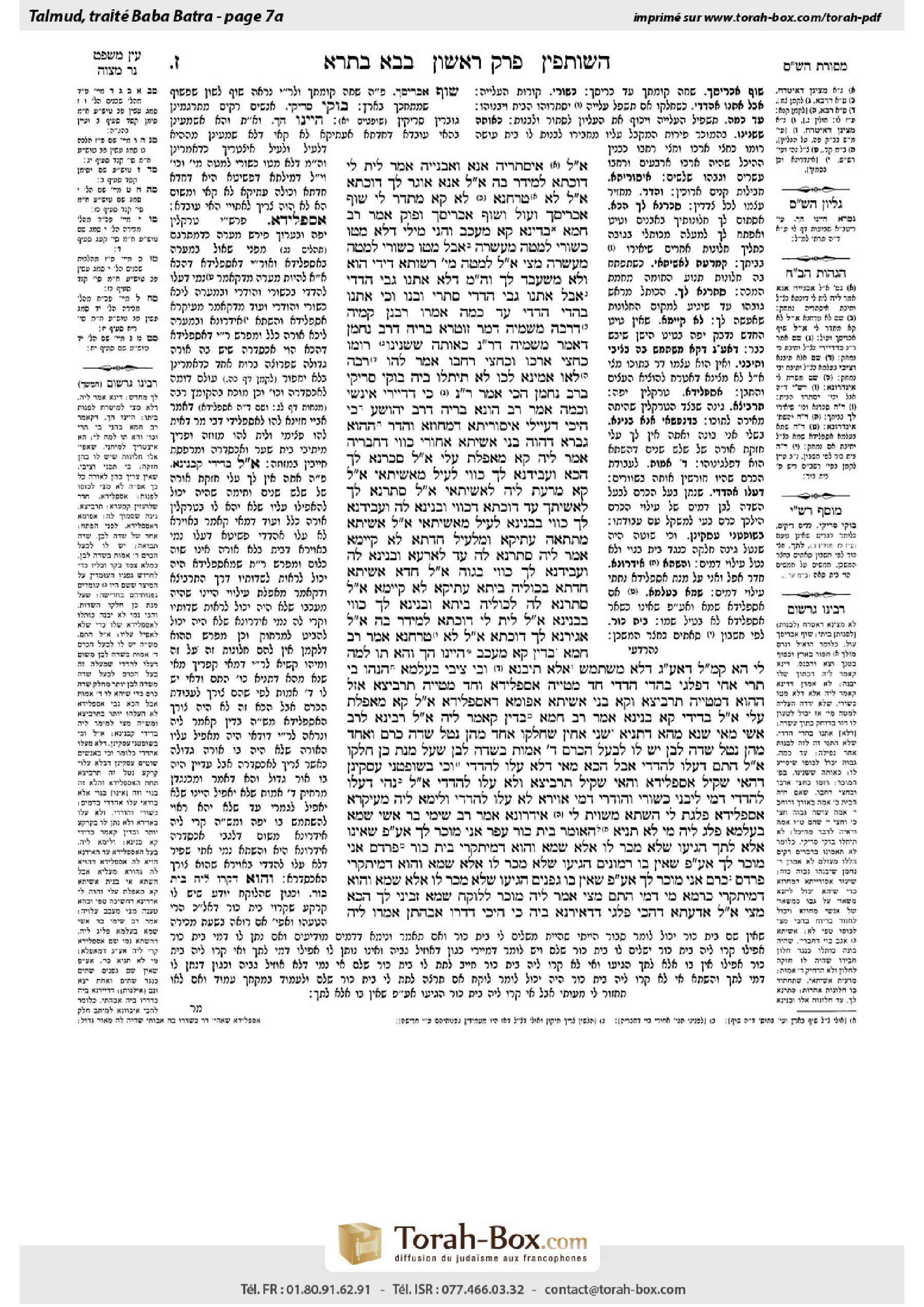
Bava Batra 7a: Talmud study for Daf Yomi
Study the Talmud for Daf Yomi with scanned pages, Hebrew text, English translations from Sefaria and AI-generated French translations.
Passage selection and English or AI-generated French translation are available where the scan has annotations. Daf Study is independent of Torah-Box and Sefaria.
Browse Bava Batra · בבא בתרא · All tractatesBava Batra 7a text and translations
This page of Bava Batra includes the Aramaic text, an English translation and an AI-generated French translation, alongside the scan above.
בבא בתרא ז׳ א · Aramaic and Hebrew text
אֲמַר לֵיהּ: ״אֶיסְתְּרֵיהּ אֲנָא וְאֶבְנְיֵיהּ״. אֲמַר: ״לֵית לִי דּוּכְתָּא לְמֵידַר בַּהּ״. אֲמַר לֵיהּ: ״אֲנָא אוֹגַר לָךְ דּוּכְתָּא״. אֲמַר לֵיהּ: ״לָא טָרַחְנָא״. ״לָא קָא מִתְּדַר לִי״. ״שׁוּף אַכְּרֵיסָךְ וְעוּל, וָשׁוּף אַכְּרֵיסָךְ וּפוֹק״.
אָמַר רַב חָמָא: בְּדִינָא קָא מְעַכֵּב. וְהָנֵי מִילֵּי דְּלָא מָטוּ כְּשׁוּרֵי לְמַטָּה מֵעֲשָׂרָה, אֲבָל מָטוּ כְּשׁוּרֵי לְמַטָּה מֵעֲשָׂרָה, מָצֵי אָמַר לֵיהּ: לְמַטָּה מֵעֲשָׂרָה רְשׁוּתָא דִידִי הוּא, וְלָא מְשַׁעְבַּד לָךְ.
וְהָנֵי מִילֵּי דְּלָא אַתְנוֹ גַּבֵּי הֲדָדֵי, אֲבָל אַתְנוֹ גַּבֵּי הֲדָדֵי – סָתְרִי וּבָנוּ.
וְכִי אַתְנוֹ בַּהֲדֵי הֲדָדֵי – עַד כַּמָּה? אָמְרוּ רַבָּנַן קַמֵּיהּ דְּרַבָּה מִשְּׁמֵיהּ דְּמָר זוּטְרָא בְּרֵיהּ דְּרַב נַחְמָן, דְּאָמַר מִשְּׁמֵיהּ דְּרַב נַחְמָן, כְּאוֹתָהּ שֶׁשָּׁנִינוּ: רוּמוֹ – כַּחֲצִי אׇרְכּוֹ וְכַחֲצִי רׇחְבּוֹ. אֲמַר לְהוּ רַבָּה, לָאו אָמֵינָא לְכוּ: לָא תִּיתְלוֹ בֵּיהּ בּוּקֵי סְרִיקֵי בְּרַב נַחְמָן?! הָכִי אָמַר רַב נַחְמָן: כִּי דְּדָיְירִי אִינָשֵׁי. וְכַמָּה? אָמַר רַב הוּנָא בְּרֵיהּ דְּרַב יְהוֹשֻׁעַ: כִּי הֵיכִי דְּעָיְילִי אִיסּוּרְיָתָא דְמָחוֹזָא, וְהָדַר.
הָהוּא גַּבְרָא דַּהֲוָה בָּנֵי אֲשִׁיתָא אֲחוֹרֵי כַּוֵּוי דְּחַבְרֵיהּ. אָמַר לֵיהּ: קָא מַאַפְלַתְּ עֲלַי. אֲמַר לֵיהּ: סָכַרְנָא לָךְ הָכָא, וְעָבֵידְנָא לָךְ כַּוֵּוי לְעֵיל מֵאֲשִׁיתַאי. אֲמַר לֵיהּ: קָא מַרַעְתְּ לֵיהּ לַאֲשִׁיתַאי. אֲמַר לֵיהּ: סָתַרְנָא לָךְ לַאֲשִׁיתָךְ עַד דּוּכְתָּא דְכַוֵּוי, וּבָנֵינָא לַהּ, וְעָבֵידְנָא לָךְ כַּוֵּוי בְּבִנְיָנָא – לְעֵיל מֵאֲשִׁיתַאי. אֲמַר לֵיהּ: אֲשִׁיתָא מִתַּתָּאָה עַתִּיקָא, וּמִלְּעֵיל חַדְתָּא – לָא קָיְימָא.
אֲמַר לֵיהּ: סָתַרְנָא לַהּ עַד לְאַרְעָא, וּבָנֵינָא לַהּ, וְעָבֵידְנָא לָךְ כַּוֵּוי בְּגַוַּהּ. אֲמַר לֵיהּ: חֲדָא אֲשִׁיתָא חַדְתָּא בְּכוּלֵּיהּ בֵּיתָא עַתִּיקָא, לָא קָיְימָא. אָמַר לֵיהּ: סָתַרְנָא לַהּ לְכוּלֵּיהּ בֵּיתָא, וּבָנֵינָא לָךְ כַּוֵּוי בְּבִנְיָנָא. אֲמַר לֵיהּ: לֵית לִי דּוּכְתָּא לְמֵידַר בַּהּ. אֲמַר לֵיהּ: אָגַירְנָא לָךְ דּוּכְתָּא. אֲמַר לֵיהּ: לָא טָרַחְנָא. אָמַר רַב חָמָא: בְּדִין קָא מְעַכֵּב.
הַיְינוּ הָךְ – וְהָא תּוּ לְמָה לִי? הָא קָא מַשְׁמַע לַן – דְּאַף עַל גַּב דְּלָא מִשְׁתַּמֵּשׁ אֶלָּא תִּיבְנָא וּבֵי צִיבֵי בְּעָלְמָא.
הָנְהוּ בֵּי תְרֵי אַחֵי דְּפָלְגִי בַּהֲדֵי הֲדָדֵי; חַד מַטְיֵיהּ אִסְפְּלִידָא, וְחַד מַטְיֵיהּ תַּרְבִּיצָא. אֲזַל הָהוּא דְּמַטְיֵיהּ תַּרְבִּיצָא, וְקָא בָנֵי אֲשִׁיתָא אַפּוּמָּא דְאִסְפְּלִידָא. אֲמַר לֵיהּ: קָא מַאַפְלַתְּ עֲלַי. אֲמַר לֵיהּ: בְּדִידִי קָא בָנֵינָא. אָמַר רַב חָמָא: בְּדִין קָאָמַר לֵיהּ.
אֲמַר לֵיהּ רָבִינָא לְרַב אָשֵׁי, מַאי שְׁנָא מֵהָא דְּתַנְיָא: שְׁנֵי אַחִין שֶׁחָלְקוּ, אֶחָד מֵהֶן נָטַל שְׂדֵה כֶרֶם וְאֶחָד מֵהֶן נָטַל שְׂדֵה לָבָן – יֵשׁ לוֹ לְבַעַל הַכֶּרֶם אַרְבַּע אַמּוֹת בִּשְׂדֵה לָבָן, שֶׁעַל מְנָת כֵּן חָלְקוּ?
אֲמַר לֵיהּ: הָתָם דְּעַלּוּ לַהֲדָדֵי. אֲבָל הָכָא – מַאי, דְּלָא עַלּוּ לַהֲדָדֵי? וְכִי בְּשׁוּפְטָנֵי עָסְקִינַן – דְּהַאי שָׁקֵיל אִסְפְּלִידָא וְהַאי שָׁקֵיל תַּרְבִּיצָא, וְלָא עַלּוּ לַהֲדָדֵי?! אֲמַר לֵיהּ: נְהִי דְּעַלּוּ לַהֲדָדֵי דְּמֵי לִיבְנֵי, כְּשׁוּרֵי וְהוּדְרֵי; דְּמֵי אַוֵּירָא לָא עַלּוּ לַהֲדָדֵי.
וְלֵימָא לֵיהּ: מֵעִיקָּרָא אִסְפְּלִידָא פְּלַגְתְּ לִי, הַשְׁתָּא מְשַׁוֵּית לִי אִידְּרוֹנָא! אָמַר רַב שִׁימִי בַּר אָשֵׁי: שְׁמָא בְּעָלְמָא פְּלַג לֵיהּ.
מִי לָא תַּנְיָא, הָאוֹמֵר: ״בֵּית כּוֹר עָפָר אֲנִי מוֹכֵר לָךְ״, אַף עַל פִּי שֶׁאֵינוֹ אֶלָּא לֶתֶךְ – הִגִּיעוֹ, שֶׁלֹּא מָכַר לוֹ אֶלָּא שְׁמָא; וְהוּא דְּמִיתְקְרֵי ״בֵּית כּוֹר״. ״פַּרְדֵּס אֲנִי מוֹכֵר לָךְ״, אַף עַל פִּי שֶׁאֵין בּוֹ רִמּוֹנִים – הִגִּיעוֹ, שֶׁלֹּא מָכַר לוֹ אֶלָּא שְׁמָא; וְהוּא דְּמִיתְקְרֵי ״פַּרְדֵּס״. ״כֶּרֶם אֲנִי מוֹכֵר לָךְ״, אַף עַל פִּי שֶׁאֵין בּוֹ גְּפָנִים – הִגִּיעוֹ, שֶׁלֹּא מָכַר לוֹ אֶלָּא שְׁמָא; וְהוּא דְּמִיתְקְרֵי ״כַּרְמָא״?!
מִי דָּמֵי?! הָתָם, מָצֵי אֲמַר לֵיהּ מוֹכֵר לְלוֹקֵחַ: שְׁמָא זַבֵּינִי לָךְ; הָכָא, מָצֵי אֲמַר לֵיהּ: אַדַּעְתָּא דְּהָכִי פְּלַגִי – דְּדָאֵירְנָא בֵּיהּ כִּי הֵיכִי דְּדָרוּ אֲבָהָתַן.
אֲמַרוּ לֵיהּ
Bava Batra 7a · English translation
The owner of the lower story said to him: I will dismantle the structure and rebuild it. The owner of the upper story said: But then I will have no place to live while you are renovating. The owner of the lower story said to him: I will rent a place for you to live for the duration. The owner of the upper story said to him: I do not want to bother with moving. The owner of the lower story said to him: But I cannot live in my apartment in this condition, as the walls have sunk into the ground. The owner of the upper story said to him: That is not my problem. Crawl on your stomach to go in, and crawl on your stomach to go out.
Rav Ḥama said: By law, the owner of the upper story can prevent his downstairs neighbor from rebuilding. The Gemara comments: And this statement applies only when the beams supporting the second story have not reached lower than ten handbreadths from the ground. But if those beams have reached lower than ten handbreadths from the ground, the owner of the lower story can say to the owner of the upper story: Below ten handbreadths is my domain and my domain is not bound to you to support your residence.
The Gemara further comments: And this statement, that the owner of the upper story can prevent his downstairs neighbor from rebuilding, applies only when they did not stipulate with each other that if the house sinks they will rebuild the house anew. But if they made such a stipulation with each other, they must dismantle the house and rebuild it.
The Gemara asks: And if they made such a stipulation with each other, to what extent must the ceiling of the lower story drop before they implement the stipulation? The Sages said before Rabba in the name of Mar Zutra, son of Rav Naḥman, who said in the name of Rav Naḥman: Like that which we learned in a mishna (98b): If one takes upon himself to build a house for another person, without stipulating its dimensions, its height must be equal to the sum of half its length and half its width. Rabba said to them: Did I not tell you not to hang empty pitchers on Rav Naḥman, meaning not to attribute foolish opinions to him? Rather, this is what Rav Naḥman said: As people normally live, and no more. And how much space is that? Rav Huna, son of Rav Yehoshua, said: The ceiling of the lower story must be high enough so that one could bring in bundles of reeds of the type made in Meḥoza and be able to turn around.
It is further related that a certain man built a wall outside the windows of his neighbor. The neighbor said to him: You are blocking the light with your wall and darkening my house. The one who built the wall said to him: I will seal your windows here and make new windows for you in your wall above the wall that I am building. The neighbor said to him: By doing so you will damage my wall. The one who built the wall said to him: I will demolish your wall until the level of the windows and rebuild it, and then I will make windows for you in the new part of the building above my wall. The neighbor said to him: A wall that is old at the bottom and new at the top will not endure.
The one who built the wall said to him: I will demolish the wall until the ground and entirely rebuild it, and then I will make windows for you in it above my wall. The neighbor said to him: One new wall in an old house will not endure. The one who built the wall said to him: I will demolish your entire house and put windows in the new building that I will erect in its place. The neighbor said to him: But in the meantime I will have no place to live. The one who built the wall said to him: I will rent a place for you to live. The neighbor said to him: I do not want to bother with moving. Rav Ḥama said: By law, the neighbor can prevent him from building the wall.
The Gemara asks: This case is identical to that case; this case is very similar to the previous case of the owner of the upper story who can prevent the owner of the lower story from rebuilding. Why do I need this additional case? The Gemara answers: This teaches us that even if he uses the house only for storing straw and wood, he can still maintain that blocking the light causes him damage and can prevent the neighbor from erecting the wall.
The Gemara further relates: There were two brothers who divided their father’s estate between them. One received a hall [aspelida] in his share and one received a garden. The one who received the garden went and built a wall in front of the opening of the hall. His brother said to him: You are blocking the light with your wall and darkening my house. The one who received the garden said to him: I am building on my property. Rav Ḥama said: By right he said that to him, as it is permitted for him to build there.
Ravina said to Rav Ashi: In what way is this different from that which is taught in a baraita: If two brothers divided their father’s estate between them, one of them taking a vineyard and the other one taking a grain field, the owner of the vineyard has the right to an area four cubits wide in the grain field for the purpose of working the vineyard, since it was on that condition that they divided the estate. Why in this case does the owner of the hall not have the right to make use of the light coming in from the garden?
Rav Ashi said to him: There, the reason is that they made an assessment with each other with regard to the value of the fields, arranging for compensation if one received more than the other, and they took the work area into account. Ravina asked: But what did they do here? Did they not make an assessment with each other? Are we dealing with fools, that this one took the valuable hall and the other one took the much less valuable garden without making an assessment with each other? Rav Ashi said to him: Although they assessed with each other the value of the bricks, the beams, and the boards, they did not assess with each other the value of the airspace. With regard to that, each one retained full rights to his respective airspace.
The Gemara says: And let the one who received the hall say to the other: Initially, you gave me a well-lit hall; now you are making it into a small dark room [idrona]. Rav Shimi bar Ashi said: He gave him only a place that is called a hall by name, that is, a place that is called a hall even though it is no longer used that way.
Rav Ashi continues: Isn’t it taught in a baraita: In the case of one who says to another: I am selling you a beit kor of dirt, it becomes his even if it is only a letekh, i.e., a half-kor, and the sale is not void, because he sold him only a place that is called a beit kor by name. The Gemara comments: And this ruling applies only as long as the land he is selling him is actually called a beit kor. Similarly, if he says to him: I am selling you an orchard, it becomes his even if it lacks pomegranates, because he sold him only a place that is called an orchard by name. The Gemara comments: And this applies only as long as the land he is selling is actually called an orchard. And similarly, if he says to him: I am selling you a vineyard, it becomes his even if it lacks grapevines, because he sold him only a place that is called a vineyard by name. The Gemara comments: And this applies only as long as the land he is selling is actually called a vineyard.
The Gemara rejects this argument: Are these cases comparable? There, the seller can say to the buyer: I sold you only a place that is called that by name; here, the one who received the hall can say to his brother: I took this portion as my share on condition that I would live there the way our fathers lived there, and that you would not change that by blocking the light entering through the windows.
With regard to Rav Ḥama’s ruling that it is permitted for the brother who received the garden to build a wall in front of the hall, they said to him,
Bava Batra 7a · Traduction française (IA)
L'propriétaire du rez-de-chaussée dit à l'autre : Je vais démonter la structure et la reconstruire. L'propriétaire du premier étage dit : Mais alors je n'aurai plus de place à habiter pendant que vous rénovez. L'propriétaire du rez-de-chaussée dit à l'autre : Je louerai une place pour toi pour la durée. L'propriétaire du premier étage dit à l'autre : Je ne veux pas m'embêter à déménager. L'propriétaire du rez-de-chaussée dit à l'autre : Mais je ne peux pas habiter dans mon appartement dans cet état, car les murs sont tombés dans le sol. L'propriétaire du premier étage dit à l'autre : Ce n'est pas mon problème. Rampe sur le ventre pour entrer et rampe sur le ventre pour sortir.
Rav Ḥama dit : Selon la loi, l'propriétaire du premier étage peut empêcher son voisin du rez-de-chaussée de reconstruire. La Guemara commente : Et cette déclaration s'applique uniquement lorsque les poutres qui soutiennent le premier étage n'ont pas atteint une hauteur inférieure à dix tefachim du sol. Mais si ces poutres ont atteint une hauteur inférieure à dix tefachim du sol, l'propriétaire du rez-de-chaussée peut dire à l'propriétaire du premier étage : Les dix tefachim en dessous sont mon domaine et mon domaine n'est pas lié à toi pour soutenir ton habitation.
La Guemara ajoute : Et cette déclaration, que l'propriétaire du premier étage peut empêcher son voisin du rez-de-chaussée de reconstruire, s'applique uniquement lorsque les deux n'ont pas stipulé entre eux que s'il y a un effondrement, ils reconstruiront la maison entière. Mais si ils ont fait une telle stipulation entre eux, ils doivent démonter la maison et la reconstruire.
La Guemara pose la question : Et si ils ont fait une telle stipulation entre eux, jusqu'à quel point doit descendre le plafond du rez-de-chaussée avant qu'ils mettent en œuvre la stipulation ? Les Sages dirent devant Rabba en nom de Mar Zutra, fils de Rav Naḥman, qui dit en nom de Rav Naḥman : Comme nous avons appris dans une mitsna (98b) : Si l'un s'engage à construire une maison pour un autre, sans stipuler ses dimensions, sa hauteur doit être égale à la somme de la moitié de sa longueur et de la moitié de sa largeur. Rabba dit à ceux-ci : N'ai-je pas dit que vous ne deviez pas accrocher des seaux vides à Rav Naḥman, c'est-à-dire ne pas attribuer d'opinions bizarres à lui ? Plutôt, c'est ce que Rav Naḥman a dit : Comme les gens vivent normalement, et pas plus. Et combien d'espace cela représente-t-il ? Rav Huna, fils de Rav Yehoshua, dit : Le plafond du rez-de-chaussée doit être assez haut pour permettre d'apporter des fagots de roseaux de type celui de Meḥoza et de pouvoir se retourner.
Il est rapporté que certains construisirent un mur en dehors des fenêtres de leur voisin. Le voisin dit à l'autre : Tu bloques la lumière avec ton mur et tu assombris ma maison. Celui qui a construit le mur dit à l'autre : Je vais sceller tes fenêtres ici et construire de nouvelles fenêtres pour toi dans ton mur au-dessus du mur que je construis. Le voisin dit à l'autre : En faisant cela, tu endommageras mon mur. Celui qui a construit le mur dit à l'autre : Je démolirai ton mur jusqu'au niveau des fenêtres et je le reconstruirai, puis je construirai des fenêtres pour toi dans la nouvelle partie de l'édifice au-dessus de mon mur. Le voisin dit à l'autre : Un mur qui est vieux en bas et nouveau en haut ne durera pas.
Celui qui a construit le mur dit à l'autre : Je démolirai le mur jusqu'au sol et je le reconstruirai entièrement, puis je construirai des fenêtres pour toi dans celui-ci au-dessus de mon mur. Le voisin dit à l'autre : Un mur nouveau dans une maison vieille ne durera pas. Celui qui a construit le mur dit à l'autre : Je démolirai toute ta maison et je construirai un nouveau bâtiment à sa place et je mettrai des fenêtres dedans. Le voisin dit à l'autre : Mais pendant ce temps, je n'aurai plus de place à habiter. Celui qui a construit le mur dit à l'autre : Je louerai une place pour toi à habiter. Le voisin dit à l'autre : Je ne veux pas m'embêter à déménager. Rav Ḥama dit : Selon la loi, le voisin peut empêcher lui de construire le mur.
La Guemara pose la question : Ce cas est identique à celui-ci ; ce cas est très similaire au cas précédent de l'propriétaire du premier étage qui peut empêcher l'propriétaire du rez-de-chaussée de reconstruire. Pourquoi ai-je besoin de ce cas supplémentaire ? La Guemara répond : Cela nous apprend que même s'il utilise la maison uniquement pour stocker du foin et du bois, il peut encore affirmer que bloquer la lumière lui cause un préjudice et peut empêcher le voisin de construire le mur.
La Guemara rapporte davantage : Il y avait deux frères qui divisèrent la succession de leur père entre eux. L'un reçut une salle [aspelida] dans sa part et l'autre reçut un jardin. Celui qui reçut le jardin alla et construisit un mur devant l'ouverture de la salle. Son frère dit à l'autre : Tu bloques la lumière avec ton mur et tu assombris ma maison. Celui qui reçut le jardin dit à l'autre : Je construis sur ma propriété. Rav Ḥama dit : Selon le droit, il a dit cela à l'autre, car il est permis à lui de construire là.
Ravina dit à Rav Ashi : Dans quelle mesure ce cas diffère-t-il de celui qui est enseigné dans une baraïta : Si deux frères divisent la succession de leur père entre eux, l'un prenant un vignoble et l'autre un champ de céréales, l'propriétaire du vignoble a le droit à une zone de quatre cubits de large dans le champ de céréales pour l'usage de la culture du vignoble, car c'est sur cette condition qu'ils ont divisé la succession. Pourquoi dans ce cas l'propriétaire de la salle n'a-t-il pas le droit d'utiliser la lumière provenant du jardin ?
Rav Ashi dit à Ravina : Là, la raison est qu'ils ont fait une évaluation entre eux concernant la valeur des champs, arrangeant une compensation si l'un recevait plus que l'autre, et ils ont pris en compte la zone de travail. Ravina demande : Mais qu'ont-ils fait ici ? N'ont-ils pas fait une évaluation entre eux ? Sommes-nous en présence d'idots, que l'un a pris la salle précieuse et l'autre a pris le jardin bien moins précieux sans faire une évaluation entre eux ? Rav Ashi dit à Ravina : Bien qu'ils aient évalué entre eux la valeur des briques, des poutres et des planches, ils n'ont pas évalué entre eux la valeur de l'espace aérien. Concernant cela, chacun a conservé pleinement ses droits respectifs sur son espace aérien.
La Guemara dit : Et celui qui a reçu la salle doit dire à l'autre : D'abord, tu m'as donné une salle bien éclairée ; maintenant, tu la fais devenir une petite pièce sombre [idrona]. Rav Shimi bar Ashi dit : Il lui a donné seulement un lieu qui s'appelle une salle, c'est-à-dire un lieu qui s'appelle une salle même s'il n'est plus utilisé ainsi.
Rav Ashi continue : N'est-il pas enseigné dans une baraïta : Dans le cas où l'un dit à l'autre : Je vends à toi un beit kor de terre, cela devient sien même s'il n'est que letekh, c'est-à-dire un demi-kor, et la vente n'est pas nulle, car il a vendu à lui seulement un lieu qui s'appelle un beit kor par nom. La Guemara commente : Et cette décision s'applique seulement tant que la terre qu'il vend à l'autre est effectivement appelée un beit kor. De même, si l'un dit à l'autre : Je vends à toi un verger, cela devient sien même s'il manque des grenades, car il a vendu à lui seulement un lieu qui s'appelle un verger par nom. La Guemara commente : Et cela s'applique seulement tant que la terre qu'il vend est effectivement appelée un verger. De même, si l'un dit à l'autre : Je vends à toi un coteau, cela devient sien même s'il manque des vignes, car il a vendu à lui seulement un lieu qui s'appelle un coteau par nom. La Guemara commente : Et cela s'applique seulement tant que la terre qu'il vend est effectivement appelée un coteau.
La Guemara rejette cet argument : Ces cas sont-ils comparables ? Là, le vendeur peut dire au acheteur : Je t'ai vendu seulement un lieu qui s'appelle ainsi par nom ; ici, celui qui a reçu la salle peut dire à son frère : J'ai pris cette portion comme ma part sous condition que je vive là comme nos pères y vivaient, et que tu ne changes pas cela en bloquant la lumière entrant par les fenêtres.
En ce qui concerne la décision de Rav Ḥama selon laquelle il est permis au frère qui a reçu le jardin de construire un mur devant la salle, ils lui dirent,
Traduction française générée par IA à partir de l’édition anglaise de Sefaria. Vérifie toujours un passage avec le texte source.
Text from Sefaria: William Davidson Edition - Vocalized Aramaic (CC BY NC); William Davidson Edition - English (CC BY NC).