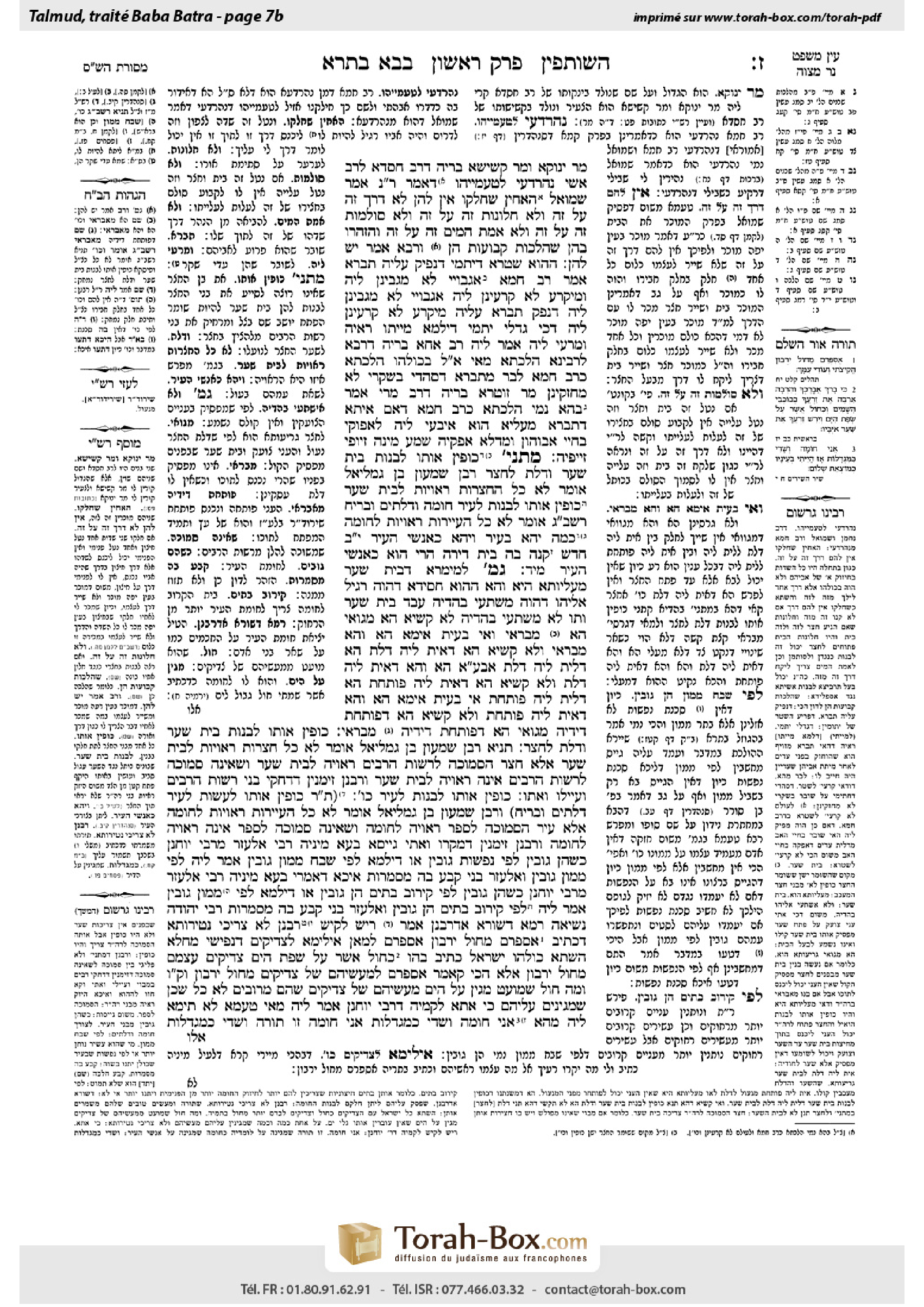
Bava Batra 7b: Talmud study for Daf Yomi
Study the Talmud for Daf Yomi with scanned pages, Hebrew text, English translations from Sefaria and AI-generated French translations.
Passage selection and English or AI-generated French translation are available where the scan has annotations. Daf Study is independent of Torah-Box and Sefaria.
Browse Bava Batra · בבא בתרא · All tractatesBava Batra 7b text and translations
This page of Bava Batra includes the Aramaic text, an English translation and an AI-generated French translation, alongside the scan above.
בבא בתרא ז׳ ב · Aramaic and Hebrew text
מָר יָנוֹקָא וּמָר קַשִּׁישָׁא בְּרֵיהּ דְּרַב חִסְדָּא לְרַב אָשֵׁי: נְהַרְדָּעֵי לְטַעְמַיְיהוּ – דְּאָמַר רַב נַחְמָן אָמַר שְׁמוּאֵל: הָאַחִין שֶׁחָלְקוּ – אֵין לָהֶן לֹא דֶּרֶךְ זֶה עַל זֶה,
וְלֹא חַלּוֹנוֹת זֶה עַל זֶה, וְלֹא סוּלָּמוֹת זֶה עַל זֶה, וְלֹא אַמַּת הַמַּיִם זֶה עַל זֶה, וְהִזָּהֲרוּ בָּהֶן שֶׁהֲלָכוֹת קְבוּעוֹת הֵן. וְרָבָא אָמַר: יֵשׁ לָהֶן.
הָהוּא שְׁטָרָא דְיַתְמֵי, דְּנָפֵיק עֲלֵיהּ תְּבָרָא. אָמַר רַב חָמָא: אַגְבּוֹיֵי לָא מַגְבִּינַן לֵיהּ, וּמִיקְרָע לָא קָרְעִינַן לֵיהּ. אַגְבּוֹיֵי לָא מַגְבִּינַן לֵיהּ – דִּנְפַק תְּבָרָא עֲלֵיהּ. מִיקְרָע לָא קָרְעִינַן לֵיהּ – דְּכִי גָּדְלִי יַתְמֵי, דִּילְמָא מַיְיתוּ רְאָיָה וּמַרְעִי לֵיהּ.
אֲמַר לֵיהּ רַב אַחָא בְּרֵיהּ דְּרָבָא לְרָבִינָא: הִלְכְתָא מַאי? אֲמַר לֵיהּ: בְּכוּלְּהוּ הִלְכְתָא כְּרַב חָמָא, לְבַר מִתְּבָרָא – דְּסָהֲדֵי בְּשַׁקָּרֵי לָא מַחְזְקִינַן.
מָר זוּטְרָא בְּרֵיהּ דְּרַב מָרִי אָמַר: בְּהָא נָמֵי הִלְכְתָא כְּרַב חָמָא; דְּאִם אִיתָא דִּתְבָרָא מְעַלְּיָא הוּא – אִיבְּעִי לֵיהּ לְאַפּוֹקֵי בְּחַיֵּי אֲבוּהוֹן, וּמִדְּלָא אַפְּקֵיהּ – שְׁמַע מִינַּהּ זַיּוֹפֵי זַיְּיפֵיהּ.
מַתְנִי׳ כּוֹפִין אוֹתוֹ לִבְנוֹת בֵּית שַׁעַר וָדֶלֶת לֶחָצֵר. רַבָּן שִׁמְעוֹן בֶּן גַּמְלִיאֵל אוֹמֵר: לֹא כׇּל הַחֲצֵרוֹת רְאוּיוֹת לְבֵית שַׁעַר. כּוֹפִין אוֹתוֹ לִבְנוֹת לָעִיר חוֹמָה וּדְלָתַיִם וּבְרִיחַ. רַבָּן שִׁמְעוֹן בֶּן גַּמְלִיאֵל אוֹמֵר: לֹא כׇּל הָעֲיָירוֹת רְאוּיוֹת לְחוֹמָה.
כַּמָּה יְהֵא בָּעִיר וִיהֵא כְּאַנְשֵׁי הָעִיר? שְׁנֵים עָשָׂר חֹדֶשׁ. קָנָה בָּהּ בֵּית דִּירָה – הֲרֵי הוּא כְּאַנְשֵׁי הָעִיר מִיָּד.
גְּמָ׳ לְמֵימְרָא דְּבֵית שַׁעַר מְעַלְּיוּתָא הִיא?! וְהָא הָהוּא חֲסִידָא דַּהֲוָה רְגִיל אֵלִיָּהוּ דַּהֲוָה מִשְׁתַּעֵי בַּהֲדֵיהּ; עֲבַד בֵּית שַׁעַר, וְתוּ לָא מִשְׁתַּעֵי בַּהֲדֵיהּ! לָא קַשְׁיָא: הָא מִגַּוַּאי, הָא מִבָּרַאי.
וְאִי בָּעֵית אֵימָא: הָא וְהָא מִבָּרַאי, וְלָא קַשְׁיָא: הָא דְּאִית לֵיהּ דֶּלֶת, הָא דְּלֵית לֵיהּ דֶּלֶת. אִי בָּעֵית אֵימָא: הָא וְהָא דְּאִית לֵיהּ דֶּלֶת, וְלָא קַשְׁיָא: הָא דְּאִית לֵיהּ פּוֹתַחַת, הָא דְּלֵית לֵיהּ פּוֹתַחַת. אִי בָּעֵית אֵימָא: הָא וְהָא דְּאִית לֵיהּ פּוֹתַחַת, וְלָא קַשְׁיָא: הָא דְּפוֹתַחַת דִּידֵיהּ מִגַּוַּאי, הָא דְּפוֹתַחַת דִּידֵיהּ מִבָּרַאי.
כּוֹפִין אוֹתוֹ לִבְנוֹת בֵּית שַׁעַר וָדֶלֶת לֶחָצֵר. תַּנְיָא, רַבָּן שִׁמְעוֹן בֶּן גַּמְלִיאֵל אוֹמֵר: לֹא כָּל חֲצֵרוֹת רְאוּיוֹת לְבֵית שַׁעַר; אֶלָּא חָצֵר הַסְּמוּכָה לִרְשׁוּת הָרַבִּים – רְאוּיָה לְבֵית שַׁעַר, וְשֶׁאֵינָהּ סְמוּכָה לִרְשׁוּת הָרַבִּים – אֵינָהּ רְאוּיָה לְבֵית שַׁעַר. וְרַבָּנַן – זִימְנִין דְּדָחֲקִי בְּנֵי רְשׁוּת הָרַבִּים, וְעָיְילוּ וְאָתוּ.
כּוֹפִין אוֹתוֹ לִבְנוֹת לָעִיר כּוּ׳. תָּנוּ רַבָּנַן: כּוֹפִין אוֹתוֹ לַעֲשׂוֹת לָעִיר דְּלָתַיִם וּבְרִיחַ. וְרַבָּן שִׁמְעוֹן בֶּן גַּמְלִיאֵל אוֹמֵר: לֹא כָּל הָעֲיָירוֹת רְאוּיוֹת לְחוֹמָה; אֶלָּא עִיר הַסְּמוּכָה לַסְּפָר – רְאוּיָה לְחוֹמָה, וְשֶׁאֵינָהּ סְמוּכָה לַסְּפָר – אֵינָהּ רְאוּיָה לְחוֹמָה. וְרַבָּנַן – זִימְנִין דְּמִקְּרוּ וְאָתֵי גְּיָיסָא.
בְּעָא מִינֵּיהּ רַבִּי אֶלְעָזָר מֵרַבִּי יוֹחָנָן: כְּשֶׁהֵן גּוֹבִין, לְפִי נְפָשׁוֹת גּוֹבִין, אוֹ דִילְמָא לְפִי שֶׁבַח מָמוֹן גּוֹבִין? אֲמַר לֵיהּ: לְפִי מָמוֹן גּוֹבִין; וְאֶלְעָזָר בְּנִי, קְבַע בָּהּ מַסְמְרוֹת!
אִיכָּא דְּאָמְרִי, בְּעָא מִינֵּיהּ רַבִּי אֶלְעָזָר מֵרַבִּי יוֹחָנָן: כְּשֶׁהֵן גּוֹבִין, לְפִי קֵירוּב בָּתִּים הֵן גּוֹבִין, אוֹ דִילְמָא לְפִי מָמוֹן גּוֹבִין? אֲמַר לֵיהּ: לְפִי קֵירוּב בָּתִּים הֵן גּוֹבִין; וְאֶלְעָזָר בְּנִי, קְבַע בָּהּ מַסְמְרוֹת!
רַבִּי יְהוּדָה נְשִׂיאָה רְמָא דְּשׁוּרָא אַדְּרַבָּנַן. אָמַר רֵישׁ לָקִישׁ: רַבָּנַן לָא צְרִיכִי נְטִירוּתָא, דִּכְתִיב: ״אֶסְפְּרֵם מֵחוֹל יִרְבּוּן״ – אֶסְפְּרֵם לְמַאן? אִילֵימָא לְצַדִּיקִים – דִּנְפִישִׁי מֵחָלָא; הַשְׁתָּא כּוּלְּהוּ יִשְׂרָאֵל כְּתִיב בְּהוּ: ״כַּחוֹל אֲשֶׁר עַל שְׂפַת הַיָּם״, צַדִּיקִים עַצְמָם ״מֵחוֹל יִרְבּוּן״?!
אֶלָּא הָכִי קָאָמַר: אֶסְפְּרֵם לְמַעֲשֵׂיהֶם שֶׁל צַדִּיקִים, מֵחוֹל יִרְבּוּן. וְקַל וָחוֹמֶר: וּמָה חוֹל, שֶׁמּוּעָט – מֵגֵין עַל הַיָּם; מַעֲשֵׂיהֶם שֶׁל צַדִּיקִים, שֶׁהֵם מְרוּבִּים – לֹא כׇּל שֶׁכֵּן שֶׁמְּגִינִּים עֲלֵיהֶם.
כִּי אֲתָא לְקַמֵּיהּ דְּרַבִּי יוֹחָנָן, אֲמַר לֵיהּ: מַאי טַעְמָא לָא תֵּימָא לֵיהּ מֵהָא: ״אֲנִי חוֹמָה וְשָׁדַי כַּמִּגְדָּלוֹת״; ״אֲנִי חוֹמָה״ – זוֹ תּוֹרָה, ״וְשָׁדַי כַּמִּגְדָּלוֹת״ –
Bava Batra 7b · English translation
i.e., Mar Yenuka and Mar Kashisha, sons of Rav Ḥisda, said to Rav Ashi: The Sages of Neharde’a follow their usual line of reasoning, as Rav Ḥama, who was from Neharde’a, issued his ruling in accordance with the opinion of Shmuel, who was also from that city. As Rav Naḥman says that Shmuel says: In the case of brothers who divided their father’s estate, they do not have a right-of-way against each other. Although the father would traverse the outer field from the inner field to access the public domain, the brother who received the inner field as an inheritance does not have the right to traverse his brother’s outer field.
Shmuel continues: Nor do they have the right of windows against each other, i.e., the right to prevent the other from building a wall facing his windows; nor do they have the right of ladders against each other, i.e., the right to set up a ladder in the other’s property in order to get to his own; nor do they have the right of a water channel against each other, i.e., the right to pass a water channel through the other’s property. And be careful with these, since they are established halakhot. Rava says: The brothers do have all of the aforementioned rights. Rav Ḥama agrees with Shmuel’s opinion, that each brother can do as he pleases on his own property without the other one preventing him from doing so.
Since Rav Ḥama’s rulings were mentioned, the Gemara cites another halakhic ruling in his name. There was a certain promissory note inherited by orphans from their father, stating that somebody owed them money, against which a receipt was produced by the borrower, stating that the debt was already paid. Rav Ḥama said: We cannot use the note to collect the debt on behalf of the orphans, nor can we tear it up. The Gemara explains: We cannot collect with the note because a receipt against it was produced by the borrower; and we cannot tear the note up because perhaps when the orphans grow up they will bring proof that the receipt was forged and undermine it.
Rav Aḥa, son of Rava, said to Ravina: What is the halakha? Ravina said to him: In all the cases in this discussion, the halakha is in accordance with the opinion of Rav Ḥama, except for the case of the receipt, because we do not presume that the witnesses are liars. Since witnesses signed the receipt, the court trusts that the debt was paid and they tear up the promissory note.
Mar Zutra, son of Rav Mari, said: In this case as well, the halakha is in accordance with the opinion of Rav Ḥama, because the validity of the receipt is in doubt. As, if it is so that it is a valid receipt, the borrower should have produced it during their father’s lifetime. And since he did not produce it at the proper time, we learn from this that he may have forged it. Even though this is not an absolute proof, it is sufficient reason not to tear up the promissory note.
MISHNA: The residents of a courtyard can compel each inhabitant of that courtyard to financially participate in the building of a gatehouse and a door to the jointly owned courtyard. Rabban Shimon ben Gamliel disagrees and says: Not all courtyards require a gatehouse, and each courtyard must be considered on its own in accordance with its specific needs. Similarly, the residents of a city can compel each inhabitant of that city to contribute to the building of a wall, double doors, and a crossbar for the city. Rabban Shimon ben Gamliel disagrees and says: Not all towns require a wall.
With regard to this latter obligation, the mishna asks: How long must one live in the city to be considered like one of the people of the city and therefore obligated to contribute to these expenses? Twelve months. But if he bought himself a residence in the city, he is immediately considered like one of the people of the city.
GEMARA: The Gemara asks: Is this to say that making a gatehouse is beneficial? But wasn’t there that pious man, with whom the prophet Elijah was accustomed to speak, who built a gatehouse, and after-ward Elijah did not speak with him again? The objection to the building of a gatehouse is that the guard who mans it prevents the poor from entering and asking for charity. The Gemara answers: This is not difficult: This, the case presented in the mishna, is referring to a gatehouse built on the inside of the courtyard, in which case the poor can at least reach the courtyard’s entrance and be heard inside the courtyard; that, the story of the pious man and Elijah, involves a gatehouse that was built on the outside of the courtyard, completely blocking the poor’s access to the courtyard’s entrance.
And if you wish, say instead that in both cases the gatehouse was built outside the courtyard, and yet this is not difficult: In the one case, there is a door to the gatehouse, so that the poor cannot be heard inside the courtyard, while in the other case there is no door. Or if you wish, say that in both cases there is a door, and still this is not difficult: In the one case, there is a key needed to open the door, and the key is not available to the poor people, whereas in the other case, there is no key needed. Or if you wish, say that in both cases there is a key needed, and even so this is not difficult: In the one case the key is on the inside, so that the poor cannot reach it, while in the other case of the mishna, the key is on the outside.
§ The mishna teaches that the residents of a courtyard can compel each inhabitant of that courtyard to financially participate in the building of a gatehouse and a door to the jointly owned courtyard. It is taught in a baraita that Rabban Shimon ben Gamliel says: Not all courtyards require a gatehouse. Rather, a courtyard that adjoins the public domain requires a gatehouse to prevent people from peering in. But a courtyard that does not adjoin the public domain does not require a gatehouse. The Gemara asks: And why don’t the Rabbis make this distinction? The Gemara answers: Even if a courtyard does not adjoin the public domain, people in the public domain sometimes are forced toward the courtyard due to crowding in the public domain, and come and enter the courtyard.
§ The mishna teaches that the residents of a city can compel each inhabitant of that city to contribute to the building of a wall, double doors, and a crossbar for the city. The Sages taught in a baraita: The residents of a city can compel each inhabitant of that city to build double doors and a crossbar for the city. And Rabban Shimon ben Gamliel says: Not all cities require a wall. Rather, a city that adjoins the state border requires a wall, whereas a city that does not adjoin the state border does not require a wall. The Gemara asks: And why don’t the Rabbis make this distinction? The Gemara answers: Even if a city does not adjoin the border, it sometimes happens that invading troops come into the area. Therefore, it is always good for a city to be protected by a wall.
With regard to this issue, Rabbi Elazar asked Rabbi Yoḥanan: When the residents of the city collect money to build a wall, do they collect based on the number of people living in each house, or perhaps they collect based on the net worth of each person? Rabbi Yoḥanan said to him: They collect based on the net worth of each person, and Elazar, my son, you shall fix nails in this, i.e., this is an established halakha, and you must not veer from it.
There are those who say that Rabbi Elazar asked Rabbi Yoḥanan: When they collect money to build a wall, do they collect based on the proximity of the houses to the wall, so that those people who live closer to the wall pay more? Or perhaps they collect based on the net worth of each person. Rabbi Yoḥanan said to him: They collect based on the proximity of the houses to the wall, and Elazar, my son, you shall fix nails in this.
§ It is related that Rabbi Yehuda Nesia once imposed payment of the tax for the wall even on the Sages. Reish Lakish said to him: The Sages do not require protection, as it is written: “How precious are your dear ones to me, O God…If I should count them, they are more in number than the sand” (Psalms 139:17–18). If I should count whom? If we say this is referring to the righteous, and the verse is saying that they are greater in number than the grains of sand, this is difficult. Now if it is written about all of Israel: “As the sand which is upon the seashore” (Genesis 22:17), can the righteous themselves, who are a part of Israel, be greater in number than the grains of sand? How can they possibly outnumber the grains of sand upon the seashore?
Rather, this is what the verse is saying: If I should count the deeds of the righteous, they are greater in number than the grains of sand. And it follows by an a fortiori inference: If the grains of sand, which are fewer in number, protect the shore from the sea, barring it from flowing inland (see Jeremiah 5:22), do not all the more so the deeds of the righteous, which are greater in number, protect them? Consequently the Sages do not need additional protection.
When Reish Lakish came before Rabbi Yoḥanan and reported the exchange to him, Rabbi Yoḥanan said to him: What is the reason that you did not quote this verse to him: “I am a wall and my breasts are like towers” (Song of Songs 8:10), which may be explained as follows: “I am a wall”; this is referring to the Torah. “And my breasts are like towers”;
Bava Batra 7b · Traduction française (IA)
c'est-à-dire Mar Yenuka et Mar Kashisha, fils de Rav Ḥisda, qui dirent à Rav Ashi : Les Sages de Neharde’a suivent leur raisonnement habituel, car Rav Ḥama, qui était de Neharde’a, a rendu son verdict conformément à l'opinion de Shmuel, qui était également de cette ville. Rav Naḥman dit que Shmuel dit : Dans le cas de frères qui ont divisé la succession de leur père, ils n'ont pas le droit de passage les uns envers les autres. Bien que le père traversât le champ extérieur depuis le champ intérieur pour accéder au domaine public, le frère qui avait reçu le champ intérieur en héritage n'a pas le droit de traverser le champ extérieur de son frère.
Shmuel continue : Ils n'ont pas non plus le droit de fenêtres les uns envers les autres, c'est-à-dire le droit de bloquer l'autre de construire un mur face à ses fenêtres ; ni le droit d'échelles les uns envers les autres, c'est-à-dire le droit de poser une échelle dans la propriété de l'autre pour accéder à son propre domaine ; ni le droit de canal d'eau les uns envers les autres, c'est-à-dire le droit de faire passer un canal d'eau à travers la propriété de l'autre. Soyez attentifs à ces points, car ils sont des halakhot établies. Rava dit : Les frères ont tous lesdits droits. Rav Ḥama est d'accord avec l'opinion de Shmuel, à savoir que chaque frère peut faire ce qu'il veut sur sa propre propriété sans que l'autre ne l'empêche.
Puisque les décisions de Rav Ḥama ont été mentionnées, la Guemara cite une autre halakha rendue en son nom. Il y avait un billet de créance hérité par des orphelins de leur père, indiquant que quelqu'un leur devait de l'argent, contre lequel un reçu avait été produit par le prêteur, indiquant que la dette avait déjà été payée. Rav Ḥama dit : Nous ne pouvons pas utiliser ce billet pour récupérer la dette au nom des orphelins, ni ne pouvons le déchirer. La Guemara explique : Nous ne pouvons pas récupérer avec ce billet car un reçu contre lui a été produit par le prêteur ; et nous ne pouvons pas le déchirer car peut-être que lorsque les orphelins grandiront, ils pourront apporter une preuve que le reçu était falsifié et le discréditer.
Rav Aḥa, fils de Rava, dit à Ravina : Quelle est la halakha ? Ravina dit à lui : Dans tous les cas discutés ici, la halakha suit l'opinion de Rav Ḥama, sauf pour le cas du reçu, car nous ne supposons pas que les témoins sont des menteurs. Puisque des témoins ont signé le reçu, la cour considère que la dette a été payée et ils déchirent le billet de créance.
Mar Zutra, fils de Rav Mari, dit : Dans ce cas également, la halakha suit l'opinion de Rav Ḥama, car la validité du reçu est en doute. Car, si c'est un reçu valide, le prêteur aurait dû le produire durant la vie de leur père. Et puisque ce n'est pas le cas, nous en déduisons qu'il pourrait avoir falsifié le reçu. Bien que ce ne soit pas une preuve absolue, cela suffit à ne pas déchirer le billet de créance.
MICHNA : Les habitants d'un courtil peuvent obliger chaque habitant de ce courtil à participer financièrement à la construction d'une porte et d'une barrière pour le courtil commun. Rabban Shimon ben Gamliel désaccorde et dit : Non tous les courtils nécessitent une porte, et chaque courtil doit être considéré selon ses propres besoins. De même, les habitants d'une ville peuvent obliger chaque habitant de cette ville à contribuer à la construction d'un mur, de deux portes et d'une barre transversale pour la ville. Rabban Shimon ben Gamliel désaccorde et dit : Non toutes les villes nécessitent un mur.
Concernant cette dernière obligation, la mishna pose la question : Combien de temps doit-on vivre dans la ville pour être considéré comme l'un des habitants de la ville et donc obligé de contribuer à ces dépenses ? Douze mois. Mais si l'on achète une résidence dans la ville, on est immédiatement considéré comme l'un des habitants de la ville.
GUEMARA : La Guemara pose la question : Est-ce que cela signifie que la construction d'une porte est bénéfique ? Mais n'y avait-il pas ce justicier, avec lequel le prophète Elie a l'habitude de parler, qui a construit une porte, et après cela Elie n'a plus parlé avec lui ? L'objection à la construction d'une porte est que le gardien qui la tient empêche les pauvres d'entrer et de demander de l'aumône. La Guemara répond : Ce n'est pas difficile : ce cas présenté dans la mishna fait référence à une porte construite à l'intérieur du courtil, dans lequel cas les pauvres peuvent au moins atteindre l'entrée du courtil et être entendus à l'intérieur du courtil ; celui de l'homme justicier et d'Elie, implique une porte construite à l'extérieur du courtil, complètement bloquant l'accès des pauvres à l'entrée du courtil.
Et si vous le souhaitez, dites plutôt que dans les deux cas la porte était construite à l'extérieur du courtil, et cependant ce n'est pas difficile : dans l'un des cas, il y a une porte à la porte, de sorte que les pauvres ne peuvent pas être entendus à l'intérieur du courtil, tandis que dans l'autre cas il n'y a pas de porte. Ou si vous le souhaitez, dites que dans les deux cas il y a une porte, et même alors ce n'est pas difficile : dans l'un des cas, il faut une clé pour ouvrir la porte, et la clé n'est pas disponible aux pauvres, tandis que dans l'autre cas il n'y a pas de clé. Ou si vous le souhaitez, dites que dans les deux cas il y a une clé, et même alors ce n'est pas difficile : dans l'un des cas la clé est à l'intérieur, de sorte que les pauvres ne peuvent pas l'atteindre, tandis que dans l'autre cas de la mishna, la clé est à l'extérieur.
§ La mishna enseigne que les habitants d'un courtil peuvent obliger chaque habitant de ce courtil à participer financièrement à la construction d'une porte et d'une entrée pour le courtil commun. Il est enseigné dans une baraïta que Rabban Shimon ben Gamliel dit : Non, tous les courtils n'ont pas besoin d'une porte. Plutôt, un courtil qui adjoine le domaine public a besoin d'une porte pour empêcher les gens de regarder à l'intérieur. Mais un courtil qui ne s'adjoine pas le domaine public n'a pas besoin d'une porte. La Guemara pose la question : Et pourquoi les Rabbins ne font-ils pas cette distinction ? La Guemara répond : Même si un courtil ne s'adjoine pas le domaine public, des gens du domaine public sont parfois poussés vers le courtil en raison de la densité dans le domaine public, et viennent entrer dans le courtil.
§ La Michna enseigne que les habitants d'une ville peuvent exiger de chaque résident de cette ville une contribution à la construction d'un mur, de deux portes et d'une barre transversale pour la ville. Les Sages ont enseigné dans une baraïta : Les habitants d'une ville peuvent exiger de chaque résident de cette ville la construction de deux portes et d'une barre transversale pour la ville. Et Rabban Shimon ben Gamliel dit : Ce n'est pas toutes les villes qui nécessitent un mur. En réalité, une ville qui touche la frontière du royaume nécessite un mur, tandis qu'une ville qui ne touche pas la frontière du royaume n'a pas besoin d'un mur. La Guemara pose la question : Et pourquoi les Rabbins ne font-ils pas cette distinction ? La Guemara répond : Même si une ville ne touche pas la frontière, il arrive parfois que des troupes ennemies pénètrent dans la région. Par conséquent, il est toujours bon que la ville soit protégée par un mur.
En ce qui concerne cette question, Rabbi Elazar a interrogé Rabbi Yoḥanan : Lorsque les habitants de la ville collectent de l'argent pour construire un mur, collectent-ils selon le nombre de personnes vivant dans chaque maison, ou bien selon la valeur nette de chaque individu ? Rabbi Yoḥanan a répondu à lui : Ils collectent selon la valeur nette de chaque individu, et Elazar, mon fils, tu dois fixer des clous dans cela, c'est-à-dire cela est une halakha établie, et tu ne dois pas en dévier.
Certains disent que Rabbi Elazar a interrogé Rabbi Yoḥanan : Lorsqu'ils collectent de l'argent pour construire un mur, collectent-ils selon la proximité des maisons par rapport au mur, de sorte que ceux qui habitent plus près du mur paient davantage ? Ou bien collectent-ils selon la valeur nette de chaque individu ? Rabbi Yoḥanan a répondu à lui : Ils collectent selon la proximité des maisons par rapport au mur, et Elazar, mon fils, tu dois fixer des clous dans cela.
§ On raconte que Rabbi Yehuda Nesia a imposé le paiement de l'impôt pour le mur même aux Sages. Reish Lakish a dit à lui : Les Sages n'ont pas besoin de protection, car il est écrit : « Combien précieux sont pour moi vos êtres chers, ô Éternel… Si je les comptais, ils seraient plus nombreux que les grains de sable » (Psaumes 139 : 17–18). Si je les compte ? Si nous disons que cela fait référence aux justes, et que le verset dit qu'ils sont plus nombreux que les grains de sable, cela est difficile. Maintenant, si cela est écrit à propos de tout Israël : « Comme la poussière sur la côte de la mer » (Genèse 22 : 17), peut-on dire que les justes eux-mêmes, qui font partie d'Israël, sont plus nombreux que les grains de sable ? Comment peuvent-ils surpasser en nombre les grains de sable sur la côte de la mer ?
Plutôt, ce que le verset dit est : Si je comptais les œuvres des justes, elles seraient plus nombreuses que les grains de sable. Et cela suit par une déduction a fortiori : Si les grains de sable, qui sont moins nombreux, protègent la côte contre la mer, l'empêchant de s'écouler à l'intérieur (cf. Jérémie 5 : 22), ne protègent-ils pas encore davantage les œuvres des justes, qui sont plus nombreuses ? Par conséquent, les Sages n'ont pas besoin de protection supplémentaire.
Lorsque Reish Lakish est venu devant Rabbi Yoḥanan et lui a rapporté ce dialogue, Rabbi Yoḥanan a dit à lui : Quel est le motif que tu n'as pas cité ce verset à lui : « Je suis un mur et mes seins sont comme des tours » (Cantique des Cantiques 8 : 10), qui peut être expliqué ainsi : « Je suis un mur » ; cela fait référence à la Torah. « Et mes seins sont comme des tours » ;
Traduction française générée par IA à partir de l’édition anglaise de Sefaria. Vérifie toujours un passage avec le texte source.
Text from Sefaria: William Davidson Edition - Vocalized Aramaic (CC BY NC); William Davidson Edition - English (CC BY NC).