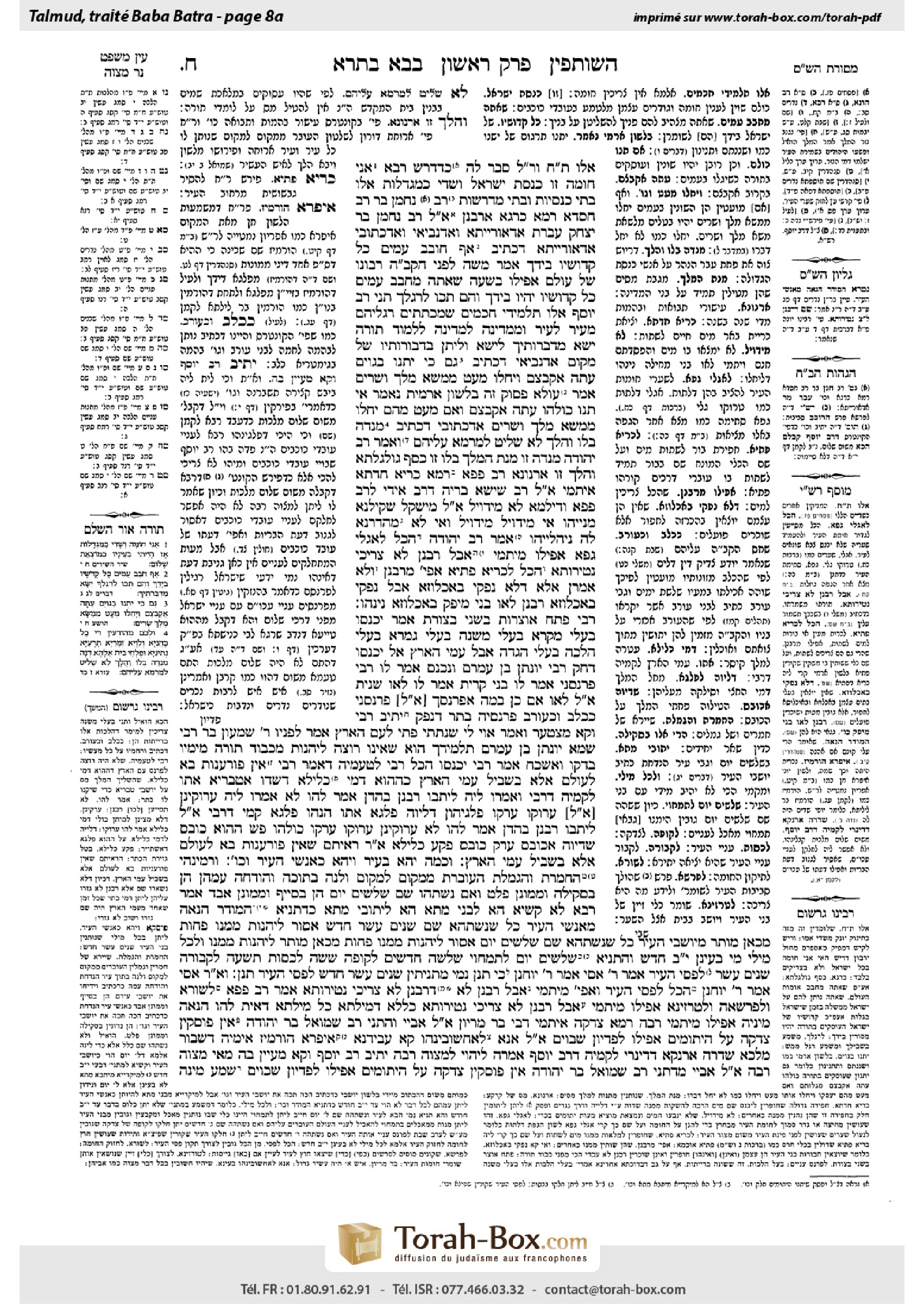
Bava Batra 8a: Talmud study for Daf Yomi
Study the Talmud for Daf Yomi with scanned pages, Hebrew text, English translations from Sefaria and AI-generated French translations.
Passage selection and English or AI-generated French translation are available where the scan has annotations. Daf Study is independent of Torah-Box and Sefaria.
Browse Bava Batra · בבא בתרא · All tractatesBava Batra 8a text and translations
This page of Bava Batra includes the Aramaic text, an English translation and an AI-generated French translation, alongside the scan above.
בבא בתרא ח׳ א · Aramaic and Hebrew text
אֵלּוּ תַּלְמִידֵי חֲכָמִים. וְרֵישׁ לָקִישׁ, סָבַר לַהּ כִּדְדָרֵשׁ רָבָא: ״אֲנִי חוֹמָה״ – זוֹ כְּנֶסֶת יִשְׂרָאֵל, ״וְשָׁדַי כַּמִּגְדָּלוֹת״ – אֵלּוּ בָּתֵּי כְנֵסִיּוֹת וּבָתֵּי מִדְרָשׁוֹת.
רַב נַחְמָן בַּר רַב חִסְדָּא רְמָא כְּרָגָא אַרַבָּנַן. אֲמַר לֵיהּ רַב נַחְמָן בַּר יִצְחָק: עֲבַרְתְּ אַדְּאוֹרָיְיתָא וְאַדִּנְבִיאֵי וְאַדִּכְתוּבֵי.
אַדְּאוֹרָיְיתָא – דִּכְתִיב: ״אַף חֹבֵב עַמִּים כׇּל קְדֹשָׁיו בְּיָדֶךָ״ – אָמַר מֹשֶׁה לִפְנֵי הַקָּדוֹשׁ בָּרוּךְ הוּא: רִבּוֹנוֹ שֶׁל עוֹלָם, אֲפִילּוּ בְּשָׁעָה שֶׁאַתָּה מְחַבֵּב עַמִּים – כׇּל קְדוֹשָׁיו יִהְיוּ בְּיָדֶךָ. ״וְהֵם תֻּכּוּ לְרַגְלֶךָ״ – תָּנֵי רַב יוֹסֵף: אֵלּוּ תַּלְמִידֵי חֲכָמִים, שֶׁמְּכַתְּתִים רַגְלֵיהֶם מֵעִיר לְעִיר וּמִמְּדִינָה לִמְדִינָה לִלְמוֹד תּוֹרָה, ״יִשָּׂא מִדַּבְּרוֹתֶיךָ״ – לִישָּׂא וְלִיתֵּן בְּדִבּוּרוֹתָיו שֶׁל מָקוֹם.
אַדִּנְבִיאֵי – דִּכְתִיב: ״גַּם כִּי יִתְנוּ בַגּוֹיִם עַתָּה אֲקַבְּצֵם, וַיָּחֵלּוּ מְּעָט מִמַּשָּׂא מֶלֶךְ וְשָׂרִים״ – אָמַר עוּלָּא: פָּסוּק זֶה בִּלְשׁוֹן אֲרָמִית נֶאֱמַר: ״אִי תָּנוּ״ כּוּלְּהוּ – ״עַתָּה אֲקַבְּצֵם״, וְאִם ״מְעַט״ מֵהֶם – ״יָחֵלּוּ מִמַּשָּׂא מֶלֶךְ וְשָׂרִים״.
אַדִּכְתוּבֵי – דִּכְתִיב: ״מִנְדָּה בְלוֹ וַהֲלָךְ, לָא שַׁלִּיט לְמִרְמֵא עֲלֵיהֹם״; וְאָמַר רַב יְהוּדָה: ״מִנְדָּה״ – זוֹ מְנָת הַמֶּלֶךְ, ״בְּלוֹ״ – זוֹ כְּסַף גֻּולְגָּלְתָּא, ״וַהֲלָךְ״ – זוֹ אַרְנוֹנָא.
רַב פָּפָּא רְמָא כַּרְיָא חַדְתָּא אַיַּתְמֵי, אֲמַר לֵיהּ רַב שִׁישָׁא בְּרֵיהּ דְּרַב אִידִי לְרַב פָּפָּא: וְדִילְמָא לָא מִידְּוִיל! אֲמַר לֵיהּ: מִישְׁקָל שָׁקֵילְנָא מִנַּיְיהוּ; אִי מִידְּוִיל – מִידְּוִיל, וְאִי לָא – מַהְדַּרְנָא לַהּ נִיהֲלַיְיהוּ.
אָמַר רַב יְהוּדָה: הַכֹּל לַאֲגַלֵּי גָפָא, אֲפִילּוּ מִיַּתְמֵי; אֲבָל רַבָּנַן – לָא צְרִיכִי נְטִירוּתָא. הַכֹּל לְכַרְיָא פַּתְיָא, אֲפִילּוּ מֵרַבָּנַן; וְלָא אֲמַרַן אֶלָּא דְּלָא נָפְקִי בְּכָלוֹזָא, אֲבָל נָפְקִי בְּכָלוֹזָא – רַבָּנַן לָאו בְּנֵי מִיפָּק בְּכָלוֹזָא נִינְהוּ.
רַבִּי פָּתַח אוֹצָרוֹת בִּשְׁנֵי בַצּוֹרֶת, אָמַר: יִכָּנְסוּ בַּעֲלֵי מִקְרָא, בַּעֲלֵי מִשְׁנָה, בַּעֲלֵי תַלְמוּד, בַּעֲלֵי הֲלָכָה, בַּעֲלֵי הַגָּדָה; אֲבָל עַמֵּי הָאָרֶץ אַל יִכָּנְסוּ. דָּחַק רַבִּי יוֹנָתָן בֶּן עַמְרָם וְנִכְנַס. אָמַר לוֹ: ״רַבִּי, פַּרְנְסֵנִי!״ אָמַר לוֹ: ״בְּנִי, קָרִיתָ?״ אָמַר לוֹ: ״לָאו״. ״שָׁנִיתָ?״ אָמַר לוֹ: ״לָאו״. ״אִם כֵּן, בַּמָּה אֲפַרְנְסֶךָ?״ [אָמַר לוֹ:] ״פַּרְנְסֵנִי כְּכֶלֶב וּכְעוֹרֵב״. פַּרְנְסֵיהּ.
בָּתַר דִּנְפַק יְתֵיב רַבִּי וְקָא מִצְטַעַר, וְאָמַר: אוֹי לִי שֶׁנָּתַתִּי פִּתִּי לְעַם הָאָרֶץ! אָמַר לְפָנָיו רַבִּי שִׁמְעוֹן בַּר רַבִּי: שֶׁמָּא יוֹנָתָן בֶּן עַמְרָם תַּלְמִידְךָ הוּא, שֶׁאֵינוֹ רוֹצֶה לֵיהָנוֹת מִכְּבוֹד תּוֹרָה מִיָּמָיו? בָּדְקוּ וְאַשְׁכַּח. אָמַר רַבִּי: יִכָּנְסוּ הַכֹּל.
רַבִּי לְטַעְמֵיהּ, דַּאֲמַר רַבִּי: אֵין פּוּרְעָנוּת בָּא לָעוֹלָם אֶלָּא בִּשְׁבִיל עַמֵּי הָאָרֶץ. כְּהַהוּא דְּמֵי כְלִילָא דִּשְׁדוֹ אַטְּבֶרְיָא, אֲתוֹ לְקַמֵּיהּ דְּרַבִּי וַאֲמַרוּ לֵיהּ: ״לִיתְּבוּ רַבָּנַן בַּהֲדַן״. אֲמַר לְהוּ: ״לָא״. אֲמַרוּ לֵיהּ: ״עָרְוקִינַן״. [אֲמַר לְהוּ:] ״עֲרוֹקוּ״. עֲרַקוּ פַּלְגֵיהוֹן, דַּלְיוּהּ פַּלְגָא.
אֲתוֹ הָנְהוּ פַּלְגָא קַמֵּי דְּרַבִּי, אֲמַרוּ לֵיהּ: ״לִיתְּבוּ רַבָּנַן בַּהֲדַן״. אֲמַר לְהוּ: ״לָא״. ״עָרְוקִינַן״. ״עֲרוּקוּ״. עֲרַקוּ כּוּלְּהוּ, פָּשׁ הַהוּא כּוֹבֵס. שַׁדְיוּהּ אַכּוֹבֵס. עֲרַק כּוֹבֵס, פְּקַע כְּלִילָא. אָמַר רַבִּי: רְאִיתֶם שֶׁאֵין פּוּרְעָנוּת בָּא לָעוֹלָם אֶלָּא בִּשְׁבִיל עַמֵּי הָאָרֶץ.
וְכַמָּה יְהֵא בָּעִיר וִיהֵא כְּאַנְשֵׁי הָעִיר וְכוּ׳. וּרְמִינְהִי: הַחַמֶּרֶת וְהַגַּמֶּלֶת הָעוֹבֶרֶת מִמָּקוֹם לְמָקוֹם, וְלָנָה בְּתוֹכָהּ וְהוּדְּחָה עִמָּהֶן, הֵן בִּסְקִילָה, וּמָמוֹנָן פָּלֵט.
וְאִם נִשְׁתַּהוּ שָׁם שְׁלֹשִׁים יוֹם – הֵן בְּסַיִיף, וּמָמוֹנָן אָבֵד!
אָמַר רָבָא, לָא קַשְׁיָא: הָא לִבְנֵי מָתָא, הָא לְיָתוֹבֵי מָתָא. כִּדְתַנְיָא: הַמּוּדָּר הֲנָאָה מֵאַנְשֵׁי הָעִיר; כׇּל שֶׁנִּשְׁתַּהָא שָׁם שְׁנֵים עָשָׂר חֹדֶשׁ – אָסוּר לֵיהָנוֹת מִמֶּנּוּ, פָּחוֹת מִכָּאן – מוּתָּר. מִיּוֹשְׁבֵי הָעִיר; כׇּל שֶׁנִּשְׁתַּהָא שָׁם שְׁלֹשִׁים יוֹם – אָסוּר לֵיהָנוֹת מִמֶּנּוּ, פָּחוֹת מִכָּאן – מוּתָּר לֵיהָנוֹת מִמֶּנּוּ.
וּלְכׇל מִילֵּי מִי בָּעִינַן שְׁנֵים עָשָׂר חֹדֶשׁ? וְהָתַנְיָא: שְׁלֹשִׁים יוֹם – לְתַמְחוּי, שְׁלֹשָׁה חֳדָשִׁים – לְקוּפָּהּ, שִׁשָּׁה – לִכְסוּת, תִּשְׁעָה – לִקְבוּרָה, שְׁנֵים עָשָׂר – לְפַסֵּי הָעִיר! אָמַר רַבִּי אַסִּי אָמַר רַבִּי יוֹחָנָן: כִּי תְּנַן נָמֵי מַתְנִיתִין ״שְׁנֵים עָשָׂר חֹדֶשׁ״ – לְפַסֵּי הָעִיר תְּנַן.
וְאָמַר רַבִּי אַסִּי אָמַר רַבִּי יוֹחָנָן: הַכֹּל לְפַסֵּי הָעִיר, וַאֲפִילּוּ מִיַּתְמֵי; אֲבָל רַבָּנַן – לָא, דְּרַבָּנַן לָא צְרִיכִי נְטִירוּתָא. אֲמַר רַב פָּפָּא: לְשׁוּרָא וּלְפָרָשָׁאה וּלְטֻרְזִינָא – אֲפִילּוּ מִיַּתְמֵי; אֲבָל רַבָּנַן – לָא צְרִיכִי נְטִירוּתָא. כְּלָלָא דְמִילְּתָא: כׇּל מִילְּתָא דְּאִית לְהוּ הֲנָאָה מִינֵּיהּ – אֲפִילּוּ מִיַּתְמֵי.
רַבָּה רְמָא צְדָקָה אַיַּתְמֵי דְּבֵי בַּר מָרִיּוֹן. אֲמַר לֵיהּ אַבָּיֵי, וְהָתָנֵי רַב שְׁמוּאֵל בַּר יְהוּדָה: אֵין פּוֹסְקִין צְדָקָה עַל הַיְּתוֹמִים – אֲפִילּוּ לְפִדְיוֹן שְׁבוּיִם! אֲמַר לֵיהּ: אֲנָא לְאַחְשׁוֹבִינְהוּ קָא עָבֵידְנָא.
אִיפְרָא הוֹרְמִיז, אִימֵּיהּ דְּשַׁבּוּר מַלְכָּא, שַׁדַּרָה אַרְנְקָא דְּדִינָרֵי לְקַמֵּיהּ דְּרַב יוֹסֵף, אֲמַרָה: לֶיהֱוֵי לְמִצְוָה רַבָּה. יָתֵיב רַב יוֹסֵף וְקָא מְעַיֵּין בַּהּ, מַאי ״מִצְוָה רַבָּה״? אֲמַר לֵיהּ אַבָּיֵי: מִדְּתָנֵי רַב שְׁמוּאֵל בַּר יְהוּדָה: אֵין פּוֹסְקִין צְדָקָה עַל הַיְּתוֹמִים אֲפִילּוּ לְפִדְיוֹן שְׁבוּיִם, שְׁמַע מִינַּהּ
Bava Batra 8a · English translation
these are Torah scholars, and towers do not require additional protection? The Gemara comments: And Reish Lakish, who did not cite this verse, holds in accordance with the way that Rava expounded the verse: “I am a wall”; this is referring to the Congregation of Israel. “And my breasts are like towers”; these are the synagogues and study halls.
It is similarly related that Rav Naḥman bar Rav Ḥisda once imposed payment of the poll tax [karga] even on the Sages. Rav Naḥman bar Yitzḥak said to him: You have transgressed the words of the Torah, the Prophets, and the Writings.
You have transgressed the words of the Torah, as it is written: “Even when He loves the peoples, all His holy ones are in Your hand” (Deuteronomy 33:3), which is understood to mean that Moses said to the Holy One, Blessed be He: Master of the Universe, even when You hold the other nations dear and grant them dominion over Israel, let “all His holy ones,” meaning the Torah scholars, be exclusively in Your hand and free from the authority of the nations, and therefore be exempt from paying taxes. The continuation of that verse can also be understood as referring to Torah scholars, as it states: “And they sit [tukku] at Your feet, receiving Your words” (Deuteronomy 33:3), and Rav Yosef teaches: These are Torah scholars who pound [mekhatetim] their feet from city to city and from country to country to study Torah; “receiving [yissa] Your words,” to discuss [lissa velitten] the utterances of God.
And you have transgressed the words of the Prophets, as it is written: “Though they have hired lovers [yitnu] among the nations, now I will gather them, and they will begin to be diminished by reason of the burden of kings and princes” (Hosea 8:10). With regard to this verse, Ulla says: Part of this verse is stated in the Aramaic language; the word yitnu should be understood here in its Aramaic sense: To learn. And the verse should be interpreted as follows: If all of Israel learns Torah, I will gather them already now; and if only a few of them learn Torah, they will be excused from the burden imposed by kings and princes. This indicates that those who study Torah should not be subject to paying taxes.
And furthermore, you have transgressed the words of the Writings, as it is written: “It shall not be lawful to impose tribute, impost or toll upon them” (Ezra 7:24), i.e., upon the priests and Levites who serve in the Temple. This halakha would apply to Torah scholars as well. And Rav Yehuda says: “Tribute”; this is referring to the king’s portion, a tax given to the king. “Impost”; this is referring to the head tax. “Toll”; this is referring to a tax [arnona] paid with property that was imposed from time to time.
It is related that Rav Pappa once imposed a tax for the digging of a new cistern even on orphans. Rav Sheisha, son of Rav Idi, said to Rav Pappa: Perhaps they will dig, but in the end they will not draw any water from there, and it will turn out that the money will have been spent for nothing. The rest of the townspeople can relinquish their rights to their money, but orphans who are minors cannot do so. Rav Pappa said to him: I shall collect money from the orphans; if they draw water, they will draw water, and if not, I will return the money to the orphans.
Rav Yehuda says: All of the city’s residents must contribute to the building and upkeep of the city gates [le’aglei gappa], and for this purpose money is collected even from orphans. But the Sages do not require protection and are therefore exempt from this payment. All of the city’s residents must contribute to the digging of cisterns [lekarya patya], and for this purpose money is collected even from the Sages, since they too need water. The Gemara comments: And we said this only when the people are not required to go out en masse [be’akhluza] and do the actual digging, but are obligated merely to contribute money for that purpose. But if the people are required to go out en masse and actually dig, the Sages are not expected to go out with them en masse, but rather they are exempt from such labor.
It is related that Rabbi Yehuda HaNasi once opened his storehouses to distribute food during years of drought. He said: Masters of Bible, masters of Mishna, masters of Talmud, masters of halakha, masters of aggada may enter and receive food from me, but ignoramuses should not enter. Rabbi Yonatan ben Amram, whom Rabbi Yehuda HaNasi did not know, pushed his way in, and entered, and said to him: Rabbi Yehuda HaNasi, sustain me. Rabbi Yehuda HaNasi said to him: My son, have you read the Bible? Rabbi Yonatan ben Amram said to him, out of modesty: No. Rabbi Yehuda HaNasi continued: Have you studied Mishna? Once again, Rabbi Yonatan ben Amram said to him: No. Rabbi Yehuda HaNasi then asked him: If so, by what merit should I sustain you? Rabbi Yonatan ben Amram said to him: Sustain me like a dog and like a raven, who are given food even though they have not learned anything. Rabbi Yehuda HaNasi was moved by his words and fed him.
After Rabbi Yonatan left, Rabbi Yehuda HaNasi sat, and was distressed, and said: Woe is me, that I have given my bread to an ignoramus. His son, Rabbi Shimon bar Rabbi Yehuda HaNasi, said to him: Perhaps he was your disciple Yonatan ben Amram, who never in his life wanted to materially benefit from the honor shown to the Torah? They investigated the matter and found that such was the case. Rabbi Yehuda HaNasi then said: Let everyone enter, as there may also be others who hide the fact that they are true Torah scholars.
Commenting on Rabbi Yehuda HaNasi’s opinion, the Gemara notes that Rabbi Yehuda HaNasi conformed to his standard line of reasoning, as Rabbi Yehuda HaNasi says: Suffering comes to the world only due to ignoramuses. This is like the incident of the crown tax [kelila] that was imposed on the residents of the city of Tiberias. The heads of the city came before Rabbi Yehuda HaNasi and said to him: The Sages should contribute along with us. Rabbi Yehuda HaNasi said to them: No, the Sages are exempt. They said to him: Then we will run away and the entire burden will fall on the Torah scholars. Rabbi Yehuda HaNasi said to them: Run away as you please. Half of the city’s residents ran away. The authorities then waived half the sum that they had initially imposed on the city.
The half of the population that remained in the city then came before Rabbi Yehuda HaNasi, and said to him: The Sages should contribute along with us. Rabbi Yehuda HaNasi said to them: No, the Sages are exempt. They said to him: Then we too will run away. Rabbi Yehuda HaNasi said to them: Run away as you please. They all ran away, so that only one launderer was left in the city. The authorities imposed the entire tax on the launderer. The launderer then ran away as well. The crown tax was then canceled in its entirety. Rabbi Yehuda HaNasi said: You see from this that suffering comes to the world only due to ignoramuses, for as soon as they all fled from the city, the crown tax was completely canceled.
§ The mishna teaches: And how long must one live in the city to be considered like one of the people of the city? Twelve months. And we raise a contradiction from what is taught in a baraita: In the case of a donkey caravan or a camel caravan that was journeying from place to place, and it lodged inside an idolatrous city, and its members were led astray along with the other residents of the city, and they too engaged in idol worship, they, the members of the caravan, are liable to death by stoning like ordinary individual idolaters, and their property escapes destruction, i.e., they are not treated like the residents of an idolatrous city, who are liable to death by the sword and whose property is destroyed.
The baraita continues: And if the caravan members had remained in that city for thirty days, they are liable to death by the sword and their property is destroyed, just as it is for the rest of the residents of the city. This seems to indicate that once an individual has lived in a city for thirty days, he is already considered one of its residents.
Rava said: This is not difficult. This period, i.e., twelve months, is required in order to be considered one of the members of the city; and that period, i.e., thirty days, suffices in order to be considered one of the residents of the city. As it is taught in a baraita: One who is prohibited by a vow from deriving benefit from the people of a particular city is prohibited from deriving benefit from anyone who has stayed there for twelve months, but it is permitted for him to derive benefit from anyone who has stayed there for less time than that. By contrast, if he prohibited himself by way of a vow from deriving benefit from the residents of a particular city, he is prohibited from deriving benefit from anyone who has stayed there for thirty days, but it is permitted for him to derive benefit from anyone who has stayed there for less time than that.
The Gemara asks: And do we require that one lives in a city for twelve months for all matters? But isn’t it taught in a baraita: If one lives in city for thirty days, he must contribute to the charity platter from which food is distributed to the poor. If he lives there for three months, he must contribute to the charity box. If he lives there for six months, he must contribute to the clothing fund. If he lives there for nine months, he must contribute to the burial fund. If he lives there for twelve months, he must contribute to the columns of the city [lepassei ha’ir], i.e., for the construction of a security fence. Rabbi Asi said that Rabbi Yoḥanan said: When we learned twelve months in the mishna, we learned that with regard to contributing to the columns of the city, money used for protecting and strengthening the city, but not for other matters.
And Rabbi Asi says that Rabbi Yoḥanan says: All are required to contribute to the columns of the city, and money is collected for that purpose even from orphans. But the Sages are not required to contribute, since the Sages do not need protection. Rav Pappa said: Money is collected even from orphans for the city wall, for the city horseman, and for the guard [uletarzina] of the city armory, but the Sages do not require protection. The principle of the matter is: Money is collected even from orphans for anything from which they derive benefit.
It is reported that Rabba imposed a contribution to a certain charity on the orphans of the house of bar Maryon. Abaye said to him: But didn’t Rav Shmuel bar Yehuda teach: One does not impose a charity obligation on orphans even for the sake of redeeming captives, since they are minors and are not obligated in the mitzvot? Rabba said to him: I did this to elevate them in standing, i.e., so that people should honor them as generous benefactors; not in order that the poor should benefit.
Incidental to this story, the Gemara relates that Ifera Hurmiz, the mother of King Shapur, king of Persia, sent a purse [arneka] full of dinars to Rav Yosef. She said to him: Let the money be used for a great mitzva. Rav Yosef sat and considered the question: What did Ifera Hurmiz mean when she attached a condition to the gift, saying that it should be used for a great mitzva? Abaye said to him: From what Rav Shmuel bar Yehuda taught, that one does not impose a charity obligation on orphans even for the sake of redeeming captives, learn from this
Bava Batra 8a · Traduction française (IA)
Ce sont des savants de la Torah, et les tours n'ont pas besoin de protection supplémentaire ? La Guemara commente : Reish Lakish, qui n'a pas cité cette versette, adopte la manière dont Rava a expliqué cette versette : « Je suis une muraille » ; cela fait référence à la Congrégation d'Israël. « Et mes seins sont comme des tours » ; ce sont les synagogues et les salles de study.
Il est également rapporté que Rav Naḥman bar Rav Ḥisda a imposé un paiement de la taxe de chevaux [karga] même sur les Sages. Rav Naḥman bar Yitzḥak lui a dit : Vous avez transgressé les paroles de la Torah, des Prophètes et des Ecritures.
Vous avez transgressé les paroles de la Torah, car il est écrit : « Même quand Il aime les peuples, tous Ses saints sont en Votre main » (Deutéronome 33:3), ce qui signifie que Moïse a dit au Saint, le Très Haut : Seigneur du Monde, même quand Vous aimez les autres nations et leur donnez le pouvoir sur Israël, que « tous Ses saints », c'est-à-dire les savants de la Torah, soient exclusivement en Votre main et libres de l'autorité des nations, et donc exemptés de payer des impôts. La continuation de cette versette peut également être interprétée comme faisant référence aux savants de la Torah, car elle dit : « Et ils s'assoient [tukku] à Vos pieds, recevant Vos paroles » (Deutéronome 33:3), et Rav Yosef enseigne : Ce sont les savants de la Torah qui frappent [mekhatetim] leurs pieds d'une ville à l'autre et d'un pays à l'autre pour étudier la Torah ; « recevant [yissa] Vos paroles », pour discuter [lissa velitten] les paroles de Dieu.
Vous avez également transgressé les paroles des Prophètes, car il est écrit : « Bien qu'ils aient engagé des amants [yitnu] parmi les nations, maintenant je les rassemblerai, et ils commenceront à être diminués à cause du fardeau des rois et des princes » (Osée 8:10). Selon Ulla, une partie de cette versette est exprimée en araméen ; le mot yitnu doit être compris ici dans son sens araméen : apprendre. Et la versette devrait être interprétée ainsi : Si tout Israël apprend la Torah, je les rassemblerai déjà maintenant ; et si seulement quelques-uns d'entre eux apprennent la Torah, ils seront exemptés du fardeau imposé par les rois et les princes. Cela indique que ceux qui étudient la Torah ne devraient pas être soumis au paiement d'impôts.
Et en outre, vous avez transgressé les paroles des Ecritures, car il est écrit : « Il ne sera pas permis d'imposer un tribut, une taxe ou un droit de passage sur eux » (Esdras 7:24), c'est-à-dire sur les prêtres et les Lévites qui servent dans le Temple. Cette halakha s'applique également aux savants de la Torah. Et Rav Yehuda dit : « Tribut » ; cela fait référence à la part du roi, une taxe donnée au roi. « Taxe » ; cela fait référence à la taxe de tête. « Droit de passage » ; cela fait référence à une taxe [arnona] payée avec des biens imposée de temps en temps.
Il est rapporté que Rav Pappa a imposé un impôt pour la construction d'un nouveau cisternes même sur les orphelins. Rav Sheisha, fils de Rav Idi, a dit à Rav Pappa : Peut-être qu'ils creuseront, mais à la fin ils ne tireront pas d'eau de là, et cela se révélera que l'argent a été dépensé pour rien. Les autres habitants de la ville peuvent renoncer à leurs droits sur cet argent, mais les orphelins mineurs ne peuvent pas le faire. Rav Pappa a dit à lui : Je vais collecter de l'argent des orphelins ; s'ils tirent de l'eau, ils tireront de l'eau, et s'ils ne le font pas, je rendrai l'argent aux orphelins.
Rav Yehuda dit : Tous les habitants de la ville doivent contribuer à la construction et à l'entretien des portes de la ville [le’aglei gappa], et à cette fin, de l'argent est collecté même des orphelins. Mais les Sages n'ont pas besoin de protection et sont donc exemptés de ce paiement. Tous les habitants de la ville doivent contribuer à la construction de cisternes [lekarya patya], et à cette fin, de l'argent est collecté même des Sages, car ils ont aussi besoin d'eau. La Guemara commente : Et nous avons dit cela seulement quand les gens ne sont pas requis à sortir en masse [be’akhluza] et à faire le travail réel, mais sont seulement obligés de contribuer de l'argent à cette fin. Mais si les gens sont requis à sortir en masse et à creuser réellement, les Sages ne sont pas attendus à sortir avec eux en masse, mais sont exemptés de ce travail.
Il est rapporté que Rabbi Yehuda HaNasi a un jour ouvert ses entrepôts pour distribuer de la nourriture pendant les années de sécheresse. Il a dit : Maîtres de la Bible, maîtres de la Michna, maîtres du Talmud, maîtres de la halakha, maîtres de l'aggada, pouvez entrer et recevoir de la nourriture de moi, mais les ignorants ne doivent pas entrer. Rabbi Yonatan ben Amram, que Rabbi Yehuda HaNasi ne connaissait pas, s'est frayé un chemin et est entré, et a dit à lui : Rabbi Yehuda HaNasi, nourris-moi. Rabbi Yehuda HaNasi lui a dit : Mon fils, as-tu lu la Bible ? Rabbi Yonatan ben Amram lui a répondu, par modestie : Non. Rabbi Yehuda HaNasi a continué : As-tu étudié la Michna ? À nouveau, Rabbi Yonatan ben Amram lui a dit : Non. Rabbi Yehuda HaNasi a alors demandé : Si c'est ainsi, par quel mérite devrais-je te nourrir ? Rabbi Yonatan ben Amram a répondu : Nourris-moi comme un chien et comme un corbeau, qui sont nourris même s'ils n'ont pas appris quoi que ce soit. Rabbi Yehuda HaNasi a été touché par ses paroles et l'a nourri.
Après que Rabbi Yonatan eut quitté, Rabbi Yehuda HaNasi s'assit, fut triste et dit : Malheur à moi, que j'ai donné mon pain à un ignorant. Son fils, Rabbi Shimon bar Rabbi Yehuda HaNasi, lui dit : Peut-être s'agit-il de ton disciple Yonatan ben Amram, qui n'a jamais voulu bénéficier matériellement de l'honneur accordé à la Torah ? Ils investiguèrent la question et découvrirent que c'était le cas. Rabbi Yehuda HaNasi dit alors : Laissez entrer tout le monde, car il peut y avoir aussi d'autres qui cachent le fait qu'ils sont des savants de la Torah véritable.
En commentant l'opinion du Rabbi Yéhuda HaNasi, la Guemara note que le Rabbi Yéhuda HaNasi s'est conformé à sa ligne de raisonnement habituelle, car le Rabbi Yéhuda HaNasi dit : La souffrance arrive au monde uniquement à cause des ignorants. Cela ressemble à l'incident de l'impôt royal [kelila] imposé aux habitants de la ville de Tibériade. Les chefs de la ville se sont présentés devant le Rabbi Yéhuda HaNasi et lui ont dit : Les Sages devraient contribuer avec nous. Le Rabbi Yéhuda HaNasi a répondu à eux : Non, les Sages sont免税. Ils lui ont dit : Alors nous fuirons et la charge totale tombera sur les savants. Le Rabbi Yéhuda HaNasi a répondu à eux : Fuyez comme vous voulez. La moitié des habitants de la ville a fui. Les autorités ont ensuite annulé la moitié de la somme qu'ils avaient initialement imposée à la ville.
La moitié de la population restante dans la ville s'est présentée devant le Rabbi Yéhuda HaNasi et lui a dit : Les Sages devraient contribuer avec nous. Le Rabbi Yéhuda HaNasi a répondu à eux : Non, les Sages sont免税. Ils lui ont dit : Alors nous aussi nous fuirons. Le Rabbi Yéhuda HaNasi a répondu à eux : Fuyez comme vous voulez. Ils sont tous partis, de sorte qu'il ne restait qu'un lavandier dans la ville. Les autorités ont imposé l'impôt total au lavandier. Le lavandier a ensuite fui à son tour. L'impôt royal a été annulé dans son entier. Le Rabbi Yéhuda HaNasi a dit : Voyez donc que la souffrance arrive au monde uniquement à cause des ignorants, car dès que tous avaient fui de la ville, l'impôt royal a été entièrement annulé.
§ La mitsna enseigne : Et combien de temps doit-on vivre dans la ville pour être considéré comme l'un des habitants de la ville ? Douze mois. Et nous dressons une contradiction à partir de ce qui est enseigné dans une baraïta : Dans le cas d'une caravane de chameaux ou de mulets voyageant d'un lieu à un autre, et qui s'installe dans une ville idolâtre, et dont les membres sont entraînés avec les autres habitants de la ville, et qui y participent également à l'idolâtrie, ils, les membres de la caravane, sont punis de mort par la pierre comme les idolâtres ordinaires, et leurs biens échappent à la destruction, c'est-à-dire qu'ils ne sont pas traités comme les habitants d'une ville idolâtre, qui sont punis par l'épée et dont les biens sont détruits.
La baraïta continue : Et si les membres de la caravane avaient resté dans cette ville trente jours, ils seraient punis par l'épée et leurs biens seraient détruits, tout comme c'est le cas pour les autres habitants de la ville. Cela semble indiquer que dès que quelqu'un a vécu dans une ville trente jours, il est déjà considéré comme l'un de ses habitants.
Rava a dit : Ce n'est pas difficile. Cette période, c'est-à-dire douze mois, est requise afin d'être considéré comme l'un des membres de la ville ; et cette période, c'est-à-dire trente jours, suffit afin d'être considéré comme l'un des habitants de la ville. Comme il est enseigné dans une baraïta : Celui qui est interdit par un serment de tirer profit des habitants d'une ville particulière est interdit de tirer profit de quiconque y a séjourné douze mois, mais il est permis de tirer profit de quiconque y a séjourné moins longtemps. À l'inverse, si il s'est interdit par un serment de tirer profit des habitants d'une ville particulière, il est interdit de tirer profit de quiconque y a séjourné trente jours, mais il est permis de tirer profit de quiconque y a séjourné moins longtemps.
La Guemara pose la question : Et exige-t-on que l'on vive dans une ville douze mois pour toutes les affaires ? Mais n'est-il pas enseigné dans une baraïta : Si l'on vit dans une ville trente jours, il doit contribuer à la table de charité depuis laquelle on distribue la nourriture aux pauvres. Si l'on y vit trois mois, il doit contribuer à la boîte de charité. Si l'on y vit six mois, il doit contribuer au fonds de vêtements. Si l'on y vit neuf mois, il doit contribuer au fonds de sépulture. Si l'on y vit douze mois, il doit contribuer aux colonnes de la ville [lepassei ha’ir], c'est-à-dire pour la construction d'un mur de sécurité. Rabbi Asi a dit que Rabbi Yoḥanan a dit : Quand nous avons appris douze mois dans la mitsva, nous avons appris que concernant la contribution aux colonnes de la ville, l'argent est utilisé pour protéger et renforcer la ville, mais pas pour d'autres affaires.
Et Rabbi Asi dit que Rabbi Yoḥanan dit : Tout le monde doit contribuer aux colonnes de la ville, et de l'argent est collecté à cet effet même auprès des orphelins. Mais les Sages ne sont pas requis de contribuer, car les Sages n'ont pas besoin de protection. Rav Pappa a dit : De l'argent est collecté même auprès des orphelins pour le mur de la ville, pour les cavaliers de la ville, et pour la garde [uletarzina] de l'arsenal de la ville, mais les Sages n'ont pas besoin de protection. Le principe de la question est : De l'argent est collecté même auprès des orphelins pour tout ce dont ils peuvent tirer profit.
On rapporte que Rabba a imposé une contribution à une certaine charité aux orphelins de la maison de bar Maryon. Abaye a dit à lui : Mais n'a-t-il pas enseigné Rav Shmuel bar Yéhuda : On ne impose pas une obligation de charité aux orphelins même pour le but de racheter des captifs, car ils sont des mineurs et ne sont pas obligés des mitsvot ? Rabba a répondu à lui : J'ai fait cela pour les élever en standing, c'est-à-dire afin que les gens les honorant comme des généreux bienfaiteurs ; pas dans le but que les pauvres puissent bénéficier.
En marge de cette histoire, la Guemara rapporte que Ifera Hurmiz, la mère du roi Shapur, roi de Perse, a envoyé un sac [arneka] plein de dinars à Rav Yosef. Elle lui a dit : Utilise l'argent pour une grande mitsva. Rav Yosef s'est assis et a réfléchi à la question : Qu'entendait Ifera Hurmiz lorsqu'elle a attaché une condition à son don, disant qu'il devait être utilisé pour une grande mitsva ? Abaye lui a répondu : Apprends-en à partir de ce que Rav Shmuel bar Yéhuda a enseigné, que l'on ne peut imposer une obligation de charité aux orphelins même pour le but de racheter des captifs, car ils sont des mineurs et ne sont pas obligés des mitsvot.
Traduction française générée par IA à partir de l’édition anglaise de Sefaria. Vérifie toujours un passage avec le texte source.
Text from Sefaria: William Davidson Edition - Vocalized Aramaic (CC BY NC); William Davidson Edition - English (CC BY NC).